


Takayama and Shirakawa-go are two of central Japan’s most atmospheric destinations, and Nagoya is one of the easiest gateways to reach them. The challenge in 2026 is no longer how to get there, but how to choose between Limited Express Hida trains, highway buses and the growing list of guided day tours from Nagoya. Just as important is deciding whether to attempt both Takayama and Shirakawa-go in a single day or slow down with an overnight stay. This guide walks through real-world transport options, current journey times and what your day actually looks like on the ground, so you can plan a trip that matches your pace rather than the timetable’s.
Understanding the Route from Nagoya into the Japan Alps
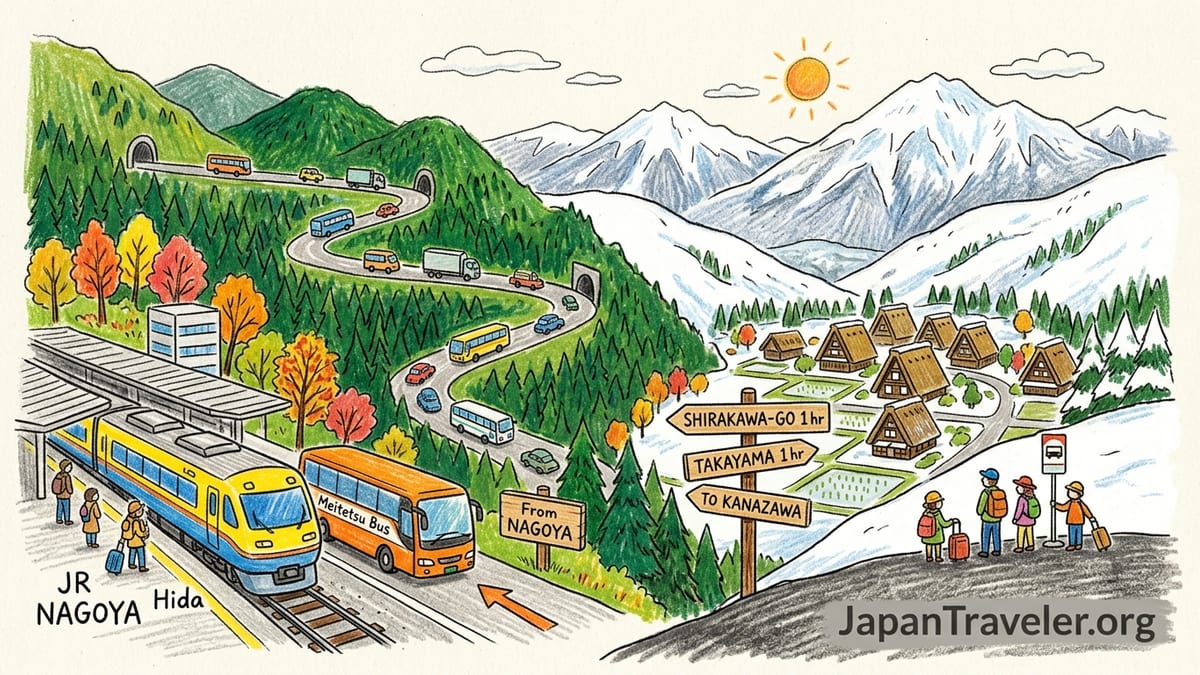
The classic route from Nagoya into the Hida region runs north through the mountains to Takayama, then west by bus to Shirakawa-go, and onward again by bus to Kanazawa if you are crossing the Japan Alps. In practice that means combining the JR Limited Express Hida train with Nohi or Hokutetsu buses, or skipping the train entirely and taking direct highway buses or guided tours that bundle everything together. The distance from Nagoya to Takayama is roughly 166 kilometers by rail and takes a little over 2 hours on the Hida, while Takayama to Shirakawa-go is about 50 kilometers by mountain road and usually 50 to 60 minutes by bus.
Because these are mountain routes with limited daily departures, the key to a good trip is not just choosing a mode of transport but understanding how those timetables translate into actual sightseeing time. A Nagoya round trip by train and bus with both Takayama and Shirakawa-go squeezed into one calendar day will still mean 6 to 7 hours in transit. A direct Nagoya bus tour that includes both can cut that to around 5.5 to 6 hours on the road, but you are tied to a fixed schedule. Staying overnight in Takayama or Shirakawa-go immediately changes the equation by transforming what would have been travel hours into relaxed evening and early-morning exploration.
Season also matters. During peak autumn foliage, New Year and the Shirakawa-go winter illumination events, travel times elongate because of road congestion and queues at bus stops. In February 2026, for instance, travelers reported Shirakawa-go buses filling up weeks in advance for popular mid-morning slots and slower progress into the village once snow and tour coaches accumulated on the access road. If you plan in-season travel, it is safer to build some buffer into your schedule rather than planning for textbook journey times.
Limited Express Hida from Nagoya to Takayama
The backbone of independent travel from Nagoya to Takayama is the JR Limited Express Hida on the Takayama Main Line. Since the March 2023 timetable revision, all Hida services use modern HC85 series train sets, which are faster and more comfortable than the old diesel stock. As of the August 2026 timetable, the journey from Nagoya to Takayama generally takes a little over 2 hours, with around ten round trips a day spread from early morning to evening. Reserved seat prices fluctuate slightly with demand but expect an adult one-way fare in the ballpark of 6,000 to 7,000 yen in ordinary class.
In practical planning terms, many visitors aiming for a full day in Takayama board a Hida departure from Nagoya sometime between 7:30 and 8:30 in the morning, arriving in Takayama around 10:00 to 10:30. This is early enough to drop luggage at your accommodation or coin lockers near the station, walk into the preserved old town and reach the morning markets before they wind down. If you are connecting straight through to Shirakawa-go the same day, an arrival in the late morning still leaves enough time to catch a midday or early afternoon bus onward.
Seat reservations are strongly recommended on the Hida, particularly Friday nights, Sunday afternoons and peak seasons such as Golden Week or the October and November foliage period. Trains can and do sell out. In 2026, many travelers use online booking services or reserve at JR ticket machines upon landing in Japan. Unreserved cars do exist on some departures, but counting on them for a tightly timed connection to a bus is risky. Treat the train schedule as your trip’s backbone: once those times are fixed, you can layer bus tickets and sightseeing around them.
Luggage on the Hida is generally straightforward. There are overhead racks for smaller suitcases and some open spaces at the ends of cars where larger luggage can be stowed, though not in huge quantities. If you are traveling with large check-size suitcases and only overnighting in Hida, consider sending bags ahead from Nagoya by takkyubin courier and traveling with a small backpack for Takayama and Shirakawa-go. This is particularly useful in winter, when snow and slush make dragging luggage around Takayama a chore.
Highway Buses: Direct Routes and Bus-only Itineraries
Highway buses are the alternative to the train, and from Nagoya there are two basic ways to use them. One is to go from Nagoya to Takayama by highway bus and then continue by local bus to Shirakawa-go. The other is to skip Takayama initially and take a direct Nagoya to Shirakawa-go bus, then later connect to Takayama or Kanazawa. As of 2026, companies such as Nohi Bus, Meitetsu Bus, JR Tokai Bus and Hokutetsu jointly operate services along these corridors, with Nagoya departures typically using the Meitetsu Bus Center near Nagoya Station.
Journey times by bus between Nagoya and Takayama are generally comparable to the train, averaging around 2 hours and 40 minutes depending on the timetable and traffic. One-way fares are usually slightly cheaper than the Limited Express Hida, often in the region of 4,000 to 5,000 yen. Direct highway buses between Nagoya and Shirakawa-go usually take around 3 hours each way. That makes a pure Nagoya to Shirakawa-go day trip by bus feasible, with around 3 hours on site if you time your buses carefully, but attempting to include Takayama in the same day using only public buses becomes very tight.
Reservation practices vary. For popular runs like Takayama to Shirakawa-go or Kanazawa to Shirakawa-go, travellers in 2026 report that reserved seats on late morning and early afternoon buses often book out days or weeks ahead in busy months. The bus companies respond by dispatching extra unreserved buses, especially on the Takayama to Shirakawa-go leg, but you may end up standing in line and boarding on a first-come basis. Seat reservation on Kanazawa to Shirakawa-go buses is more rigid, with some services being entirely reservation-only and no walk-up option once they are sold out.
If your itinerary threads several buses in a row, it is worth fixing at least the most constrained legs in advance. For example, a traveler heading from Takayama to Shirakawa-go on a spring Saturday and then onward to Kanazawa the same afternoon would be well advised to pre-book the Shirakawa-go to Kanazawa seat, while leaving Takayama to Shirakawa-go slightly flexible. As of early 2026, a common pattern is that buses leaving Shirakawa-go for Kanazawa mid to late afternoon are the first to sell out. The same principle applies in reverse if you are starting in Kanazawa and aiming to reach Takayama by evening via Shirakawa-go.
Guided Day Tours from Nagoya: Convenience vs Time on the Ground
The surge in international visitors since borders reopened has triggered a boom in guided day tours from Nagoya to Takayama and Shirakawa-go. Major operators and regional companies now offer full-day excursions that bundle round-trip bus transport, an English-speaking guide and free time in each destination. A typical itinerary advertised in summer 2026 departs near Nagoya Station around 8:30 in the morning, reaches Takayama around 11:00, allows about 2 to 2.5 hours of free time including lunch, then moves on to Shirakawa-go for roughly 90 minutes before returning to Nagoya by around 18:30.
In real terms, that means you are on the road for roughly 5.5 to 6 hours, with total free exploration time of 3.5 to 4 hours split between Takayama and Shirakawa-go. Travellers reviewing these tours often describe the pace as “tight but manageable” if you plan your route carefully, prioritising one or two key streets or viewpoints rather than trying to see everything. For example, in Takayama you might limit yourself to the main old town streets like Sanmachi-suji and Kamisannomachi, pick one sake brewery to step into, then head back via the Miyagawa riverside market, accepting that museums like Takayama Jinya will need to wait for another trip.
The advantages of these tours are obvious. You do not need to navigate timetables in Japanese, reserve buses independently or worry about missed connections in the mountains. Some operators also manage luggage by allowing you to store bags on the bus, which can be a relief if you are checking out of a Nagoya hotel in the morning and catching a Shinkansen onwards after the tour returns. Prices vary, but many full-day tours from Nagoya that include both Takayama and Shirakawa-go in 2026 cluster in the 12,000 to 18,000 yen range per adult, depending on whether lunch, admission fees or observation deck shuttles are included.
The trade-off is flexibility. The schedule is fixed for the entire group, so if you fall in love with a quiet side street in Takayama or wish you could linger over coffee with Hida milk at a local cafe, you will still need to be back at the bus at the appointed time. Guided tours can also feel rushed in high season when crowds slow walking speeds through Takayama’s narrow old streets, eating into your limited window. If you value slow, unscripted wandering and night-time ambience, even the best-organised day tour will feel more like an introduction than a full experience.
Can You Do Takayama and Shirakawa-go in One Day from Nagoya?
On paper, combining Takayama and Shirakawa-go in one day from Nagoya is absolutely possible, and many travellers do exactly that. The question is not whether it can be done but what kind of day you want. A DIY itinerary using the morning Limited Express Hida to Takayama, a midday bus to Shirakawa-go and an afternoon bus back to Takayama, then an evening Hida to Nagoya, often looks like this: depart Nagoya around 8:00, arrive in Takayama around 10:30, catch a bus to Shirakawa-go in the late morning or just after lunch, spend 2 to 2.5 hours in the village, return to Takayama by late afternoon, and board an evening train back to Nagoya that arrives around 21:00.
When you add up the pieces, you typically get somewhere between 2 and 3 hours of usable time in Takayama and roughly 2 hours in Shirakawa-go, depending on which specific departures you choose and how smooth your transfers are. That is enough to stroll one side of Takayama’s old town, grab a quick bowl of Hida beef ramen or skewers on the street and check the riverside market if you arrive early enough. In Shirakawa-go, a 2-hour window lets you visit the main viewpoint, walk through the core of Ogimachi village and step inside one gassho-zukuri farmhouse, but not much more.
The main stress points are the transfers. Missing a bus from Takayama to Shirakawa-go by ten minutes can cut your village time in half or force you into a later return that makes your train home uncomfortably tight. In winter, snow on the mountain roads and photo stops in Shirakawa-go itself often accumulate small delays. In busy seasons, travellers in 2026 report queues forming 20 to 30 minutes before departure at popular times, especially for buses leaving Shirakawa-go back to Takayama or Kanazawa. Even if extra unreserved buses are dispatched, you may not be boarding the exact bus you planned on.
For some visitors, this “highlight reel” style day with a guide taking care of logistics is exactly right. If you are based in Nagoya on business or visiting friends and only have one free day to see the Japan Alps, a guided tour that delivers you back to your hotel by early evening is likely the most efficient solution. For others, especially photographers or anyone who likes to linger in small details, the same schedule can feel like skimming the surface. In that case, the better question is not how to fit both Takayama and Shirakawa-go into one day, but which of them deserves your limited time or whether you can stretch the trip to include an overnight.
When an Overnight Stay Transforms the Trip
Spending a night in Takayama or Shirakawa-go often turns a rushed box-ticking exercise into a highlight of a Japan itinerary. In Takayama, evenings are when the old town exudes a quieter charm. Day trippers fade away, paper lanterns light up, and local restaurants serving Hida beef, mountain vegetables and regional sake come into their own. Waking up in Takayama also allows you to experience the morning markets without the crowds, visit Takayama Jinya as it opens or stroll to the Higashiyama temple area while streets are still empty. An overnight in town gives you a full extra half-day with almost no additional transport time.
In Shirakawa-go, staying in a gassho-zukuri farmhouse minshuku is as much the attraction as the village scenery itself. These thatched-roof houses offer simple tatami rooms, home-style dinners featuring river fish and mountain vegetables, and the chance to see the village before and after day-tripper crowds. In winter, when snow piles on the roofs and lights glow in the early dusk, overnight guests can wander quiet streets or photograph houses from the viewpoint without the tour buses that dominate midday. Many travellers say that the impression left by these quiet hours outweighs anything experienced during the peak afternoon window.
Logistically, inserting an overnight stay also eases bus reservation pressure. For example, you might take a late-morning Hida from Nagoya to Takayama, enjoy a relaxed afternoon and night in town, then catch an early bus to Shirakawa-go the next morning when tours from Nagoya and Kanazawa have yet to arrive. After a long, leisurely visit to the village, you can continue to Kanazawa or return to Takayama without watching the clock. Similarly, staying overnight in Shirakawa-go allows you to avoid the busiest bus departures in and out of the village, which are often mid-morning to mid-afternoon.
The main downsides are cost and luggage logistics. Gassho-zukuri stays, especially those that include dinner and breakfast, can be significantly more expensive than a business hotel in Nagoya, and availability is limited in peak seasons, with bookings sometimes filling months out. Many houses have shared bathrooms and thin walls, which may not appeal to everyone. In Takayama, ryokan-style inns with kaiseki dinners are wonderful experiences but not strictly necessary if you are on a tighter budget. Even a modest guesthouse near the old town will buy you the overnight atmosphere that so many visitors feel is missing from day trips.
Onward to Kanazawa: Crossing the Alps Instead of Backtracking
One of the most efficient ways to structure a Nagoya, Takayama and Shirakawa-go trip is to avoid returning to Nagoya at all. Instead, treat Nagoya as your entry point, then cross the Japan Alps and exit via Kanazawa. In practice, that means taking the Limited Express Hida to Takayama, continuing by bus to Shirakawa-go and then onward by bus to Kanazawa. From Kanazawa you can board a Hokuriku Shinkansen for Toyama, Nagano or Tokyo, or connect southwards toward Kyoto and Osaka via limited express trains. This route forms a natural arc across central Honshu and saves several hours of backtracking.
A common pattern in 2026 looks like this: Day 1, travel from Nagoya to Takayama by Hida, explore the town and stay overnight. Day 2, take a mid-morning bus from Takayama to Shirakawa-go, spend 3 to 4 hours in the village, then continue by mid to late afternoon bus to Kanazawa and stay the night there. Each leg is relatively short, usually under 2 hours, and there is no need to rush. You also spread your exposure to potential bus crowding across two different days, which makes it easier to reserve at least one key bus in advance, such as Shirakawa-go to Kanazawa.
For travellers using regional rail passes like the Takayama-Hokuriku Area Pass, this cross-Alps route can be particularly good value, because the pass typically covers the Hida train within its area and many of the Nohi and Hokutetsu buses between Takayama, Shirakawa-go and Kanazawa. The details and coverage can change, so it is wise to verify current conditions close to your travel dates, but anecdotal reports from 2026 suggest that pass holders still benefit from bundled coverage on these popular routes. Even without a pass, the combined train and bus fares for Nagoya to Takayama, Takayama to Shirakawa-go and Shirakawa-go to Kanazawa are often comparable to the cost of a single long-distance Shinkansen ride.
If you do need to return to Nagoya, you can still use Kanazawa as a pivot. One option is to travel Nagoya to Takayama and Shirakawa-go, continue to Kanazawa, spend the night and then ride the limited express or Shinkansen routes south or east that eventually bring you back through Nagoya. Another is to treat Shirakawa-go as a side trip from Kanazawa rather than Nagoya, particularly in winter when Kanazawa’s coastal climate and compact old quarter provide a strong base for exploring the region in several directions.
Luggage, Seasonality and Reservations: Practical 2026 Considerations
Whichever route you choose, handling luggage smartly will make your life easier. Most buses serving Takayama and Shirakawa-go allow large suitcases in underfloor storage, but space is not infinite. On busy days, bus staff may ask late-arriving passengers with multiple oversized bags to wait for a following bus even if they have seats reserved, simply because there is no more room under the coach. For that reason, travelling across the Alps with one medium suitcase per person or using forwarding services for excess baggage is more comfortable than hauling multiple large cases along every leg.
Coin lockers at Nagoya and Takayama stations are a useful part of many itineraries. A common strategy for travellers doing a one-night stay in Shirakawa-go is to leave their main suitcase in a large locker or luggage storage service in Takayama, travel to Shirakawa-go with just an overnight bag, then return to Takayama the next day to retrieve the suitcase and continue to Kanazawa or back to Nagoya. Guided tours sometimes provide bus-based luggage storage, but this is not universal, so it is important to check tour details before booking if you are mid-journey between cities.
Seasonality affects reservations more than anything else. In shoulder seasons like early June or late November on weekdays, it is often still possible to reserve buses just a few days in advance, and some travellers successfully walk up on the day for less popular departures. By contrast, during Christmas and New Year, the February snow period, spring break in March and peak autumn weekends, the most desirable mid-morning and mid-afternoon buses to and from Shirakawa-go routinely sell out well ahead of time. Travellers posting in early 2026 mention booking certain winter bus slots around one month in advance for peace of mind.
Finally, keep in mind that 2026 remains a period of adjustment for Japanese transport operators as they match capacity to sustained post-reopening demand. Timetables and bus frequencies can shift from year to year, sometimes with extra seasonal services added or removed. When planning, sketch your ideal route using current information, but check specific departure times and booking rules again a few weeks before your trip. Leaving some flexibility in your hotel reservations, particularly around weekends and public holidays, can help you adapt if a preferred train or bus fills up earlier than expected.
The Takeaway
For travellers starting in Nagoya, the key decision in 2026 is not whether Takayama and Shirakawa-go are reachable, but how much time you are willing to spend in transit versus on the ground. The Limited Express Hida offers a fast, scenic rail spine to Takayama, highway buses fill in the gaps to Shirakawa-go and Kanazawa, and guided tours from Nagoya have become a reliable option for those who want logistics handled. A same-day visit to both Takayama and Shirakawa-go from Nagoya is realistic, particularly on an organised tour, but expect a taste rather than a deep exploration, with only a few precious hours in each place.
If you can spare one or two extra days, an overnight stay in Takayama and/or Shirakawa-go transforms the experience. Even a single night shifts the balance from clock-watching between buses to leisurely walks through quiet streets, markets and temples. Combining this with a one-way crossing from Nagoya through Takayama and Shirakawa-go to Kanazawa uses your travel time efficiently and avoids unnecessary backtracking. With thoughtful planning around trains, buses, luggage and seasonality, the Japan Alps can feel like a highlight of your journey rather than a rushed detour.
FAQ
Q1. Is it really possible to visit both Takayama and Shirakawa-go in one day from Nagoya?
Yes, it is possible, especially on a guided bus tour, but you should expect only a few hours in each place and a long day with a lot of time spent in transit.
Q2. How much actual sightseeing time will I have on a typical Nagoya day tour to Takayama and Shirakawa-go?
Most 2026 tours advertise around 2 to 2.5 hours of free time in Takayama and about 90 minutes in Shirakawa-go, with the rest of the roughly 10-hour day spent on the road.
Q3. Is the Limited Express Hida better than the bus from Nagoya to Takayama?
The Hida is usually faster, more comfortable and more scenic, but slightly more expensive. Highway buses are cheaper and sometimes better timed for budget travellers, though more affected by road traffic.
Q4. Do I need to reserve buses between Takayama, Shirakawa-go and Kanazawa in 2026?
Reservation is strongly recommended in busy seasons, especially for Shirakawa-go to Kanazawa. Some routes dispatch extra unreserved buses, but popular mid-morning and afternoon departures often sell out.
Q5. Is it worth staying overnight in Shirakawa-go instead of just visiting for a few hours?
For many travellers, yes. Overnight stays in gassho-zukuri farmhouses offer quiet evenings, home-style meals and uncrowded early-morning views that day trips simply cannot match.
Q6. Where is it more practical to stay overnight, Takayama or Shirakawa-go?
Takayama is more practical for most visitors, with a wider range of accommodation, restaurants and transport options. Shirakawa-go is more atmospheric but has limited, often more expensive, lodgings.
Q7. Can I travel from Nagoya to Takayama and Shirakawa-go and then continue to Kanazawa without returning to Nagoya?
Yes. A popular route is Nagoya to Takayama by Hida train, Takayama to Shirakawa-go by bus, then Shirakawa-go to Kanazawa by bus, forming a one-way arc across the Japan Alps.
Q8. What should I do with large luggage when visiting Shirakawa-go?
Use station lockers or luggage storage in Takayama or Nagoya, or send bags ahead by courier. Travel to Shirakawa-go with only a small overnight bag to avoid storage limits on buses.
Q9. Which season is best for visiting Takayama and Shirakawa-go from Nagoya?
Spring and autumn offer mild weather and beautiful scenery, but they are also busier. Winter brings magical snow scenes and possible illumination events, but requires more careful planning for buses and clothing.
Q10. Should first-time visitors choose a guided tour or travel independently?
First-time visitors with only one free day often find guided tours easier and less stressful. Independent travel suits those with more time, flexibility and interest in slower, deeper exploration.