


Tokai is one of Japan’s richest regions for hot-spring travel, and its onsen towns are far more varied than a quick glance at the map suggests. Gero in Gifu offers a classic mountain town built entirely around its riverfront baths, Atami and Ito in eastern Shizuoka deliver sea views within an hour or two of Tokyo, the Izu Peninsula hides smaller hot-spring pockets like Shuzenji and Toi, and Okuhida sits deep in the Northern Alps with some of the most atmospheric open-air baths in the country. Choosing between them is less about finding “the best” onsen and more about matching your hot-spring stay to the kind of Tokai journey you want to build.
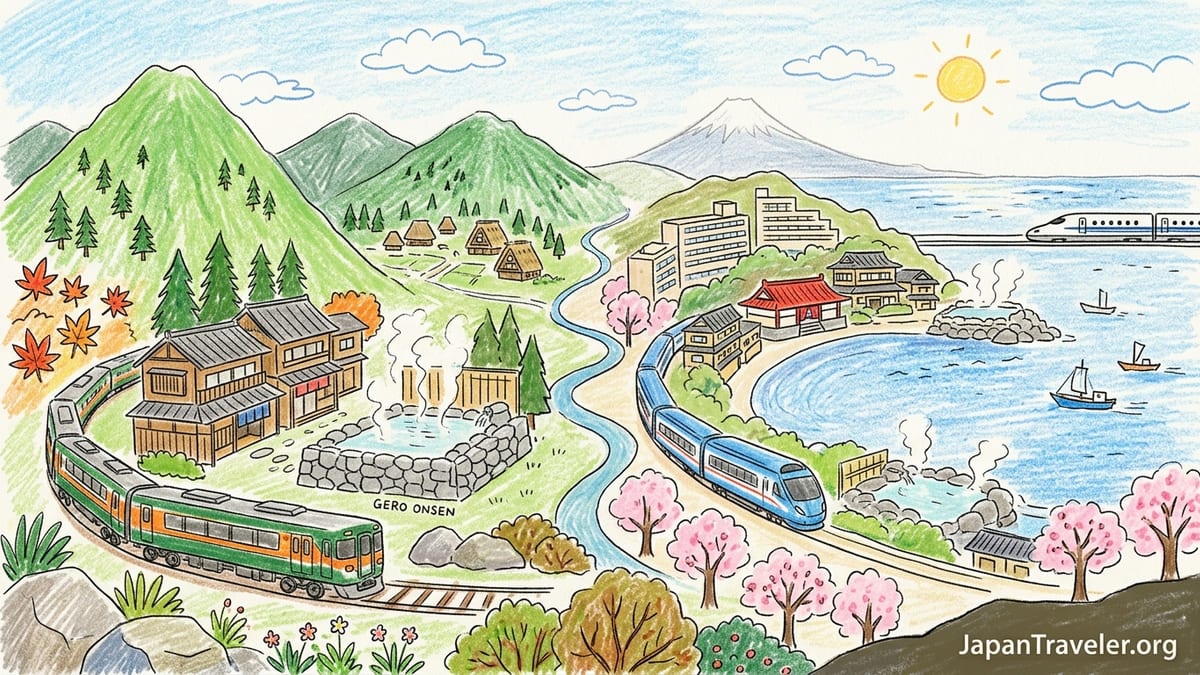
How These Tokai Onsen Fit Into a Larger Itinerary
If you are traveling the Tokyo–Nagoya–Kyoto axis, the Tokai region’s onsen cluster neatly into two main corridors. From Tokyo, Atami, Ito and the broader Izu Peninsula are easy weekend or one-night escapes, reached by shinkansen or limited express trains in roughly 45 to 120 minutes. From Nagoya, Gero and Okuhida are the natural hot-spring extensions, combining well with Takayama, Shirakawa-go and the Japan Alps. Thinking in terms of train lines and transfer stress is key, because it determines whether your onsen stay feels like a detour or a seamless part of the route.
For example, a first-time visitor doing a Tokyo–Takayama–Kanazawa loop could add Okuhida as a one-night stop between Takayama and Matsumoto, soaking in open-air baths with mountain views before heading back to the main rail line. By contrast, someone based in Tokyo for a week might pick Atami or Ito for a spontaneous overnight: leave the city mid-morning, eat sashimi rice bowls at the seaside by lunch, then check into a ryokan with a private rotenburo in time for sunset. Meanwhile, Nagoya-based travelers often treat Gero as a straightforward rural getaway: a scenic 1.5-hour ride up the Hida line, a night in a traditional inn, and back in the city by the following afternoon.
Because most Tokai onsen towns are genuine resort centers, you rarely come just for a quick soak and then rush off. Even destinations with good day-use options, such as Atami’s public seaside baths or Gero’s central bathhouses, reward an overnight stay with quiet early-morning walks, multi-course kaiseki dinners and the chance to try multiple baths at different times of day. When you choose between Gero, Atami, Ito, Izu and Okuhida, you are really choosing between mountain and sea, between convenience and remoteness, and between polished resort atmospheres and smaller, more old-fashioned villages.
Gero Onsen: Classic Riverfront Ryokan From Nagoya
Gero Onsen in Gifu is officially recognized as one of Japan’s “Three Famous Hot Springs” and is arguably the most famous onsen destination easily reached from Nagoya. The town hugs a curve of the Hida River, with medium-sized and large ryokan lining the riverbank, many of them built to give at least some rooms a view of the water. Travelers typically arrive via the JR Hida limited express from Nagoya, which takes about 1.5 hours, or by slower local trains along the same line. That train journey itself feels like part of the experience, moving from industrial suburbs to increasingly steep forested valleys.
As a resort, Gero balances traditional and practical. Well-known inns such as Suimeikan or Yunoshimakan focus on large communal baths, landscaped gardens and set-piece kaiseki dinners that double as an introduction to Hida beef and seasonal river fish. Expect a standard plan with dinner and breakfast to start from the mid-20,000 yen range per person for nicer rooms, with cheaper business-style hotels and older ryokan closer to 10,000 to 15,000 yen when booked in advance and outside holiday periods. Several properties offer rooms with private rotenburo on the balcony, which are especially popular with couples and travelers who are shy about communal bathing.
Gero is also relatively friendly to day-trippers compared with some onsen towns. The compact center has public bathhouses where you can pay a modest admission and soak even if you are not staying overnight, and some ryokan open their baths to non-guests during daytime hours for a fee when capacity allows. Travelers staying in Nagoya often take a late-morning train up, enjoy a soak and a casual lunch at local restaurants near the station, stroll through the open-air Gassho-mura museum of thatched farmhouses, then head back on an evening train.
Tattoo policies in Gero tend to be conservative, in line with many traditional ryokan across Japan. Large visible tattoos may be refused in communal baths, and even small designs might cause concern at more old-fashioned properties. However, the growing trend of reservable family baths and in-room open-air tubs means travelers with tattoos still have options if they choose their accommodation carefully and check policies in advance. In practice, booking a room with a private onsen or reserving a kashikiri bath for your group is usually the smoothest route.
Atami: Gateway Seaside Onsen Close to Tokyo
Atami sits at the northeastern tip of the Izu Peninsula and has long been promoted by Japan’s national tourism bodies as one of the country’s leading seaside hot-spring resorts. From Tokyo Station, the ride on the Tokaido Shinkansen to Atami takes around 40 minutes on a Kodama service, which makes it one of the quickest true onsen escapes from the capital. This convenience has shaped the town’s character: Atami is busy, a little brash in places, with a mix of sleek contemporary hotels, concrete resort towers from the economic boom years, and a traditional shopping arcade that still caters to weekenders buying seafood and onsen manju sweets.
For travelers, Atami’s main draw is how easily you can combine sea views, hot springs and city access. Many ryokan and hotels are built into the hillside above the bay so that clifftop rooms and open-air baths look straight out over Sagami Bay. Some properties, such as small design-conscious ryokan with just a handful of rooms, offer private terrace baths where you can sit in steaming mineral water while watching fishing boats move across the water at dusk. A double-occupancy room with private bath and two meals in such places often ranges from 30,000 to 40,000 yen per person on weekends, with simpler city hotels and large onsen resorts undercutting that significantly on weekdays.
For day use, Atami is almost unmatched in Tokai. You can leave Tokyo mid-morning, soak at a hotel or public bath in the afternoon, enjoy a seafood dinner featuring local kinmedai or sashimi, and still be back in the capital that night. Some larger onsen hotels sell afternoon bathing passes, often bundled with lunch, where visitors can enjoy vast communal baths with multiple pools, saunas and rest lounges. This ease of access means Atami works especially well at the start or end of a trip: an overnight onsen stay the night you arrive, before pushing deeper into Japan, or a final day of hot-spring relaxation before flying home.
Atami’s tattoo policies vary widely. Big resort hotels usually follow conventional rules that bar large tattoos from communal baths, though staff may allow small, easily covered designs at their discretion. However, because Atami has a relatively international guest mix and a strong romantic getaway market, there are several ryokan where every room has its own private onsen or where detached private baths can be reserved by the hour, making it easier for tattooed travelers to enjoy the waters without friction.
Ito and the Smaller Izu Onsen Towns
Further down the eastern Izu coast from Atami, Ito feels noticeably more low-key despite being one of the peninsula’s main hot-spring cities. Local tourism bodies often highlight that Ito has one of the largest volumes of onsen water in Shizuoka Prefecture, and for visitors this translates into an unusually dense concentration of baths. Some ryokan, such as smaller traditional inns tucked back from the seafront, offer both large shared baths and private open-air tubs fed directly from the hot-spring source. At higher-end ryokan like Ito Ryokuyu, each guest room has its own private garden rotenburo in addition to access to larger communal baths, which works well for mixed groups where not everyone is comfortable bathing with strangers.
Access from Tokyo is straightforward. You can ride the Tokaido Shinkansen to Atami and then transfer to a local line down to Ito, or take a through-service limited express that runs from Tokyo along the coast. Typical travel time is about 1 hour 45 minutes in total, longer than Atami but still reasonable for a one-night escape. This slight extra distance has a real effect on atmosphere: Ito attracts plenty of domestic visitors but feels more like a lived-in town where onsen is part of daily life instead of a purely tourist-facing resort. Public bathhouses used by locals sit only a few streets away from ryokan that serve elaborate kaiseki dinners, and small izakaya near the station make it easy to skip the traditional dinner plan if you prefer flexibility.
Beyond Ito, the Izu Peninsula hides a string of smaller onsen areas that reward travelers willing to spend an extra hour in transit. Inland Shuzenji, for instance, is considered Izu’s oldest hot-spring town, with a compact riverside district of wooden inns, bamboo-lined paths and a small temple complex. It lacks the sea views of Atami and Ito but makes up for it with atmosphere and easy walking. On the western coast, places like Toi offer hot springs that face sunsets over Suruga Bay and tend to see fewer foreign visitors, creating space for more intimate encounters with innkeepers and local bath culture.
Because these Izu towns are so close together, they invite “onsen hopping” within a single itinerary. One realistic pattern for a three-night Izu trip from Tokyo might be a first night in Atami for the convenience of the shinkansen, a second in Ito or nearby Kawana for a quieter seaside experience, and a third inland in Shuzenji or Nakaizu among rice paddies and rivers. In each stop, choosing a ryokan with at least one private bath, whether en suite or bookable by time slot, makes the trip smoother for anyone with tattoos or who simply enjoys bathing together as a family or couple.
Okuhida: Deep-Alps Open-Air Baths and Mountain Ryokan
Okuhida Onsen-go in northern Gifu is a group of hot-spring villages scattered along the valley that runs between Takayama and the Northern Japan Alps. Official tourism materials emphasize that Okuhida has the highest concentration of open-air baths in any single area of Japan, and walking through places like Hirayu or Shin-Hotaka makes this claim feel plausible. Wooden rotenburo perch beside rivers, baths are tucked into forest clearings, and many ryokan have multiple outdoor pools facing mountains that stay snow-capped into late spring.
Reaching Okuhida from Tokyo or Nagoya is slower than the other destinations in this article, which is part of its appeal. A common approach from Tokyo is to ride the shinkansen to Nagoya or Toyama, transfer to the limited express to Takayama, then continue by highway bus for roughly another hour into the Okuhida villages. Travelers already staying in Takayama can simply catch a direct bus to Hirayu Onsen or Shin-Hotaka. The extra transfers mean Okuhida rarely works as a quick overnight detour; it makes more sense as a centerpiece for travelers who specifically want a mountain onsen stay, or as a quiet reset in the middle of a longer Kansai–Alps–Tokyo route.
Ryokan selection here leans strongly toward traditional wooden inns and mid-sized family-run resorts, many with several types of open-air baths. A place like Hirayu no Mori, for instance, offers multiple outdoor pools set among trees, with day-use admission that allows travelers without an overnight booking to experience the hot springs. Higher-end properties, including new openings from well-known Japanese resort operators, combine contemporary design with classic tatami rooms and multi-course dinners built around Hida beef and local vegetables. Expect prices from the mid-20,000 yen range per person with meals at nicer ryokan, with more modest pensions and minshuku available for budget-conscious travelers willing to forgo in-room baths.
For those with tattoos or who prefer privacy, Okuhida can actually be more forgiving than its remote setting suggests. Many ryokan have family baths that can be reserved for 45- or 60-minute slots, and several outdoor facilities offer private rotatable baths for a modest surcharge on top of the public entry fee. Because visitor numbers are lower than in big-name resorts, staff often take a case-by-case approach rather than rigidly enforcing no-tattoo policies, though travelers should still assume that large tattoos may not be welcome in the main communal baths. From a broader travel perspective, Okuhida ties neatly into visits to Takayama’s preserved merchant streets and Shirakawa-go’s thatched farmhouses, creating a three-stop mini-itinerary entirely within Gifu.
Private Baths, Tattoos and Choosing the Right Ryokan
Across all of these Tokai destinations, the practical experience of onsen travel depends heavily on the type of baths your chosen accommodation offers. For most foreign visitors and many younger Japanese travelers, rooms with private open-air baths are the most comfortable option, especially on a first onsen trip. These range from modest terrace tubs attached to standard rooms in Atami business hotels, to deep stone baths in Gero suites that face the river, to cypress tubs at Okuhida ryokan where the air can be below freezing while you soak. Booking such a room almost always costs more than a standard room that relies solely on communal baths, but it also sidesteps the uncertainty around tattoos and bathing etiquette.
Where a private bath is not available in-room, look for ryokan that advertise kashikiri-style baths. In Ito and smaller Izu towns, many mid-range inns have at least one or two private baths that guests can reserve at check-in. Time slots of 30 to 50 minutes are typical, often free for staying guests or available for a few thousand yen per session. In Okuhida, these private baths may be simple wooden structures with outdoor tubs facing a river valley; in Atami they might be rooftop baths with white-tiled walls and views of the bay. Reading recent guest reviews in either Japanese or English can help confirm how easy it is in practice to secure a time slot, especially on weekends and holidays.
Tattoo policies remain inconsistent across Tokai, though the overall trend is slowly softening. Travelers with large or highly visible tattoos should assume that many communal baths in Gero, Atami and Ito will officially prohibit them, even if enforcement varies. In practical terms, the most reliable strategies are to prioritize inns with private or family baths, to travel outside peak periods when baths are less crowded, and to send simple inquiries to your accommodation in advance. In smaller Izu towns and in Okuhida, where tourism boards are keen to attract international visitors and mountaineers, you may find a slightly more relaxed attitude, but it is still wise to plan as though public baths will be off-limits.
Price is another decision point that often pushes travelers toward one destination over another. Atami offers some of the widest range, from modest business hotels walking distance from the station where you can add onsen access as a low-cost extra, to boutique ryokan that charge luxury rates for sea-facing suites. Gero and Okuhida skew more toward mid-range ryokan stays, where two meals and ample bathing are bundled into a single rate that feels good value when compared with paying separately for hotel rooms, restaurant dinners and day spas in large cities. In Izu, especially in Shuzenji or smaller west-coast towns, the combination of fewer rooms and high demand from domestic travelers can push prices up, but in exchange you gain quieter streets and a more intimate, small-town feel.
Day-Use Soaks vs Immersive Overnight Stays
Day-use bathing, known as higaeri onsen, is available in all of the onsen areas discussed here, but it plays a different role in each. In Atami, the short ride from Tokyo means many domestic travelers choose not to stay the night, instead arriving mid-morning, soaking in either hotel baths or public facilities, then wandering the shopping arcades before catching a late train home. Large seaside hotels often respond by selling daytime bathing packages that combine access to multiple pools, rest areas and sometimes buffet lunches. For travelers who want to sample onsen culture without committing to an overnight stay or a full kaiseki dinner, these packages can be an efficient choice.
In Gero and Ito, day-use bathing is available but tends to be secondary to overnight stays. Public bathhouses in central Gero sell single-entry tickets, and a few ryokan open their baths to non-guests during part of the day, but the town’s rhythm still revolves around guests walking to dinner in yukata and wooden geta clogs, and late-night or early-morning soaks before breakfast. Similarly, Ito’s local bathhouses are mainly used by residents, while ryokan focus on multi-course dinners and breakfast-inclusive plans. You can visit for a day from Nagoya or Tokyo, but you risk missing the slow, unhurried side of onsen culture that unfolds after most day-trippers leave.
Okuhida and the smaller Izu towns lean even more strongly toward overnight stays. While facilities such as Hirayu no Mori in Okuhida or public baths in Shuzenji do welcome day visitors, the effort involved in getting there means few travelers can justify coming only for a few hours. Instead, these destinations reward building at least one full day and night into your itinerary so you can alternate between walking, bathing and lingering over meals. If you are designing a broader Tokai journey, it often makes sense to pair a more accessible day-trip-friendly onsen like Atami with a more remote overnight-focused one like Okuhida or Shuzenji, giving you both types of experience in a single trip.
The Takeaway
Gero, Atami, Ito, Izu’s smaller hot-spring towns and Okuhida all deserve their reputations within Tokai, but they suit different travelers and different stages of a journey. Gero is the obvious choice for a classic mountain onsen town from Nagoya, with plenty of mid-range ryokan, a riverside setting and straightforward access. Atami and Ito are the go-to seaside options from Tokyo, offering quick train rides, sea views and a broad spectrum of hotels and inns, from budget to boutique. Deeper into the Izu Peninsula, places like Shuzenji and Toi trade convenience for atmosphere, giving you quieter lanes and more intimate stays.
For travelers who value remoteness, Okuhida stands apart. Its cluster of hot-spring villages in the Alps region, combined with nearby Takayama and Shirakawa-go, creates a mountain-focused itinerary built around open-air baths and cool nights under starry skies. Across all these destinations, decisions about private baths, tattoo policies and day use versus overnight stays will shape your experience as much as scenery or water quality. Matching these practical details to the way you like to travel is the surest path to finding “your” Tokai onsen town.
FAQ
Q1. Which Tokai onsen town is best for a first-time visitor to Japan?
For most first-time visitors based in Tokyo, Atami or Ito work best because they combine relatively easy access with a wide choice of ryokan, sea views and plenty of English-friendly services, while still giving a genuine onsen experience.
Q2. If I am traveling from Nagoya, should I choose Gero or Okuhida?
Gero is simpler for a one-night trip from Nagoya thanks to direct trains and a compact town center, while Okuhida is better if you have more time and want a deeper mountain experience that fits into a Takayama and Japan Alps itinerary.
Q3. Where can I find the best private open-air baths in these areas?
All of the destinations offer ryokan with private rotenburo, but Okuhida and Izu stand out: Okuhida for rustic river and forest views, and Izu for boutique ryokan in Ito, Atami and Shuzenji where many rooms have their own terrace baths.
Q4. Are any of these onsen towns good for travelers with visible tattoos?
Tattoo rules vary by property, but in general you will have the smoothest experience if you stay at ryokan that offer in-room or reservable private baths, which are widely available in Atami, Ito, smaller Izu towns and Okuhida.
Q5. Can I visit these onsen as day trips without staying overnight?
Yes. Atami is the easiest day trip from Tokyo, with many hotels and public baths offering daytime access, while Gero, Ito and some facilities in Okuhida and Shuzenji also accept day visitors, although they are more rewarding as overnight stays.
Q6. How expensive are ryokan stays in these Tokai onsen areas?
Mid-range ryokan with dinner and breakfast often start in the mid-20,000 yen range per person in places like Gero, Okuhida and Izu, with cheaper options in business-style hotels or older inns and higher prices for rooms with private open-air baths.
Q7. Which onsen town combines best with a visit to Takayama and Shirakawa-go?
Okuhida is the most natural fit, as it sits in the same region and is connected to Takayama by frequent buses, allowing you to combine preserved towns, thatched villages and mountain hot springs in a single route.
Q8. I am nervous about communal bathing. Where should I go?
If you prefer to bathe in private, look for ryokan in Atami, Ito, Izu and Okuhida where each room has its own onsen tub or where kashikiri family baths can be reserved; this setup is common and specifically caters to more private bathing styles.
Q9. Are these onsen towns suitable for families with children?
Yes. Larger hotels in Atami and Ito are especially used to families and often have family rooms and buffet meals, while Gero and Okuhida offer more nature-focused stays where older children can enjoy river walks, ropeways and small museums.
Q10. How many nights should I plan for an onsen stay in Tokai?
One night is enough to experience bathing and kaiseki meals in any of these towns, but two nights allow a slower rhythm, especially in Izu and Okuhida where you can combine onsen time with coastal walks or mountain excursions.