


Osaka is one of Japan’s best bases for rail day trips, and the wider Kansai region rewards anyone willing to hop on a train early in the morning. From temple-packed Kyoto to the deer of Nara, the harbor lights of Kobe, the white castle of Himeji, the temple mount of Koyasan, the hot springs of Arima Onsen, the lakeshore towns around Lake Biwa and even the coastal sandbar of Amanohashidate, you can cover a lot of ground in one week. This guide compares the most popular options in practical, real-world terms so you can decide which destinations truly fit your time, budget and travel style.
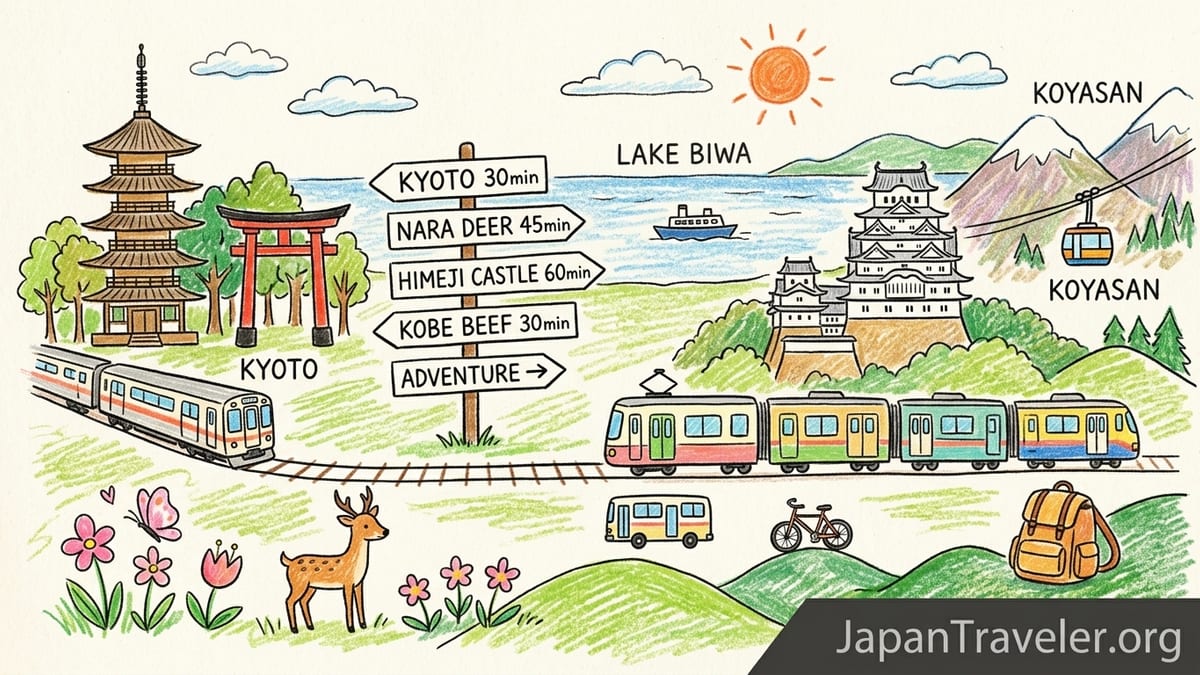
How to Choose the Right Day Trip from Osaka
When planning Kansai day trips from Osaka, distance on the map matters less than train speed and transfers. Kyoto, Nara, Kobe and Himeji are the simplest options, with fast, frequent direct trains from major Osaka hubs like Osaka/Umeda, Shin-Osaka and Namba. Koyasan, Arima Onsen, Lake Biwa and Amanohashidate require more planning, but reward that extra effort with quieter scenery and fewer tour groups once you arrive.
As a rule of thumb, day trips that keep total one-way travel under 60 minutes feel relaxed, leaving plenty of time on the ground. For example, a JR Special Rapid from Osaka Station to Kyoto or Kobe often takes around 30 minutes, and a JR Special Rapid from Osaka to Himeji is typically just under an hour in normal conditions. By contrast, reaching Amanohashidate usually involves 2.5 hours or more with a transfer, which is still doable as a long summer day trip but can feel rushed in winter.
Rail passes and guided tours become more useful as your planning complexity rises. If you only have two or three days and want to hit Kyoto, Nara and Himeji efficiently, a regional JR pass or an Icoca and Haruka package can trim costs compared with buying separate tickets. Meanwhile, for more complicated routes like Koyasan, where you combine private rail, cable car and sometimes a bus, an organized day tour from Osaka can remove the stress of transfers and tight connections.
Before you choose, think about your priorities. First-timers often put Kyoto and Nara together, photographers gravitate to Himeji and Lake Biwa, food lovers look to Kobe and Arima Onsen, and repeat visitors often add Koyasan or Amanohashidate as deeper, more spiritual or scenic excursions.
Kyoto: The Classic First Day Trip
Kyoto is the most popular and straightforward day trip from Osaka. From JR Osaka Station, JR Special Rapid trains on the Kyoto Line usually take around 30 minutes to reach Kyoto Station in normal conditions. From Hankyu Osaka-Umeda Station, limited express trains to central Kyoto stations such as Kawaramachi are typically in the 40 to 45 minute range, depending on the time of day and transfers. These routes run frequently throughout the day, which makes Kyoto highly flexible: you can leave as late as mid-morning and still see a great deal.
For fares, expect a one-way regular JR commuter fare from Osaka to Kyoto to be roughly the cost of a couple of coffees in a Kyoto cafe, with Hankyu slightly cheaper but arriving in a different part of the city. If you are doing multiple JR legs in a single day, such as Osaka to Kyoto in the morning and then Kyoto to Nara or back to Osaka at night, a JR Kansai Area Pass or a regional Kansai pass sold by JR West can sometimes pay off, especially over two or three packed days. If your itinerary centers on central Kyoto and Arashiyama, a rechargeable IC card like Icoca combined with a one-day city bus or subway pass often offers better flexibility than a more expensive long-distance pass.
Guided tours make sense in Kyoto when you want to compress several far-flung highlights into a single day. A small-group tour that covers Fushimi Inari in the early morning, Kiyomizu-dera before lunch, then Arashiyama and the bamboo grove by late afternoon can save you from constantly checking bus routes and temple opening times. Families, older travelers, or anyone visiting in peak seasons such as early April cherry blossoms or mid-November foliage often find the extra cost worthwhile simply to avoid long ticket lines and crowded local buses.
If you are comfortable with local transport and willing to focus on one side of the city, independent travel is simple. For example, you could spend a full day just on the western side: take JR or Hankyu to Saga-Arashiyama, rent a bicycle, visit Tenryu-ji, the bamboo grove, and the riverside, then return to Osaka after dinner. In that scenario, a rail pass is less crucial than a good transit app and some patience for crowds.
Nara: Easy Temples and Friendly Deer
Nara is one of the easiest places to reach from Osaka and pairs naturally with Kyoto in a short Kansai stay. From Osaka, you have two main rail options. Kintetsu trains from Osaka-Namba to Kintetsu Nara usually take slightly over 30 minutes on a rapid or limited express service, based on current Kintetsu travel-time leaflets. JR trains from Osaka Station to JR Nara Station generally take roughly 45 to 50 minutes on a rapid service in normal conditions, and run frequently throughout the day.
The main difference in practice is where you arrive. Kintetsu Nara Station sits closer to Nara Park, where you will find Todaiji, Kasuga Taisha and the famous deer, so many day trippers happily pay a small premium versus JR to save their legs. With JR you walk a bit farther or take a short city bus ride. Fares are modest either way, and for a single out and back from Osaka, a regional pass is usually unnecessary unless you are combining Nara with Kyoto and Himeji on the same rail pass.
Nara is also a destination where guided tours are truly optional. The main sights are well signposted, and a simple walking loop from Kintetsu Nara through Kofukuji, Todaiji, Kasuga Taisha and back through the park can fill a day. That said, a private or small-group guide can add value if you are deeply interested in Buddhist art or Shinto history, since many temple halls have limited English signage. Families often like half-day guided tours that include structured time feeding the deer and visiting Naramachi’s preserved merchant houses.
If you want to keep costs low, buy simple point-to-point tickets or use an IC card. Consider a Kintetsu rail pass only if you also plan to visit places on the same network such as Ise or Yoshino. For most short-stay visitors based in Osaka, Nara remains an easy, flexible and budget-friendly day out.
Kobe and Arima Onsen: Food, Harbor Lights and Hot Springs
Kobe is another straightforward destination, ideal for evening dining or a relaxed shopping and harbor stroll. From JR Osaka Station to JR Kobe Station, Special Rapid services on the Kobe Line commonly take around 25 to 30 minutes in typical conditions. You can also use Hanshin or Hankyu lines from Umeda and Namba, which offer competitive timings and often slightly lower fares, though they arrive at Sannomiya rather than JR Kobe. The cost is modest, similar to a short suburban commute, and trains run very frequently, which makes Kobe a good last-minute decision if you wake up to good weather.
A rail pass rarely pays off for Kobe alone, but if you already hold a JR Kansai Area Pass for Himeji or Kyoto trips, it covers this segment and makes an impromptu Kobe dinner run essentially free. On the ground, Kobe is compact: from Sannomiya you can reach the harbor area, Chinatown and the former foreign settlement on foot or with short local rides. Guided tours are less crucial here; many travelers simply follow a self-guided food trail, sampling Kobe beef, bakeries and craft coffee as they wander.
Arima Onsen, in the hills behind Kobe, requires more effort but rewards it with one of Japan’s most atmospheric hot spring towns. From Osaka, a common approach is to take a Hankyu or JR train to Kobe or Sannomiya, then transfer to a combination of Kobe municipal subway and private rail, or board a direct highway bus from Osaka-Umeda. Typical total travel times by public transport cluster around 60 to 90 minutes in normal conditions, depending on the route, with buses often hitting the shorter end when traffic is light. Current hotel access pages and regional bus timetables describe these as standard estimates rather than guarantees.
Because you mix operators to reach Arima, an all-in-one regional pass is less likely to cover every segment cleanly. Some visitors opt for dedicated Arima and Rokko passes sold locally, which bundle cable car and bus access with discounts at baths. For a same-day soak from Osaka, a direct bus from Umeda to Arima Onsen often feels simplest: you board in the city center, step off near the hot spring lanes, soak in a day-use bath such as Kin no Yu, then ride back in the evening. Guided group tours are available but less common; Arima is compact enough that once you arrive, a paper map from the tourist office is usually all you need.
Himeji: The White Castle Power Day Trip
Himeji is a favorite for travelers who want one iconic sight achieved in a single, efficient day. From Osaka to Himeji, JR Special Rapid services on the Kobe Line typically take about an hour, with commuter limited express trains at certain times shaving several minutes off that. Some services continue from Shin-Osaka with journey times in the 45 to 60 minute range depending on the train type and time of day. Shinkansen alternatives from Shin-Osaka to Himeji can be faster but more expensive, with travel times under 30 minutes on some bullet trains according to recent timetables.
For most visitors, the best cost-performance comes from JR commuter trains. One-day or multi-day JR Kansai passes can easily pay off if you combine Himeji with Kyoto or Nara within the validity period. For example, using a 1-day JR Kansai Area Pass to take the Special Rapid from Osaka to Himeji in the morning, then stopping at Kobe on the way back for dinner, often costs less than buying separate long-distance JR tickets for each leg, especially in 2026 pricing where single fares have gradually crept up.
From JR Himeji Station, the castle is visible straight ahead as you exit and can be reached on foot in about 15 to 20 minutes or by a short bus ride. Most independent travelers manage fine without a guide: the castle complex has clear English signage, and the main route through the keep is one-way. That said, history enthusiasts may appreciate a half-day guided tour that includes Kokoen Garden and the surrounding samurai district, particularly if they are curious about castle architecture and siege tactics.
Timewise, you can comfortably leave Osaka around 8:00 a.m., spend four to six hours exploring Himeji Castle and Kokoen, enjoy a late lunch near the station, and be back in Osaka by early evening. In peak cherry blossom season, consider booking train seats in advance where possible or starting even earlier to stay ahead of group tours.
Koyasan and Lake Biwa: Rewarding Trips with More Planning
Koyasan and Lake Biwa feel quieter and more contemplative than the big-name circuits, but getting there from Osaka involves more moving parts. Koyasan is reached mainly via the Nankai Railway from Namba. Typical routes involve taking a limited express or express train from Namba to Gokurakubashi, which in ordinary conditions takes around 80 to 100 minutes, then transferring to a cable car up the mountain and a bus into the temple town. Timetables can vary by season, and the last evening cable car down is often earlier than many visitors expect, which makes forward planning essential.
Nankai sells a dedicated Koyasan World Heritage Ticket that usually bundles rail, cable car and local bus rides for a fixed price, offering savings over separate tickets if you are making a round-trip from Osaka. For those with limited JR-oriented passes, this is especially attractive since most national or JR regional rail passes do not cover Nankai-operated lines. Guided tours can be particularly valuable for Koyasan first-timers, because they manage transfer points and return timings, and often include a night or meal at a temple lodging where English may be limited.
Lake Biwa, Japan’s largest freshwater lake, sits primarily in Shiga Prefecture, just northeast of Kyoto. From Osaka Station, JR commuter and limited express trains run toward Otsu, Kusatsu and Maibara along the Biwako Line. Standard commuter services from Osaka to Otsu often take in the 40 to 50 minute range depending on the train and connection, while limited express services or named commuter trains such as Biwako Express can shorten the journey. Some morning and evening trains run through from Osaka via Kyoto to Otsu and beyond, making lakeshore towns accessible within roughly an hour or a bit more in typical conditions.
For fares, a one-way trip from Osaka to Otsu or Kusatsu usually costs more than a hop to Kyoto but still sits within a reasonable day-trip budget. Lake Biwa is where a JR rail pass begins to shine if you plan to hop between several stations, like combining Otsu’s lakeside promenade with Hikone Castle or a cruise from a port near Otsu before returning to Osaka. On the ground, signage is generally clear but lakeshore attractions can be spaced out, so allow extra time for local buses or bike rentals, especially if your goal is a sunset shoreline photo rather than a quick in-and-out.
Amanohashidate: The Ambitious Northbound Option
Amanohashidate, often listed among Japan’s three classic scenic views, is a more ambitious day trip from Osaka but increasingly popular in recent search results and travel blogs. The sandbar and pine trees sit on the Tango Peninsula, north of Kyoto, reaching the Sea of Japan coast. Getting there from Osaka typically involves a limited express train to Fukuchiyama followed by a Kyoto Tango Railway service to Amanohashidate Station, or a route via Kyoto Station with a further limited express northbound. Recent travel guides describe total one-way times from Osaka in the 2.5 to 3 hour range under normal conditions, depending on the specific departures you choose and how tight your transfer is at Fukuchiyama.
Because the journey is longer and relies on specific limited express departures, it becomes important to check updated timetables and seat availability, especially on weekends and holidays. Many travelers opt to reserve seats on the limited express segment, which adds a modest surcharge but significantly reduces stress on busy days. Costs add up quickly at this distance, so if you are already using a wide-area JR pass that covers northern Kansai, or a flexible regional pass that includes the relevant limited express trains, you can make considerable savings compared with single tickets.
Once there, Amanohashidate is compact but not tiny. You will likely want to combine a bicycle ride along the sandbar with a chairlift or cable car to a viewpoint, and perhaps a short bay cruise. The round-trip travel time means a day trip is best in longer daylight months, or for travelers comfortable with a very early departure and late return. Guided tours exist but are usually private or small-group arrangements, often combining Amanohashidate with nearby hot spring towns such as Kinosaki Onsen in a two-day loop. For most visitors based in Osaka with only a few days in Kansai, Amanohashidate is a rewarding but optional extra rather than a core day trip.
Before committing, ask whether you are willing to dedicate almost a full day’s energy to train rides. If your schedule is short and your priority is classic Kansai highlights, it might be wiser to focus on Kyoto, Nara, Kobe, Himeji, Koyasan or Lake Biwa and leave Amanohashidate for a future, more leisurely trip.
Passes, Tickets and When a Tour Is Worth It
In 2026, the landscape of rail passes around Kansai is more fragmented than in years past, with some nationwide passes more expensive and limited, and regional options more targeted. For pure Osaka-based day trips, the passes that most often help are JR West regional passes such as the JR Kansai Area Pass, private-rail passes for specific networks, and city passes for local transport once you arrive. As a simple rule, calculate the total cost of your likely long-distance rail segments, then compare it to the cost of a pass rather than assuming a pass is always best value.
Kyoto, Nara, Kobe and Himeji are where a JR regional pass usually makes the most sense, especially if you cluster them into a tight window, such as three or four consecutive days. Koyasan, Arima Onsen and some parts of Lake Biwa involve private operators like Nankai, Hankyu, Hanshin or local railways, so specialized passes such as the Koyasan World Heritage Ticket or Arima and Rokko combination tickets can be more helpful. For Amanohashidate and other northern destinations you may benefit from passes that include limited express services beyond Kyoto, but availability and coverage change frequently, so always confirm the current conditions before purchase.
Guided tours are worth considering when three conditions overlap: the route is complicated, you are short on time, and missing a transfer would seriously inconvenience you. Koyasan fits this profile well, particularly for first-time visitors in winter when daylight is limited. So do some combined itineraries, like a one-day bus and rail tour from Osaka that covers both Himeji Castle and Kobe’s harbor night view, or Kyoto itineraries crossing multiple areas in a single day. On the other hand, straightforward point-to-point trips like Osaka to Kyoto or Osaka to Nara rarely demand a guide unless you prefer a curated experience.
Whichever you choose, travel light. For true day trips, leave large luggage in Osaka at your hotel or in coin lockers at hub stations like Osaka, Shin-Osaka or Namba. Kansai trains can be busy at rush hour, and dragging big suitcases onto commuter services to Kyoto or Nara is stressful for you and everyone else. A small backpack, a preloaded IC card, and a screenshot of your rail timetable are, for most visitors, the most important “passes” you carry.
The Takeaway
Current travel patterns and search results consistently show Kyoto, Nara, Kobe and Himeji as the easiest, highest-reward day trips from Osaka. They combine quick rail access, frequent services and world-class sights that can be comfortably enjoyed in a single day. Koyasan, Arima Onsen, Lake Biwa and Amanohashidate demand more planning, but repay it with quieter streets, hot springs, lakeside views and coastal landscapes that feel a world away from Osaka’s neon in just a few hours.
If you have three full days, a strong core plan is Kyoto, Nara and Himeji, possibly adding an evening in Kobe. With five days, consider weaving in Koyasan for a spiritual contrast or Arima Onsen for a restorative soak. With a week or more, Lake Biwa and Amanohashidate become realistic, especially outside winter when daylight is long. Throughout, buy passes only when the math works, and consider guided tours not as must-haves but as optional tools when complexity and crowds threaten to overwhelm your trip.
Above all, remember that from Osaka’s central stations, some of Japan’s most storied temples, castles and landscapes are as little as 30 minutes away. With a bit of timetable checking the night before, you can wake up, grab an onigiri and coffee at a station kiosk, and be stepping out into a new Kansai city before most visitors have even finished breakfast.
FAQ
Q1. Which is the easiest day trip from Osaka for first-time visitors?
Kyoto is usually the easiest, thanks to frequent direct JR and private-line trains taking about 30 to 45 minutes one way, plus excellent tourist infrastructure and English signage.
Q2. Is a JR rail pass worth it just for Osaka-based day trips?
For one or two short trips, single tickets or an IC card are usually cheaper. A JR Kansai-area pass starts to pay off if you combine longer JR routes like Himeji, Kyoto and Lake Biwa within its validity.
Q3. Should I book a guided tour for Kyoto or go independently?
If you want to see several far-apart sights in one busy day or you are visiting in peak cherry blossom or autumn foliage season, a small-group tour can save time and stress. Otherwise, confident travelers often enjoy exploring independently.
Q4. Is Nara better visited from Osaka or Kyoto?
Nara works well from either city. From Osaka, Kintetsu Nara trains take a bit over 30 minutes and arrive closer to Nara Park, while from Kyoto, both JR and Kintetsu offer convenient routes.
Q5. Can I combine Himeji and Kobe in a single day from Osaka?
Yes. Many travelers take a morning JR Special Rapid to Himeji, visit the castle and gardens, then stop in Kobe for dinner on the way back, all using the same JR line.
Q6. Is Koyasan realistic as a day trip from Osaka?
It is possible but long. Expect roughly 2.5 to 3 hours each way including train, cable car and bus. Many travelers prefer at least one night in temple lodging to make the journey worthwhile.
Q7. How much time do I need at Lake Biwa?
A relaxed day allows you to travel from Osaka to Otsu or another lakeshore town, enjoy a cruise or lakeside walk, and have a meal before heading back. Adding castles like Hikone is easier with a JR pass and an early start.
Q8. Is Arima Onsen better by bus or train from Osaka?
For day trips, direct highway buses from Osaka-Umeda are usually the simplest, often taking about an hour in good traffic. Train routes via Kobe and local lines are more complex but can be slightly more reliable in bad weather.
Q9. Is Amanohashidate worth the long journey for a day trip?
It can be, especially in summer or early autumn when daylight is long and you want a scenic coastal contrast to Osaka. Just be prepared for about 2.5 to 3 hours each way and plan connections carefully.
Q10. How early should I leave Osaka for these day trips?
Leaving between 7:00 and 9:00 a.m. works for most destinations. For longer journeys like Koyasan or Amanohashidate, aim for the first or second convenient departure to maximize time on the ground and avoid rushing the last return train.