

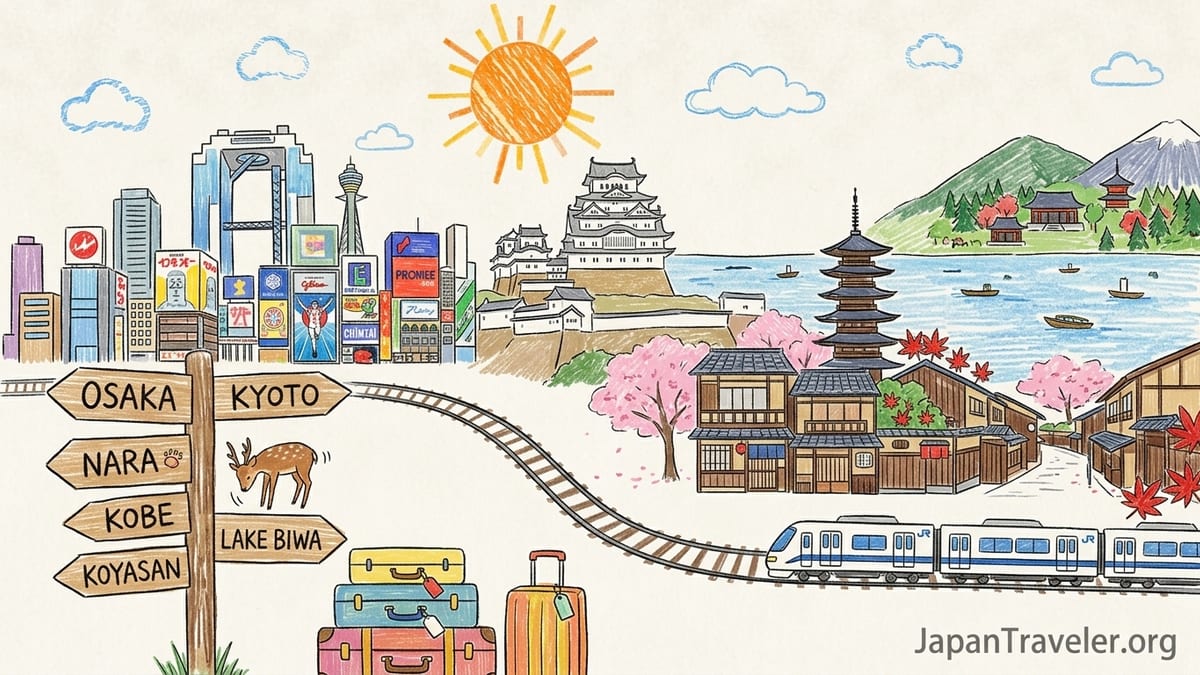
Kansai is where many travelers fall in love with Japan. Compact yet remarkably diverse, the region brings together Osaka’s street food, Kyoto’s temple districts, Nara’s ancient heritage, Kobe’s port-city charm, Himeji’s perfect castle silhouette, the wide waters of Lake Biwa and the spiritual mountains of Wakayama, including Koyasan and the Kumano Kodo pilgrimage. For a first-time visitor, it can feel overwhelming to decide where to start and how to fit it all in. This guide focuses on clear, real-world advice so you can build a balanced Kansai itinerary that matches your interests and time.
Understanding Kansai’s Key Hubs and How Long to Stay
For most first-time visitors, Kansai means Osaka, Kyoto and Nara, with side trips to Kobe or Himeji and perhaps a night on Mount Koya. These places sit within roughly 60 to 90 minutes of each other by train, which makes the region ideal for basing yourself in one or two cities instead of constantly packing and unpacking. A common pattern is three or four nights in Osaka and three or four nights in Kyoto, with day trips layered on top.
If you have a week in Kansai, a practical split would be four nights based in Osaka and three in Kyoto. From Osaka you can explore Namba and Umeda, visit Universal Studios Japan, day trip to Nara, Kobe or Himeji, and connect easily to Koyasan. From Kyoto, you focus on temples, gardens and traditional neighborhoods, with the option of a Lake Biwa outing. On a shorter five-day visit, many travelers stay only in Osaka, day tripping to Kyoto and Nara to avoid switching hotels.
With 10 to 14 days in Japan, you can fold Kansai into a broader itinerary that might start in Tokyo and end in Osaka or the reverse. In this case, three nights in Kyoto, three in Osaka and one on Koyasan is a comfortable rhythm. If you are interested in long walks and quieter rural areas, consider trimming one city night and using that time for the Kumano Kodo in southern Wakayama or lakeside towns in Shiga.
It helps to think of Kansai in themes. Osaka is your base for food and nightlife, Kyoto for temples and classic streetscapes, Nara for early Japan and friendly deer, Kobe and Himeji for port-city atmosphere and Japan’s most famous castle, Shiga for big-sky lake views and cycling, and Wakayama for mountains, hot springs and spiritual journeys at Koyasan and along the Kumano Kodo. Decide which themes matter most, then allocate nights accordingly.
Arriving at KIX and Moving Around Kansai
Kansai International Airport, built on an artificial island south of Osaka, is the main entry point for many visitors. The fastest way into Osaka from KIX is usually the Haruka limited express train operated by JR West, which connects the airport to Tennoji, Osaka and Shin-Osaka. Reserved-seat tickets to Tennoji or Osaka typically cost less than a mid-range restaurant meal, and the trip takes about 30 to 45 minutes depending on your stop. Trains run frequently through the day, and seats can be reserved at vending machines or JR ticket counters inside the airport.
Budget conscious travelers often choose the JR airport rapid to Osaka Station or the Nankai Airport Express to Namba. These trains take slightly longer than Haruka but are cheaper and still comfortable, with luggage racks near the doors. The Nankai line is particularly convenient if your hotel is around Namba, Shinsaibashi or Dotonbori. There are also limousine buses from KIX to central Osaka, Kyoto and Kobe, but many services remain limited or seasonal, so it is worth checking current timetables a few weeks before travel.
Within Kansai, IC cards and regional rail passes make transport simpler. As of 2025, long-running cards like ICOCA or Suica sometimes face stock or issuance limits, but visitors can usually buy region-specific IC solutions or simple anonymous cards from major train companies. You tap in and out at the gates, and the cost for common rides such as Osaka to Nara or Kyoto to Otsu will usually be equivalent to a modest coffee or snack. For intensive train use, the JR West Kansai Area Pass or Kansai Mini Pass can provide good value, especially if you plan to ride Haruka and make JR day trips to Himeji or Nara in a short span.
On top of JR, Kansai is served by excellent private railways like Hankyu, Hanshin, Kintetsu and Nankai. For example, it is often quicker to take Kintetsu from Osaka Namba to Nara than to use JR, and many locals use Hankyu from Umeda to reach Kyoto’s Kawaramachi or Arashiyama areas. Fares on these private lines are paid with IC cards in the same way as JR. When planning day trips, check whether your route is better on JR or a private company rather than simply defaulting to one brand.
Osaka: Food Capital and Nightlife Base
Osaka is nicknamed the nation’s kitchen and is the most relaxed major city in Japan, which makes it an ideal base for first-timers. The Dotonbori canal area glows with neon crab signs and giant pufferfish lanterns, and street stalls serve takoyaki octopus balls, grilled crab legs and skewered kushikatsu. A casual order of six or eight takoyaki usually costs less than an inexpensive museum ticket, and you will see locals standing at counters in business suits wolfing them down between trains. Nearby, small alleyway izakaya serve shared plates of yakitori, sashimi and seasonal vegetables with draft beer.
The Namba and Shinsaibashi districts are Osaka’s heart for nightlife and shopping. You can browse tax free electronics stores, then duck into a standing bar where an after-work crowd squeezes shoulder to shoulder while the TV plays a Hanshin Tigers baseball game. For a different atmosphere, Umeda in the north has polished malls and modern observation decks. The Umeda Sky Building offers an open-air rooftop with city views that are particularly atmospheric around sunset. Visiting in the early evening after an early dinner is a good way to balance crowds and night views.
Osaka is also practical. From here, day trips fan out in every direction. Trains from Osaka or Tennoji reach Nara in roughly 40 to 50 minutes, Kobe in about 25 minutes and Himeji in about an hour. Universal Studios Japan sits on its own JR station, so families often stay in the Bay Area around Universal City for a night or two, then move to Namba or Umeda for city life. First-timers who are nervous about language often find Osaka’s straightforward grid and chatty locals easier to navigate than Kyoto’s maze of alleys.
Hotel prices in Osaka are often slightly lower than central Tokyo or Kyoto. You can find clean business hotels near Namba or Umeda at rates that are comparable to a dinner for two at a mid-range restaurant, and capsule hotels with shared baths for significantly less. For first visits, staying within walking distance of a major station such as Namba, Umeda, Shin-Osaka or Tennoji saves time and keeps late night transfers simple.
Kyoto: Temples, Gardens and Traditional Streets
Kyoto is Japan’s cultural showcase and deserves slow exploration. First-time visitors should give the city at least three full days if possible. One day can focus on the Arashiyama area, starting with the iconic bamboo grove early in the morning before tour buses arrive, then moving to Tenryuji Temple and the riverfront. Lunch in a small soba shop near the station costs little more than a convenience store bento yet often comes with handmade noodles and local vegetables.
A second day can be dedicated to the eastern Higashiyama district, walking from Kiyomizudera downhill through Ninenzaka and Sannenzaka’s preserved stone-paved lanes, then on to Yasaka Shrine and Maruyama Park. The wooden facades and low tiled roofs here are what many people picture as old Japan. Evenings in Gion and Pontocho, with lantern-lit alleys and narrow townhouses, offer a chance to glimpse geiko and maiko moving between appointments, though visitors are expected to behave respectfully, avoid blocking their paths and follow local photography rules.
On a third day, head north to Kinkakuji, the Golden Pavilion, and Ryoanji, famous for its stone garden, then finish around the Philosopher’s Path near Ginkakuji. The path is especially popular during cherry blossom season in late March and early April, when tree branches arc over the canal. In autumn, late November often brings vivid maple colors at temples like Eikando or Tofukuji. Hotel rates rise sharply in these peak seasons and some ryokan and boutique hotels in Gion or central Kyoto are booked out months in advance, so consider staying farther from the old quarter or in Osaka if your budget is tight.
Kyoto’s compact core makes buses and subways practical, but traffic jams are common. First-timers often spend more time than they expect stuck on buses to Kinkakuji or Kiyomizudera. To avoid long waits, combine subway rides with short taxi hops, or use rental bicycles on flatter routes such as between Kyoto Station, the Imperial Palace and the river. For day trips, JR and private lines connect Kyoto to Osaka in less than 30 minutes and to Lake Biwa in roughly the same time, which means you do not have to change hotels to experience both city temples and lakeside scenery.
Nara: Ancient Heritage and Accessible Day Trip
Nara is one of Japan’s ancient capitals and offers some of the easiest access to early Japanese history. Most first-time visitors make a day trip from Osaka or Kyoto, since JR and Kintetsu trains reach Nara Station in 40 to 50 minutes. From Kintetsu Nara Station, you can walk straight up into Nara Park, where free roaming deer bow for crackers sold at stands throughout the lawns. A bundle of crackers costs roughly the same as a local bus ticket and provides both fun encounters and good photos, though visitors should be prepared for assertive deer and keep maps and tickets out of reach.
The main sights cluster around the park, which makes Nara straightforward to explore on foot. Todai-ji houses a massive bronze Buddha in a wooden hall that dwarfs the people below. Nearby, Kasuga Taisha Shrine sits in atmospheric forest, its stone lanterns lined in long mossy rows. The grounds feel especially quiet in the late afternoon after many tour groups head back to Osaka. If you have more time, the older temple district of Horyu-ji, a short train ride away, offers some of the world’s oldest surviving wooden buildings.
Because Nara is so compact, it works whether you have a full day or just a half day. A relaxed schedule could be a late morning departure from Osaka, lunch near Nara Station, an afternoon in the park and temples, then dinner back in Namba. Families with children often appreciate Nara as a break from dense urban streets, while history fans may choose to spend a night at a small guesthouse near the park to experience early mornings before the tour buses arrive.
Transport wise, you can reach Nara using either JR or Kintetsu. Kintetsu tends to be more convenient for Nara Park because its station is closer to the main sights, but JR may be better if you are using a JR regional rail pass that already covers the route. In either case, contactless IC cards make payment effortless, and trains run frequently enough that you rarely need to look at a timetable outside early morning or late night.
Kobe and Himeji: Port City Vibes and Japan’s Iconic Castle
Kobe and Himeji sit along the same rail corridor west of Osaka, which makes them easy to combine into one or two days. Kobe is known for its waterfront district, international history and namesake beef, while Himeji is home to what many consider Japan’s most beautiful original castle. From Osaka Station, JR special rapid trains reach Kobe’s Sannomiya Station in about 25 minutes and Himeji in about an hour. If you are holding a JR Kansai Area Pass, these rides are usually covered, which encourages spontaneous detours.
In Kobe, shoppers head to Motomachi and Sannomiya’s covered arcades, then continue to the portside Meriken Park and Harborland areas, where a red observation tower and modern mall look out over the bay. Street level restaurants serve everything from ramen and Chinese dishes in Nankinmachi Chinatown to high end teppanyaki meals featuring Kobe beef. A lunchtime tasting menu of local wagyu in a small restaurant can cost roughly the same as a mid-range hotel night in Osaka, so many travelers opt for a single special splurge meal rather than multiple luxury dinners.
Himeji Castle, about 15 minutes on foot from Himeji Station, is a highlight of many Kansai trips. The white walls and layered roofs rise above a broad moat, and the approach path passes through several gates before you climb steep wooden staircases inside the keep. Visiting in the morning right after opening or in late afternoon helps skirt the longest crowds. Adjacent Kokoen Garden, reconstructed in traditional styles, offers quiet paths and tea houses where you can sip matcha while looking at koi ponds.
If you are short on time, a very achievable day trip is to take an early train from Osaka to Himeji for the castle and garden, then return in the afternoon and stop in Kobe for dinner and an evening stroll along the waterfront before heading back to your base. Travelers who enjoy hot springs sometimes stay in Arima Onsen, a historic spa town in the hills north of Kobe, accessible by a combination of train and ropeway.
Shiga and Lake Biwa: Lakeside Escapes from the Cities
East of Kyoto, Shiga Prefecture wraps around Lake Biwa, Japan’s largest freshwater lake. It is less famous than Kyoto’s temple districts but offers space, quiet and easy outdoor escapes. JR trains from Kyoto reach Otsu, the prefectural capital on the southwestern shore, in roughly 10 minutes. Farther along the west side, small resort towns like Omi-Maiko and Shiga Highland area attract swimmers and windsurfers in summer. Lakeside guesthouses here can be noticeably cheaper than central Kyoto hotels during busy seasons.
Lake Biwa works especially well as a day trip or overnight stay for travelers who want a change from shrine hopping. In summer you can swim from small beaches or rent basic paddleboards. In cooler months, scenic cruises and lakeside walks offer wide open views, and some hotels and ryokan feature onsen baths facing the water. Cyclists sometimes ride sections of the Biwaichi route, a long loop around the lake, though the full circuit is best left to experienced riders with more time.
There is also history around the lake. Hikone, on the eastern shore, has a compact original castle with a small museum and peaceful garden. The town’s old merchant district has low wooden warehouses converted into cafes and shops. From Kyoto Station, the trip to Hikone by JR local or rapid train generally takes under an hour, and the castle is about a 15-minute walk from the station. Combining Hikone with a lakeside stop near Otsu or Omi-Maiko makes for a full yet manageable day.
For first-time visitors, Shiga is a good way to insert a slower day into an otherwise temple-heavy Kansai schedule. If you have a week, you might spend three nights in Kyoto, take one day for Lake Biwa, then move on to Osaka. Travelers with children often appreciate lakeside parks as a place for kids to run and play without worrying about traffic.
Wakayama, Koyasan and the Kumano Kodo
Wakayama Prefecture stretches south from Osaka along the Kii Peninsula and is Kansai’s gateway to mountain temples, hot springs and the UNESCO listed Kumano Kodo pilgrimage routes. For most first-time travelers, the most accessible experience is Mount Koya, usually reached as Koyasan. The Nankai Koya Line connects Osaka’s Namba or Shin-Imamiya Stations to Gokurakubashi at the foot of the mountain, then a short cable car climbs up to Koyasan Station. The total journey typically takes around 1.5 to 2 hours depending on whether you use express or limited express services.
Many visitors purchase a Koyasan World Heritage Ticket from Nankai Railway, which normally bundles a round trip between Osaka and Koyasan with local bus rides and small discounts at major temple sites. Prices are often similar to or slightly lower than buying separate train, cable car and bus tickets, and the ticket simplifies transfers. Once on the mountain, a local loop bus connects Koyasan Station with the temple town, Okunoin cemetery and other sites, though the main street is also walkable for those comfortable with moderate distances.
Staying overnight in a shukubo temple lodging is a signature Kansai experience. Guests typically sleep on futons laid out on tatami mats, soak in communal baths and eat shojin ryori, a Buddhist vegetarian cuisine that might include delicate tofu, mountain vegetables and sesame based dishes. Early morning prayers, often around 6 am, allow guests to sit quietly while monks chant sutras in incense filled halls. Room rates usually include dinner and breakfast and can range from affordable shared facilities to more polished temples with private toilets and sliding screen views of gardens.
Farther south, the Kumano Kodo network of trails links coastal and inland shrines such as Kumano Hongu Taisha and Kumano Nachi Taisha. Access is usually via the JR Kinokuni Line to Kii-Tanabe or Shingu from Osaka or Kyoto, then onward buses into the mountains. Many travelers arrange their walks, luggage transport and accommodation through the Tanabe City Kumano Tourism Bureau’s booking service. For a first visit, a one or two day section such as the Nakahechi route between Takijiri and Hongu provides a taste of pilgrimage walking without needing full multi day treks.
Accommodation Bases, Seasons and Dividing Your Time
Choosing smart bases can make Kansai feel manageable rather than rushed. For a typical first trip of 7 to 10 days focused on Kansai, consider staying three or four nights in Osaka, three or four in Kyoto and one on Koyasan. From Osaka, take day trips to Nara, Kobe and Himeji. From Kyoto, explore temples and add an outing to Lake Biwa or Hikone. If Koyasan feels too far, you could instead spend a night in Arashiyama, a traditional ryokan in Kyoto or a hot spring ryokan on Lake Biwa.
Season matters. Late March to early April brings cherry blossoms, with Kyoto, Osaka Castle Park and Nara Park all filling with picnickers. Hotel prices spike, and popular sites can feel crowded from mid-morning until late afternoon. Late October to late November brings autumn foliage, particularly strong around Kyoto temples, Koyasan’s cedar forests and the hills behind Arashiyama. Winter from December to February is quieter in the cities and can be a good time for lower room rates, crisp air and onsen stays, though mountain areas like Koyasan and the Kumano Kodo can be cold or occasionally snowy.
Summer in Kansai, especially from late June through August, is hot and humid. Travelers in this season often plan temple and hiking activities early in the morning, retreat to air conditioned museums, department stores or their hotels during midday, then head out again in the evening. Lakeside areas such as Lake Biwa, and coastal towns in Wakayama, feel more comfortable, and beach days or river rafting near Kyoto can give a welcome break from pavement.
When dividing time, consider your energy levels and travel style. If you love food and nightlife, you might extend Osaka and add an extra evening in Dotonbori or Shinsekai. If you enjoy quiet walks and photography, give Kyoto and Wakayama more days. Those fascinated by history and architecture should reserve enough time for Nara’s Todai-ji, Kyoto’s temple clusters and Himeji Castle. Above all, avoid planning too many distinct regions into a short stay; it is more satisfying to explore two or three bases well than to rush through five.
FAQ
Q1. How many days should a first-time visitor spend in Kansai?
Most first-time visitors do well with 7 to 10 days in Kansai, including about three or four nights in Osaka, three or four in Kyoto and an optional night on Koyasan.
Q2. Is it better to stay in Osaka or Kyoto as a base?
Osaka is more convenient for KIX, nightlife and day trips to Nara, Kobe and Himeji. Kyoto is better if your priority is temples, gardens and traditional neighborhoods. Many travelers split time between both.
Q3. Do I need a JR rail pass just for Kansai?
You usually do not need a nationwide Japan Rail Pass for Kansai only. Instead, consider regional passes like the JR West Kansai Area Pass or Kansai Mini Pass if you will ride JR trains intensively, or simply use IC cards and pay per ride.
Q4. Can I visit Nara, Kobe and Himeji as day trips?
Yes. Nara is around 40 to 50 minutes from Osaka or Kyoto, Kobe about 25 minutes from Osaka and Himeji about an hour from Osaka by JR special rapid trains, making all three easy day trips.
Q5. Is Koyasan doable as a day trip from Osaka?
Koyasan can be visited as a long day trip of roughly 1.5 to 2 hours each way by Nankai trains and cable car, but staying overnight in a temple lodging is recommended for early prayers and a quieter experience.
Q6. When is the best season to visit Kansai?
Spring from late March to early April and autumn from late October to late November are most popular for cherry blossoms and foliage. Winter is quieter and often cheaper, while summer is hot and humid but good for lakes and coastlines.
Q7. Are IC cards available for visitors in Kansai?
Yes. While specific card names and availability can change, visitors can usually buy IC cards or visitor-focused versions at major stations and airports to use on most trains, subways and buses in Kansai.
Q8. How far is Lake Biwa from Kyoto?
JR trains from Kyoto Station reach Otsu on Lake Biwa’s southwestern shore in around 10 minutes, and towns like Hikone on the eastern shore in under an hour, so Lake Biwa works very well as a short day trip.
Q9. Do I need to book accommodation early for Kyoto and Koyasan?
In peak seasons such as cherry blossom and autumn foliage, Kyoto hotels and Koyasan temple lodgings can book out months in advance. It is wise to reserve as early as possible, especially for weekends and popular ryokan.
Q10. Can I combine Kumano Kodo with a Kansai city itinerary?
Yes. Many travelers add one or two days on the Kumano Kodo by taking JR trains from Osaka or Kyoto to Kii-Tanabe or Shingu, then overnighting in small inns along the trail before returning to Osaka or continuing elsewhere in Japan.