


If you are flying into Kansai in 2026, the first hard decision usually is not Tokyo vs Osaka. It is a far more local and practical question: for Kyoto, Osaka, Nara, Kobe, Himeji and Universal Studios Japan, should you base yourself in Kyoto or in Osaka, or split your time between both? With hotel prices and crowd patterns shifting again post‑pandemic, the answer in 2026 is more nuanced than it was even a few years ago.
Kyoto vs Osaka at a Glance
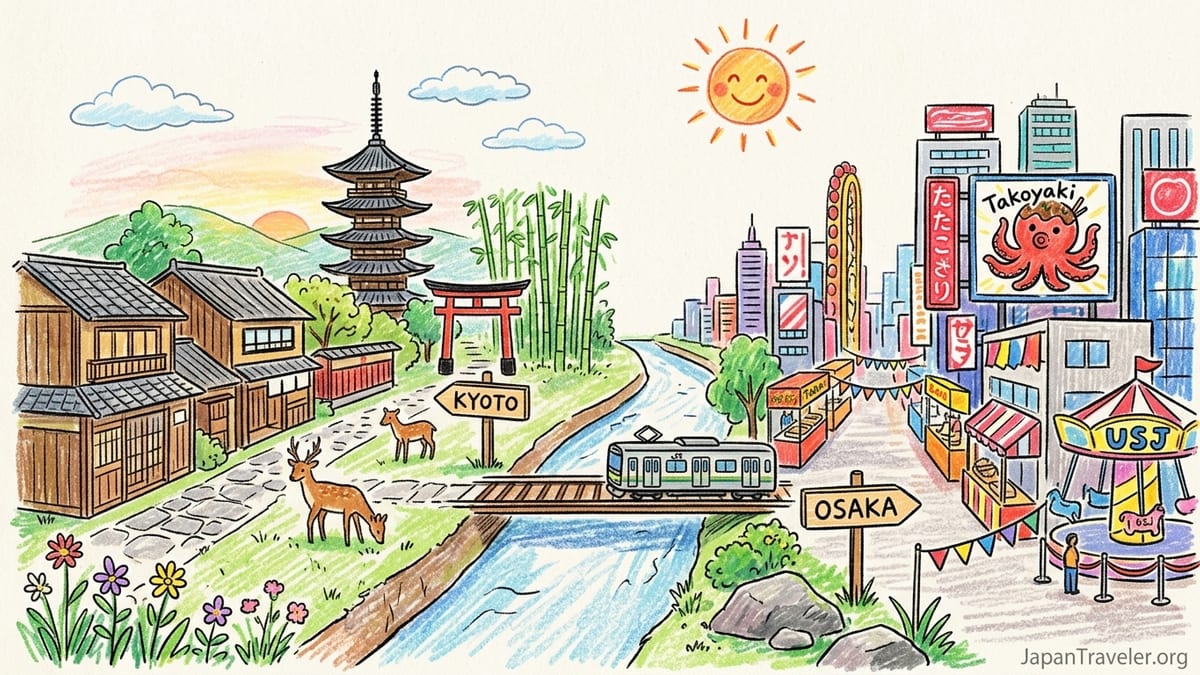
Kyoto and Osaka sit less than 30 minutes apart by frequent JR and private trains, yet they feel like different countries. Kyoto is low‑rise, temple‑filled and walks quietly after dark. Osaka is vertical, neon bright and built around food, nightlife and rail hubs that fan out across Kansai. On paper the distance is short. In reality, your base city will shape your mornings, late evenings and how many hotel changes you need.
Most 2026 planning guides converge on a similar pattern. Travelers who care most about quiet evenings, early temple starts and traditional streets are happier basing in Kyoto. Those chasing nightlife, lower hotel bills and quick rail access to Kansai International Airport, Nara, Kobe, Himeji and Universal Studios Japan tend to do better in Osaka. The trick is matching that split to your actual days instead of choosing on vibes alone.
In practice, transport between the two is simple. From JR Osaka Station to JR Kyoto Station, a rapid JR train typically takes around 30 minutes and runs several times an hour. Private lines like Hankyu and Keihan add more options to specific neighborhoods rather than just station to station. These short hops make day trips entirely workable, but they also add 60 to 90 minutes of daily commuting if you go back and forth repeatedly.
Hotel Prices and Neighborhood Feel in 2026
One reason Osaka has surged in 2026 comparison articles is cost. Across dozens of mid‑range listings, visitors routinely find business hotels or compact four‑star rooms near Umeda or Namba in the 10,000 to 18,000 yen per night range for two, especially outside peak cherry blossom and autumn foliage weeks. In equivalent central Kyoto locations like around Kyoto Station or Kawaramachi/Gion, similar rooms often price several thousand yen higher, and some nights can spike much more during festivals or in November.
Concrete example: for an early June weekday night, it is increasingly common to see a modern chain business hotel around Osaka Station at roughly 12,000 yen for a double, while a comparable property opposite Kyoto Station may be closer to 15,000 to 17,000 yen. In classic neighborhoods such as Gion or near Nishiki Market, small boutique hotels and machiya conversions tend to climb higher again. Budget travelers and families booking two rooms often find that a week in Osaka can free enough money to cover a Kansai day pass or even Universal Studios Japan tickets.
Tax adds another quiet difference. Kyoto’s accommodation tax is tiered and can be higher per person per night at the price levels many overseas visitors now book. That tax is paid at the hotel and is usually not included in foreign booking‑site totals. Osaka’s tax exists too but is generally lower at equivalent price points. Over five or six nights for a couple or family, that gap can cover several train rides between the cities.
The neighborhoods themselves also steer the decision. Central Osaka hubs like Umeda and Namba feel like classic big‑city Japan: underground malls, department stores, late‑opening restaurants, and easy late‑night connections back to your hotel. Kyoto still has nightlife and dining near Kawaramachi and Pontocho, but many streets quiet early and last orders can feel abrupt if you are used to Tokyo or Osaka hours. That calmer pace is exactly why some travelers choose Kyoto, but it can feel restrictive if you want to head back out after 10 p.m.
Transport, KIX Access and Big Day Trips
When you map day trips, Osaka starts to look like a wheel at the center of Kansai’s rail spokes. Direct or one‑change trains from central Osaka reach Kyoto, Nara, Kobe, Himeji and Kansai International Airport without needing to cross another city first. From Osaka Station or nearby hubs, you can sit on a single JR train that runs along the Kyoto Line or Kobe Line to reach many of these destinations without complicated transfers.
Nara sits roughly 40 to 50 minutes from central Osaka on direct JR or Kintetsu services, and a similar time from Kyoto. Kobe is about 25 to 30 minutes from Osaka by JR or private railway. Himeji, famous for its white castle, is around an hour by JR rapid services from Osaka. From Kyoto, all of these are still doable, but you are generally backtracking through Osaka or another major hub, which lengthens some days and complicates return journeys when everyone is tired.
Kansai International Airport access is another practical factor. Trains from KIX run straight toward Osaka on lines such as JR’s Kansai Airport services and Nankai’s limited express options to Namba. Many visitors can be at a hotel near Osaka Station or Namba within 50 to 70 minutes of clearing immigration. Reaching central Kyoto directly from KIX usually means either changing in Osaka or taking a longer limited express that costs more and runs less frequently. For very early flights home, Osaka lets you avoid pre‑dawn transfers or airport hotels.
For a day built around free‑form sightseeing with multiple hops, the Osaka base is especially useful. A single day might look like: morning Nara deer park and Todaiji, afternoon Kobe harbor and Sannomiya shopping, then back to Namba for late dinner in Dotonbori. The routes are simple and you are always riding back toward the same central spoke. From Kyoto you could do the same, but a good part of your morning and evening becomes passing through Osaka’s rail network anyway.
Early Temple Starts, Nightlife and Food Culture
If your mental image of Kansai is a quiet stone path at Fushimi Inari under a soft sunrise, Kyoto as your base is hard to beat. Being already in the city means a pre‑7 a.m. arrival at popular sites is realistic. Walking from a Kyoto Station hotel or a machiya near Higashiyama, you can be at Fushimi Inari, Kiyomizu‑dera or Arashiyama before most tour buses roll in. Guides increasingly emphasize that in 2026, beating the crowds is less about the month and more about the hour, and your base determines whether you can routinely claim those hours.
From Osaka, those same dawn starts are possible in theory but messy in practice. You need to line up the first or very early trains, factor in a 25 to 35 minute ride, then another local connection or walk at the Kyoto end. By the time you reach the torii tunnels at Fushimi Inari from Namba or Umeda, it is often closer to 8 a.m. or later, which can be the difference between quiet corridors and thick flows of visitors on busy dates. If your top priority is photography and contemplative time at temples, at least a few nights actually in Kyoto make a disproportionate difference.
Evenings flip the advantage. Osaka’s food and nightlife are genuinely world‑class and very concentrated. Dotonbori and the streets around Namba are dense with okonomiyaki grills, kushikatsu counters, takoyaki stands and tiny bars stacked above each other in narrow buildings. Umeda offers more polished cocktail bars, craft beer, and late‑night izakaya scattered through office towers and underground malls. English‑friendly bars, from sports spots to small live‑music rooms, cluster in these areas and stay busy well past midnight.
Kyoto’s food scene is different rather than weaker. High‑end kaiseki, tofu restaurants, obanzai home cooking and refined sweets are specialties, but many close early, especially on quieter weeknights. A dinner along Pontocho or near Gion can be extraordinary, yet by 10 or 11 p.m. a lot of shutters are down and trains toward Osaka are thinning out. Travelers who want to stretch every evening with bar‑hopping and late snacks usually come away happier from an Osaka base, popping into Kyoto for specific lunches or early dinners when atmosphere matters more than closing time.
Universal Studios Japan and Family Logistics
Universal Studios Japan is planted firmly on Osaka’s western waterfront, a short hop from the city’s core stations. From Osaka Station, most visitors take a JR train to Nishikujo and change onto the short spur to Universal City. The whole journey can be around 15 minutes once you are onboard, plus walking time through the station complex and park entrance.
From Kyoto, visiting USJ for a single day means more moving parts. You typically ride a JR train from Kyoto to Osaka or Shin‑Osaka, then connect through to Nishikujo and out to Universal City. Total time from Kyoto Station platform to the USJ gates is often 50 to 60 minutes or more each way. That is entirely manageable for adults, but for families with small children or anyone planning to rope‑drop Super Nintendo World and stay until the night parade, it adds a long, tired ride at both ends of an already intense day.
Families also feel the difference in room stock. Osaka has a deep supply of family‑friendly hotels and serviced apartments, including properties around Universal City with themed rooms, four‑bed configurations and breakfast packages tailored to the park crowd. In central Osaka, small apartments and connecting business‑hotel rooms near Namba or Umeda are common, giving groups of four to six a home base with laundry machines and kitchenettes at prices that still beat two equivalent doubles in Kyoto.
Kyoto has grown its apartment‑hotel and family room offering since borders reopened, but options remain more limited in the most historic neighborhoods. Traditional machiya rentals can be magical for a night or two but come with stairs, thin walls, strict trash rules and higher price tags. If your Kansai plan has at least one full USJ day and multiple wider Kansai day trips, Osaka reduces daily friction. If your children are more excited by kimono streets, bamboo groves and feeding deer in Nara than by rides, then a Kyoto base with one carefully planned Osaka or USJ day can still work well.
Single Base vs Split Stay: Who Wins What
The strongest 2026 advice from local writers and repeat visitors is simple: if your Kansai time is three nights or less, choose one base and stay put. Changing hotels eats a surprising amount of time when you count checking out, storing bags, riding trains and checking back in. With only two or three full days, that time is often better spent inside temples, at USJ or in food streets instead of in check‑in queues.
For a single base on a short trip, Osaka is the pragmatic winner for many travelers. You can arrive at KIX, ride a direct train to Namba or Osaka Station, day trip to Kyoto once or twice, add Nara or Kobe in a flexible way, and finish with a USJ day without ever repacking. Budget and mid‑range visitors especially appreciate being able to book one apartment‑style place in Namba for four to five nights and just radiate outward by train.
Once you reach four to six nights in Kansai, a split stay starts to make sense if Kyoto’s early mornings are critical to you. A classic pattern is two or three nights in Kyoto first to walk Higashiyama before breakfast, visit Fushimi Inari at dawn, and end evenings strolling Pontocho without a train ride home. Then you move to Osaka for the remaining two to four nights to tap into nightlife, do USJ and day trips to Nara or Himeji, and finish close to KIX.
There are also cases where a Kyoto‑only base works as the single stay. If your trip is almost entirely about temples, gardens, tea houses and photo walks, with no USJ and only one light day trip to Nara, then staying all five or six nights in a well located Kyoto hotel can reduce backtracking and give a deeper sense of place. You would still pop into Osaka for one evening to walk Dotonbori or ride up Abeno Harukas, but it becomes a day trip in the opposite direction.
Families, Luggage and Minimizing Hotel Changes
Families and anyone with large luggage usually benefit more from fewer hotel changes than from the subtle advantages of each city. Moving a family of four with two large suitcases and strollers from Kyoto to Osaka for just one extra night can wipe out the time saved by being closer to the airport. In those situations, most recent on‑the‑ground advice leans toward picking one very convenient neighborhood and designing the itinerary around it, not the other way around.
For a single base, Namba, Umeda or Tennoji in Osaka work particularly well with children. All three sit on major rail lines, have direct or simple connections to KIX, and pack supermarkets, casual restaurants and department store food halls into a tight radius. In Namba you can step out from an apartment, grab breakfast pastries from a basement food hall, walk Dotonbori in the evening, and get a one‑seat train to KIX on your final day. From there, you can still spend one whole day in Kyoto and one in Nara without changing hotels.
In Kyoto, staying near Kyoto Station simplifies incoming and outgoing trains and bus connections, though it is less atmospheric than staying near Gion or the Philosopher’s Path. Families sometimes compromise by doing two or three nights near the station to cover big rail days, then a final one or two nights in a smaller ryokan or machiya in a characterful district, using a luggage forwarding service so they are not dragging suitcases through narrow lanes or crowded buses.
Travelers with mobility issues or a strong preference for taxis should also weigh base city carefully. Osaka’s denser central grid often shortens taxi rides at night after trains thin out. Kyoto’s sightseeing is more spread along north‑south and east‑west axes with hills and rivers in between. A Kyoto base still works well, but choosing a hotel near the subway or on major bus routes becomes more important, and the appeal of a single, accessible Osaka base rises if multiple day trips are planned.
The Takeaway
Kyoto and Osaka are close enough that there is no single correct answer for every Kansai trip, but in 2026 patterns are clear. Hotel for hotel, Osaka is often cheaper, better connected to Kansai International Airport and more convenient as a springboard for Nara, Kobe, Himeji and Universal Studios Japan. Kyoto sells the quieter, earlier hours that define many people’s idea of Japan, at the cost of higher average prices and slightly trickier airport and wide‑area access.
If you have three nights or fewer, choose one base and resist the temptation to move. Osaka is usually the most efficient choice for a mixed itinerary with USJ, food and at least one Kyoto day. If you have four to six nights and care deeply about early temple access and Kyoto’s streets before the crowds, consider a split stay: start with Kyoto, end in Osaka. For trips built almost entirely around Kyoto’s culture, a full stay in Kyoto still works, with Osaka as a day trip.
Ultimately, decide by anchoring your mornings and late evenings, not by staring at a map. List which days require dawn starts, which nights you want to stay out late, when you need to be at KIX, and how many times you realistically want to repack. Once those anchors are clear, the choice between Kyoto and Osaka as your Kansai base usually reveals itself quickly.
FAQ
Q1. Is Osaka really cheaper than Kyoto for hotels in 2026?
In many date checks, standard business and mid‑range hotels near Osaka Station or Namba are a bit cheaper than equivalent rooms around Kyoto Station or in central Kyoto, especially outside peak sakura and foliage weeks. Prices still fluctuate heavily by season and event, so you should always compare for your exact dates.
Q2. If I only have three nights in Kansai, should I split my stay?
Usually no. With only two or three full days, changing hotels tends to cost more time than it saves. A single base in Osaka works well for most mixed itineraries that include Kyoto, Nara or USJ during such a short stay.
Q3. When does a Kyoto base make more sense than Osaka?
A Kyoto base wins when your priority is early access to temples and quiet historic streets, and you do not plan on multiple long day trips or a USJ‑focused day. Photographers and visitors who value calm evenings over nightlife often prefer staying in Kyoto at least for the first part of the trip.
Q4. How hard is it to visit Kyoto as a day trip from Osaka?
It is straightforward. Direct JR and private trains link central Osaka with Kyoto in roughly 25 to 35 minutes. The main tradeoff is time: repeated day trips add around one hour of round‑trip commuting each day, which matters more for early mornings and late returns.
Q5. Is Universal Studios Japan doable as a day trip from Kyoto?
Yes, many people do it, but you should expect about 50 to 60 minutes each way with at least one transfer through Osaka. From a Kyoto hotel, it is a longer and more tiring day than from Osaka, especially for families with children who plan to arrive before opening and stay for evening shows.
Q6. Which city is better for nightlife, Osaka or Kyoto?
Osaka is significantly stronger for nightlife, with dense bar and restaurant districts around Namba, Umeda and other hubs that stay busy late into the night. Kyoto has charming evening areas like Pontocho and Gion but tends to quiet down earlier and offers fewer small bars clustered together.
Q7. What is the best base for day trips to Nara, Kobe and Himeji?
Osaka usually works best because it sits near the middle of the rail web. Direct or simple‑transfer trains head out toward Nara, Kobe and Himeji, and you are usually riding back toward the same central hub, which shortens returns when you are tired at the end of the day.
Q8. For families, is it better to stay in Osaka or Kyoto?
For most families, especially those visiting Universal Studios Japan or planning several regional day trips, Osaka is more convenient thanks to better airport access, more family‑oriented rooms and apartments, and easier late‑evening food options. Families mainly focused on temples and quieter streets might still prefer a Kyoto base.
Q9. Does staying in Kyoto significantly reduce crowds at major temples?
Staying in Kyoto does not change how busy midday becomes, but it does make pre‑8 a.m. visits to places like Fushimi Inari or Kiyomizu‑dera much more realistic. Those first hours of the day can feel entirely different from late‑morning peak times, especially in popular seasons.
Q10. Should I stay near Kyoto Station or in a historic neighborhood?
Near Kyoto Station gives the simplest rail and bus connections and is convenient for arrivals and departures but feels more modern. Staying near areas like Gion or Higashiyama is more atmospheric and walkable to many sights, although transport in and out can involve more buses or taxis. Many visitors split nights between both if they have time.