


Kansai is where many first-time visitors fall in love with Japan. Kyoto’s temples, Osaka’s food, Nara’s deer, Kobe’s harbor, Himeji’s castle and Koyasan’s mountaintop temples are all within a couple of hours of each other. The real challenge is not finding things to do, but choosing where to spend your limited nights. This guide compares the main Kansai bases and side trips so you can match destinations to your priorities instead of building a random checklist.
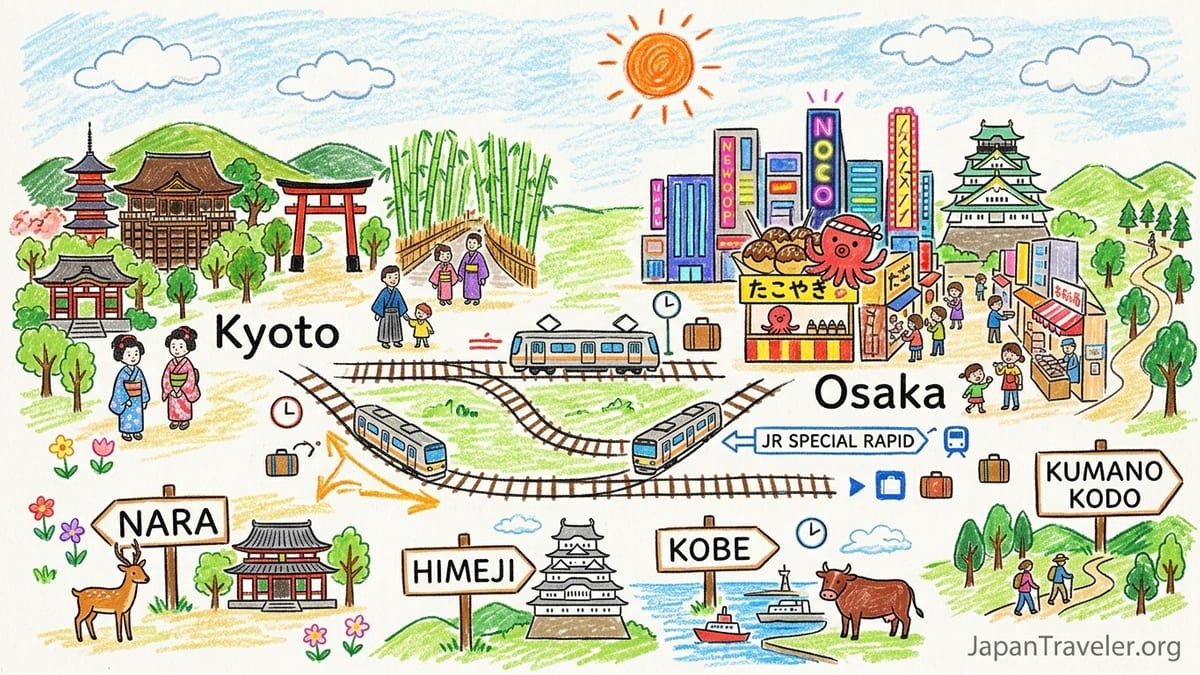
How to Think About Kansai: Bases, Day Trips and Travel Time
On a map, Kansai looks compact, but logistics matter. From Osaka Station, you can reach Kyoto in roughly 30 minutes by JR Special Rapid train and pay around 600 yen one way. Himeji Castle is about an hour away in the other direction, while Nara is roughly 45 to 60 minutes by train depending on the line. That means you can sleep in one city and still see several others without changing hotels, as long as you choose your base strategically.
For most travelers, the key decision is whether to split time between Kyoto and Osaka or stay in a single hub. A common pattern is three nights in Kyoto to focus on temples and traditional districts, then two to four nights in Osaka for food, nightlife and day trips to Nara, Kobe and Himeji. If your trip is only four or five days, you might base entirely in one city and use fast trains to sample the rest.
Another factor is your appetite for hotel changes. Moving every night to “collect” cities quickly becomes tiring, especially if you are carrying large suitcases on commuter trains. Some classic Kansai experiences, however, really do deserve an overnight. Koyasan’s temple stays and Arima Onsen’s hot springs feel very different if you arrive by late afternoon, soak or stroll in the evening, and wake up before the day-trippers arrive.
Finally, consider rail passes and ticket types. Local and rapid JR trains around Kansai are relatively inexpensive, so travelers who are only visiting the region often skip a nationwide rail pass. Regional passes that cover Kyoto, Osaka, Kobe, Nara and Himeji can still make sense if you plan several day trips in a row, but do not feel obliged to buy one if you are only taking one or two intercity rides.
Kyoto vs Osaka: Culture Capital or Urban Playground
Kyoto works best if your priority is classic temples, gardens and traditional streetscapes. The city has hundreds of temples, but most visitors focus on a handful of areas: the Higashiyama slopes around Kiyomizu-dera, the Arashiyama bamboo grove and riverside, and the Golden Pavilion. Staying near Kawaramachi, Gion or Kyoto Station makes it easier to visit these zones early in the morning or later in the afternoon, when day trip crowds thin and the atmosphere is calmer.
Because Kyoto is compact in terms of sightseeing, you can fill two or three days without long train commutes. For example, one day might combine Fushimi Inari Shrine in the early morning, lunch in central Kyoto and an afternoon loop through Gion and Pontocho. Another day could be dedicated to Arashiyama, with a river boat ride or a short hike into the surrounding hills. The downside is that restaurant kitchens often close earlier than in Osaka, and nightlife is more subdued and scattered.
Osaka, by contrast, is the best choice if you care most about food, shopping and nightlife, with culture as a secondary bonus. Neighborhoods such as Dotonbori, Namba and Shinsekai are packed with izakaya, ramen counters, yakiniku grills and takoyaki stands that stay busy until late at night. Families often base here to be closer to Universal Studios Japan and Osaka Aquarium, both major full day attractions on the city’s bayfront.
In practice, Osaka also makes a convenient rail hub. From Osaka or nearby Umeda, you can ride rapid JR or private railway trains directly to Nara, Kobe, Himeji and Wakayama. That is why many experienced travelers treat Osaka as their Kansai “home base” and tack on day trips, while using Kyoto for a shorter, quieter cultural stay. If you have six to eight days in the region, splitting nights between the two gives you the best of both worlds.
Nara and Uji: Deep Culture in Manageable Bites
Nara is ideal for travelers who want grand temple architecture and history without navigating a huge city. From either Osaka or Kyoto, the journey is under an hour. Once you arrive, most major sights cluster around Nara Park, where free roaming deer share space with school groups and local families. The main draw is Todai-ji, the temple that houses an enormous bronze Great Buddha statue. Even a brief visit here shows why many consider it one of the most impressive religious buildings in Japan.
Because Nara’s core sights are walkable, many visitors comfortably treat it as a day trip. You might arrive mid morning, tour Todai-ji and nearby Kasuga Taisha Shrine, feed the deer, have a simple lunch of local specialties like kakinoha-zushi (sushi wrapped in persimmon leaves), and be back in Kyoto or Osaka for dinner. An overnight stay makes sense only if you want to explore lesser known temples outside the park or prefer a quieter evening atmosphere after tour buses depart.
Uji, about 20 to 30 minutes from Kyoto by local train, is best thought of as a half day add on for temple and tea lovers. The standout sight is Byodo-in, a historic temple whose Phoenix Hall appears on the 10 yen coin. Around it, a compact riverside town specializes in high quality matcha. It is easy to imagine a real visit where you tour the temple, sit for a matcha tasting at one of several tea houses, buy a small tin of powdered tea to take home, and still be back in central Kyoto by mid afternoon.
If you are building a Kyoto based itinerary, combining Nara and Uji into a long, culture heavy day is a popular pattern: morning at Todai-ji and Nara Park, then an afternoon stop in Uji on your return. Travelers based in Osaka often dedicate one day to Nara alone, then fold Uji into a different Kyoto based outing to avoid backtracking.
Kobe, Himeji and Arima Onsen: Western Kansai Trio
Kobe suits travelers who like a softer version of big city Japan. Its compact center mixes a modern waterfront, a Chinatown district and European style houses in the Kitano area. Many visitors come specifically to try Kobe beef at a small teppanyaki restaurant, often at lunch for slightly lower prices than dinner. From Osaka or Kyoto, trains to Kobe’s Sannomiya Station typically take between 30 and 60 minutes, making it realistic as a half or full day outing.
Himeji, about 50 minutes west of Kobe by rapid train, is all about its castle. Himeji Castle is widely regarded as Japan’s best preserved original feudal castle, with white plaster walls and a multi layered keep visible as soon as you leave the station. A real world visit usually involves a 15 minute walk straight up the broad main street, two to three hours exploring the castle grounds and interior, and perhaps a short stroll through the adjacent Koko-en garden. Most travelers then return to Kobe or Osaka by late afternoon.
Arima Onsen, tucked into the mountains just behind Kobe, gives you a classic hot spring town experience without traveling deep into rural Japan. From Kobe’s Sannomiya area, you can reach Arima in roughly an hour via a mix of train and cable car or bus. The town itself is compact: narrow streets lined with small inns, bathhouses and snack shops selling carbonated rice crackers and local sweets. Day trippers often buy an entry ticket to one of the public bathhouses that offer “gold” and “silver” mineral waters and still have time for a leisurely lunch.
If time allows, an overnight in Arima Onsen is one of the most relaxing ways to end a Kansai trip. Staying in a ryokan with in house hot spring baths usually includes a multi course dinner and breakfast, which can easily justify the higher nightly rate. A three day loop that combines Kobe’s harbor, Himeji Castle and an Arima Onsen stay works well for visitors who have already seen Kyoto and Osaka on a previous trip and want a different side of Kansai.
Koyasan and Wakayama: Spiritual Peaks and Coastal Nature
Koyasan works best for travelers who prioritize religious history, quiet evenings and a unique overnight experience. The journey from Osaka involves a limited express or rapid train to the base of the mountains, a cable car up the slope and a short bus ride into the temple town. Total travel time from central Osaka typically ranges from two to three hours each way, which is why most people either dedicate a full day tour or sleep in one of the shukubo, or temple lodgings.
Staying in a shukubo is very different from a standard hotel. Rooms are usually simple tatami spaces with futons, and shared baths are common. The draw is the chance to eat vegetarian temple cuisine served on low trays and join morning prayers in candlelit halls. In practice, travelers who find this most rewarding tend to be comfortable with basic accommodation and interested in Buddhism or Japanese religious culture. If you mainly want photos of lantern lit pathways, a long day trip tour from Osaka or Kyoto can work, but you will spend more time in transit than on the mountain.
Beyond Koyasan, the wider Wakayama region appeals to visitors who value nature and onsen more than urban sights. Coastal areas on the Kii Peninsula, such as Shirahama or the towns along the Kumano Kodo pilgrimage routes, offer beaches, cliffs, waterfalls and hot spring resorts. Reaching them from Osaka can take three to four hours by limited express train or highway bus, so they fit best into longer itineraries or repeat visits when you can commit two or three nights to the area.
Families sometimes overlook Wakayama in favor of theme parks, but those with older children who enjoy hiking or outdoor adventure can find it a welcome contrast to city sightseeing. In practical terms, you might pair two nights in Osaka with two nights near the coast, using Osaka’s rail connections for arrival and departure days and focusing your Wakayama time on walks, hot springs and simple seafood dinners.
Lake Biwa, Otsu and Amanohashidate: Scenic Water and Quiet Towns
Lake Biwa, Japan’s largest freshwater lake, lies just east of Kyoto. Otsu, the main city on its southwestern shore, is less of a must see than Kyoto or Nara, but it suits travelers who want a slower paced excursion with lake views. From Kyoto Station, local trains can reach Otsu in around 10 minutes. A realistic half day visit might include a lakeside walk, a short cruise if boats are operating, and a visit to a nearby temple complex, before returning to Kyoto for dinner.
More scenic corners of Lake Biwa, such as higher viewpoints or small beach areas, take longer to access and usually require a mix of train and bus. These are appealing to repeat visitors in warmer months who want to escape Kyoto’s heat for the day. However, for most first timers on limited schedules, Lake Biwa and Otsu work best as flexible add ons rather than core Kansai bases. You are unlikely to give them a full night if you have not yet seen Kyoto’s major temples or Himeji Castle.
Amanohashidate, on the Sea of Japan side of Kyoto Prefecture, is often described as one of Japan’s classic scenic views. It is a pine covered sandbar stretching across a bay, best appreciated from hilltop viewpoints reached by chairlift or cable car. Getting there from Kyoto takes around two to two and a half hours by limited express train or a combination of services, which makes it a long but feasible day trip for motivated travelers.
In practical terms, Amanohashidate is better suited to those with an extra day and a preference for landscapes over more temples. A common pattern is to leave Kyoto early, spend the late morning riding up to a viewpoint, walk or cycle along the sandbar in the afternoon, and return in the evening. Some travelers pair it with a nearby fishing village stay, but most first time visitors will find that their limited time is better spent focusing on Kyoto, Osaka and a handful of nearer day trips.
Choosing by Theme: Temples, Food, Nightlife, Nature and Onsen
If your main focus is temples and traditional Japan, prioritize Kyoto, Nara, Uji and Koyasan. In Kyoto, you could easily spend a whole day just in the Higashiyama area, visiting Kiyomizu-dera, wandering the old streets of Ninenzaka and Sannenzaka, and watching the daylight fade over Yasaka Shrine. Adding Nara for Todai-ji and Uji for Byodo-in deepens the picture without requiring overnight moves. A single night at Koyasan then adds a different spiritual dimension, especially if you join an early morning service.
For food and nightlife, Osaka is the clearest winner, with Kobe as a stylish complement. Osaka’s Dotonbori and Namba neighborhoods concentrate hundreds of small restaurants and bars within a walkable grid of neon lit streets and narrow alleys. It is entirely plausible to spend each evening trying a different local specialty, from skewers of kushikatsu to okonomiyaki pancakes cooked on the griddle in front of you. Kobe adds waterfront cocktails, a compact Chinatown and refined beef dinners, often paired with a short evening stroll along the harbor.
Families weighing theme parks and child friendly attractions might lean toward basing in Osaka. Universal Studios Japan and Osaka Aquarium are both full day commitments that are easier to manage if your hotel is within a 20 to 40 minute train ride. From there, Nara’s deer park makes a gentle day out, and Himeji’s castle grounds offer open spaces along with history. Kyoto can still fit into a family plan, but younger children may tire quickly of long temple days unless you balance them with hands on experiences and parks.
Nature and onsen seekers should look toward Koyasan, Arima Onsen, Lake Biwa’s quieter shores and the wider Wakayama coast. Of these, Arima is the most accessible from major cities, while Wakayama’s coastal towns require more travel but reward you with beaches, cliffs and sea views. Koyasan combines wooded walking paths with temple stays but requires comfort with simpler accommodation. If you only have one spare night, a Kyoto plus Arima or Osaka plus Arima combination is usually easier to fit into a standard Japan itinerary than a multi night coastal detour.
Planning With Limited Time: One to Four Full Days
Travelers with only one full day in Kansai should resist the temptation to overreach. If you are staying in Osaka, a focused day trip to either Kyoto or Nara is more rewarding than trying to dash through both. A realistic “Kyoto in a day” from Osaka might hit Fushimi Inari in the early morning, then move to the Higashiyama area for Kiyomizu-dera and a walk through Gion before heading back in the evening. Conversely, if your hotel is in Kyoto, a single day in Osaka focusing on Osaka Castle in the afternoon and Dotonbori at night gives you a solid taste of the city.
With two to three full days, a common pattern is one or two days based in Kyoto for temples and traditional districts, plus one day trip to Nara or Osaka. Those who prefer cities sometimes reverse this, spending two nights in Osaka for food and nightlife and using one day each for Kyoto and Nara. In both cases, Himeji, Kobe, Arima Onsen and Lake Biwa remain optional rather than essential; you can note them for a return visit.
Four or more full days unlock a more ambitious loop. For example, you might spend three nights in Kyoto, day trip to Nara and Uji, then move to Osaka for two or three nights and visit Himeji and Kobe on one day and Koyasan or Arima Onsen on another. That way, each day has a clear focus, and you avoid wasting hours on unnecessary hotel changes while still reaching a mountaintop temple town or hot spring village.
When in doubt, choose fewer bases and more depth. It is better to really experience Kyoto’s early mornings, Osaka’s late nights and one or two standout day trips than to arrive exhausted in yet another station city every afternoon. Kansai’s rail network makes it easy to come back and see the rest on a future trip.
The Takeaway
The best place to visit in Kansai is not a single city but the mix that fits your interests, season and energy level. Kyoto, Osaka, Nara, Kobe, Himeji, Koyasan, Arima Onsen, Lake Biwa and the wider Wakayama region all have strong identities and do not need to be crammed into one hurried week. Use the region’s excellent trains to your advantage by treating a couple of cities as overnight hubs and the rest as carefully chosen day or one night excursions.
If you crave temples and traditional streets, anchor yourself in Kyoto and add Nara, Uji and perhaps Koyasan. If you live for food and nightlife, let Osaka be your home base and dip into Kyoto, Nara and Himeji as day trips, with Kobe and Arima as evening or overnight treats. Nature and onsen fans can layer in Lake Biwa, Koyasan and the coastal stretches of Wakayama as time allows.
Most importantly, accept that you will not see everything. Kansai rewards repeated visits, and many seasoned travelers return again and again to explore new corners of the region. Rather than chasing every famous name, build an itinerary around the experiences you genuinely care about, whether that is a quiet temple garden at opening time, sizzling street food under neon, or a steaming outdoor bath on a cold mountain night.
FAQ
Q1. If I only have three days in Kansai, where should I stay?
For a first visit, spend all three nights in either Kyoto or Osaka to avoid wasting time on hotel changes. Kyoto is better if you care more about temples and traditional districts, while Osaka suits travelers who prioritize food, nightlife and easy day trips to Nara.
Q2. Is Kyoto or Osaka better as a base for day trips?
Both work, but Osaka has slightly better connections to Kobe, Himeji and Wakayama, while Kyoto has shorter rides to Nara, Uji and some Lake Biwa areas. If you plan more cultural day trips, Kyoto is convenient; if you want castles, harbor cities and theme parks, Osaka is usually more practical.
Q3. Does Nara deserve an overnight stay or is a day trip enough?
For most travelers, a day trip is enough to see Nara Park, Todai-ji and a few nearby temples. An overnight only becomes worthwhile if you want to visit outlying temples, enjoy a quieter evening after crowds leave or simply prefer to slow your pace and reduce backtracking.
Q4. How much time should I allow for Himeji Castle?
Plan two to three hours for the castle grounds and interior, plus time for lunch and the walk between the station and the castle. From Osaka or Kobe, Himeji usually works well as a half day visit, often paired with a few evening hours in Kobe or a relaxed return to Osaka.
Q5. Is Koyasan suitable for families with children?
Koyasan can be rewarding for older children who are comfortable with simple temple lodgings and interested in something different from city sightseeing. For very young kids, the long journey, quiet atmosphere and early schedules may feel restrictive, so a more accessible onsen town like Arima may be easier.
Q6. When does an overnight in Arima Onsen make sense instead of a day trip?
An overnight makes sense if you want to fully unwind, enjoy both dinner and breakfast at a ryokan and soak without watching the clock. If you are on a tight schedule or budget, a day trip that combines a few hours in the baths with a simple lunch can still be satisfying.
Q7. Is Lake Biwa or Otsu worth including on a first Kansai trip?
Lake Biwa and Otsu are pleasant but not essential if you have limited time. They work best as half day outings from Kyoto in warmer months, especially for travelers who have already seen major temples and want a quieter lakeside walk rather than more urban sightseeing.
Q8. How difficult is it to reach Amanohashidate from Kyoto or Osaka?
From Kyoto, expect around two to two and a half hours each way by limited express or local connections. It is feasible as a long day trip if you leave early, but the journey time means it is better reserved for travelers with extra days who strongly prefer scenic coastal landscapes.
Q9. Should I buy a regional rail pass for Kansai or pay per trip?
If you plan several intercity trips in a short period, such as Osaka to Kyoto, Nara, Kobe and Himeji over a few days, a regional pass can save money and simplify ticketing. If you are only making one or two short hops, paying per ride is usually cheaper and avoids the pressure to overuse the pass.
Q10. How many nights should I spend in Kyoto versus Osaka?
On a weeklong trip focused on Kansai, a common split is three nights in Kyoto and three or four nights in Osaka. If you have less time, choose whichever city matches your interests more closely and use fast trains to sample the other rather than squeezing in an extra hotel move.