


Kansai can feel deceptively simple on a map. Kyoto, Osaka, Nara, Kobe, Himeji, Koyasan and the remote bays of Amanohashidate and Ine all sit within a few hours of each other, stitched together by dense train networks and romantic marketing about rail passes. On the ground, though, changing trains with luggage, navigating bus transfers to mountain temples or coastal villages, and timing connections so you do not miss the last cable car down from Koyasan are all very real problems. This is where a guided tour is less a luxury and more a practical tool. In some corners of Kansai you are paying to avoid getting stranded or exhausted; in others, a pass and a timetable app are all you need.
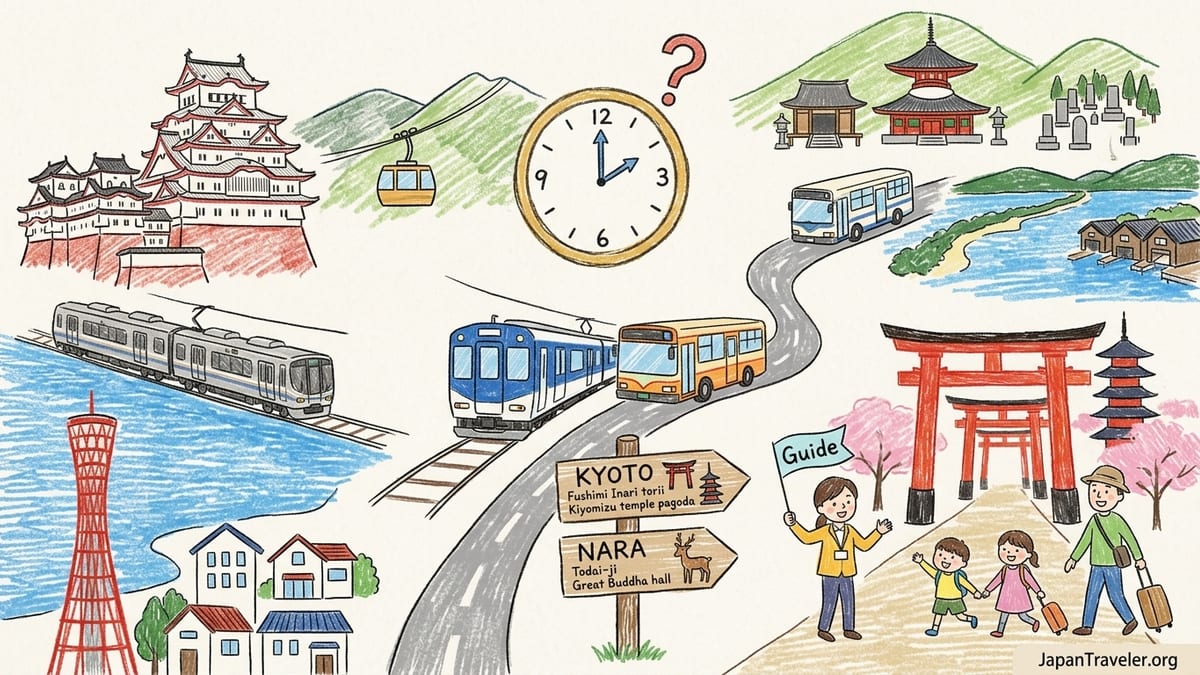
How to Decide When a Kansai Guide Is Worth Paying For
The first step in comparing Kansai tours is not the itinerary but the problem you are trying to solve. In central Kyoto or Nara, the challenge is usually not “how do I get there” but “how do I sequence this many sights without backtracking or burning out.” By contrast, a day that combines a regional hub like Himeji with Kobe’s harbor and hillside neighborhoods, or a run from Kyoto up to Amanohashidate and Ine, is primarily a transport puzzle. Every change between JR, private rail, bus, ropeway and sightseeing boat is a chance to lose time or miss a connection.
Most guided products in Kansai fall into three camps: classic Kyoto and Nara combinations, Himeji and Kobe pairings from Osaka, and more specialist runs to Koyasan or the Japan Sea coast around Amanohashidate and Ine. In 2026, you will also see plenty of private multi-day offers such as three-day Osaka–Kyoto–Nara car charters, plus a growing number of evening food tours in Osaka’s Dotonbori or Kyoto’s Pontocho. Group tours tend to be cheaper and more structured, while private tours trade higher prices for door-to-door logistics, custom pacing and hotel pickup.
To understand where each option shines, it helps to imagine specific travel days. Think about a family based in an Osaka hotel trying to see Fushimi Inari, Arashiyama bamboo grove, a Gion evening walk and Nara’s giant Buddha in Todai-ji, all within two days. Or a couple who want to see Himeji Castle, eat Kobe beef near Sannomiya and ride a ropeway to Mount Rokko within a single daylight window. These are the real-world scenarios Kansai tour companies currently design around, and where a guide can solve a problem that a simple train ticket cannot.
Kyoto + Nara Combination Tours: Time Management vs. DIY Flexibility
Kyoto and Nara sit roughly 45 minutes apart by rapid train and are, in theory, easy to visit independently. A Japan Rail Pass or an IC card, plus a mapping app, is enough to get you between Kyoto Station, Nara Station and the main temples. The real difficulty starts when you try to compress both cities into a single day from a base in Osaka or Kyoto. A typical DIY attempt might be Fushimi Inari at dawn, a dash to Nara for Todai-ji and Nara Park by late morning, and then back to Kyoto for Kiyomizu-dera and Gion at sunset. One delayed train, a crowded city bus or a wrong bus stop can collapse that structure.
This is why current marketplaces feature so many Kyoto and Nara combination days with hotel pickup from Osaka or central Kyoto. A common pattern is a ten-hour charter that collects you from an Osaka hotel around 8:30, drives directly to Nara’s Todai-ji and Kasuga Taisha, then transitions to Kyoto for Kiyomizu-dera, Fushimi Inari and Arashiyama before returning you to your door in the evening. Transport is in a private van rather than public trains and buses, and admission to at least some temples is often pre-arranged, removing ticket-machine confusion at busy gates.
For small groups or families, the math can be surprisingly favorable. A private day charter for up to seven or eight people may cost roughly what four or five travelers would spend on separate train tickets, city buses and individual temple admissions, especially if you factor in the value of hotel pickup and a bilingual guide explaining etiquette at shrines and temples. If all you want is a relaxed day in either Kyoto or Nara, public transport is fine. If your goal is “Kyoto plus Nara in one shot” with limited days in Japan, a guided combination tour genuinely reduces the risk of wasting time and missing key sights.
Independent travelers still have good reasons to skip a guide here. Kyoto and Nara are awash with English signage, and the main train lines between Osaka, Kyoto and Nara run frequently. If you have three or four days and enjoy a slower pace, buying a day bus pass in Kyoto, using the JR Nara Line or Kintetsu trains, and wandering without a schedule can be more rewarding. But for tight itineraries or nervous first-timers based in Osaka, the guided Kyoto–Nara day fills a real need.
Himeji and Kobe: When a Simple Day Trip Becomes a Logistics Chain
Himeji Castle is one of Kansai’s easiest major sights to reach independently. From Osaka or Kyoto, you ride a single JR train west for about an hour, walk straight up the castle avenue from Himeji Station and buy your ticket at the gate. For many travelers, this is a classic DIY day trip. The problem emerges when you add Kobe into the same day. Kobe’s highlights are scattered: the waterfront around Harborland and Meriken Park, the hillside Kitano Ijinkan district, ropeways up Mount Rokko, and restaurants that serve quality Kobe beef close to Sannomiya.
Trying to combine Himeji and Kobe without a guide means juggling JR trains between cities, local trains or subway lines within Kobe, and a ropeway or bus to viewpoints. You need to keep an eye on castle closing times and the last ropeway runs, especially in winter. Many 2026 tour itineraries now explicitly sell “Himeji Castle & Kobe” as a paired product from Osaka, sometimes adding Arima Onsen or a night-view stop at Mount Rokko. These tours leverage a private vehicle or chartered coach so that once you board in Osaka, you never have to think about transfer times again.
In typical Himeji and Kobe day tours, transport and attraction tickets are often bundled. You might have your Himeji Castle admission and Koko-en garden tickets prepaid, followed by an arranged Kobe beef lunch in a restaurant that understands dietary preferences communicated by your guide. Moving between Himeji, Kobe’s harbor, Kitano and Rokko happens in a van or coach, which is especially helpful for groups with mobility concerns or luggage that would be awkward on packed commuter trains.
If you are an independent traveler who simply wants to see Himeji Castle and return to Osaka or Kyoto, a tour is rarely necessary. JR trains are frequent, station signs are bilingual, and walking directions are obvious. But the moment you turn Himeji into a two-city circuit that also covers Kobe’s scattered neighborhoods, a guide and vehicle begin to solve concrete problems: coordinating multiple modes of transport, keeping an eye on closing times and reserving quality dining in a busy port city.
Koyasan: Complex Access and Cultural Context in One Package
Mount Koya, or Koyasan, is where a guide solves both logistics and interpretation at the same time. The physical journey from Osaka involves a private railway from Namba into Wakayama Prefecture, a cable car up the mountain and often a bus ride within the temple town to reach lodgings or trailheads. Each segment has its own timetable and ticketing rules. A missed connection can mean a long wait on a platform or a scramble to catch the last cable car down in the evening.
Current tour offerings from Osaka or Kyoto to Koyasan typically package all of this into a single product. You might join a fully guided day tour from Osaka where the operator handles rail tickets, cable car reservations, local buses and admission to key temple complexes. The guide leads you through Kongobu-ji, Danjo Garan and, crucially, the atmospheric Okunoin cemetery, where English explanations of statues, lanterns and mausoleums add layers you would likely miss on your own. Lunch at a shukubo temple lodging, often featuring shojin ryori Buddhist vegetarian cuisine, is sometimes included.
Overnight stays at temple lodgings are even more where a guide earns their fee. Many shukubo are comfortable but run on strict schedules, with early evening baths, set dinner times and pre-dawn prayer services. A private or small-group tour can ensure your arrival aligns with these rhythms and help communicate any special requests in Japanese. For travelers anxious about customs such as how to behave during morning prayers or in shared baths, on-site guidance reduces stress and cultural missteps.
Could you visit Koyasan independently? Absolutely, especially if you are comfortable navigating multiple ticket types at Namba Station and checking cable car timetables. Discounted passes for the railway and Koyasan buses exist and are well documented. For solo travelers focused on budget and flexible timing, DIY is realistic. For anyone who wants a one-day or overnight Koyasan experience folded smoothly into a broader Kansai trip, without worrying about connections or temple etiquette, a guided package delivers clear value.
Amanohashidate and Ine: Remote Beauty That Rewards a Coach Seat
Amanohashidate, famous as one of Japan’s three classic scenic views, lies on the Sea of Japan side of northern Kyoto Prefecture. On its own, it is reachable in about two hours by train from Kyoto or Osaka, with straightforward walking access from Amanohashidate Station to the sandbar and nearby viewpoints. The complication comes when you add Ine, the fishing village where traditional funaya boathouses line the sheltered bay. Getting from Amanohashidate to Ine and back to a mainline station in a single day requires fitting infrequent coastal buses and sightseeing boats together like a puzzle.
Local operators and transport companies have introduced dedicated sightseeing buses and seasonal express services linking Kyoto Station to Amanohashidate and Ine, as well as cruises in Ine Bay and chairlifts up to observation parks. There are also full-day guided products from Kyoto or Osaka that include round-trip coach transport, lifts to panoramic viewpoints over the sandbar, an Ine Bay boat cruise and time to walk through the boathouse district. Prices are often in the range of a modest day trip budget per person, with the crucial advantage that you can ignore bus timetables and just follow the guide’s schedule.
Independent travelers can absolutely reach Amanohashidate by regular train, buy a local day pass and explore viewpoints, temples and the sandbar at their own pace. Adding Ine, however, is where a tour or at least a packaged bus-and-boat ticket becomes attractive. Without it, you must calculate connections between the railway, local buses that may run only once or twice an hour, and the last sightseeing cruises of the day. Missing a late-afternoon bus from Ine back toward Amanohashidate or Miyazu could turn a scenic day out into an expensive taxi ride.
Guided tours in this region rarely include hotel pickup unless they are private charters, but they do typically bundle long-distance transport and attraction tickets. You might check in at Kyoto Station early in the morning, board a reserved coach, enjoy commentary about the Tango Peninsula en route, ride the chairlift up to an Amanohashidate viewpoint, take a scheduled Ine Bay cruise and be back in Kyoto by evening. For travelers who value remote scenery but do not want to study PDF timetables or juggle multiple regional passes, that is exactly what you are paying for.
Food Tours and Nightlife Walks: Depth More Than Logistics
Food-focused tours in Kansai solve a different problem. Getting to Dotonbori in Osaka or Pontocho in Kyoto is simple on your own. What is harder, especially if you do not speak Japanese, is knowing which counter-only izakaya welcomes foreign visitors, where to find regional specialties such as kushikatsu or Kyoto-style kaiseki at approachable prices, and how to avoid tourist traps with laminated menus and inflated bills.
In Osaka, small-group evening food tours typically meet at a central landmark near Namba or Umeda, then weave through alleyways to three or four venues. The fee usually includes shared plates at each stop, one or two drinks and a bilingual guide who explains dishes, helps with ordering and steers you toward local favorites you probably would not have tried alone. These tours rarely include hotel pickup or long-distance transport; their value is access and translation more than pure logistics.
Kyoto’s food tours often emphasize atmosphere as much as food. A guide might lead you on an early evening walk through Gion or Pontocho, pausing to explain maiko and geiko culture and pointing out where photography is restricted, before settling into a small restaurant for seasonal dishes. Some higher-end private experiences include reservations at kaiseki restaurants that are difficult to book without Japanese, with the guide on hand to interpret the menu and customs.
If you are comfortable wandering into busy restaurants, deciphering basic menus and accepting the occasional misfire, you can absolutely DIY your Kansai food experiences. Convenience stores, department store food halls and major chains all have English signage. But for travelers anxious about language barriers or keen to understand the stories behind dishes and neighborhoods, an evening food tour converts what could have been a generic meal into one of the trip’s most memorable nights.
Private Multi-City Tours: Osaka, Kyoto, Nara and Beyond
One of the most noticeable trends in Kansai’s 2026 tour landscape is the growth of private multi-city itineraries. Instead of booking separate day tours, travelers can now arrange two or three-day car-and-guide packages that cover Osaka, Kyoto and Nara in a single continuous circuit, sometimes with add-ons to Koyasan, Himeji or Kobe. Typical offers include an English-speaking driver-guide, door-to-door hotel transfers, tolls and parking, and the flexibility to adjust stops on the fly.
These private products are not cheap, but they solve several real-world problems. First, they smooth luggage transitions. A family checking out of an Osaka hotel in the morning can load bags into the vehicle, sightsee in Nara and southern Kyoto during the day, and be dropped at a Kyoto hotel that evening without ever hauling suitcases through stations. Second, they allow you to link destinations that are awkward by public transport, such as a morning at Himeji Castle followed by an afternoon in Kobe and a drop-off at an Osaka airport hotel.
In terms of inclusions, multi-city private tours often keep attraction tickets separate so that the itinerary can remain flexible. Transport and guiding are the core; temple admissions, castle tickets and meals are usually paid as you go. Compared with large group bus tours, you sacrifice the lower per-person price and fixed structure in exchange for customized pacing. Families with young children, older travelers and groups with mixed interests often find that ability to pivot mid-day worth the premium.
From a DIY perspective, you can absolutely string together Osaka, Kyoto and Nara on your own using JR and private rail lines, especially if you are traveling light. Many travelers enjoy the sense of independence that comes with navigating between Umeda, Kyoto Station and Kintetsu Nara. The question is how much mental energy you want to spend solving transport puzzles, especially when tired or jet-lagged. For some, the right answer is still a stack of train tickets. For others, paying for two days of private guiding is what keeps the trip from feeling like a series of commutes.
The Takeaway
Across Kansai, guided tours are not a binary good or bad choice so much as targeted tools. In compact, well-signed cities like Kyoto and Nara, a guide’s main job is time management and storytelling rather than basic navigation; independent travel works well if you have enough days and enjoy planning. In more complex circuits such as Himeji plus Kobe, or remote corners like Koyasan and the Amanohashidate–Ine coast, the combination of multiple transport modes, tight timetables and limited services means that a guide and dedicated vehicle really can prevent missed connections and stressful scrambles.
When comparing options, look past glossy photos to specifics. Does the tour include hotel pickup or do you need to get yourself to a central station at dawn. Are entrance fees to key sights such as Himeji Castle, Todai-ji, Kiyomizu-dera or Amanohashidate’s cable cars prearranged or payable on the day. How large is the group, and can the itinerary flex for weather, energy levels or special interests. Above all, ask whether this tour genuinely solves a problem you have, whether that is limited time, a language barrier, mobility concerns or anxiety about rural transfers. If the answer is yes, then for that particular Kansai day, a guide is not an indulgence. It is a form of travel insurance that buys you back both time and peace of mind.
FAQ
Q1. Is it worth booking a Kyoto and Nara combination tour, or should I visit each city on separate days?
For most first-time visitors with limited days, a Kyoto and Nara combination tour from Osaka or Kyoto is worth considering because it reduces the risk of wasting time on transfers and crowded city buses. If you have three or more full days in the region and prefer a slower pace, visiting each city independently on separate days by train is very manageable.
Q2. Do Himeji and Kobe need a guided tour, or can I do them in one day by train?
Himeji Castle alone is straightforward by JR train and easy to visit without a guide. The moment you add Kobe’s harbor, hillside neighborhoods and possibly Mount Rokko or Arima Onsen into the same day, a guided tour or private car becomes much more useful for coordinating multiple transfers and keeping an eye on closing times.
Q3. Is Koyasan possible as a DIY day trip from Osaka?
Koyasan is feasible as a DIY day trip if you are comfortable with buying combined rail and cable car tickets and checking timetables for the last return services. However, a guided tour or package simplifies the multi-step journey and adds valuable cultural context at temples and Okunoin, which many travelers find enhances the experience.
Q4. How difficult is it to reach Amanohashidate and Ine on my own?
Reaching Amanohashidate itself by train from Kyoto or Osaka is relatively straightforward. Adding Ine fishing village in a single day means fitting in infrequent coastal buses and boat schedules, which can be challenging. Guided coach tours and packaged bus-and-boat tickets exist largely to make this combination smooth and to avoid missed connections.
Q5. Are Kansai food tours mainly about logistics or about access to local places?
Kansai food tours are mostly about access, interpretation and confidence rather than transport. Getting to Dotonbori or Pontocho is easy; the tour value lies in knowing which small venues are welcoming, what to order and how to understand local food culture without worrying about language barriers.
Q6. What are the main advantages of private multi-city tours over group bus tours?
Private multi-city tours offer door-to-door transport, the ability to carry luggage between hotels, flexible timing and personalized itineraries. Group bus tours are usually cheaper and more structured but involve fixed routes, set meeting points and less room to adjust the day around your interests or energy levels.
Q7. Do most guided Kansai tours include attraction tickets in the price?
Many day tours that focus on a clear set of sights, such as Himeji Castle plus nearby gardens or a combination of specific Kyoto temples, include admission tickets. Longer private car charters and multi-city tours often keep tickets separate so the itinerary can change on the day. Always check what is included before booking.
Q8. Is hotel pickup common for Kansai day tours?
Hotel pickup is common for private tours and some bus tours departing from major Osaka or Kyoto hotels. Many group tours, especially to places like Amanohashidate and Ine, begin at central stations instead. If doorstep convenience is important to you, confirm pickup details before committing.
Q9. When is it better to skip a guide and use trains in Kansai?
It is usually better to skip a guide when you have flexible time, are comfortable with basic train navigation and are visiting straightforward routes such as Osaka to Kyoto, Kyoto to Nara or Osaka to Himeji only. In these cases, clear signage, frequent services and widely available route information make independent travel practical and economical.
Q10. How far in advance should I book guided Kansai tours?
For popular seasons such as cherry blossom and autumn foliage, booking key tours several weeks to a few months in advance is sensible, especially for Koyasan overnights, private multi-city charters and highly rated food tours. Outside peak periods, many standard day tours can be booked closer to your travel dates, but last-minute availability is never guaranteed.