


Landing at Kansai International Airport can feel overwhelming, especially after a long-haul flight. Between JR Haruka, Nankai Rapi:t, airport limousine buses, shared shuttles and an army of taxis, it is not always obvious which option is best for Osaka, Kyoto, Kobe or Nara. This guide cuts through the noise and focuses on one thing: helping you choose the most practical transfer for your destination, group size, luggage and arrival time.
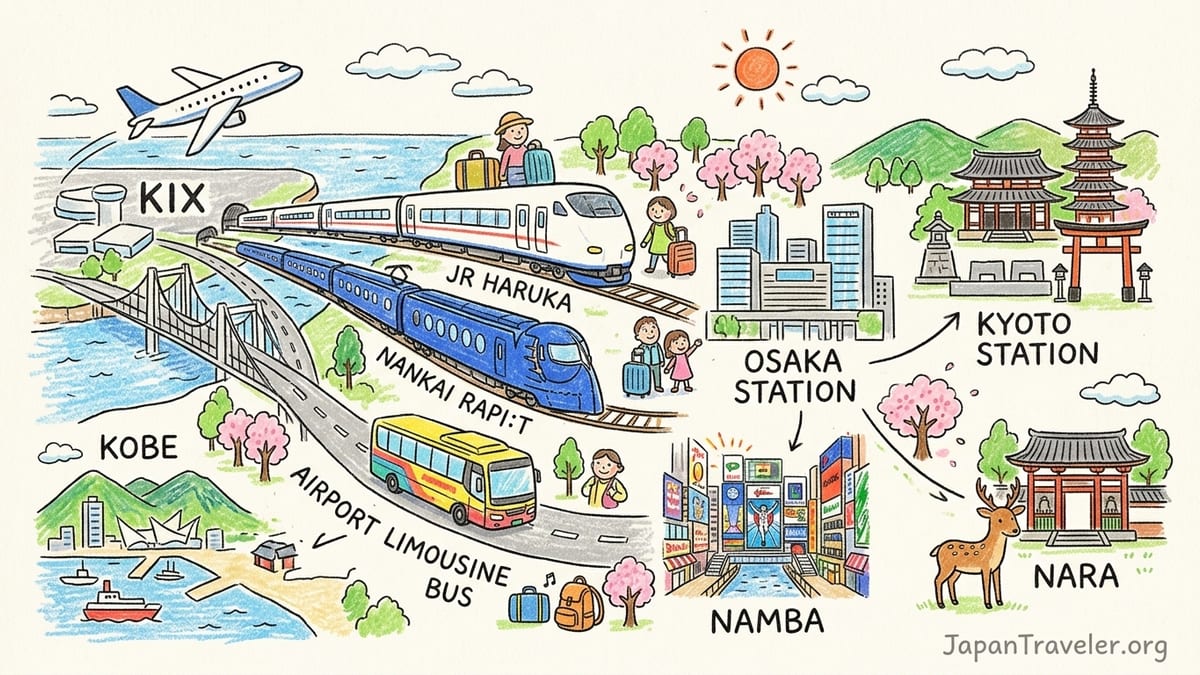
How Kansai Airport Is Connected to Osaka, Kyoto, Kobe and Nara
Kansai International Airport (KIX) sits on an artificial island south of Osaka and is the main international gateway for western Japan. Two rail operators, JR West and Nankai, run directly into the airport station, which is attached to the Terminal 1 building by a short covered walkway. On the road side, multiple airport limousine bus operators serve Osaka, Kyoto, Kobe and Nara, while taxi companies and shared shuttle providers offer door-to-door transfers to hotels and homes.
For most visitors, the choice is between fast trains such as JR Haruka and Nankai Rapi:t, or the network of airport limousine buses that stop at major stations and hotels. These services are set up specifically for air travelers, with clear English signage, luggage space and staff at KIX ready to direct you. In addition, companies based in Kyoto, Osaka and Kobe run shared and private airport shuttles that you prebook online and meet in the arrivals hall for a direct ride to your accommodation.
Before deciding, it helps to be realistic about your priorities. A couple with backpacks going to a hotel by Osaka Station will usually want the JR Haruka. A family of four with two large suitcases each heading to a Kyoto ryokan might find a shared shuttle or limousine bus more comfortable. Late-night arrivals who miss the last train often find that a prebooked private transfer is worth the extra cost compared with hunting for a metered taxi after midnight.
This guide walks through each main corridor from KIX: to Osaka Station and Umeda, to Namba, to Kyoto, to Kobe and to Nara. For each, it compares rail, limousine buses, shared shuttles, taxis and private transfers, with concrete examples of when each makes the most sense based on luggage, children, mobility needs, arrival time and group size.
KIX to Osaka Station & Umeda: JR Haruka vs Bus vs Taxi
Osaka Station and the surrounding Umeda district form the main rail hub of the Kansai region. If your hotel is around Osaka Station, Kita-Umeda or directly connected by JR lines such as Shin-Osaka and Kyoto, JR Haruka is usually the most efficient option. The Haruka limited express runs directly from Kansai-Airport Station to Tennoji, Osaka Station and Shin-Osaka, with some trains continuing to Kyoto. Typical journey time from KIX to Osaka Station is around 50 minutes, and trains are designed with overhead racks and some luggage space at the ends of the cars.
As of mid-2026, a one-way non-reserved Haruka ticket from KIX to Osaka Station costs in the low 2,000s of yen, while a reserved seat adds a modest premium. Foreign visitors can often buy discounted Haruka-only or Haruka plus regional pass tickets through travel agencies and official channels. A concrete example: a couple landing at 15:00, staying at the Hilton Osaka beside Osaka Station with one suitcase each, can walk to the railway station, board the next Haruka, and be at their hotel check-in desk in about 75 minutes from touchdown, with only one simple transfer from train concourse to hotel lobby.
Airport limousine buses also connect KIX with Umeda, typically taking about 60 to 75 minutes depending on traffic. Buses appeal to travelers with heavy or multiple suitcases, because luggage goes in the underfloor hold and you avoid maneuvering bags through station crowds or escalators. For example, a family of four with two small children and a stroller staying near Umeda Sky Building may find the bus more relaxing than threading through Osaka Station with luggage. Fares per adult are usually slightly cheaper than Haruka reserved seats, and children generally pay about half, which can make buses good value for families.
Taxis and private transfers come into their own for late-night arrivals or mobility needs. A metered taxi from KIX to Umeda is a long ride, typically around 60 to 70 minutes, and the fare is high by most visitors’ standards, often equivalent to several times the cost of Haruka tickets for two people. Shared shuttle services and prebooked private vans smooth this by offering a fixed rate per person or per vehicle to central Osaka hotels. A group of five adults with three large suitcases arriving at 22:30, staying in a serviced apartment north of Osaka Station, might find that a prebooked van transfer is only modestly more expensive per head than train tickets plus local taxis, with the bonus of door-to-door convenience after a long flight.
KIX to Namba: Nankai Rapi:t and Other Options
If your hotel is in southern central Osaka, particularly around Namba, Shinsaibashi or Dotonbori, the Nankai lines are usually more convenient than JR. The Nankai Airport Line connects Kansai-Airport Station to Namba, with the Nankai Limited Express Rapi:t as its flagship service. The Rapi:t takes around 35 to 40 minutes, runs frequently during the day, and offers reserved seating in distinctive deep-blue trains. Standard airport express trains without seat reservations are slightly slower but cheaper and still go directly to Namba.
In practical terms, travelers staying at properties like Swissotel Nankai Osaka (directly above Nankai Namba Station) or budget hotels clustered around Dotonbori often find Rapi:t unbeatable. You walk from arrivals to the Nankai ticket area, follow orange signage, board with your reserved seat, and arrive in Namba with escalators and elevators linking directly to underground malls and hotel corridors. With only carry-on or one suitcase per person, this is usually the smoothest way into central south Osaka.
For visitors carrying bulky luggage, airport limousine buses to Namba and Shinsaibashi are an alternative. Buses take roughly 50 to 60 minutes depending on traffic and stop near major hotels and shopping areas. A concrete scenario: two adults with skis or a snowboard bag heading to a Namba hotel for one night before transferring to the mountains might choose the bus to avoid carrying long gear through station ticket gates and busy platforms.
Taxis and shared transfers also serve the Namba area, and their pros and cons mirror those for Umeda. A late-night arrival that misses the last Nankai train will face a choice between an expensive metered taxi to Namba or a pre-arranged transfer. For a couple on a budget, the default plan is usually to aim for the last Nankai airport express departure around midnight; for groups or those with young children landing after 22:30, locking in a private van in advance eliminates stress about connection times.
KIX to Kyoto: Haruka, Limousine Buses and Shared Shuttles
Kyoto is about 75 minutes from Kansai Airport by direct JR Haruka train, which terminates at JR Kyoto Station. For most independent travelers with manageable luggage and a hotel near the station, Haruka is the default recommendation. Trains run roughly every 30 minutes during the day. Fares for a one-way ticket from KIX to Kyoto Station sit in the mid-3,000 yen range for non-reserved seats, with a small supplement for a reserved seat. Many foreign travelers take advantage of advance-purchase discounts or rail passes that cover the Haruka, making the train both fast and good value.
Haruka works particularly well if you plan to continue onwards from Kyoto Station by JR or subway within the city. For example, a solo traveler staying near Kyoto Station or in the Karasuma area can arrive at KIX at 09:00, pass immigration, buy a Haruka ticket at the JR West counter in arrivals, and be walking out of the central exit at Kyoto Station around 11:00. With a rolling suitcase and backpack, navigating the station concourse and short walk or local subway ride to a business hotel is straightforward.
Airport limousine buses from KIX to Kyoto offer a competitive alternative, especially for those whose accommodation is not close to Kyoto Station or who prefer to avoid transfers with luggage. Buses generally take around 90 to 100 minutes, depending on traffic, and stop at JR Kyoto Station and several major hotels and bus terminals in the city. Seats are comfortable coach-style, and large suitcases go into the luggage bay below. A family of four staying at a central Kyoto hotel that is a short walk from one of the limousine bus stops may appreciate being able to sit together, let the kids doze and step off close to their door without negotiating crowded station platforms.
Shared shuttle taxis and private transfers are particularly popular on the Kyoto route, as several well-known operators based in Kyoto run minivan shuttles between KIX and hotels or guesthouses throughout the city. These services usually require prebooking and group your trip with other passengers whose destinations are in similar areas. For guests staying in traditional machiya townhouses or ryokan in neighborhoods such as Gion, Higashiyama or Arashiyama, where direct station access is limited, a shared shuttle that drops directly at the accommodation can save a lot of effort. For example, three adults with two large suitcases each staying in a Gion alleyway might find that a prebooked shuttle, priced per person, ends up similar in total cost to three Haruka tickets plus two taxis within Kyoto.
KIX to Kobe and Nara: When Buses and Shuttles Beat Trains
Reaching Kobe from Kansai Airport is possible by combining JR or Nankai rail with local transfers, but many travelers choose airport limousine buses or the high-speed ferry plus train. Limousine buses link KIX with central Kobe areas such as Sannomiya, typically in about 65 to 75 minutes in normal traffic. For visitors staying at major Kobe hotels near Sannomiya or Shin-Kobe, the bus is a practical single-seat ride, with luggage stored in the hold. A couple arriving in the evening and staying at a Sannomiya business hotel might simply board the Kobe-bound bus from the terminal curb and walk a short distance from the final stop to their hotel.
There is also a high-speed ferry connecting KIX with Kobe Airport’s marine terminal, from which a short shuttle bus and Port Liner train ride bring you into central Kobe. The ferry can be very fast in pure travel time and appeals to some travelers for the novelty of a sea crossing, but it involves several transfers and does not always align well with late arrivals. For families with children or travelers with mobility issues, a direct limousine bus or prebooked shuttle from KIX to a Kobe hotel is usually easier than juggling ferry and local trains with luggage.
Nara sits inland, southeast of Osaka, and lacks a direct rail line from the airport. While it is technically possible to take JR to Tennoji and change to a JR Nara Line train, or take Nankai to Namba and transfer to Kintetsu services, many visitors find the direct limousine bus from KIX to Nara the most straightforward option. Typical journey time is around 90 to 100 minutes, with stops at JR Nara Station, Kintetsu Nara Station and some major hotels. For first-time visitors heading straight to Nara with one or two suitcases, this bus offers a stress-free choice: board at the airport, store your luggage in the compartment and ride directly into the city.
Shared shuttle services also cover Nara and can be advantageous if you are staying away from the main stations, such as in residential guesthouses or temple lodgings. For example, a small group staying near Nara Park might find that a shared shuttle which drops them within a short walk of their accommodation is worth the slight premium over the bus fare, especially when arriving at night or in poor weather. These services usually operate from early morning until late evening, with surcharges for very late or very early flights.
Choosing by Luggage, Children, Arrival Time and Group Size
Beyond destination, the most important factors in choosing a KIX transfer are luggage, children, arrival time and group size. Trains like JR Haruka and Nankai Rapi:t are fast and frequent but require you to handle your bags through station gates, up and down escalators or elevators, and sometimes along crowded platforms. If you are traveling light, this is not an issue. For example, two adult backpackers heading to a hostel near Namba can move quickly through KIX, buy Rapi:t tickets and be checking in less than an hour after leaving the airport.
Heavy suitcases or multiple bags change the equation. Airport limousine buses, shared shuttles and private transfers remove most of the physical effort by loading large luggage into bay compartments or van trunks. A family with two young children, a stroller and three large suitcases going to Kyoto or Nara might find that the small timetable advantage of the train disappears once you factor in transferring between lines and walking from the station. In that case, a direct bus or door-to-door shuttle usually means fewer tears and less stress, even if the bus is 15 to 20 minutes slower in clear traffic.
Arrival time also matters. During the day and early evening, trains and buses run frequently and you can choose based on cost and convenience. Late at night, schedules thin out. The last JR and Nankai airport trains typically depart before midnight, and some limousine bus routes end earlier. If your flight is scheduled to land at 21:30 or later, it is prudent to check the latest timetables shortly before travel. For a 23:00 scheduled arrival that may be delayed, a prebooked private transfer or shared shuttle provides more security than relying on catching the last train.
Group size affects cost calculations. For solo travelers and couples, train or bus fares are significantly cheaper than a private taxi. Once you reach three or four adults, especially with luggage, the total price of train tickets plus onward taxis in the city can approach or even exceed a fixed-rate shared shuttle or private van. For example, four friends arriving at 19:00 and staying in an Airbnb townhouse in central Kyoto might find that a private transfer for the whole group ends up close in cost per person to taking Haruka to Kyoto Station and then two local taxis, but with the added comfort of direct drop-off at their door.
How to Buy Tickets and Plan Connections
Buying tickets at Kansai Airport is straightforward, but planning ahead saves time and confusion. Inside the arrivals hall of Terminal 1 you will find JR West and Nankai ticket counters and machines. Staff usually speak basic English and are familiar with common requests such as “Haruka to Kyoto” or “Rapi:t to Namba.” Many travelers now purchase QR-code based tickets or discount passes online before departure, then simply scan the code at the ticket gates or exchange for a physical ticket at designated counters.
For limousine buses, you typically buy a ticket at dedicated bus counters or vending machines near the bus stops outside the terminal. The ticket will indicate your destination and sometimes a specific departure time. At busy times such as Golden Week or New Year, certain bus routes can fill, but there are usually frequent departures to Osaka, Kyoto, Kobe and Nara throughout the day. Staff outside help load luggage and direct you to the correct queue. Keeping some cash available is useful, although many services increasingly accept credit cards and transport IC cards.
Shared shuttle and private transfer bookings are usually made online through the operator’s website or major booking platforms before you fly. You provide your flight details, number of passengers and luggage, and accommodation address. On arrival, a driver or desk staff will meet you in the arrivals area holding a sign, or you will go to a specific counter to check in. It is important to include buffer time for immigration and baggage claim when selecting pick-up times. As a rule of thumb, allow at least one hour from scheduled landing to meeting your driver for international flights, and longer in peak seasons.
Regardless of transport type, always double-check the latest timetables and ticket conditions on official operator channels shortly before travel, as schedules and prices can change. Note that some discounted train tickets and shuttle services are restricted to foreign passport holders or require specific booking steps, such as scanning a QR code with the same name as on your passport.
The Takeaway
There is no single “best” way to leave Kansai Airport, only the best match for your specific trip. If you are staying near Osaka Station or heading straight to Kyoto, JR Haruka is often the top choice for speed and simplicity. If your base is around Namba or Dotonbori, Nankai Rapi:t or the Nankai airport express is the most convenient. For Kobe and Nara, and for travelers with heavy bags or young children, airport limousine buses provide an appealing balance between comfort, cost and simplicity.
Shared shuttles and private transfers fill the gaps when your accommodation is not close to a major station, when you are traveling as a larger group, or when your flight arrives late at night or very early in the morning. Taxis remain the ultimate in flexibility but are generally the most expensive way to get from KIX to the cities of Kansai, particularly for solo travelers and couples. Thinking carefully about your luggage, your kids or older relatives, and your arrival time will usually point you clearly toward one or two best options.
Whatever you choose, the key is to decide your strategy before you land, know roughly where the train platforms or bus stops are, and understand how you will get from your final stop to your hotel. With a little planning, your first journey from Kansai Airport to Osaka, Kyoto, Kobe or Nara can be a smooth introduction to one of Japan’s most fascinating regions rather than a stressful obstacle at the end of a long flight.
FAQ
Q1. What is the fastest way from Kansai Airport to Osaka Station or Umeda?
The JR Haruka limited express is usually the fastest practical option, taking around 50 minutes from Kansai-Airport Station to Osaka Station, with frequent daytime departures.
Q2. How do I choose between JR Haruka and Nankai Rapi:t?
Use JR Haruka if you are going to Osaka Station, Shin-Osaka or Kyoto; choose Nankai Rapi:t if your hotel is near Namba, Dotonbori or Shinsaibashi in southern central Osaka.
Q3. Are airport limousine buses from KIX suitable for travelers with a lot of luggage?
Yes, limousine buses are ideal if you have large or multiple suitcases, because staff load bags into the luggage bay and you avoid carrying them through train stations.
Q4. What is the best option from KIX to Kyoto with children?
If your hotel is near Kyoto Station and your kids can manage a short station walk, JR Haruka is fast and easy. Otherwise, a limousine bus or shared shuttle that stops closer to your hotel is usually more comfortable.
Q5. How should I get from Kansai Airport to Namba late at night?
If your flight lands early enough, aim for the last Nankai airport express or Rapi:t service. For very late arrivals or delays, prebooking a shared shuttle or private transfer is safer than relying on a metered taxi.
Q6. Is there a direct train from Kansai Airport to Nara?
No, there is no single direct train from KIX to Nara. Most visitors either take the direct airport limousine bus to Nara or combine JR or Nankai trains with a transfer to JR or Kintetsu Nara lines.
Q7. What is the most convenient way from KIX to Kobe for first-time visitors?
For most first-timers staying around Sannomiya or central Kobe, the direct airport limousine bus from KIX is the simplest option, offering a single ride with luggage stored in the hold.
Q8. When does it make sense to book a private transfer from KIX?
Private transfers make sense if you arrive very late or early, travel with small children or older relatives, have a lot of luggage, or stay far from major train or bus stops.
Q9. Can I use transport IC cards like ICOCA on trains from Kansai Airport?
Yes, you can use IC cards on most JR and Nankai local services from KIX, but limited express surcharges for trains like Haruka and Rapi:t may still require a separate ticket or reservation.
Q10. Should I buy transfer tickets or passes before arriving at KIX?
Buying in advance is not strictly necessary, but prebooking discounted Haruka, Rapi:t or shuttle tickets can save money and time in the arrivals hall, especially during busy seasons.