


Kyushu can feel deceptively compact on the map, yet its volcano rims, onsen towns and historic ports are spread across mountain roads and multiple prefectures. For many travelers basing themselves in Fukuoka, the biggest question is not what to see, but when an organized tour is worth paying for and when you can comfortably go it alone. This guide compares the main Kyushu highlights that most visitors try to fit into a short trip: Mount Aso and Takachiho Gorge, Beppu and Yufuin, Nagasaki, Kagoshima and Sakurajima, plus Fukuoka’s famous food scene. The focus is firmly on logistics, using real tours you can book today and explaining where shared or private transport genuinely makes your life easier.
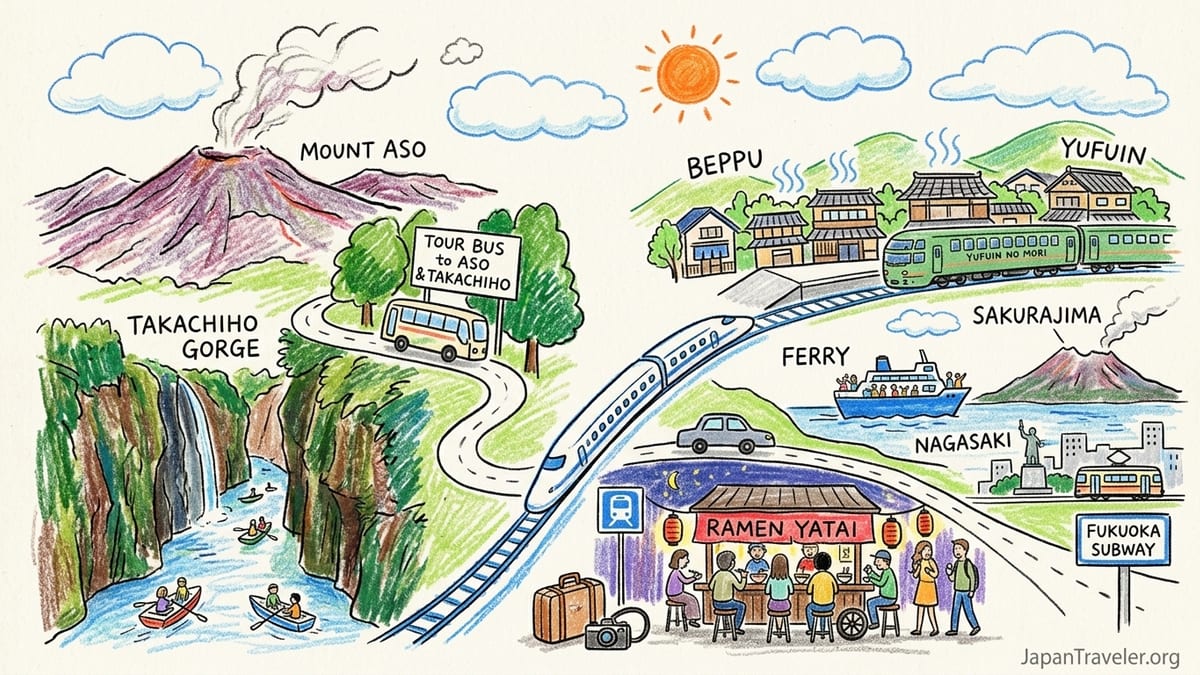
Understanding Kyushu Logistics From a Fukuoka Base
Most international visitors fly into or out of Fukuoka, then consider a series of ambitious day trips. The challenge is that Kyushu’s star sights are strung around a broad ring of mountains and bays. Even with expressways, driving from central Fukuoka to Mount Aso takes roughly 2.5 to 3 hours one way, and Takachiho Gorge is another 1 to 1.5 hours beyond that. Public transport adds transfers and waiting time, so a “simple” outing can easily stretch to 12 hours of travel and sightseeing.
The distances mean that organized tours are not just about commentary. They often solve very real problems such as infrequent rural buses, tight connections between trains and mountain transport, and closures around active volcanic areas. For example, current bookable products include 10 hour Aso and Takachiho day tours departing from Fukuoka, typically with early morning departures around 8:00 and returns by early evening. These itineraries bundle highway driving, scenic viewpoints, boat rides on the gorge and lunch stops into one package.
That said, Kyushu is not uniformly difficult to navigate. Fukuoka itself, Nagasaki city and the onsen towns around Beppu and Yufuin are relatively straightforward for independent travelers willing to combine trains, buses and occasional taxis. In contrast, Mount Aso, rural Takachiho and parts of Sakurajima reward those who invest in either a rental car or a well planned tour. As you read through the sections below, keep asking two questions: how much rural transport am I comfortable handling, and how much of my short Kyushu stay do I want to spend watching highway guardrails roll past the window.
Mount Aso & Takachiho Gorge: When Tours Beat DIY
Mount Aso and Takachiho Gorge are the most striking natural duo in central Kyushu, and also the pair that raises the most logistical headaches. From Fukuoka, a typical shared bus tour or small group tour to Aso and Takachiho is advertised as a 10 hour round trip, often leaving from Hakata Station. Many current tours include hotel pickup in central Fukuoka for a supplement and then follow a loop that includes Mount Aso’s caldera view at Kusasenri or Daikanbo, a lunch stop, and the famous basalt cliffs and rental boats of Takachiho Gorge.
Private full day versions departing Fukuoka, offered by operators such as Japan Local Journeys or on platforms like Klook, usually use a chartered minivan with a driver guide for up to eight or nine people. These private tours typically cost more per person than a shared coach if you are two travelers, but become competitive for families or small groups. They are also more flexible with timing, which matters when road works, crater closures or weather force plan B. The usual duration is about 10 hours door to door, with custom pickup at Fukuoka hotels and English speaking guides on request.
Could you visit Aso and Takachiho independently? It is possible but demanding. The most realistic DIY option is to ride the Shinkansen or limited express from Fukuoka to Kumamoto, rent a car near Kumamoto Station, then drive via Aso to Takachiho and back, or better, spend a night at a rural ryokan in the area. Travelers who attempt Aso and Takachiho as a single day trip purely by public transport from Fukuoka face multiple transfers, tight rural bus timetables and limited time on site. Unless you are already staying in Kumamoto or a nearby onsen town, organized transport provides clear value here.
Language and guiding are another factor. Many shared bus tours from Fukuoka operate with Japanese speaking guides and distribute simple English or Chinese leaflets. Private tours, on the other hand, can usually confirm an English speaking driver guide or a separate guide. If you want context around volcanic monitoring, Shinto mythology at Takachiho Shrine, or help navigating the sometimes long queues for rental rowboats in peak seasons, that guidance can be worth the premium.
Beppu & Yufuin: Easy Onsen Country With Optional Tours
By contrast, Beppu and Yufuin in Oita Prefecture are two of the easiest Kyushu highlights to visit independently. From Fukuoka’s Hakata Station, direct limited express trains such as the Sonic and Yufuin no Mori make the trip to Beppu or Yufuin in roughly two hours, with several departures per day. Once you arrive, both towns have compact centers with walkable onsen districts, clearly signposted bus routes and plenty of accommodation near the stations. For most travelers comfortable with trains, booking a hotel and heading out on your own is straightforward.
Where tours become useful is when you want to combine multiple experiences or travel with limited mobility. From Fukuoka, some operators offer full day bus trips that visit several of Beppu’s “hells,” stop at Yufuin for café strolling, and return to Fukuoka in the evening. These are usually shared tours with commentary in Japanese and basic audio guides or printed materials in English. They rarely include hotel pickup in Fukuoka, instead using Hakata Station or Tenjin as the meeting point. Expect around 10 to 11 hours in total, with several hours of highway driving.
Another style of tour focuses on local experiences once you are based in Beppu or Yufuin. You might book a half day private taxi tour to visit outlying hot springs that are not served frequently by buses, or arrange a guided cycling or walking tour to photograph steam vents at sunrise. In Yufuin, small group food walks introduce local sweets and croquettes along Yunotsubo Kaido, while private guides help you combine quiet onsen time with short hikes around Lake Kinrin. Because the underlying transport is simple, these tours tend to be shorter, usually 3 to 5 hours, and are fine to book after you arrive.
If you are choosing between a Beppu or Yufuin day tour from Fukuoka and an Aso and Takachiho tour, remember that Beppu and Yufuin are far easier to visit on your own. For a short Kyushu itinerary, many travelers prioritize organized transport for the genuinely complex Aso and Takachiho logistics, then ride the train independently to Beppu or Yufuin for a more relaxed overnight stay.
Nagasaki History Tours: Depth Over Distance
Nagasaki is about two hours from Fukuoka by limited express train, and the city’s tram network makes independent sightseeing relatively easy. Key sites such as Nagasaki Peace Park, the Atomic Bomb Museum, the Hypocenter and Glover Garden are all reachable by tram with short walks. For confident travelers, a DIY day trip using the train and trams works well, especially if you focus on a few core locations rather than trying to see everything.
However, Nagasaki’s history is layered and emotional, and this is where guided tours can add significant depth. From Fukuoka, there are full day bus tours that include the Atomic Bomb Museum, Peace Park, and often Glover Garden or Mount Inasa for night views, with commentary about the events of 1945 and the city’s role in earlier periods of foreign trade. These coach tours usually last around 11 to 12 hours door to door and may start from Hakata Station in the morning. Some include brief visits to secondary sites such as Yutoku Inari Shrine on the way, which means less time in Nagasaki itself but a varied schedule.
Private taxi tours within Nagasaki city are another strong option, especially for visitors who prefer to move at a slower pace or have accessibility needs. Local taxi companies and tour offices sell three to six hour courses that bundle the Atomic Bomb Museum, Peace Park, the Urakami Cathedral ruins area and a drive up to Mount Inasa. Guides or drivers may speak basic English, and written explanations are provided in several languages at the museums. Because the city is compact, private tours can remain relatively affordable for couples or small groups.
If you speak little Japanese and are concerned about processing Nagasaki’s history respectfully, booking a guided experience for at least part of your visit is worth considering. For travelers spending multiple days in Kyushu, a balanced approach might be to ride the train independently from Fukuoka, then join a half day guided tour that focuses on the bombing and reconstruction, leaving the rest of your time for independent tram hopping around Chinatown, Dejima or the hillside churches.
Kagoshima & Sakurajima: Volcanic Adventures Across the Bay
Kagoshima, at Kyushu’s southern tip, is another city where base transport is straightforward but the surrounding landscapes benefit from organized excursions. Shinkansen trains link Fukuoka’s Hakata Station with Kagoshima Chuo Station in about 1.5 to 2 hours. Once there, local buses and the Kagoshima City View tourist bus loop between major stops such as the port, Sengan-en garden and city museums. The star of the region, however, is Sakurajima, the active volcano that rises across Kinko Bay.
Reaching Sakurajima independently is conceptually simple. Frequent ferries cross from Kagoshima Port to Sakurajima Port in around 15 minutes, even running through the night. From the Sakurajima side, a local Island View bus loops between the visitor center, observation points and attractions such as the long footbath facing the bay. For a traveler who enjoys reading signboards and planning their own schedule, a self guided visit with the ferry and local buses works well.
Where tours become attractive is when you want to reach more remote viewpoints or combine several experiences in a single day. Official tourism offices in Kagoshima list guided walks on Sakurajima’s lava fields, kayak eco tours in the bay and private boat cruises that circle the volcano and stop at observation decks such as Arimura. These may depart from Kagoshima’s waterfront or the Sakurajima side and typically last from three hours to a full day. Guides are often Japanese speaking with basic English support, so checking language options when booking is important.
Because Kagoshima is significantly farther from Fukuoka than Aso or Nagasaki, it rarely makes sense as a long day trip from Fukuoka with current train schedules. A more comfortable plan is to travel independently by Shinkansen, base yourself for one or two nights in Kagoshima city, then join half day or full day Sakurajima tours that handle the ferry timing and bus transfers. For travelers with mobility issues or limited time, private taxi tours that pick up at Kagoshima hotels and include ferry crossings and viewpoint stops can be a particularly efficient way to explore the volcano.
Fukuoka Food Tours: Staying Local, Going Deep
Fukuoka is easily the most accessible destination in this guide, and one where organized tours are less about solving transport and more about unlocking the local food scene. The city’s famous yatai food stalls, tonkotsu ramen shops and izakaya lanes are scattered across central districts such as Tenjin, Nakasu and Hakata, all connected by subway and bus. Independent travelers can easily wander and snack without any guide at all.
Food tours, however, can transform a casual evening of grazing into a deeper cultural experience. Small group yatai tours typically start near Tenjin or Nakasu around dusk, then move between a few different stalls over three hours. Many include one drink and several small dishes at each stop, as well as reserved seats at popular stalls that might otherwise be intimidating to approach. English speaking guides help explain regional specialties such as mentaiko, motsunabe and mizutaki, and often tailor recommendations for post tour ramen or bars.
Private food tours offer even more flexibility. These might include pickup at central hotels, though guests are usually asked to meet at a landmark station exit to avoid traffic delays. Some combine food with short cultural walks, stopping at Kushida Shrine, canal-side neighborhoods or shopping arcades before focusing on dinner. Tours vary from 2.5 to 4 hours and can be particularly valuable on your first night in the city, giving you the confidence to revisit favorite spots on your own later in the trip.
Since transport is simple, the decision here is less about logistics and more about budget and interest. If you are comfortable navigating Japanese menus and already familiar with izakaya culture, you might skip formal tours and build your own tasting route. If you are new to Japan or traveling solo and want easy conversation along with your food, a guided evening in Fukuoka is a relatively low stress, high reward investment.
Shared vs Private Tours: Choosing the Right Format
Across Kyushu, you will see a spectrum of tour formats: large shared buses, small group minivans, driver only charter cars and fully guided private tours. For long range itineraries between Fukuoka and Aso, Takachiho or Nagasaki, shared bus tours are usually the most economical. Prices vary by season and operator, but as a rough reference a full day shared tour might start from the equivalent of under 150 US dollars per person, including highway tolls and some entrance fees. These tours often operate on fixed schedules with limited time at each stop and Japanese language commentary, which suits travelers who prioritize seeing headline sights on a budget.
Private full day tours from Fukuoka to Aso and Takachiho are more expensive overall but can be cost effective for groups. A chartered van with up to eight passengers and an English speaking driver guide can spread the cost across several people, while also allowing itinerary tweaks. For example, you might swap a standard souvenir stop for an extra hour walking along Takachiho Gorge, or adjust the day to account for an early closure of the Aso crater road. Private tours nearly always include hotel pickup and drop off within central Fukuoka, using mid sized vehicles rather than large coaches.
Guide language is a practical differentiator. Many shared tours specify “Japanese only guide, simple English handouts,” while private tours either guarantee English or allow you to pay a supplement for an English speaking guide. In destinations with complex stories, such as Nagasaki’s atomic bombing sites or Sakurajima’s volcanic history, that live interpretation can significantly enhance your experience. In more self explanatory environments like Beppu’s onsen streets or Fukuoka’s food alleys, language support is less critical.
Duration and stamina matter too. A 10 to 12 hour day tour with four to six hours of highway driving is realistic but tiring, especially if you are recovering from jet lag. Before booking, look carefully at departure times, number of stops and whether meals are included or self paid. If you dislike feeling rushed, lean toward private or very small group options, or break long journeys by staying one or two nights closer to the attractions instead of forcing everything into a single outing from Fukuoka.
The Takeaway
Kyushu rewards travelers who match their transport choices to the character of each destination. For Mount Aso and Takachiho Gorge, the combination of distance, rural roads and variable volcanic conditions means that a 10 hour shared or private tour from Fukuoka is often the most sensible and least stressful option, unless you are already planning to rent a car and stay locally. Beppu and Yufuin, by contrast, are tailor made for independent travel by train, with optional short tours to refine your onsen or photography time once you arrive.
Nagasaki sits in the middle ground. You can comfortably reach and navigate the city alone using trains and trams, yet a guided component, whether a full day bus from Fukuoka or a half day taxi course within the city, deepens your understanding of its heavy twentieth century history. Farther south, Kagoshima and Sakurajima work best as an overnight extension from Fukuoka, mixing independent Shinkansen travel with locally based volcanic cruises and walking tours that handle the ferry dances for you.
Within Fukuoka itself, where the only real obstacle between you and a steaming bowl of ramen is decision fatigue, food tours are less about logistics and more about confidence and connection. Whether you join a small group yatai crawl or simply follow your nose, you will likely close your Kyushu journey in the same city where it began, reflecting on whether the hours spent crossing mountain expressways were worth the scenes they unlocked. With a little planning around where organized transport adds genuine value, the answer is almost always yes.
FAQ
Q1. Is it realistic to visit both Mount Aso and Takachiho Gorge as a day trip from Fukuoka?
Yes, but only with a very long day. Current shared and private tours run about 10 hours round trip from Fukuoka, using expressways and minimizing waiting time. Doing the same route independently by public transport in one day is possible but far more tiring and prone to delays, so most travelers either join a tour or stay one night closer to Aso.
Q2. Do Aso and Takachiho tours from Fukuoka usually include hotel pickup?
Many private full day tours include pickup and drop off at central Fukuoka hotels, while shared bus tours often start from Hakata Station or another fixed meeting point. Always check the meeting details before booking, especially if you are staying outside the usual pickup area or near the airport.
Q3. Can I visit Beppu and Yufuin on my own without joining a tour?
Yes. Beppu and Yufuin are among the easiest Kyushu destinations to explore independently. Direct limited express trains connect them with Fukuoka, and both towns have walkable centers and clearly signed bus routes. Many visitors simply book accommodation, buy train tickets and decide on specific onsens or viewpoints once they arrive.
Q4. Is a guided tour necessary to understand Nagasaki’s history sites?
Not strictly, because the Atomic Bomb Museum and Peace Park provide extensive multilingual displays. However, a local guide can help connect the sites into a coherent story and answer questions about the city’s wartime and earlier international history. For many visitors, a half day guided tour combined with independent tram exploring offers a good balance.
Q5. How difficult is it to get to Sakurajima without a tour?
Reaching Sakurajima is fairly simple. You ride a ferry from Kagoshima Port to Sakurajima Port, then use the Island View bus or walk between key viewpoints. The challenge is more about optimizing your route and reaching lesser known trails or lava fields, where guided walks, kayak tours or private taxi courses can be helpful.
Q6. Are English speaking guides easy to find for Kyushu tours?
English speaking guides are widely available for private tours to Aso, Takachiho, Nagasaki and Sakurajima, though you should confirm language when booking and expect higher prices than Japanese only tours. Large shared buses often provide Japanese commentary with basic English pamphlets or audio, which may be sufficient if you mainly want transport.
Q7. When is it better to rent a car instead of joining a tour?
Renting a car works best if you are comfortable driving in Japan and plan to spend several days in rural Kyushu, staying in places like Aso, Kurokawa Onsen or Takachiho. For one off long day trips from Fukuoka, especially if you are tired or jet lagged, a driver guided tour or shared bus is usually safer and less stressful than a full day behind the wheel.
Q8. Are Kyushu day tours suitable for families with children?
Many are, but you should check minimum age requirements and expected walking distances. Long Aso and Takachiho or Nagasaki day tours can involve early starts, tight schedules and several hours on highways, which may be challenging for very young children. Private tours allow for more breaks and spontaneous changes if kids need rest time.
Q9. How far in advance should I book popular Kyushu tours?
For peak holiday periods such as cherry blossom season, Golden Week or autumn foliage, it is wise to book Aso and Takachiho, Nagasaki and Sakurajima tours several weeks in advance. Food tours in Fukuoka and local experiences in Beppu or Yufuin can sometimes be secured closer to the date, but availability is never guaranteed on weekends or holidays.
Q10. If I only have three full days based in Fukuoka, which tours should I prioritize?
With three days, many travelers choose one long organized nature or history day tour, such as Aso and Takachiho or Nagasaki, then spend another day visiting Beppu or Yufuin independently by train, and reserve one evening for a Fukuoka food tour. This balance maximizes variety while keeping overall travel time manageable.