


Hokuriku and Shinetsu sit along the Japan Sea coast and the northern Japanese Alps, stitched together by the Hokuriku and Joetsu Shinkansen lines. For hot‑spring travelers, this corridor offers some of the easiest access in Japan to classic onsen towns: Kaga’s historic ryokan, Awara’s resort hotels, Toyama’s Unazuki gateway to Kurobe Gorge, the ski village baths of Nozawa Onsen, and the monkey‑adjacent springs of Yudanaka and Shibu. Choosing where to actually spend a precious onsen night, however, can be surprisingly difficult. This guide compares the main onsen hubs along this route and helps you decide which deserve an overnight stay, which work best as day trips, and how to fit them into a wider Hokuriku–Shinetsu itinerary.
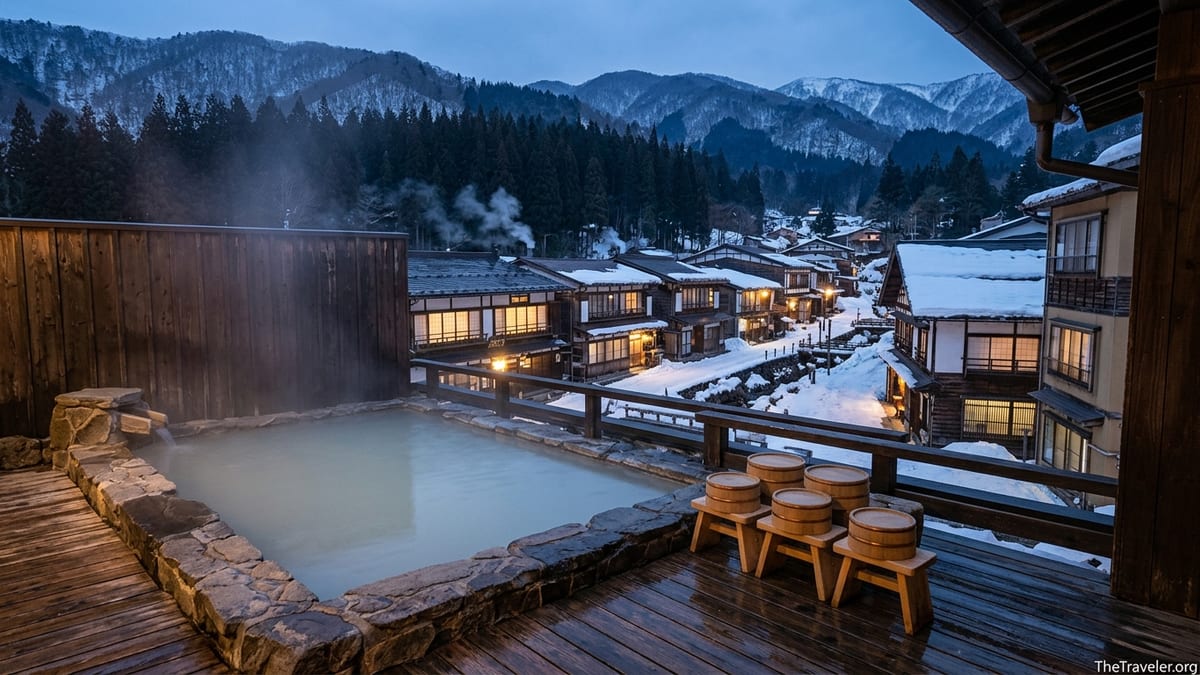
How to Choose Between Hokuriku and Shinetsu Onsen Towns
Before looking at individual towns, it helps to think about the type of trip you want. Hokuriku onsen like Kaga and Awara lean coastal and cultural, pairing easily with Kanazawa, Fukui and Toyama. Shinetsu towns such as Nozawa, Yudanaka and Shibu are more alpine, snow‑focused and pair naturally with Nagano, Myoko or Shiga Kogen ski resorts. Unazuki and Echigo‑Yuzawa sit in between, combining mountains with quick Shinkansen access.
Accessibility from Tokyo has improved dramatically in the last decade. As of 2026, the Hokuriku Shinkansen runs from Tokyo through Nagano and Iiyama to Joetsu‑Myoko, Itoigawa, Kanazawa and beyond, while the Joetsu Shinkansen runs from Tokyo to Echigo‑Yuzawa and Niigata. That means you can leave Tokyo mid‑morning, soak in a rotenburo with mountain or sea views by late afternoon, and still be back in a major city the following day without ever renting a car.
For most travelers, the deciding factors will be atmosphere, scenery and logistics. Do you want a compact traditional town where you can walk everywhere in yukata, like Nozawa or Shibu, or are you comfortable staying in a large modern hotel at Awara with bigger rooms but less historic charm? Are you chasing deep snow and cosy indoor baths, or a mixed itinerary that includes coastal seafood, art museums and short hikes?
Tattoo policies, meal style and whether a place is better as a day trip or an overnight also matter. In this region, it is still safest for heavily tattooed travelers to book a ryokan with private or in‑room baths, though more facilities around Kaga and other tourist centers are slowly relaxing their rules. Dinner is usually kaiseki style in mid‑ and high‑end ryokan, while more casual hotels sometimes offer buffet plans that suit families or groups with picky eaters.
Kaga Onsen: Kaga, Yamanaka and Yamashiro
“Kaga Onsen” is a convenient label for several distinct hot‑spring areas just south of Kanazawa in Ishikawa Prefecture: Yamashiro, Yamanaka, and Katayamazu, with Daishoji as the historic castle town. From Kanazawa Station you can reach Kaga Onsen Station in around 25 minutes on a limited express or Hokuriku Shinkansen service, then take local buses or ryokan shuttles to each onsen town. That makes Kaga a classic one‑night add‑on to a Kanazawa stay, especially for visitors coming from Tokyo or Kyoto.
Yamashiro Onsen is the most established hot‑spring town, with a central public bath and narrow streets lined with ryokan. High‑end properties here often include elaborate kaiseki dinners featuring local Kaga vegetables and seafood from the Japan Sea. Yamanaka Onsen, tucked further into the mountains, hugs the Kakusenkei Gorge and suits travelers who want riverside walks and quieter surroundings. In both, many mid‑range ryokan offer rooms with attached semi‑open baths, a good option for guests with tattoos or those who prefer privacy.
Kaga’s strength is how naturally it fits into a wider itinerary. You can spend a day in Kanazawa visiting Kenrokuen Garden and the 21st Century Museum of Contemporary Art, then transfer to a Kaga ryokan in time for a late‑afternoon soak and a long dinner. The next morning, it is easy to continue south toward Fukui’s dinosaur museum or east toward Gifu and Takayama. For most travelers, Kaga Onsen justifies at least one full overnight rather than a rushed day visit.
Tattoo policies vary by property. Some onsen in the Kaga area have begun publicly accepting tattoos, particularly where overseas guests are common, while others remain strict. Because the rules can change, it is safest to check your chosen ryokan’s English or plan page and, if necessary, email ahead. Booking a room with a private bath or reservable “kashikiri” bath usually sidesteps any concerns and still lets you enjoy the mineral‑rich waters.
Awara Onsen: Relaxed Resort Hub Near the Coast
Awara Onsen in Fukui Prefecture feels more like a resort district than a compact old town. From Kanazawa it is around 30 minutes on the Hokuriku Shinkansen to Awara Onsen Station, followed by a short bus, taxi or ryokan shuttle ride into the onsen area. This makes it one of the easiest hot‑spring towns in Hokuriku to reach on a day trip, especially for travelers who prefer not to deal with transfers on local lines.
The atmosphere in Awara is defined by larger ryokan and hotels with spacious rooms and extensive public baths rather than intimate wooden inns on narrow lanes. Families and groups often appreciate the generous facilities, such as multiple indoor and outdoor pools, on‑site lounges and large banquet halls. Meal plans range from formal kaiseki featuring Echizen crab in winter to more casual dinner buffets where you can pick and choose, which can work well for families or those with simpler tastes.
Because many properties in Awara cater to group tours and corporate retreats, you may find a slightly more flexible attitude toward tattoos, especially in private or reserved baths, although strict no‑tattoo policies are still common in large communal areas. Booking a room with its own bath, or confirming access to a private family bath, is still the safest approach if you are heavily tattooed. Overnight stays are recommended, but Awara also functions well as a day‑use stop if you are simply seeking a long afternoon soak between Kanazawa and Kyoto or Osaka.
In terms of a broader itinerary, Awara fits naturally with coastal sightseeing. Many visitors combine a night here with visits to the Tojinbo cliffs or Eiheiji Temple near Fukui. If you are short on time, you might choose Kaga over Awara for a more traditional streetscape, but if you want large, full‑service hotels within easy Shinkansen reach, Awara delivers.
Unazuki Onsen: Gateway to Kurobe Gorge
Unazuki Onsen in Toyama Prefecture is a riverside hot‑spring village at the entrance to Kurobe Gorge, one of Japan’s most dramatic canyons. From Tokyo, you ride the Hokuriku Shinkansen to Kurobe‑Unazukionsen Station in roughly two and a half hours, walk to the adjacent Shin‑Kurobe Station, then take the Toyama Chiho Railway about 25 minutes to Unazuki Onsen Station. Once there, most ryokan are within walking distance of the small station and the starting point of the Kurobe Gorge Railway sightseeing train.
Despite its mountain location, Unazuki benefits from Toyama’s coastal bounty. Ryokan dinners often feature sashimi from Toyama Bay alongside local sake brewed with gorge water. Many properties make the most of their position overlooking the Kurobe River, with outdoor baths positioned to capture views of the red Shin‑Yamabiko Bridge and forested slopes. In autumn, this becomes a classic koyo destination as the hillsides turn red and gold.
Unazuki lends itself particularly well to an overnight stay combined with a daytime ride into Kurobe Gorge. A typical pattern is to arrive from Tokyo or Kanazawa in the afternoon, enjoy baths and dinner, then take one of the morning Kurobe Gorge Railway departures the next day before continuing on to Toyama or Kanazawa in the evening. Day trips are technically possible from Kanazawa or Toyama, but the additional transfer and limited train schedules make an overnight visit more relaxed.
As with other traditional areas, tattoo policies differ by ryokan. Because Unazuki attracts a sizeable domestic market, some properties keep conservative rules in shared baths. Travelers with visible tattoos should either focus on private or in‑room baths when booking, or choose larger hotels that explicitly mention acceptance of tattooed guests. Unazuki’s quiet, scenic setting and easy Shinkansen link from Tokyo make it a compelling alternative to more famous mountain onsens further south.
Nozawa Onsen: Snow Village With Free Public Baths
Nozawa Onsen in Nagano Prefecture combines a traditional hot‑spring village with one of Japan’s best‑known ski resorts. The town’s compact center is laced with narrow lanes, steaming drains and a network of small public bathhouses known as “soto‑yu.” From Tokyo you take the Hokuriku Shinkansen to Iiyama Station, then transfer to the Nozawa Onsen Liner bus, which takes around 25 minutes to climb up to the village. As of 2026, bus tickets are modestly priced and scheduled to connect with Shinkansen arrivals during daytimes.
In winter, Nozawa is alive with ski tourists walking the streets in snow boots and yukata, while the soto‑yu provide free, very hot mineral baths for both locals and visitors. Many of these baths are simple wooden rooms with a single pool, sometimes with separate men’s and women’s sections, where etiquette is important: wash thoroughly before entering, soak quietly, and be prepared for high temperatures. Because space is limited, it is not the best environment for travelers who need a very private or slow bathing experience.
Ryokan and guesthouses in Nozawa range from simple family‑run inns to modern lodges with in‑house onsen. Some properties include breakfast only, while others offer dinner plans with hearty local dishes such as nabe hotpots, mountain vegetables and the region’s famous rice. If you are skiing, it often makes sense to book at least one night with half‑board so you can return from the slopes, bathe and eat immediately on site.
Tattoo experiences in Nozawa vary not only by property but also by type of facility. The small public soto‑yu can feel more tolerant in practice, but rules are not always posted in English. For larger tattoos, it is safer to rely on baths inside your accommodation or to look for a room with a private tub. Nozawa very clearly deserves at least one overnight, and in ski season many visitors stay three nights or more, using the village as a base for both slopes and soaks.
Yudanaka and Shibu Onsen: Springs Near the Snow Monkeys
Yudanaka and Shibu Onsen form a pair of linked hot‑spring settlements in Yamanouchi, Nagano Prefecture, best known as the gateway to Jigokudani Monkey Park. From Tokyo you reach Nagano by Hokuriku Shinkansen in about 90 minutes, then change to the Nagano Dentetsu line for roughly 45 minutes to Yudanaka Station. Shibu Onsen sits a short bus or taxi ride uphill, with many visitors walking between the two towns or using their ryokan’s shuttle service to the monkey park trailhead.
Yudanaka itself is small and slightly more modern, with a handful of ryokan and public baths near the station. Shibu Onsen, by contrast, is a tight cluster of wooden inns along a narrow main street, with nine communal bathhouses available to overnight guests holding special keys provided by their ryokan. Strolling the street in yukata in the evening, unlocking tiny bathhouses and trying different pools, is one of the classic onsen experiences in central Japan.
These towns work both as day trips and as overnight bases. Many travelers based in Nagano or even Tokyo come for a single day to see the snow monkeys, soak once and return. However, allocating at least one night in either Yudanaka or Shibu lets you visit the park early or late when it is quieter, then enjoy the onsen without rushing for trains. Typical ryokan plans include breakfast and dinner, often served in guest rooms or small dining halls, with local Shinshu beef or river fish.
Tattoo considerations are similar to other traditional onsen districts. Individual ryokan can sometimes be more flexible, especially when you reserve a private family bath or book a room with an attached tub. Small public bathhouses in Shibu may not post clear rules in English, so discretion is advised for larger or highly visible tattoos. Because access from Nagano is straightforward, Yudanaka and Shibu slip easily into a Chubu itinerary that also includes Zenkoji Temple, Nozawa, or the Alpine Route.
Echigo‑Yuzawa: Shinkansen‑Friendly Hub With Mixed Atmosphere
Echigo‑Yuzawa in Niigata Prefecture is one of the most accessible onsen hubs from Tokyo thanks to the Joetsu Shinkansen. Journey time from Tokyo Station is as short as 70 to 80 minutes on the fastest services, and the town begins directly outside the station, with several hotels connected by covered walkways. That makes Echigo‑Yuzawa a popular candidate for both day trips and low‑effort one‑night stays, especially in winter when surrounding ski resorts operate.
The atmosphere in Echigo‑Yuzawa is more functional and resort‑oriented than deeply historic. Many accommodations are mid‑ to large‑scale hotels or ryokan with a mix of Western and Japanese rooms, indoor and outdoor baths, and dining options that range from buffet halls to set‑course dinners heavy on Niigata rice and sake. For travelers focused on convenience and snow sports, this trade‑off is acceptable, but if you are primarily seeking a picturesque onsen town, Nozawa or Shibu may appeal more.
Echigo‑Yuzawa works extremely well as a flexible stop in a longer itinerary. For example, you can leave Tokyo around midday, check into a hotel in time for a late‑afternoon soak, enjoy an onsen and kaiseki dinner, then head onward to Kanazawa via the Joetsu and Hokuriku Shinkansen lines the next morning. Because of the volume of international visitors, some hotels here are gradually adopting more relaxed approaches to tattoos, at least in private or family baths, but it remains important to confirm policies when booking.
As a rule of thumb, Echigo‑Yuzawa is ideal for travelers who value minimal transfers, reliable snow and the ability to combine skiing with easy onsen access. Those chasing a more storybook onsen atmosphere may want to allocate their limited nights instead to Nozawa, Yudanaka or Kaga, using Echigo‑Yuzawa only as a transit or day‑use soaking stop.
Tattoos, Private Baths and Meal Plans Across the Region
Onsen etiquette and tattoo policies across Hokuriku and Shinetsu still reflect Japan’s broader caution around body art. Many public baths and older ryokan continue to prohibit visible tattoos, at least on paper, even as practice slowly evolves. For travelers with small tattoos, simple covers such as skin‑tone patches can sometimes be enough, but for large or multiple tattoos, the most reliable solution is to book a ryokan with private or in‑room onsen baths where usage is reserved for you alone.
Across Kaga, Awara, Unazuki, Nozawa, Yudanaka, Shibu and Echigo‑Yuzawa, mid‑range ryokan frequently offer “kashikiri” family baths that can be booked in 40 to 60 minute time slots, typically at no extra charge or for a small fee. When reserving, look for room descriptions mentioning open‑air rotenburo on the balcony or attached cypress tubs. In many properties, staff make clear that tattoos are a non‑issue in these private spaces and only apply stricter rules to large communal pools.
Meal plans influence the overall experience as much as the baths. Traditional ryokan in Kaga, Yamanaka, Yamashiro and Shibu usually default to half‑board, with elaborate seasonal kaiseki dinners served in guest rooms or private dining spaces. In ski‑heavy areas like Nozawa and Echigo‑Yuzawa, you will also find many pensions and hotels that sell bed‑and‑breakfast or room‑only plans so guests can explore local restaurants. Group‑focused hotels in Awara and Echigo‑Yuzawa increasingly rely on buffet dining, which can be convenient for families but less atmospheric than a multi‑course kaiseki.
Dietary restrictions are becoming easier to accommodate, but you should always notify ryokan in advance if you need vegetarian, vegan, halal or allergy‑friendly meals. Many properties in Nagano and Niigata are familiar with simple vegetarian requests, especially during ski season, but may still use fish stock in soup or sauces unless specifically asked not to. Written requests via the booking form or a short email in simple English or Japanese work best.
Building a Regional Itinerary: When to Stay Overnight vs Day Trip
Because all of these onsen towns sit along or near Shinkansen routes, many travelers are tempted to treat them as day trips from Tokyo or Kanazawa. While this is workable for Awara, Echigo‑Yuzawa and, with some planning, Yudanaka and Nozawa, you miss much of the onsen atmosphere by leaving before evening. For most visitors, it is worth selecting one or two towns for overnight stays and using others as daytime stops.
If your route runs Tokyo to Kanazawa, a classic pattern is to stop first at Echigo‑Yuzawa for lunch and a bath, then continue to Kanazawa for urban sightseeing, finishing with one or two nights in Kaga Onsen or Awara. Alternatively, you can remain on the Hokuriku Shinkansen to Toyama and Unazuki for a gorge‑focused, quieter onsen stay. Travelers heading toward Nagano might choose a night in Nozawa or Yudanaka instead, especially in winter, then return to Tokyo by Shinkansen.
Unazuki and Kaga particularly reward overnight stays because of the surrounding scenery and the rhythm of travel. Arriving in late afternoon, soaking before dinner, relaxing afterward and enjoying a final morning bath before checking out are integral parts of the ryokan experience. By contrast, Awara and Echigo‑Yuzawa can be more forgiving as day‑use options if your schedule is tight, since large hotels commonly offer daytime bath and meal packages allowing access without a full stay.
When planning, pay attention to last train times and seasonal bus schedules, such as the Nozawa Onsen Liner between Iiyama and Nozawa or local buses between Yudanaka, Shibu and the monkey park. Winter weather can slow connections, and smaller lines may run less frequently outside peak seasons. Building in a buffer, especially when connecting back to Shinkansen services, helps keep your onsen retreat relaxed rather than rushed.
FAQ
Q1. Which onsen town in this region is best for a first‑time visitor to Japan?
For a first‑time visitor who wants easy access and a classic ryokan experience, Kaga Onsen near Kanazawa is a strong choice. It combines traditional inns, good food and straightforward Shinkansen connections from Tokyo and Kyoto, and it is simple to pair with Kanazawa’s gardens and museums.
Q2. Where should I go if I want deep snow and a walkable onsen village?
Nozawa Onsen is ideal if you want both heavy snow and a compact, walkable hot‑spring village with plenty of small public baths. Yudanaka and Shibu also offer snow in winter, but Nozawa has more ski infrastructure and a livelier après‑ski scene.
Q3. Which of these onsen are most convenient for a short trip from Tokyo?
Echigo‑Yuzawa is the most convenient for a very short trip, as it is around 70 to 80 minutes from Tokyo by Joetsu Shinkansen and the town begins right at the station. Awara Onsen and Unazuki Onsen are also reachable on the Hokuriku Shinkansen but involve at least one extra transfer.
Q4. Is it realistic to visit the snow monkeys and an onsen as a day trip from Tokyo?
It is possible but a long day. Many visitors take a morning Shinkansen to Nagano, continue by local train to Yudanaka and bus or taxi to the monkey park, then soak in Yudanaka or Shibu before returning in the evening. Staying overnight in Yudanaka or Shibu makes the experience considerably more relaxed.
Q5. Which towns are better for an atmospheric, traditional streetscape?
For the most atmospheric old‑town feeling, focus on Shibu Onsen, Nozawa Onsen, Yamanaka Onsen and parts of Yamashiro Onsen. These areas have narrow lanes, wooden ryokan and small public baths that give a strong sense of traditional Japan compared with resort‑style areas like Awara or Echigo‑Yuzawa.
Q6. How should travelers with tattoos plan their onsen visits here?
Travelers with visible tattoos should prioritize booking ryokan that offer private or in‑room baths and confirm policies in advance. In practice, many properties are comfortable with tattoos in private spaces but still restrict them in large communal baths. Planning around private bathing allows you to enjoy the onsen culture without stress.
Q7. Do I really need to book half‑board meals at a ryokan?
In traditional ryokan areas like Kaga, Yamanaka, Yamashiro and Shibu, half‑board is usually the default and adds a lot to the experience, as dinners highlight local seafood and mountain produce. In ski‑oriented towns such as Nozawa or Echigo‑Yuzawa, opting for breakfast only is more common because there are many local restaurants.
Q8. Which onsen towns work best with a coastal sightseeing itinerary?
Kaga, Awara and Unazuki integrate naturally with coastal sightseeing along the Japan Sea. You can combine them with Kanazawa, Toyama Bay or Fukui’s cliffs and temples while still enjoying mountain or river views from your baths.
Q9. How far in advance should I book ryokan in these areas?
For peak seasons like New Year, January and February ski weeks, and autumn foliage around Kurobe Gorge and Kaga, it is wise to book several months ahead. Outside those periods, you can often find availability a few weeks in advance, though specific room types with private baths may still sell out early.
Q10. If I only have time for one overnight onsen stay, where should it be?
If you want a balance of culture, food and easy transport, choose Kaga Onsen and stay in Yamashiro or Yamanaka. If snow and a village feel matter more, spend your night in Nozawa Onsen or Shibu Onsen instead. In both cases you will experience the rhythm of evening and morning bathing that defines a Japanese onsen stay.