


Hot springs are one of Tohoku’s defining travel experiences. From nostalgic lamp-lit streets to remote mountain baths reached by snow-crunching paths, every onsen town in northern Japan has a different personality. For travelers planning a Tohoku itinerary, the real question is not whether to bathe but where: Ginzan, Nyuto, Zao, Naruko, Akiu and a handful of smaller hot-spring villages all compete for limited nights. This guide compares them in plain, practical terms so you can match the right onsen destination to your travel style, comfort level and schedule.
How to Choose a Tohoku Onsen Without Getting Overwhelmed
Tohoku’s main onsen areas share the same basics: mineral-rich hot water, mountain air and a slower pace of life. Yet the experience on the ground can feel very different. Ginzan Onsen trades on its perfectly preserved Taisho era townscape, Nyuto Onsen on its secluded thatched baths in the woods, Zao Onsen on ski lifts and steaming lanes, Naruko Onsen on sheer hot-spring variety, and Akiu Onsen on quick access from Sendai. Deciding between them starts with being honest about how much time you have and how far from the city you want to wander.
For first-time visitors to Japan, an onsen town that works as an easy side trip from a major Shinkansen hub can be ideal. Akiu and Naruko both connect cleanly from Sendai, while Ginzan, Zao and Nyuto require a little more planning, local buses and occasionally some walking in the snow. If your Tohoku trip already includes skiing, Zao Onsen often makes the most sense. If you mainly want that storybook “snow and gas lamps” atmosphere, Ginzan pushes itself to the top of the list, particularly from late December through February when heavy snow is common.
Two other filters matter for many travelers: tattoo visibility and comfort with shared nudity. Rural hot springs in Tohoku remain relatively conservative, though change is slow and steady. Travelers with tattoos often do best in towns with ryokan that offer private kashikiri baths by the hour or in the room, or in places where public facilities are known to be flexible if tattoos are small and discreet. Those nervous about onsen etiquette should look for destinations where hotels clearly explain rules in English and have simple, modern facilities alongside traditional ones.
With those broad priorities in mind, this guide looks at each of the major Tohoku onsen hubs in turn, focusing on mood, ryokan style, snowy scenery, ease of visiting without a car, realistic day-trip options and what to expect if you have tattoos or are new to bathing culture.
Ginzan Onsen: Nostalgic Streets and Winter Storybook Scenery
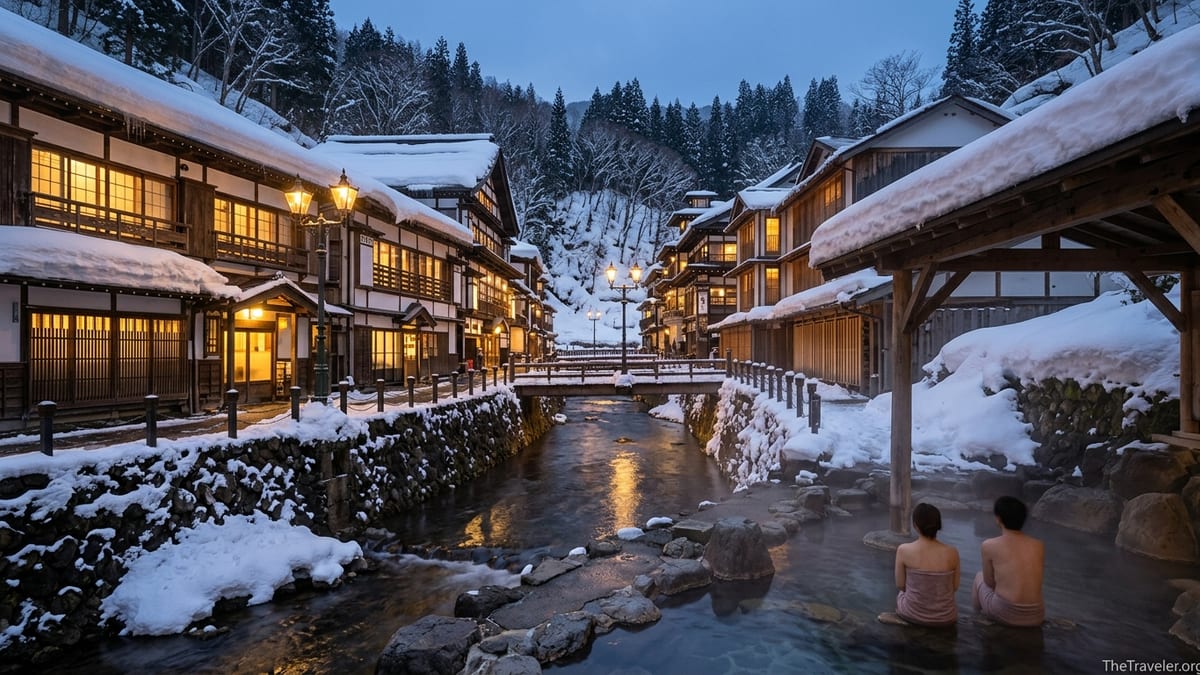
Ginzan Onsen in Yamagata Prefecture is what many travelers picture when they imagine a traditional hot-spring town. A narrow river is lined with three and four story wooden ryokan, some with exposed beams and white plaster walls, lit at night by gas-style lamps. In winter, these facades and footpaths are piled with snow, and the whole scene feels like stepping into a period drama set. Rooms in classic ryokan such as Notoya Ryokan or Fujiya tend to be tatami suites, usually including dinner and breakfast, with prices that often start from the equivalent of the mid to upper hundreds of US dollars per person in peak season.
Practically, Ginzan is more remote than it appears from postcards. From Tokyo, travelers take the Yamagata Shinkansen to Oishida Station, which takes around three hours, then transfer to a local bus for roughly 35 minutes into the valley. In heavy snow, luggage wheels can be awkward on the sloping main street, so it helps to pack light or choose a ryokan that offers a shuttle from the bus stop. Without a car, arrival and departure are still straightforward if you time your plans to the bus timetable, but same-day trips from Tokyo feel rushed. An overnight stay lets you enjoy the lamps and snow at night, then stroll in yukata robes in the early morning when the town is almost silent.
Ginzan’s baths are mostly inside ryokan, with a small public bath and a popular foot bath along the stream. Some inns provide simple open-air rotenburo facing the river. The overall atmosphere rewards travelers interested in slow streets and historic design rather than a large variety of bath types. Tattoo policies vary widely. A few of the more design-forward ryokan have private baths or even in-room rotenburo where tattoos are not an issue because only your party uses the tub. Public areas, however, often stick to traditional “no visible tattoos” rules, so travelers with large, conspicuous tattoos should contact their chosen ryokan in advance and expect to rely on private options.
Ginzan best suits travelers who prioritize atmosphere, photography and quiet over large resort facilities. For most people it works primarily as an overnight stay rather than a day trip. Arrive by midafternoon to check in, bathe before dinner, then explore the streets after dark when the snow reflects the lamplight. In other seasons, hiking trails to the old silver mine and nearby waterfalls fill the daytime hours. First-time onsen visitors will find that staff are used to guiding foreigners through the process, but facilities themselves can be quite traditional, with older changing rooms and modest showers compared with big modern resort spas.
Nyuto Onsen: Remote Mountain Ryokan and Rustic Rotenburo
Nyuto Onsen in Akita Prefecture is a scattered collection of small ryokan in the beech forests of Towada Hachimantai National Park. The most famous, Tsurunoyu, is known for milky white pools enclosed by snowbanks in winter, surrounded by rustic wooden buildings and thatched roofs. Other inns such as Kuroyu, Taenoyu and Ogama provide their own mix of indoor and outdoor baths, often with different spring qualities and water temperatures. This is one of the best places in Tohoku to experience truly secluded mountain bathing, especially when snow muffles the valley and steam mingles with falling flakes.
Reaching Nyuto Onsen without a car involves some logistics but is manageable with planning. Travelers typically ride the Akita Shinkansen to Tazawako Station, then transfer to a local bus toward Nyuto Onsen-kyo. Some ryokan pick up guests from dedicated stops, such as the Tsurunoyu Onsen Kyudoguchi bus stop listed on tourism maps, while others can be reached by short walks on forest roads. In winter, buses operate on reduced schedules and roads can be slick, so allowing generous connection time is important. Because of the travel time and infrequent buses, Nyuto is really an overnight or two-night destination; attempting it as a day trip from a major city leaves you rushing and reduces the magic considerably.
The bathing experience here is more rustic than in tidy resort towns. Many ryokan offer multiple baths with different spring sources, often including outdoor rotenburo that look out onto trees, streams or snowfields. Mixed-gender open-air baths still exist at some properties, sometimes with separate hours or side pools for women. Facilities tend to be simple: expect basic showers with stools and buckets, wooden floors that may stay wet and minimal English signage. Staff are generally patient with first-time visitors, but this is not the place to push boundaries on etiquette.
Tattoo policies differ by ryokan. Some traditional inns are strict and do not permit visible tattoos in communal baths, while others quietly accept foreign guests with small tattoos, especially if the bath is not crowded. Many Nyuto ryokan also have private kashikiri baths that can be reserved for 30 to 50 minutes, giving more flexibility. If tattoos are important to your group, choose and book specific properties well in advance and confirm in writing that private options are available. With its remoteness, rustic accommodations and sometimes older facilities, Nyuto is better suited to travelers already comfortable with Japanese bathing culture or very keen on wilderness onsen than to anxious first-timers.
Zao Onsen: Ski Slopes, Sulfur Steam and Active Travelers
Zao Onsen sits high on the slopes of Mount Zao, straddling the Yamagata and Miyagi border. Unlike compact Ginzan, Zao is a full-scale ski and onsen resort town. Narrow streets thread between hotels, rental shops and sulfurous vents, with constant white steam floating from small drains and bathhouses. The hot spring water here is strongly acidic, with a low pH that gives it a distinctive sulphur smell and a prickly sensation on the skin, often advertised as good for certain skin conditions. Bath water can tint metal fixtures and requires rinsing off swimsuits or towels quickly if they are accidentally dipped.
Access is straightforward for travelers already in Yamagata or Sendai. From Yamagata Station, buses run up to Zao Onsen in under an hour. From Tokyo, the Yamagata Shinkansen connects in around two and a half hours to Yamagata, followed by the bus. In winter, snow chains and hairpin roads can cause delays, but buses are built for the conditions. Many hotels cluster within walking distance of the Zao Ropeway and ski lifts, so visitors without cars can manage comfortably with snow-friendly footwear. This setup makes Zao ideal for combining skiing or snowboarding with nightly hot spring sessions.
The town offers a mix of large hotel complexes with multiple baths and intimate ryokan with one or two indoor pools and maybe a compact outdoor tub. Public day-use facilities allow those staying in guesthouses or self-catering lodgings to still enjoy the springs. Snow tends to be deep in midwinter, and soaking in an outdoor bath while watching the famous Zao “snow monsters” on the slopes above is a highlight if you time your visit right. Outside winter, hiking and the Okama crater lake draw active travelers, and bathing provides a soothing end to long days outdoors.
Tattoo policies vary between properties, but larger ski hotels are sometimes more accustomed to international guests and may be slightly more flexible, especially if tattoos are modest and guests behave discreetly. Private baths are less common than in some smaller hot spring villages, though many midrange hotels offer at least one or two rentable family baths, often bookable on arrival. For first-time onsen users, Zao’s modern hotels, clear signage and mix of Japanese and Western-style rooms can make the culture shift feel easier, provided you are comfortable with the stronger smell of the water and occasional crowds during peak ski weeks in January and February.
Naruko Onsen: Hot-Spring Variety and Classic Town Feel
Naruko Onsen in Miyagi Prefecture is less internationally famous than Ginzan or Zao but beloved by domestic travelers for its water. The wider Naruko Onsen-kyo area is recognized for offering many of Japan’s different hot-spring types in one place, with local promotional materials highlighting that most of the country’s primary spring categories can be sampled within a compact valley. This diversity means you can alternate, for example, between cloudy sulfur baths and clearer sodium-rich springs over the course of a single overnight stay.
Getting to Naruko without a car is straightforward. From Tokyo, travelers ride the Tohoku Shinkansen to Sendai or Furukawa, often in around two hours from the capital, then change to the Rikuu East Line for a local train of roughly 45 minutes into Naruko Onsen. JR Pass holders usually appreciate that these trains are included. Buses also run within the valley, and the town around Naruko Onsen Station is walkable, with small shops selling wooden kokeshi dolls and snack stalls along the approach to various baths. For many travelers, Naruko works well as an overnight stop between Sendai and northern Tohoku, or as a one-night getaway from the city.
The townscape feels comfortably old-fashioned rather than picturesque in a museum-like way. Steam rises from vents along the streets, and narrow alleys hide small public baths and ryokan. Large hotels have cavernous indoor pools and sometimes rooftop rotenburo, while older inns may feature creaking corridors and views over the valley. Because local tourism emphasizes the springs themselves, bath facilities are numerous, and day visitors can buy tickets to several different baths in a single afternoon. This makes Naruko appealing to enthusiasts who want to experience and compare different water qualities.
Tattoo attitudes in Naruko are typical of rural Tohoku. Some public baths post “no tattoos” signs, others take a more relaxed approach, especially outside of weekends and holidays. Many ryokan solve the issue by offering private family baths on a reservation basis or in-room tubs that still draw real hot spring water. Naruko’s balance of variety, easy access and midrange pricing makes it an excellent choice for travelers who already like bathing and want to go deeper than a single resort, without committing to the remoteness of Nyuto. For nervous first timers, the mix of simple public facilities and modern hotels allows you to start in an easy environment and, if you enjoy it, graduate to more traditional baths within the same trip.
Akiu Onsen and Other Accessible Hot Springs Near Sendai
Akiu Onsen lies in the hills southwest of Sendai and has been known since ancient times as one of the region’s classic hot springs. Its major advantage today is proximity. From central Sendai, buses reach Akiu in roughly 30 to 40 minutes, depending on traffic and route, which makes it one of the simplest onsen destinations in all of Tohoku for car-free travelers. This ease of access means you can slot an Akiu soak into a busy sightseeing day that also includes Sendai’s city sights, or treat it as a one-night escape from the Shinkansen corridor before continuing north or south.
The town stretches along a mountain river and mixes older ryokan with modern resort hotels. Some properties sit directly on the riverbank, with outdoor baths overlooking small rapids and wooded slopes that glow red and gold in autumn. Day-use bathing is well developed. Facilities such as nature park complexes in Akiu combine landscaped gardens, walking paths and multiple baths, allowing day trippers to arrive in the morning, soak, stroll through mossy stone lanterns and maple trees, then head back to Sendai by late afternoon. Prices for day-use entry often fall somewhere in the range that feels reasonable for a half-day outing rather than a major splurge.
Tattoo experiences in Akiu vary. Some large hotels maintain strict policies in public baths, which can surprise travelers expecting city-level flexibility this close to Sendai. On the other hand, a number of ryokan now advertise tattoo-friendly private baths or explicitly allow tattoos in certain time slots. Travelers with ink may find it easiest to book a property that clearly states its policy and includes a private open-air bath attached to the room or rentable on site. Because Akiu draws many domestic couples and families on short breaks, staff are generally accustomed to gently coaching new guests through bathing etiquette, which is helpful if this is your first onsen stop in Japan.
Other accessible hot-spring areas near Sendai include Sakunami Onsen to the northwest, also reachable by train and bus, and smaller day-use facilities dotted through the hills. Compared with Nyuto or Ginzan, these spots feel less cinematic but more practical. If your Tohoku itinerary includes festivals in Sendai or onward travel on the Tohoku Shinkansen and you cannot spare multiple nights for mountainside ryokan, Akiu or Sakunami can give you a genuine onsen experience with minimal detour.
Etiquette, Mixed Comfort Levels and How to Bathe Like a Local
Regardless of which onsen town you choose, the basics of bathing etiquette remain the same. Most facilities separate men and women into different areas, each with its own changing room and baths. You undress completely in the changing room, leaving clothes and large towels in baskets or lockers, and bring only a small wash towel into the bathing area. Children of a certain age may bathe with a parent of the opposite sex at the discretion of the facility, but adults do not mix except in designated mixed baths.
Inside the bathing area, you must wash thoroughly before soaking. Typical setups include low stools, hand-held showers and pumps for body soap and shampoo. Sit to wash, using your small towel to scrub, and rinse all soap away so none enters the shared pools. Only once clean do you step slowly into the hot water, using your towel on your head or set beside the bath but never dipping it into the tub. Talking quietly is acceptable, but splashing, swimming or using phones is not. After soaking, many locals rinse quickly with cooler water or lightly shower to avoid feeling sticky, especially if the water is very mineral-rich.
For travelers feeling shy, starting with a private or family bath can help. Many ryokan in all the towns covered here offer small, lockable baths that can be reserved for a fee or by signing up on a list. You still follow the same etiquette inside, but being alone removes the pressure of other bathers watching. After one or two private sessions, many guests feel comfortable enough to try the larger public baths, discovering that most locals are politely uninterested in other people’s bodies. In rural Tohoku, modesty and discretion are normal, but so is minding one’s own business.
If you have tattoos, the safest strategy is always to check policies in advance, ideally by emailing the ryokan in simple English or through a booking service that lists tattoo information. Some travelers also carry waterproof bandages or tattoo covers for small designs; while not a guaranteed solution, they can sometimes make a conversation easier. Remember that onsen staff rarely make these rules personally. A polite attitude and willingness to follow suggestions often go a long way, especially in family-run ryokan where the owner might bend a rule for respectful foreign guests at quieter times.
Day Trips Versus Overnight Stays: What Each Onsen Does Best
Not all Tohoku hot springs demand the same time commitment. Your broader route largely determines whether a destination makes more sense as a day trip or an overnight. Akiu Onsen is the clearest day-trip candidate, given its sub-one-hour bus ride from Sendai and plentiful day-use baths. You can leave Sendai Station after breakfast, be in a riverside rotenburo by late morning, enjoy a long lunch at your ryokan or a local restaurant, and still be back in the city before dinner. Sakunami, another nearby hot-spring cluster, plays a similar role.
Naruko Onsen can work as an ambitious day trip from Sendai or as a relaxed overnight. Travel times from Sendai by train are short enough that you can arrive before lunch, explore one or two public baths and a kokeshi workshop, then head back on an evening train. Yet the variety of water and the calm streets after the last trains make it worth staying a night if your schedule allows. This also lets you enjoy kaiseki-style dinners and quiet morning strolls along the valley before most day trippers show up.
Ginzan, Nyuto and Zao generally reward at least one overnight stay, both because of travel time and because much of their charm emerges in the hours when day visitors have gone. Ginzan’s lamps and Nyuto’s snowy silence are after-dark experiences. Zao’s appeal often revolves around early ski starts and late-evening soaks. If you are visiting in winter and concerned about weather delays, staying two nights in Nyuto or Zao gives you a buffer if buses or lifts shut down temporarily.
When planning, think of onsen nights as anchors in your Tohoku itinerary. A common pattern is to spend one night in Akiu or Naruko early on to ease into bathing culture, then later dedicate one or two nights to a more remote, atmospheric location such as Ginzan or Nyuto. This approach gives you both convenience and depth without forcing too many long travel days in a row.
The Takeaway
For many travelers, the memory that defines a Tohoku journey is not a single temple or view but the feeling of stepping from a snowy street into the steam of a wooden bathhouse. Choosing the right onsen town shapes that memory. Ginzan Onsen offers the cinematographic streets and riverside lamps that fill guidebooks, best enjoyed with at least one night. Nyuto Onsen trades polish for seclusion, rewarding those willing to navigate buses and forest paths to reach thatched-roof ryokan in the woods. Zao Onsen speaks to skiers and hikers who want sulfur steam and slopes in one compact package.
Naruko Onsen quietly excels on water quality and variety, a strong choice for travelers who love the springs themselves as much as the scenery. Akiu Onsen and its neighbors answer the practical need for an easy, genuine bathing experience close to a major transport hub, ideal for first timers or those with tight schedules. Across all of them, travelers with tattoos can usually find solutions through private baths and careful property selection, while newcomers to onsen culture quickly discover that etiquette is straightforward and that locals are far more focused on relaxing than on judging others.
Whichever onsen you choose, building at least one night in a Tohoku hot-spring town into your trip offers a window into a slower, more seasonal rhythm of Japanese life. Whether you are watching snow fall past lanterns in Ginzan, listening to wind in the beech forests of Nyuto or soaking tired legs after a day on Zao’s slopes, the hot water becomes a frame for everything else you see in the region.
FAQ
Q1. Which Tohoku onsen is best for a first-time visitor to Japan?
Akiu Onsen and Naruko Onsen are especially good for first timers. Both are easy to reach from Sendai by public transport, offer modern hotels alongside traditional ryokan, and have staff who are accustomed to explaining onsen etiquette in simple terms. You can ease into bathing culture there before tackling more remote or rustic destinations like Nyuto.
Q2. If I only have one night, should I choose Ginzan Onsen or Nyuto Onsen?
Choose Ginzan if you prize townscape, historic wooden ryokan and evening strolls under gas-style lamps. It is more photogenic and compact, with a clear main street to explore. Nyuto is better if your priority is secluded outdoor baths in nature and you do not mind fewer shops or sights outside your ryokan. Both require planning, but Ginzan tends to feel more approachable on a tight schedule.
Q3. Can I visit any of these onsen areas as a day trip from Tokyo?
A technically possible but long day trip from Tokyo could include Akiu or Naruko by taking an early Tohoku Shinkansen to Sendai and returning late at night. However, travel times mean the experience can feel rushed. Ginzan, Nyuto and Zao are better treated as overnight destinations, as they involve transfers to local buses and shine most in the early morning and evening hours.
Q4. What should I do if I have tattoos and want to enjoy onsen in Tohoku?
Research and choose specific ryokan that offer private kashikiri baths or in-room open-air tubs, and confirm tattoo policies before booking. In places like Akiu, Naruko and parts of Zao, some properties quietly accept small tattoos, especially in less crowded hours. In more traditional or rural inns, such as some in Nyuto or Ginzan, you may need to rely entirely on private baths and avoid public pools if rules are strict.
Q5. Is onsen water in Zao really harsher than in other towns?
Yes, Zao Onsen’s springs are notably more acidic than many others, which gives the water a strong sulfur smell and a prickly feel on the skin. Most people tolerate it well and find it invigorating, but those with very sensitive skin or recent sunburns should limit their soak time and rinse gently afterward. In contrast, milky baths in places like Nyuto can feel softer and more moisturizing.
Q6. Do I need to stay in a ryokan, or can I just use day-use baths?
All of these areas offer some form of day-use bathing. Akiu and Naruko are particularly well set up for day trippers, with multiple facilities selling entry tickets. Ginzan, Nyuto and Zao also have public or hotel baths that accept non staying guests, but hours and availability are more limited. Staying overnight in a ryokan brings the added experience of kaiseki dinners, breakfast in yukata and late-night soaking without watching the clock.
Q7. How expensive are ryokan stays in these onsen towns?
Prices vary widely by season, room size and meal plan. In popular spots like Ginzan and Nyuto, classic ryokan with dinner and breakfast often start in the midrange for Japanese standards and rise significantly for premium rooms with private baths, especially on weekends and during winter or autumn foliage. Naruko and Akiu generally offer more budget friendly options, including business hotels with access to nearby baths. Booking outside peak holidays and choosing weekday nights can reduce costs.
Q8. Is it safe to travel to these onsen towns in winter without a car?
Yes, but you need to plan carefully. Trains and buses in Tohoku are designed to run in snow, and major routes to towns like Ginzan, Zao, Naruko and Akiu are maintained. However, services can be less frequent, and walking streets or paths with luggage can be slippery. Good footwear with traction, flexible timing and a willingness to slow down are essential. If heavy snow is forecast, consider building an extra night into your schedule.
Q9. Will language be a barrier at rural onsen?
English levels vary. Larger hotels in Zao, Akiu and Naruko usually have at least some staff who can communicate basic information in English, and many display bilingual signs in baths. Smaller ryokan in Ginzan and Nyuto may rely more on gestures, simple English phrases and printed instructions. Learning a few key words, using translation apps and maintaining patience and politeness usually smooths over most communication gaps.
Q10. What should I pack specifically for an onsen-focused trip to Tohoku?
Pack a small overnight bag for onsen nights, leaving larger suitcases in lockers or at city hotels when possible. Essentials include quick drying clothing, warm layers for walking between baths in winter, sandals or boots with good grip, and any personal skincare you prefer, as rural baths sometimes provide only basic amenities. Most ryokan supply yukata robes, towels and slippers, so you rarely need to bring your own unless you want a familiar towel or swimsuit for non hot-spring hotel pools.