


Every August, a narrow band of dates in northern Japan turns into one of the world’s densest clusters of major festivals. Lantern towers sway over Akita, gigantic illuminated floats charge through Aomori, tens of thousands of dancers fill the streets of Morioka, Yamagata and Sendai. The schedule is thrilling but unforgiving: most events overlap, hotel rooms vanish months ahead and trains fill with festival-goers. With careful planning, though, you can link several of Tohoku’s signature summer matsuri into one unforgettable trip instead of spending your entire holiday shuttling between stations.
The Early August Tohoku Festival Calendar at a Glance
The core challenge of planning a Tohoku festival trip is timing. In a typical year, Aomori Nebuta runs August 2 to 7, Morioka Sansa Odori August 1 to 4, Akita Kanto August 3 to 6, Yamagata Hanagasa August 5 to 7 and Sendai Tanabata August 6 to 8. This means there is a six to eight day window when several of Japan’s biggest regional festivals are all in full swing across neighboring prefectures.
These dates are fairly stable from year to year, but you should always confirm the exact calendar on the respective city or festival websites for the year of your trip. Local tourism offices and the Japan National Tourism Organization typically publish an August events calendar that lists all five together with the current year’s dates and venues. Treat that official calendar as your master reference when you start booking trains and hotels.
Because so many festivals overlap, you will not be able to see every night of every event. The key is to prioritize one or two “anchor” festivals and then add one or two more that you can reach in under three hours by train without wrecking your sleep. For most travelers, that means choosing either Aomori Nebuta or Akita Kanto as the main focus, then adding Morioka Sansa on the way up from Tokyo and finishing with Sendai Tanabata or Yamagata Hanagasa on the way back.
In practice, this turns your itinerary into a search problem: you are balancing fixed dates, limited hotel inventory and finite rail capacity. The good news is that Tohoku’s Shinkansen and limited express network was essentially built for this kind of regional hopscotch. With a Japan Rail Pass or individual Shinkansen tickets booked ahead, you can realistically combine three major festivals in six or seven nights without spending every daylight hour on the move.
What It Feels Like: Inside Each Festival
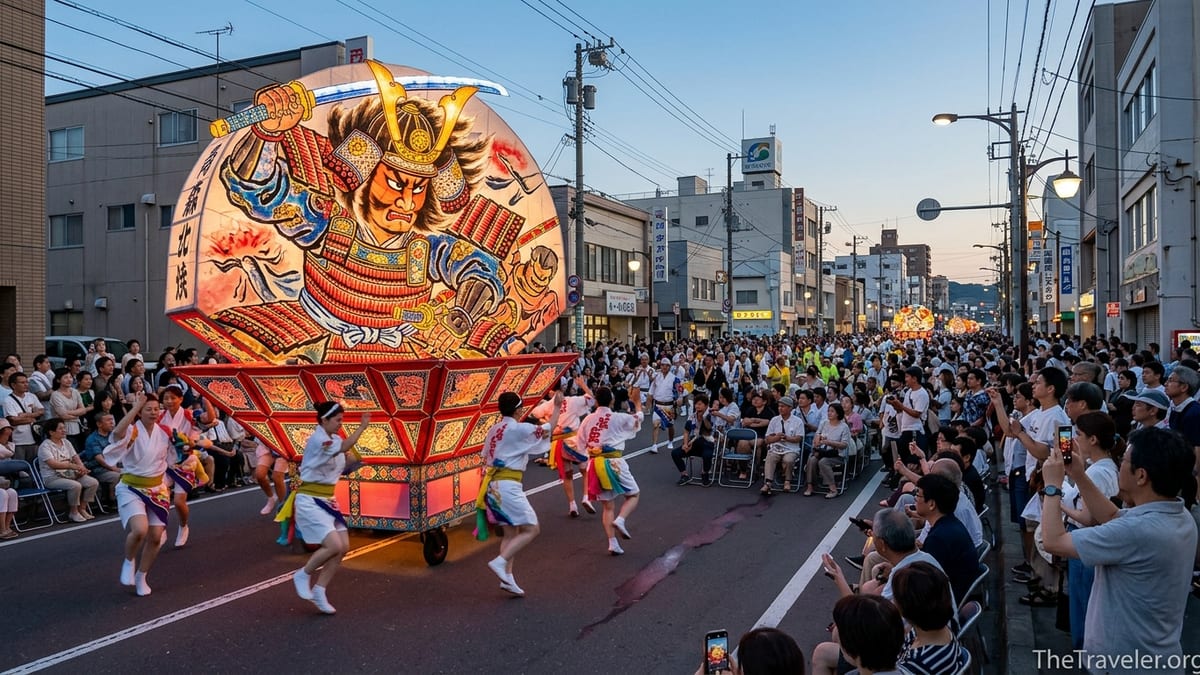
Aomori Nebuta is the most visually overwhelming of the five. After dusk, enormous illuminated paper floats depicting warriors and mythical scenes are pulled through central Aomori by teams of locals, accompanied by taiko drums, flutes and rows of dancers called haneto. As a spectator you stand or sit curbside along wide streets such as Shinmachi and Hakkoda-dori, with floats often passing just a few meters away. On the final night, many of the floats move to Aomori Port for a marine procession and fireworks, so the atmosphere shifts from street carnival to waterfront spectacle.
Akita Kanto is all about tension and balance. Performers walk or kneel under towering bamboo poles hung with dozens of paper lanterns, gradually shifting them from palm to shoulder, hip, forehead or lower back while the crowd chants encouragement. The main performances take place along Kanto O-dori, a broad boulevard in central Akita. As a visitor you typically sit on low bleachers or on the curb watching each team enter, perform intricate balancing routines, then exit while another team steps forward. When a strong gust of wind hits, you can feel the entire audience collectively hold its breath.
Morioka Sansa Odori feels like a continuous river of drummers and dancers. In the evenings, a parade of groups advances along Chuodori in central Morioka, each with rows of taiko drums, flute players and dancers in brightly patterned costumes. The pace is steady rather than frantic, so you have time to appreciate the different choreography and costumes as group after group passes. Later in the evening a portion of the route turns into an open circle dance where spectators are encouraged to join locals in a simple repeated step.
Yamagata Hanagasa and Sendai Tanabata are more about color and atmosphere than raw intensity. In Yamagata, groups of dancers carrying flowered hats move down the main streets to the rhythmic hanagasa ondo music, while food stalls and local sake stands keep spectators lingering long after the parade ends. In Sendai, the headline attraction is the city-wide decoration: huge streamers of paper and bamboo hang from shopping arcades and side streets, so your experience is more of a daytime wander under handmade decorations than an evening parade. That makes it an ideal soft landing after several nights of high-energy events.
Dates, Venues and What Spectators Actually See
Aomori Nebuta generally runs August 2 to 7 each year. Evening parades from August 2 to 6 travel a loop of central streets a short walk from JR Aomori Station. Floats typically start moving around 7 pm, and the parade lasts about two hours. On the afternoon of August 7 there is a daytime parade of prize-winning floats, followed by an evening marine procession at the port and a large fireworks display. As a spectator with a reserved seat you are stationary along one section of the route; with standing or curb spots you may be able to move to catch the floats twice at different intersections.
Morioka Sansa Odori officially runs August 1 to 4, with parades in the early evening on Chuodori. The route is about 1.2 kilometers long, starting near the prefectural hall and ending near Eigakan-dori. The parade typically begins around 6 pm. Many visitors arrive in late afternoon, eat at nearby ramen or wanko soba shops, then settle into their seats or standing area. At several points along the route, there are small stages or open squares where local groups give additional performances, so you can wander between them if you do not have a reserved seat.
Akita Kanto takes place roughly August 3 to 6, centered on Kanto O-dori in downtown Akita. From around 7 pm, performers bring out the kanto poles, line up in front of the audience, then take turns balancing them to the accompaniment of flutes and drums. Between formal performances, many teams walk close to the crowds so visitors can photograph the lanterns or, occasionally, try holding a smaller kanto under supervision. Daytime events at venues like Senshu Park or the civic plaza offer closer, less crowded views of practice sessions and smaller poles.
Yamagata Hanagasa is usually held August 5 to 7 along the main streets of Yamagata City, while Sendai Tanabata officially runs August 6 to 8 with decorations concentrated in central shopping arcades. The Hanagasa parade tends to start around early evening, with waves of dancers passing by fixed viewing zones. In Sendai, since the highlight is the decorations, most visitors roam from arcade to arcade, stopping for shaved ice or beef tongue at restaurants beneath the streamers. Some years Sendai also holds an opening fireworks display on the night of August 5 at the nearby river, which can be a pleasant low-key evening if you arrive a bit early.
Reserved Seats, Viewing Spots and Typical Costs
For Aomori Nebuta, paid viewing seats are strongly recommended at least one night. The city and festival committee sell box and bench-style seats along the parade route, often through Japanese ticket agencies or local tourist centers. Prices change annually but simple benches may be in the range of 3,000 to 5,000 yen per person for a single evening, while more spacious boxed areas marketed to small groups can run higher. These seats give you an unobstructed view and reduce the need to arrive hours in advance, which is particularly valuable during peak nights around August 4 to 6.
Morioka Sansa Odori also offers ticketed bleacher seats along Chuodori. These tend to be a bit less expensive than Nebuta, often closer to what you might pay for a mid-range concert ticket rather than a premium event, and they rarely sell out at the same frantic speed as Aomori’s. The tradeoff is that spectator crowds are usually more manageable, so determined budget travelers can still watch comfortably from standing areas near the start or end of the route if they arrive early.
Akita Kanto’s reserved seats are highly worthwhile because much of the action involves vertical movement of the lantern poles, and being close to the front helps you appreciate the subtle shifts as performers move the bamboo from hand to forehead or hip. Ticket prices are often comparable to Nebuta’s basic seats. If you cannot secure official tickets, locals sometimes line up hours ahead on the free sections of Kanto O-dori with small folding stools. In that case, plan to arrive well before sunset, bring water and be prepared for hot pavement and little shade.
Yamagata Hanagasa and Sendai Tanabata are the most forgiving for non-reserved viewing. Hanagasa does offer official viewing zones with simple paid seating, but many visitors simply stand along the sidewalk and move between sections as different groups pass. In Sendai, there are no parade seats as such; instead, you experience the festival by walking beneath decorations and occasionally queueing to enter especially elaborate displays inside department stores or public buildings. Your main spend there is on food, drinks and perhaps a special Tanabata-themed craft or souvenir rather than on tickets.
Accommodation Reality: How Early to Book and Where to Base
The single biggest constraint in early August is accommodation. For Aomori Nebuta in particular, central hotels commonly sell out almost as soon as they release rooms. Some local chains open bookings exactly six or twelve months before the stay date, and festival dates can disappear within minutes. Travelers who have successfully booked Nebuta stays often report setting alarms to reserve rooms the moment inventory appears or using Japanese travel agencies that block-book rooms a year in advance for package tours.
If you cannot find a bed in Aomori City, consider staying in nearby Hirosaki, Hachinohe or even Shin-Aomori and using local trains to reach the festival. The ride from Hirosaki to Aomori is roughly 45 to 60 minutes on regional trains, and there are often late-night returns timed for festival crowds, though you should confirm the current timetable for your travel year. Some visitors treat Nebuta as a day trip from larger hubs like Hachinohe or even from Hakodate in Hokkaido using the Shinkansen, but that often means arriving home past midnight and requires careful planning of last trains.
Akita, Morioka, Yamagata and Sendai all see heavy demand but are slightly less cutthroat than Aomori. In these cities, booking three to six months in advance is usually enough to secure mid-range business hotels if you are flexible on exact location. For example, you might find a room near Morioka Station rather than directly on Chuodori, or stay one or two stops outside central Akita on the JR Ou Main Line and ride in for the evening. As always, the night before and the peak central nights of each festival see the tightest availability and highest prices.
A practical rule of thumb is to lock in your rooms as soon as your international flights are confirmed, then refine your itinerary around those anchor reservations. If you plan to attend Nebuta plus at least one other major festival in the same trip, think of your accommodation hunt as the first step, not the last. Once rooms and Shinkansen seats are booked, you can relax knowing that even if parades are crowded, you have a guaranteed bed and a seat on the train at the end of the day.
Getting Around: Rail Links Between Festival Cities
Tohoku’s rail network makes multi-festival itineraries feasible, but travel time still adds up if you zigzag unnecessarily. From Tokyo, the Tohoku Shinkansen connects to Morioka and Sendai in around 2 to 2.5 hours on the fastest services. From Morioka, additional Shinkansen or limited express lines branch toward Aomori and Akita, while conventional lines connect to Yamagata. If you arrange your route in a gentle arc rather than constant backtracking, you can typically move between festival cities in 1 to 3 hours per leg.
For example, Morioka to Aomori by Shinkansen and local connection can be as quick as 1.5 hours, making it easy to attend Sansa Odori one night and Nebuta the next. Akita to Yamagata via the Ou Main Line is slower, roughly 3 to 4 hours on limited express services, but that still leaves time to check into a hotel and reach an evening parade if you travel in the morning. Sendai to Yamagata is particularly convenient, with frequent trains covering the distance in about an hour, which is why many visitors base themselves in Sendai and day-trip to Yamagata Hanagasa.
During festival days, trains can be crowded in the late afternoon outbound and late evening inbound directions. Reserving Shinkansen seats several weeks in advance is advisable, especially if you are traveling in a group or carrying luggage. For conventional lines, simply arrive early and line up at the platform; staff often add extra cars or run short special services during festival periods, but you should not rely on these without checking local information once in Japan.
For short hops within cities, local buses and trams do operate, but walking is often the most efficient option. In Aomori, for example, most Nebuta viewing areas are within a 15 to 25 minute walk of the station. In Sendai, the main Tanabata decorations are concentrated in central arcades like Ichibancho and Clis Road, a short walk from Sendai Station. Taxis can be difficult to secure immediately after fireworks or parade finales, so plan on walking back with the crowds or waiting out the rush with a late meal near the venue.
Realistic Multi-Festival Itineraries That Do Not Live on Trains
One sensible seven-night plan for first-time visitors starts in Tokyo, uses Morioka and Aomori as early anchors and then arcs down to Sendai. You might travel from Tokyo to Morioka on July 31 or August 1, enjoy Morioka Sansa Odori on August 1 or 2, then move on to Aomori on August 3 for two nights of Nebuta. After the night of August 4 or 5 in Aomori, you could ride the Shinkansen down to Sendai on August 6 and spend August 6 to 8 immersed in Sendai Tanabata, possibly adding a half-day trip to Matsushima Bay.
Another approach focuses on Akita Kanto and Yamagata Hanagasa with a Sendai base. For example, arrive in Sendai on August 3, drop your luggage and take an afternoon Shinkansen to Akita to experience the Kanto performances that evening, then stay overnight in Akita. Spend the next morning exploring Senshu Park and Akita Museum of Art, return to Sendai in the afternoon of August 4 or 5, then day-trip to Yamagata one evening between August 5 and 7 to see the Hanagasa parade. You finish the trip with relaxed daytime walks under Sendai Tanabata decorations from August 6 to 8.
Ambitious travelers sometimes attempt a chain of Morioka Sansa, Aomori Nebuta, Akita Kanto and Yamagata Hanagasa in a single run, but the overlap means you end up seeing only one or two nights in each city and moving almost every day. If you try this, design at least one “rest” afternoon, perhaps in Morioka’s cafes or in an onsen town near Yamagata, where you do not have a long rail transfer. Otherwise, fatigue and heat can blunt your enjoyment of the later festivals.
For most people, three festivals in one trip is the sweet spot: one high-intensity anchor like Nebuta or Kanto, one secondary parade-style event such as Sansa or Hanagasa, and one atmospheric finisher like Sendai Tanabata. This balance gives you variety without constant packing and unpacking. If you have only four or five days total in Japan, consider focusing on just one city, such as Aomori or Sendai, and experiencing its main festival in depth while exploring nearby side trips during the day.
The Takeaway
The early August cluster of Tohoku summer festivals is as logistically demanding as it is spectacular. You are not simply choosing which events sound appealing; you are coordinating fixed parade dates, finite hotel rooms and peak-season trains across several prefectures. Yet with thoughtful planning, the payoff is immense: in the space of a week you can feel the thud of hundreds of taiko drums in Morioka, watch lantern towers sway against the Akita night sky, stand within arm’s length of glowing Nebuta floats in Aomori and wander under miles of Tanabata streamers in Sendai.
The most important decisions happen months before you set foot in Japan. Secure accommodation in your anchor cities early, especially for Aomori Nebuta. Sketch a route that flows in one direction, typically Tokyo to Morioka and Aomori, then back via Akita, Yamagata and Sendai, rather than zigzagging. Use reserved Shinkansen seats and paid festival seating strategically to reduce stress during the busiest nights. Then, once on the ground, allow yourself to follow the sound of drums and the glow of lanterns down side streets that are not on any timetable.
If you treat itinerary planning as part of the adventure instead of a chore, the Tohoku summer festival circuit rewards you with some of Japan’s most powerful communal experiences. The sight of a performer in Akita steadily raising a swaying kanto pole from palm to forehead, or of a Nebuta float bursting out from an intersection into a sea of drums and shouts, will linger long after you have folded away your JR tickets. For many travelers, that combination of careful planning and spontaneous street magic is exactly what makes this region worth the effort.
FAQ
Q1. Can I realistically see all five major Tohoku festivals in one trip?
It is technically possible if you move almost every day, but most travelers find that exhausting in August heat. A more enjoyable approach is to choose three festivals, such as Morioka Sansa, Aomori Nebuta and Sendai Tanabata, and give yourself at least two nights in your anchor city so you can experience both the parades and the daytime atmosphere without constant packing.
Q2. How far in advance should I book hotels for Aomori Nebuta?
For Aomori Nebuta, treat six to twelve months ahead as normal rather than extreme. Many city-center hotels release rooms either six or twelve months before the stay date, and festival nights can sell out within minutes of opening. If you cannot secure central Aomori rooms at that stage, immediately check nearby cities like Hirosaki or Hachinohe and build your itinerary around those alternatives.
Q3. Is a Japan Rail Pass worth it for a Tohoku festival itinerary?
Whether a rail pass is good value depends on how much long-distance travel you pack into your dates. If you are riding Shinkansen multiple times, for example Tokyo to Morioka, then Aomori, then Sendai and back to Tokyo, a nationwide or Tohoku regional rail pass can save money compared to buying separate tickets. If your plan is to base in one or two cities with only short hops, individual tickets or discount advance fares may be cheaper and simpler.
Q4. Do I need reserved seats to enjoy the parades?
You can watch all of these festivals from free standing areas, but reserved seats make a significant difference on the most crowded nights. At Aomori Nebuta and Akita Kanto in particular, paid seats give you an unobstructed view and let you arrive closer to parade time instead of staking out pavement hours in advance. For Morioka Sansa and Yamagata Hanagasa, seats are helpful but not essential unless you have mobility issues or are traveling with small children.
Q5. How should I handle luggage when moving between festivals?
The safest strategy is to travel between cities in late morning or early afternoon, drop bags at your next hotel, then head to the festival in the evening. If your room is not ready yet, most hotels will store luggage for free from midday. Major stations in Tokyo, Sendai and other cities have coin lockers, but these can fill up quickly in August, so do not rely on last-minute storage at the station during peak hours.
Q6. What kind of weather should I expect in early August in Tohoku?
Expect hot, humid conditions, especially in the evenings when crowds gather. Daytime highs often reach the high 20s to low 30s Celsius, with plenty of moisture in the air. Light, breathable clothing, a hat, sunscreen and a compact towel are essential. Sudden showers are common, so a small foldable umbrella or lightweight rain jacket is useful during both parades and station transfers.
Q7. Are these festivals suitable for families with children?
Yes, but plan conservatively. The parades are loud, crowded and run late into the evening, which can be tiring for younger children. If you are traveling as a family, consider focusing on one or two cities and booking reserved seats so kids have a defined space to sit. Daytime events, such as practice sessions in Akita or decorations in Sendai, are often more relaxed and may be better suited to younger travelers.
Q8. Can I participate in any of the dances or performances as a visitor?
Several festivals offer limited participation opportunities. Morioka Sansa often has an open circle dance at the end of the evening where anyone can join, and some Nebuta groups accept visitors in haneto costumes if you register through local shops or associations in advance. Participation rules change from year to year, so check the current guidelines and arrive early if you hope to join in.
Q9. What should I budget per day during festival season?
Budgets vary widely, but many independent travelers find that a mid-range festival day in Tohoku, excluding long-distance train tickets, might involve a business hotel, several meals from local restaurants and festival stalls, drinks and perhaps a reserved seat ticket. That often works out to a moderate daily spend by Japanese standards. If you choose high-end ryokan stays or premium seating and frequent Shinkansen rides, your costs will rise accordingly.
Q10. Is it safe to walk back to my hotel after late-night parades?
Festival cities in Tohoku are generally safe, and thousands of people walk back to stations and hotels together after parades and fireworks. Normal urban common sense still applies: keep valuables secure, avoid extremely dark side streets and follow the main flow of people toward transport hubs. If your hotel is far from the center, confirm the last train or bus departure in advance so you are not stranded after festivities end.