


Planning a trip through Japan’s Tokai region can feel like trying to fit too many beautiful places onto one map. Nagoya, Takayama, Shirakawa-go, Mount Fuji, and Ise-Shima all compete for time, and the rail and bus network offers multiple ways to connect them. Instead of cramming every stop into a single loop, the most satisfying trips are built as smart routes, using Nagoya as a hub when it helps and changing bases when it clearly saves hours on the road. This guide walks through realistic route combinations and shows where to trim your plans when days are limited.
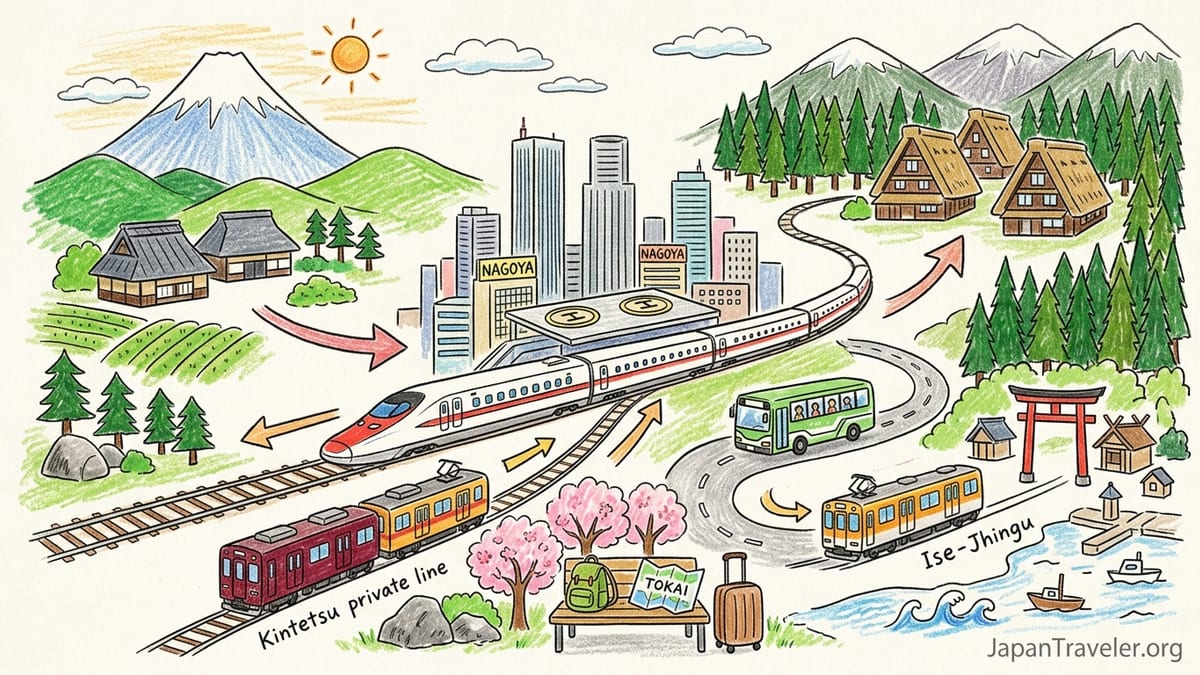
How to Think About Routes in the Tokai Region
Tokai stretches from the Pacific coast around Shizuoka and Nagoya inland toward the Japan Alps and north to Shirakawa-go. On the ground, that means bullet trains, private railways, and highway buses that do not always line up neatly. The key to a good itinerary is to follow the direction of those lines instead of fighting them. Travelers often get into trouble when they insist on seeing Shirakawa-go, Ise-Jingu, and Mount Fuji in four days while flying in and out of the same city.
In practice, Nagoya works best as a flexible hub rather than a place you must return to every night. For example, a visitor landing at Chubu Centrair International Airport might stay two or three nights in Nagoya to explore the city and make a day trip to Ise-Jingu. From there it makes sense to move on to Takayama, stay at least one night, and continue by bus to Shirakawa-go and then Kanazawa or Toyama rather than backtracking.
The other big structuring choice is whether you travel east–west between Tokyo and Kansai, or make a loop that begins and ends in the same city. A route like Tokyo to Shizuoka or Fuji to Nagoya to Takayama to Kanazawa and onward to Kyoto follows the natural flow of the Tokaido Shinkansen and highway bus lines. Trying to return to Tokyo directly from Shirakawa-go in one day will consume most of your daylight in vehicles even if it looks possible on a timetable.
Finally, set expectations about travel days. Moving from Nagoya to Ise-Shima and back is straightforward, but a round-trip plus full shrine visit, coastal side-trips and meals can feel rushed in one day. Similarly, combining Shirakawa-go and a long onward train leg to Kyoto or Tokyo is realistic, but you will be watching the clock rather than lingering in viewpoints or farmhouses.
Nagoya as a Base: When It Works and When It Does Not
Nagoya is an efficient transport hub, sitting on the Tokaido Shinkansen between Tokyo and Kyoto and linking inland by the Hida limited express to Takayama and by Kintetsu trains to Mie and Ise-Shima. The city also has dense business hotels and mid-range properties around Nagoya Station, where a walk of a few minutes can take you from a Shinkansen platform to a local subway. For simple out-and-back day trips, this convenience makes it a strong base.
For example, an Ise-Jingu day trip works well from Nagoya. The Kintetsu limited express from Kintetsu-Nagoya Station to Iseshi takes around 80 minutes, and a reserved-seat ticket typically costs just over 3,000 yen one way. That gives enough time to visit both the outer and inner shrines, stroll the Oharai-machi approach street, and have a late lunch before returning on an afternoon or early evening train. Travelers who want an upgraded experience sometimes ride the premium Shimakaze or Ise-Shima Liner trains, paying an extra supplement for wide seats and observation-style windows.
Nagoya also works as a base for short hops to places like Inuyama Castle or Gifu City, but it becomes less efficient for the mountains once you try to combine too much in a single day. A run from Nagoya to Takayama on the Wide View Hida limited express already takes around 2.5 hours in one direction. Adding a same-day bus to Shirakawa-go and back would leave you spending more time in transit than among the gassho-zukuri houses. In this case, shifting your base to Takayama or Kanazawa saves a full half-day of travel.
As a rule of thumb, use Nagoya as your base when your day trips are under about two hours one way by direct rail, and when you will return to the Shinkansen line that evening. Once you are heading into the Japan Alps or thinking about Shirakawa-go, plan to sleep closer to your destination so that early-morning light and evening quiet are part of the experience rather than times you are stuck on a bus.
Nagoya – Takayama – Shirakawa-go: Classic Mountain Route
One of the most logical itineraries through northern Tokai links Nagoya, Takayama, Shirakawa-go and then onward to Kanazawa or back south. Many travelers use the JR Takayama-Hokuriku Area Pass for this route, which covers the limited express Hida from Nagoya to Takayama and highway buses or trains onward toward Shirakawa-go and Kanazawa. Others simply buy tickets as they go; a one-way reserved seat from Nagoya to Takayama can be similar in price to a mid-range dinner for two in the city, which helps keep costs predictable.
A practical version of this route is to spend one night in Nagoya, two nights in Takayama and one night in Kanazawa. On day one, you would arrive in Nagoya, explore Nagoya Castle or the SCMaglev and Railway Park, and prepare for an early train. Day two, you take the Hida limited express in the morning, arriving in Takayama around midday and checking into a ryokan or small hotel near the old town. The afternoon is spent in Sanmachi Suji, sampling Hida beef skewers and visiting the morning markets if you arrived early enough.
On day three, you travel from Takayama to Shirakawa-go by Nohi Bus or Hokutetsu bus. Reserved seats sell out in busy seasons, so many travelers now prebook online or buy tickets immediately after arriving in Takayama. In recent years, buses have added unreserved capacity on popular departures, but lines at the Shirakawa-go bus stop can still be chaotic during peak weekends. To avoid stress, plan for at least a few hours in the village and then continue onward to Kanazawa rather than racing back to Nagoya the same day.
This pattern of moving your base in stages also makes weather more manageable. If heavy rain hits on the day you planned for Shirakawa-go, you can swap days around and spend more time indoors in Takayama’s museums or sake breweries. Staying overnight in either Takayama or Kanazawa means you can catch an early or late bus with fewer crowds, something impossible to do if you are trying to return to a Nagoya hotel by nightfall.
Nagoya – Ise-Shima: Coastal Shrines and Bays
The other obvious arc from Nagoya leads south into Mie Prefecture and the Ise-Shima area, home to Ise-Jingu, the Meoto Iwa “wedded rocks,” Toba’s aquarium and pearl heritage, and the island-dotted Ago Bay. Here the decision is whether to dash down and back as a day trip or to stay overnight near the coast. Kintetsu operates frequent limited express trains from Kintetsu-Nagoya to Ise and on to Toba and Kashikojima. A direct limited express to Toba typically takes around 1 hour 40 minutes and costs roughly 3,400 yen in total, while going all the way to Kashikojima is over 2 hours and just above 4,000 yen one way.
For a first-time visitor focused mainly on Ise-Jingu, a Nagoya-based day trip is reasonable. Leaving Nagoya around 8:00 in the morning, you reach Iseshi in time for a late-morning visit to the outer shrine, then ride a short local train or bus to the inner shrine, stroll Oharai-machi for lunch, and be back on a late-afternoon train north. This pattern is common among domestic travelers who are short on vacation days but still want to pay their respects at one of Japan’s most important shrines.
If your interests lean toward the coastline, consider changing base to Toba or Kashikojima. Staying overnight in a coastal ryokan with an onsen and dinner built around local seafood transforms Ise-Shima from a checklist stop into a short retreat. From Kashikojima, sightseeing cruises around Ago Bay and visits to mikimoto-related pearl sites are easy half-day outings. Passes such as the Kintetsu Rail Pass or region-specific tickets occasionally offer better value if you plan multiple train rides within a few days, especially when linking Osaka, Kyoto, Nagoya and Ise-Shima in one arc.
Linking the mountain and coastal routes is also possible. For example, you could travel from Nagoya to Ise-Shima for two nights, come back via Kintetsu-Nagoya, and then transfer to the Hida limited express for Takayama the following day. This works best when you allow a buffer between each leg, avoiding tight cross-platform transfers between Kintetsu and JR areas in Nagoya Station, which can be confusing on the first attempt.
Tokyo – Shizuoka / Mount Fuji – Nagoya: East–West Corridor
Many international visitors enter Japan through Tokyo and eye the Tokai region as a way to travel west toward Kyoto and Osaka without simply riding the bullet train point to point. The most natural corridor follows the Tokaido Shinkansen through Shizuoka Prefecture, where you can access Mount Fuji viewpoints and then continue to Nagoya. Using this pattern, a traveler might leave Tokyo early, stop near Shin-Fuji Station for views of the mountain or for buses into the Fuji foothills, then continue to Nagoya for the night.
From Tokyo Station to Shin-Fuji on the Shinkansen can take around an hour on a fast Nozomi or Hikari service, depending on the stopping pattern. Shin-Fuji Station itself is not a trailhead, but seasonal buses connect to stations on Mount Fuji’s slopes and to scenic spots like Shiraito Falls and Lake Tanuki. Travelers who prefer local culture often base themselves in Shizuoka City or Fujinomiya for a night, splitting the journey and visiting tea fields, viewpoints, and small-town shotengai shopping streets rather than rushing.
Continuing onward, the ride from Shizuoka or Hamamatsu to Nagoya on the Tokaido Shinkansen is short enough that some visitors treat Nagoya as an overnight stop between Tokyo and Kansai. For example, a family might spend the day in Fujinomiya, ride a local train to Shizuoka in the late afternoon, then take an evening Shinkansen to Nagoya and check into a business hotel directly above the station. The next morning, they either head north to Takayama or west to Kyoto. This approach avoids backtracking and turns Mount Fuji into a natural staging point instead of an awkward detour.
Those who want to see Fuji from other angles, such as Kawaguchiko or Gotemba, can still make their way toward Nagoya without doubling back to Tokyo. One common pattern is bus from the Fuji Five Lakes area to Mishima or Gotemba, then transfer to the Shinkansen for a direct ride to Nagoya. While the timetables require attention, this can be done within a travel day and opens up itineraries like Tokyo to Kawaguchiko to Nagoya to Takayama without retracing your steps.
Linking Gifu and Mie on Longer Journeys
When you have a week or more for the central part of your trip, linking the mountainous interior of Gifu with the coastal landscapes of Mie gives a strong sense of how varied the Tokai region can be. One workable pattern is Tokyo to Nagoya to Takayama to Shirakawa-go and Kanazawa, then train to Kyoto, followed by Kintetsu limited express down to Ise-Shima and finally back up to Nagoya or Osaka. In this example, Nagoya is a pivot but not a place you must sleep every time you pass through.
Another approach is to base yourself part of the time in Nagoya and part in Ise-Shima, using Gifu City or Takayama as intermediate steps. For instance, a 10-day journey might allocate two nights in Nagoya, two in Takayama, one in Kanazawa, two in Kyoto, and two in Toba or Kashikojima. Travelers interested in rail journeys sometimes add the Kintetsu “Hinotori” or “Urban Liner” trains between Osaka and Nagoya to the plan, making the trip itself part of the experience rather than just a connection.
Practical considerations matter on these longer arcs. Transferring between Kintetsu-Nagoya Station and JR Nagoya can take 10 to 15 minutes if you are not familiar with the station and are carrying luggage, so back-to-back limited express connections with only a few minutes’ margin are risky. In practice, many visitors schedule a simple lunch inside Nagoya Station’s underground malls between legs, sampling local specialties like miso katsu or kishimen while waiting for the next train.
It is also worth thinking about passes that cover both rail and bus. For the mountain segment, passes such as the Takayama-Hokuriku Area Pass often bundle the Hida limited express and buses to Shirakawa-go and Kanazawa, which can pay off if you are making several long journeys in a few days. On the Mie side, Kintetsu-issued passes occasionally include discounted limited express surcharges within a defined area, which can be worthwhile when you hop between Kyoto, Osaka, Nagoya and Ise-Shima by Kintetsu rail rather than by JR Shinkansen.
Onward to Tokyo, Kyoto, Hokuriku and When to Cut Destinations
Nagoya’s position on the Tokaido Shinkansen makes onward travel very simple once you return to the main line. Fast Nozomi services reach Kyoto in roughly 35 minutes and Tokyo in about 90 minutes, while slightly slower Hikari trains add only a little time but are more likely to be covered by nationwide rail passes. This means you can comfortably leave Nagoya after breakfast and be checking into a Kyoto machiya guesthouse in time for lunch, or reach Tokyo in mid-morning for a full afternoon in the city.
From the northern end of the mountain route, Hokuriku destinations link in equally smoothly. The limited express from Kanazawa heads toward Kyoto and Osaka, and with the ongoing extension of the Hokuriku Shinkansen gradually bringing faster services further west, it is increasingly common to build itineraries like Tokyo to Kanazawa to Shirakawa-go to Takayama to Nagoya and then south. In these cases, you may only pass through Nagoya long enough to catch an evening train to Kyoto, using the station’s coin lockers rather than booking a hotel.
When time is tight, the most important decision is what to cut. For a five-day window between Tokyo and Osaka, trying to visit Mount Fuji, Nagoya, Takayama, Shirakawa-go and Ise-Shima is not realistic if you want meaningful time in each place. A more enjoyable version might focus on Tokyo to Fuji to Nagoya to Takayama and Shirakawa-go, ending in Kyoto. Alternatively, you might skip the mountains entirely and focus on Tokyo to Nagoya to Ise-Shima to Kyoto, accepting that you will not see the gassho villages on this trip.
As a planning exercise, lay out your days with actual train times and consider how many daylight hours remain at each destination. If a plan repeatedly leaves you arriving at 16:00 or later and departing again before 10:00 the next morning, you are not giving yourself time to explore. In Tokai, distances are deceptive: a single extra transfer or a missed limited express can easily turn a manageable day into one where you arrive after dark and leave with little more than a hotel breakfast as your memory of the town.
FAQ
Q1. Is Nagoya a good base for visiting both Takayama and Ise-Shima?
It works as a starting hub, but using it as a constant base for both areas leads to long days. For Takayama, it is better to sleep in the mountains after the first leg. For Ise-Jingu, a day trip from Nagoya is fine, but if you also want Toba or Kashikojima, consider at least one night in Ise-Shima.
Q2. How many days do I need for Nagoya, Takayama and Shirakawa-go?
A comfortable minimum is four nights: one in Nagoya, two in Takayama and one in Kanazawa or back in Nagoya. That allows a full day in Takayama and half a day or more in Shirakawa-go without rushing between buses and trains.
Q3. Can I visit Shirakawa-go as a day trip from Nagoya?
Technically it is possible using highway buses, but you will spend most of the day in transit and be limited to a short visit. For a much better experience, travel to Takayama first, stay overnight, and visit Shirakawa-go from there with time to explore the viewpoints and side streets.
Q4. Is an Ise-Jingu day trip from Nagoya realistic?
Yes. Direct Kintetsu limited express trains from Kintetsu-Nagoya to Iseshi take around 80 minutes, making a same-day round trip workable. You will have enough time for both the outer and inner shrines and a walk through Oharai-machi if you leave Nagoya in the morning.
Q5. How should I link Mount Fuji with Nagoya?
If you are coming from Tokyo, ride the Tokaido Shinkansen to a Shizuoka-area station like Shin-Fuji or Shizuoka, stay a night near Fuji viewpoints or in Fujinomiya, then continue by Shinkansen to Nagoya. This keeps your route flowing west without doubling back to Tokyo.
Q6. What is the best direction to travel if I want to end in Kyoto or Osaka?
A logical flow is Tokyo to Fuji or Shizuoka to Nagoya to Takayama and Shirakawa-go to Kanazawa and then down to Kyoto or Osaka. Alternatively, if you focus on the coast, travel Tokyo to Nagoya to Ise-Shima and then take a Kintetsu limited express directly to Kyoto or Osaka.
Q7. Are regional rail passes worth it for these Tokai routes?
They can be, but only with enough long-distance legs. Passes like the Takayama-Hokuriku Area Pass work well if you are riding the Hida limited express and buses to Shirakawa-go and Kanazawa within a few days. If you are only making one or two long trips, buying standard tickets is often simpler.
Q8. When should I change hotels instead of day-tripping?
As a guideline, if your outbound ride is over two hours one way or requires multiple transfers, it is usually more efficient to stay near your destination. That applies particularly to Takayama, Shirakawa-go, Kanazawa and coastal Ise-Shima towns, where early morning and evening are part of the appeal.
Q9. Can I combine both Shirakawa-go and Ise-Shima in a one-week trip?
Yes, but you will need to prioritize. One workable plan is Tokyo to Nagoya, then Takayama and Shirakawa-go, onward to Kanazawa, down to Kyoto, and finally to Ise-Shima by Kintetsu limited express before finishing in Nagoya or Osaka. Accept that some cities will only get a brief visit.
Q10. Which destination should I drop if I only have five days between Tokyo and Osaka?
Most travelers are happiest if they either skip Ise-Shima or skip Shirakawa-go, rather than attempting both. Focusing on Tokyo, a Fuji stop, Nagoya and Takayama, or alternatively on Tokyo, Nagoya and Ise-Shima, creates a more relaxed itinerary with real time to explore each place.