


Kyushu is compact enough to cross in a day, yet diverse enough that choosing the right base can make or break your trip. High speed trains, scenic private railways and increasingly good highway buses mean you can see a lot with just a few hotel changes, but deciding where to spend those precious nights is not always obvious. This guide compares Kyushu’s main hubs and onsen towns as practical bases, with concrete examples of travel times, typical hotels and when it is worth the hassle of a one night splurge in a ryokan.
How to Think About Bases in Kyushu
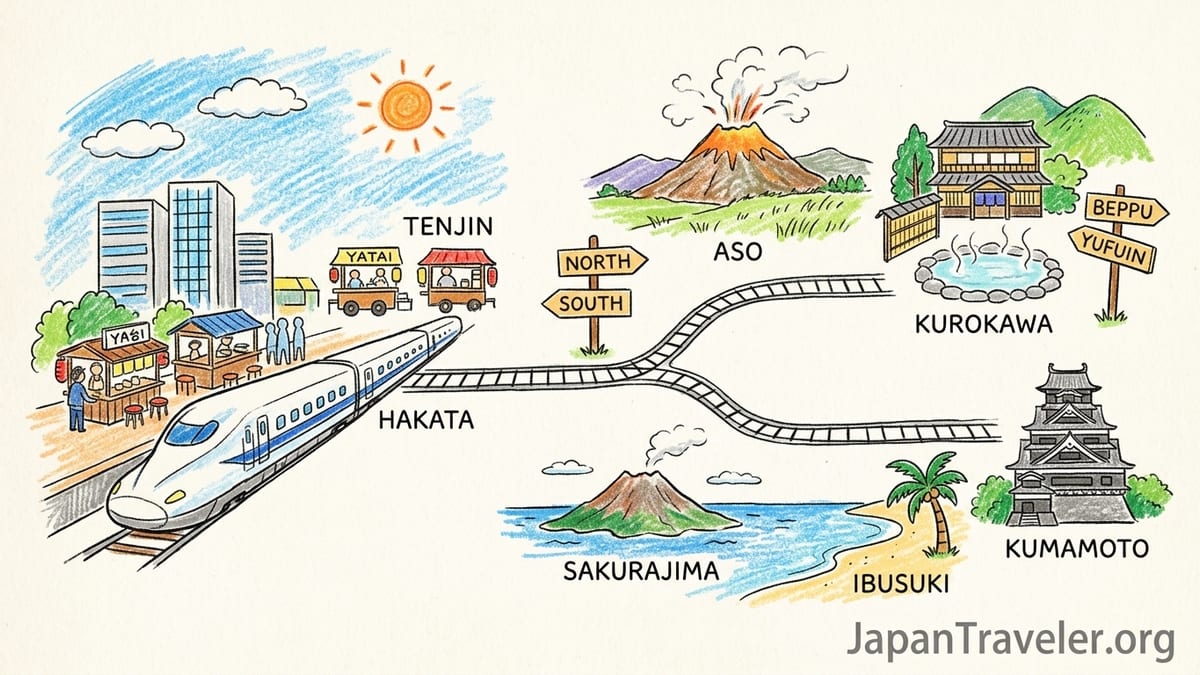
For most travelers, Kyushu trips start and end in Fukuoka, home to Hakata Station and Fukuoka Airport, the region’s main air and rail gateway. Hakata sits on the Sanyo and Kyushu Shinkansen lines, with direct trains to Hiroshima and Osaka to the north and Kumamoto and Kagoshima to the south, plus limited express services to Nagasaki, Beppu and Oita. That hub status means you can roll a suitcase off a Shinkansen and be on a subway to the airport or a local train for a day trip in minutes, with no complex transfers.
Within Kyushu, the key decision is whether to focus on the northern half, which includes Fukuoka, Nagasaki, Beppu, Yufuin, Aso and Kurokawa, or to push further south to Kumamoto, Kagoshima, Kirishima and Ibusuki. With 7 to 10 days, many travelers choose a northern loop only, using Fukuoka, Nagasaki and Beppu or Yufuin as main bases, plus one countryside onsen night. With closer to two weeks, adding Kumamoto for Aso and Kagoshima for Sakurajima and southern Kyushu starts to feel relaxed rather than rushed.
In practical terms, each base offers something different. Fukuoka is best for simple arrivals, shopping and day trips across northern Kyushu. Nagasaki works for history and atmosphere. Beppu and Yufuin give very different onsen experiences: one a sprawling hot spring city with major public bath infrastructure, the other a quieter, upscale resort town. Kumamoto puts you within about 90 minutes of Mount Aso’s crater area, while Kagoshima opens up volcanic scenery around Sakurajima and the hot spring coasts to the south. Layered on top are smaller onsen areas like Kurokawa, Kirishima and Ibusuki, which may deserve a full night instead of a day trip.
Fukuoka: Best Arrival Hub and Northern Kyushu Base
If you are flying into Kyushu or arriving by Shinkansen from Honshu, Fukuoka is the simplest starting point. Hakata Station is both the Shinkansen stop and the main JR hub for the island, with frequent trains to Kumamoto in roughly 40 minutes on the Kyushu Shinkansen and to Kagoshima in around 80 to 90 minutes. Limited express trains also fan out to Nagasaki, Huis Ten Bosch, Beppu, Oita and the Saga area, which makes it easy to do long day trips without changing hotels. From Hakata, the subway ride to Fukuoka Airport typically takes about 5 minutes, so flying in late or out early is rarely a problem.
Hakata Station and nearby Tenjin give you two main lodging zones. Around Hakata, you will find a dense cluster of business hotels and mid range chains such as JR Kyushu Hotel, Miyako Hotel and international brands such as Hilton or Crowne Plaza level properties. Rooms are usually compact but functional, often in the 12 to 20 square meter range, with prices that can be competitive outside peak cherry blossom and Golden Week periods. If you plan multiple day trips by train, staying within a short walk of Hakata saves time, especially with luggage.
Tenjin, a few subway stops from Hakata, is Fukuoka’s shopping and nightlife heart, packed with department stores, small boutiques and the famous riverside yatai food stalls scattered along the Naka River. Here the hotel stock ranges from older business hotels to newer design properties and serviced apartments. For travelers who only plan one or two train trips and care more about evening atmosphere, Tenjin can be more appealing. Either way, you will generally eat dinner in town rather than your hotel, choosing from everything from ramen chains specializing in Hakata style tonkotsu to small yakitori counters and modern izakaya.
Fukuoka is also the most convenient place to pick up or return a rental car if you plan to drive part of your Kyushu itinerary. Major companies cluster around Hakata Station and the airport, and driving north to Itoshima’s beaches, east toward Beppu or south to the Aso area becomes straightforward once you are on the expressways. For trips concentrated in the cities and well served onsen like Beppu and Yufuin, trains and buses are usually enough, but if you want to string together smaller countryside onsen or explore remote coastal roads, a car from Fukuoka is often the most efficient solution.
Nagasaki: Historic Port City With Character
Nagasaki is best chosen as an overnight base when history and atmosphere are priorities. The limited express train from Hakata to Nagasaki typically takes around 2 hours, with the newer Shinkansen section shaving down times when combined with a short transfer, but the city still feels a world away from Fukuoka’s modern bustle. The harbor, hillside neighborhoods and mix of churches, temples and Western style buildings reflect centuries of international contact, from the Portuguese and Dutch trading eras to the late 19th century industrial boom.
As a base, the most practical areas to stay are near Nagasaki Station and around the central tram lines that run past Dejima, Chinatown and the Meganebashi bridge area. Near the station, you will find mid range business hotels and some larger properties with ocean views. Closer to the old town and tram stops, there are smaller hotels and a handful of guesthouses that put you within an easy walk of many sights. A typical pattern is to arrive from Fukuoka around midday, explore the Atomic Bomb Museum, Peace Park and Urakami area that afternoon, then wander the downtown and hillside viewpoints the next day before moving on.
Nagasaki does not have the same dense onsen infrastructure as Beppu or Yufuin, but nearby hot spring towns such as Unzen and Obama on the Shimabara Peninsula can be visited as excursions from the city or as separate overnight stays. Without a car, reaching them involves a combination of trains and buses that can turn a day trip into a long travel day, so many travelers either limit themselves to one of these or add a night in a local ryokan to break up the journey. If your Kyushu time is tight and you are choosing between more nights in Nagasaki or an extra ryokan stay elsewhere, it can make sense to treat Nagasaki as a 1 or 2 night city stop and save your onsen splurge for an easier to reach area.
Beppu vs Yufuin: Choosing Your Onsen Experience
On the eastern side of Kyushu, Beppu and Yufuin offer two distinct styles of hot spring stay. Beppu is one of Japan’s largest onsen resorts, with multiple hot spring areas collectively known as Beppu Hatto and dozens of public bathhouses. Around Beppu Station and the Beppu Onsen district, you will find many municipal baths, including classic facilities such as Takegawara Onsen, as well as sand baths near the beach where staff bury you in warm, mineral rich sand for a short timed session before you rinse off in regular hot spring water. The city is also home to the Hells of Beppu, colorful hot spring pools visited as sightseeing spots rather than for bathing.
Because Beppu is a sizable city, accommodation runs from budget business hotels and simple hostels to large traditional ryokan perched on hillsides with ocean views. You can stay a short walk from Beppu Station for easy train access to the rest of Kyushu, or base yourself in more atmospheric areas like Kannawa, home to steaming streets and historic bathhouses connected by local buses. Meals depend on your choice of lodging: many urban hotels are room only, leaving you to explore local izakaya, while resort style ryokan often include multi course kaiseki dinners featuring local seafood and Oita specialties.
Yufuin, about an hour inland by train or bus from Beppu and reachable in around 2 to 2.5 hours from Hakata on services like the Yufuin no Mori, is quieter and more overtly resort oriented. The town stretches between Yufuin Station and Lake Kinrin, framed by Mount Yufu, with streets of small galleries, cafes, dessert shops and boutiques. Many of the best ryokan in Yufuin are low rise and spread out, often with private open air baths attached to each room or small groups of rooms. Price points are generally higher than in Beppu for comparable room sizes, and dinner and breakfast in house are the norm, turning Yufuin into an upscale retreat rather than a city base.
For a principal onsen base to explore the region, Beppu usually wins in terms of infrastructure and transport. Trains, highway buses and ferries converge here, and you can do day trips to Yufuin, Kitsuki’s samurai district or even onward to Aso with careful planning. Yufuin is better treated as a one or two night splurge if you value quiet, nature and ryokan comforts over sheer variety of baths. Travelers who enjoy sampling multiple public baths across a town will find more options in Beppu, while those who prefer to stay in one luxury property and soak in private baths may gravitate to Yufuin.
Kumamoto and Aso: Volcano Scenery and When to Stay Overnight
Kumamoto is the logical hub for exploring central Kyushu and the Aso region. Shinkansen trains from Hakata to Kumamoto Station typically take about 40 minutes, making it an easy hop from Fukuoka. From Kumamoto Station, the Hohi Main Line continues east toward Aso, with local and limited express services that usually take around 80 to 90 minutes to reach Aso Station. Highway buses also connect Kumamoto city and Aso, and the Aso Kumamoto Airport sits roughly halfway between, with buses running from the airport to both the city and Aso Station.
Within Kumamoto city, staying near Kumamoto Station gives the fastest access to Aso trains and buses, while the central area around Kumamoto Castle and the shopping arcades offers more dining and nightlife. Many visitors split the difference by staying near the tram lines that link the station and downtown, using a combination of tram and taxi in the evenings. Hotel stock is typical of a regional Japanese city: business hotels clustered near the station, mid range chains near the castle district and a few higher end properties with castle views. You will generally eat out, trying local specialties like basashi horse sashimi or mustard filled lotus root in small restaurants around the arcades.
Whether Aso deserves an overnight depends on your priorities. A day trip from Kumamoto to Aso Station, then up to the Kusasenri plateau or the ropeway area and back, is possible by train plus local bus, but can feel rushed, especially if you want to hike short trails or linger at viewpoints. With an overnight in the Aso region, either around Aso Station or in onsen villages on the caldera rim, you can check train schedules less anxiously, soak in outdoor baths with views of the crater rim and see the grasslands in the softer light of early morning or late afternoon. Travelers relying on public transport often find one night in Aso balances time and effort well.
Rental cars become particularly useful in the Aso area, where sights, trailheads and onsen are spread out. From Kumamoto, picking up a car near the station or airport and driving into the Aso caldera allows you to reach rural guesthouses, farm stays and small onsen that buses pass infrequently, and you can combine Aso with a loop through Kurokawa Onsen before returning to Fukuoka or Beppu. If you prefer to avoid driving, basing in Kumamoto and joining a local tour or carefully planning train and bus connections through Aso City’s and Aso Geopark’s transport information can still make a satisfying non driving visit.
Kagoshima, Sakurajima and Southern Kyushu
Kagoshima anchors the southern tip of Kyushu and is the best base for exploring Sakurajima and the nearby hot spring regions of Kirishima and Ibusuki. Shinkansen trains from Hakata to Kagoshima Chuo Station usually take around 80 to 90 minutes, passing through Kumamoto and smaller cities along the way. Kagoshima has its own airport as well, with buses connecting the terminal and Kagoshima Chuo in roughly an hour. Once in town, trams and buses link the main areas, including the ferry terminal for Sakurajima and the hillside viewpoints.
The most convenient area to stay is around Kagoshima Chuo Station, where you will find standard business hotels, some larger properties and shopping complexes. This location suits travelers using trains as their main mode of onward travel, whether back to Fukuoka, north toward Miyazaki or toward ferries serving Yakushima and other islands. Another popular area is closer to the waterfront and Tenmonkan, the downtown district filled with restaurants and bars. Here, dinner options range from izakaya serving local black pork tonkatsu and shochu to small seafood places showcasing fish from Kagoshima Bay.
Sakurajima itself is best experienced as a long half day or full day trip from Kagoshima city rather than a separate overnight unless you specifically want a very quiet rural stay. The frequent ferry from the city crosses the bay in a short ride, and local buses and scenic viewpoints circle the volcano’s lower slopes. For hot springs, Kagoshima city has onsen style sento, but the real draws lie outward: Kirishima’s mountain resorts to the north and Ibusuki’s coastal sand baths to the south. With a rental car, you can string these into a two or three night loop, perhaps spending one night in a Kirishima ryokan and another in an Ibusuki onsen hotel before returning to Kagoshima or continuing by train.
When Kurokawa, Kirishima and Ibusuki Deserve an Overnight
Kurokawa Onsen, tucked in the mountains north of Aso, is one of Kyushu’s most atmospheric hot spring villages. A river cuts through a compact settlement of traditional ryokan, many with thatched roofs or wooden facades and landscaped outdoor baths along the water. Access by public transport typically involves a combination of train and bus via Aso or Yufuin, with relatively few services per day. Because of that, trying to do Kurokawa as a day trip generally means arriving just as you have to start thinking about heading back.
An overnight stay in Kurokawa lets you arrive by mid afternoon, change into yukata, then visit two or three different ryokan baths using the village’s onsen pass before returning to your own property for dinner. Most ryokan stays here are built around half board plans that include elaborate kaiseki meals and breakfast, and many travelers choose a room with attached open air bath for the full experience. If you are renting a car, Kurokawa can be woven into a scenic drive between Aso and Beppu or Yufuin, but even then, one night is the minimum to justify the detour and cost.
Kirishima, in the mountains north of Kagoshima, offers a different kind of onsen stay, with many ryokan and resort hotels scattered around forested slopes and volcanic plateaus. Without a car, reaching Kirishima usually requires a train to a nearby station such as Kirishima Jingu or Hayato, followed by a bus or ryokan pickup van up into the hot spring zones. As a result, Kirishima works best as an overnight stop between Kagoshima and Miyazaki or as a one or two night base for hiking, especially if you want to soak in milky volcanic hot springs after walking ridge trails.
Ibusuki, along the southern coast of Kagoshima Prefecture, is famous above all for its coastal sand baths, where you lie on the beach and are buried in naturally heated sand before rinsing off in hot spring water. It is reachable by train from Kagoshima in a little over an hour and by car in roughly the same time, so in theory it can be a day trip. In practice, many visitors choose to spend a night in Ibusuki or at a nearby resort hotel to slow down, enjoy the sand baths without watching the clock and then relax in regular onsen, often with ocean views. If your schedule is very tight, a day trip is feasible, but with more than a week in Kyushu, planning one night in Ibusuki makes the journey feel less hurried.
In each of these places, the character of the town or village shifts in the evening once day trippers leave and lanterns flicker to life around the baths. That after dark atmosphere, plus the leisurely rhythm of bathing before dinner and again in the early morning, is what justifies an overnight. By contrast, more urban onsen areas like central Beppu, where trains and buses run often and restaurants stay open late, lend themselves more easily to day visits or multi night stays where onsen are just one part of a broader city experience.
Hotels vs Ryokan, Station Access and Rental Cars
Deciding between hotels and ryokan in Kyushu often comes down to location and purpose. In transport hubs like Fukuoka, Nagasaki, Kumamoto and Kagoshima, standard hotels within a few minutes’ walk of major stations are usually the most practical choice, especially if you are moving every couple of days with luggage. Rooms tend to be smaller but efficient, breakfast is often buffet style, and you eat dinner at nearby restaurants. This pattern keeps nightly costs predictable and gives you flexibility to stay out late or change dinner plans on the fly.
Ryokan fit best in onsen towns and rural areas where the stay itself, and not just the surrounding sights, is the focus. In Beppu or Yufuin, you might spend one or two nights in a ryokan with in room baths and elaborate meals, then switch back to a station side hotel in Fukuoka or Kumamoto to save money and simplify travel days. In Kurokawa, Aso’s onsen hamlets, Kirishima or Ibusuki, most of the appealing properties are ryokan or resort hotels with hot springs, and there may be few independent restaurants open at night, so booking half board plans is close to essential.
Station access affects how much of your day you lose in transit. In a city like Fukuoka, a hotel directly connected to or across the street from Hakata Station might shave 15 to 20 minutes off each travel day compared with staying deeper in a residential neighborhood. In Beppu, lodging near Beppu Station simplifies day trips, while a stay in the hills may require relying on local buses that run less frequently. Before committing to a property because of views or an appealing bath, it is worth checking the real world walk time from the nearest station or bus stop, especially if you have large suitcases.
Rental cars are not mandatory in Kyushu, but they unlock certain areas and make some classic loops more comfortable. A popular pattern is to rely on trains between cities, then rent a car in one city, such as Fukuoka, Kumamoto or Kagoshima, for a 3 or 4 day segment linking Aso, Kurokawa, Kirishima or Ibusuki before returning it in another city. This saves backtracking and lets you reach trailheads, small waterfalls and countryside cafes that buses rarely serve. The trade off is the need to navigate mountain roads and manage parking, which is usually easy in small towns but requires more attention in dense urban centers.
Building a Practical Kyushu Base Strategy
For a first time visit focused on northern Kyushu, a simple structure might be to spend 3 nights in Fukuoka, 2 nights in Nagasaki, 2 or 3 nights split between Beppu and Yufuin, and 1 night in or near Aso or Kurokawa. This gives you an arrival and departure base with excellent rail access, dedicated time for history in Nagasaki, exposure to both major onsen infrastructure in Beppu and a quieter upscale stay in Yufuin, and at least one night in the Aso highlands. Day trips from Fukuoka could cover Dazaifu and nearby coastal areas, while Beppu based excursions might reach Yufuin or local countryside.
With more time and an interest in southern Kyushu, you could add 2 or 3 nights in Kagoshima, with a day devoted to Sakurajima and city sights and one or two nights stepping out to Kirishima or Ibusuki. In this case, Kumamoto can either remain a full base, giving you time in the city and a day or overnight in Aso, or become more of a transit stop if volcano scenery is less critical. It is entirely possible to structure a loop Hakata to Kumamoto to Kagoshima to Beppu or Yufuin and back to Hakata, using a mix of Shinkansen, limited express trains and local lines.
Throughout, the key is to select just a few principal bases, then layer in one or two special onsen nights where moving is worth it. Fukuoka anchors airport and Shinkansen arrivals and most northern itineraries. Nagasaki adds history and a very different urban feel. Beppu and Yufuin cover the spectrum from big city onsen to boutique resort. Kumamoto and Kagoshima open the doors to Aso, Sakurajima and the less visited rural hot spring regions. By thinking in terms of what each base actually delivers day to day, from station access to restaurant choice, and then sprinkling in one or two ryokan splurges in places like Kurokawa or Ibusuki, you can build a Kyushu trip that feels rich without becoming frantic.
FAQ
Q1. Is Fukuoka the best place to stay for my whole Kyushu trip?
For very short trips of 3 to 4 nights focused on day trips, basing entirely in Fukuoka can work, thanks to Hakata Station’s excellent train and bus connections. For longer itineraries, adding at least one more base such as Nagasaki, Beppu or Kagoshima reduces backtracking and gives you more evening atmosphere in different cities.
Q2. Should I stay in Beppu or Yufuin for onsen?
Choose Beppu if you want lots of public baths, varied price points and easy rail access, and do not mind a more urban feel. Choose Yufuin if you prefer a quieter, more upscale resort town with many ryokan and are happy to spend more on lodging that includes meals and private baths.
Q3. Does Kurokawa Onsen deserve an overnight stay?
Yes, Kurokawa is much better as an overnight than as a day trip because access is time consuming and the charm lies in wandering between ryokan baths in the late afternoon and evening. One night is usually enough to enjoy several onsen, a full kaiseki dinner and breakfast in a traditional setting.
Q4. Is Kumamoto a good base for visiting Mount Aso?
Kumamoto works well as a practical base if you prefer city conveniences and are comfortable with a long day trip to Aso by train and bus. If volcano scenery and onsen are priorities, consider spending at least one night closer to Aso itself so you can see the caldera area without rushing to catch the last return transport.
Q5. How many nights should I spend in Kagoshima?
Two to three nights in Kagoshima suits most visitors, with one day for Sakurajima and city sights and at least one more night if you want to add a side trip or overnight in Kirishima or Ibusuki. With only one night, you will likely have to choose between Sakurajima and a more relaxed onsen experience.
Q6. Do I need a rental car to enjoy Kyushu?
No, you can see the main cities and popular onsen towns like Beppu and Yufuin using trains and buses. A rental car becomes useful if you want to connect rural areas such as Aso, Kurokawa, Kirishima or small coastal towns in a single loop, or if you prefer flexible schedules over fixed bus timetables.
Q7. Are ryokan stays worth the higher cost compared with hotels?
For many travelers, one or two ryokan nights are highlights of a Kyushu trip, especially in places like Yufuin, Kurokawa, Aso or Ibusuki where the hot springs and meals are integral to the experience. In big cities, standard hotels near stations usually offer better value and more dining flexibility, so a mix of both can keep budgets balanced.
Q8. Is Nagasaki better as a day trip or overnight stay?
Nagasaki is best enjoyed with at least one night, as you will likely want a full day for the Atomic Bomb Museum, Peace Park and historical districts, and another half day for harbor views and hillside neighborhoods. While a very long day trip from Fukuoka is technically possible, staying overnight lets you experience the evening atmosphere and local restaurants.
Q9. When should I choose Kirishima or Ibusuki over a simple day trip from Kagoshima?
If you are mainly curious about seeing the landscape and can accept a tight schedule, a day trip can work. If you want to soak unhurriedly in onsen, enjoy included dinners and breakfasts and see the areas at quieter times of day, plan at least one night in Kirishima or Ibusuki instead of commuting back to Kagoshima city.
Q10. How many different bases are ideal for a 10 day Kyushu itinerary?
For about 10 days, three to four main bases usually work well, for example Fukuoka, Nagasaki, an onsen base such as Beppu or Yufuin, and Kagoshima, plus one or two single night ryokan stays in places like Aso or Kurokawa. More bases than that tend to add packing and transit time without greatly increasing what you can see.