


The Chugoku region of western Honshu can feel overwhelming when you first look at the map. Hiroshima, Miyajima, Okayama, Tottori, Matsue, Hagi, Yamaguchi, Onomichi, Kurashiki and Izumo all compete for space on your itinerary, and most guidebooks simply stack them into one long list of sights. This guide takes a different approach. Instead of cataloguing every temple and museum, it helps you decide where to sleep, where to day trip from a hub, and where travel becomes easier if you are willing to rent a car.
Understanding the Chugoku Region at a Glance
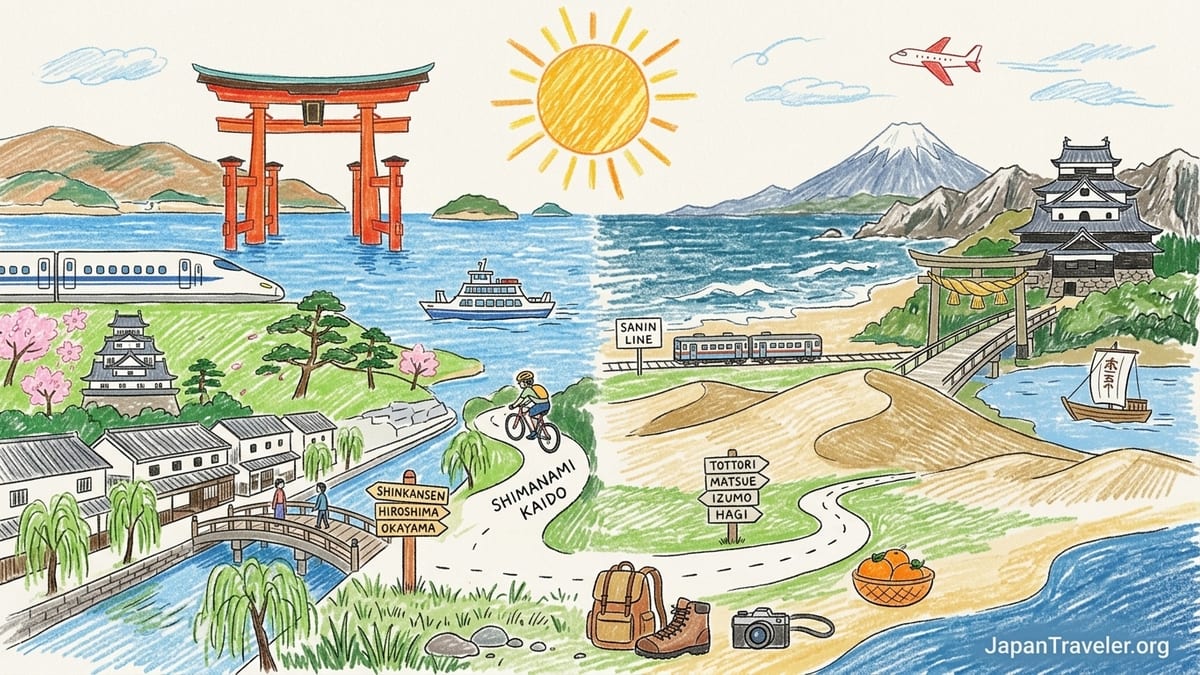
Chugoku stretches from the sheltered Seto Inland Sea on the south coast to the wilder Sea of Japan on the north. Hiroshima and Okayama sit on the Shinkansen line, with frequent bullet trains from Osaka and Fukuoka, while places like Tottori, Matsue and Hagi feel almost rural by comparison. The official tourism material from the Japan National Tourism Organization highlights this contrast: Hiroshima’s coastal islands and Onomichi’s cycling routes on one side, and Tottori’s coastal dunes and Mount Daisen massif on the other, with historic castle towns such as Matsue and Hagi scattered along the Sea of Japan.
For most travelers with 7 to 14 days in Japan, Chugoku becomes one segment of a larger trip that might also include Kansai or Kyushu. That makes smart base selection crucial. Staying in Hiroshima or Okayama gives you fast rail access to multiple destinations. Venturing out to Tottori or Hagi adds atmosphere but requires longer rides on slower trains or highway buses. Understanding these tradeoffs upfront will help you decide whether to prioritize easy logistics, scenic variety, samurai history or spiritual heritage.
In practical terms, think of three main travel axes. The Seto Inland Sea axis runs from Okayama to Hiroshima and Onomichi, ideal for gardens, old merchant districts and island-hopping. The Sea of Japan axis runs through Matsue, Izumo and the Sanin coast, with a focus on castles, mythology and rugged nature. The western tip around Hagi and Yamaguchi blends samurai-era townscapes with quiet countryside. You probably will not see everything in one trip, so use these axes as a mental map to choose what fits your interests and available days.
Hiroshima vs Miyajima: How Many Nights and Where to Sleep
Hiroshima and Miyajima are often bundled together as a single tick-box, but they offer very different experiences. Hiroshima is a modern regional city with the Peace Memorial Park, Atomic Bomb Dome and a lively downtown of okonomiyaki restaurants and bars. Miyajima is a compact island village wrapped around a shrine, famous for the vermilion torii gate of Itsukushima Shrine that appears to float at high tide. A JR train from Hiroshima Station to Miyajimaguchi takes about 25 minutes, and the ferry crossing is under 10 minutes, so many travelers treat Miyajima as a day trip and sleep in Hiroshima.
For a first-time visitor with limited time, a common pattern is one full day in Hiroshima and one day for Miyajima, spending both nights in Hiroshima. This gives you easy access to evening dining, a wider range of hotels (including business hotels near Hiroshima Station in the 8,000 to 15,000 yen per night range for mid-range doubles), and simple onward Shinkansen connections. You can visit the Peace Memorial Museum in the morning, stroll along Hondori shopping street in the afternoon, and try Hiroshima-style okonomiyaki at a local chain in the evening before heading to Miyajima the next day.
Staying overnight on Miyajima shifts the experience. Once the day trippers leave on the last ferries, the island becomes much quieter. Traditional ryokan with half-board kaiseki dinners often cost more than a business hotel in Hiroshima, but in return you walk back to your room under lantern-lit streets with deer wandering the alleys, and you can visit Itsukushima Shrine or Daisho-in Temple early in the morning before crowds arrive. An overnight stay is worthwhile if you value atmosphere over convenience, are traveling outside peak public holidays or cherry blossom, or want to hike Mount Misen and soak in an onsen before bed.
From a logistics point of view, Hiroshima works best as the hub. The city is on the Sanyo Shinkansen line, with direct bullet trains to Osaka and Fukuoka, and limited express trains north toward Miyoshi and beyond. Hiroshima also anchors day trips not just to Miyajima but to Iwakuni with its Kintaikyo Bridge, and to Onomichi if you are willing to sit on a local train for about 90 minutes. If you only have two nights for this part of Japan, book Hiroshima, accept that Miyajima will be a daytime visit, and save the island overnight experience for a future trip.
Okayama and Kurashiki: Base for Gardens and Historic Streets
Okayama and neighboring Kurashiki are an attractive alternative base to Hiroshima, especially if you are traveling from Osaka or Kyoto. Okayama is a Shinkansen stop about 45 minutes from Shin-Osaka on a fast service. The city’s main draw is Korakuen Garden, widely considered one of Japan’s top three landscape gardens, alongside Kenrokuen in Kanazawa and Kairakuen in Mito. Visiting Korakuen takes two to three hours at a relaxed pace. From the garden you can cross the bridge to Okayama Castle, recently renovated, and backtrack easily to hotels clustered around Okayama Station.
Kurashiki, 15 to 20 minutes away on a local train from Okayama, offers the kind of preserved canal quarter that many travelers only expect to find in Kyoto. The Bikan Historical Quarter is a compact grid of white-walled storehouses and merchant homes hugging a willow-lined canal. You can easily wander for half a day, visiting small museums, sipping coffee in old kura buildings, and browsing craft boutiques. Many travelers use Okayama as the main sleep base, then day trip to Kurashiki, returning in the evening for dinner near the station.
If you have at least two nights in the area and enjoy quiet evenings, consider spending one night in Kurashiki itself. Small inns and stylish guesthouses in the Bikan area put you right in the heart of the historic district once the tour buses depart. Expect prices to be higher than generic business hotels near Okayama Station, but the tradeoff is a more atmospheric stroll after dark over stone bridges reflected in the canal. For travelers focused on gardens and charming streets rather than big-city nightlife, a Kurashiki overnight can feel more special than another night in a transport hub.
Economically, Okayama works extremely well as a base because of its rail connections. From here, you can visit Kurashiki, hop to Naoshima and the art islands via Uno Port, or continue west toward Hiroshima. Train fares for local hops are modest, often well under 1,000 yen one way between Okayama and Kurashiki or Uno, which adds flexibility if you want to decide on short trips based on the weather. Most sites around Okayama and Kurashiki are reachable on foot or by short bus rides, so there is no real need for a car unless you plan to explore deeper into rural Okayama Prefecture.
Onomichi and the Seto Inland Sea: Scenery and Cycling
Onomichi occupies a unique niche in Chugoku travel. It is a hillside port town on the Seto Inland Sea, with narrow lanes, small temples and sea views, but it is also the gateway to the Shimanami Kaido, Japan’s most famous long-distance cycling route. The Shimanami Kaido runs about 70 kilometers between Onomichi in Hiroshima Prefecture and Imabari in Ehime Prefecture, crossing a chain of islands via dedicated cycling paths alongside the Nishiseto Expressway. The bridges and islands create a continuous sequence of sea views, fishing harbors and citrus groves.
For many visitors, Onomichi is a relaxed overnight stop woven into a larger Setouchi itinerary. You might arrive on an afternoon local train from Hiroshima, drop bags at a small hotel or guesthouse near the station, then wander the Temple Walk or ride the short ropeway up to Senkoji Park for sunset. The town has a growing number of cafes and small bakeries, and a handful of design-focused accommodations such as converted warehouses or cyclist-oriented hotels with bike storage. Prices often sit between those in smaller inland towns and major cities, reflecting Onomichi’s growing popularity with domestic travelers and cyclists.
If you plan to ride the Shimanami Kaido, staying at least one night in Onomichi is wise. You can reserve bikes through municipal or private rental services, pick up maps and get an early start. Rental fees vary by bike type, but typical cross-bike rentals for a day are in the several-thousand-yen range, with additional charges if you return the bike on the other side in Imabari. Many riders aim to complete the full route in one long day, while more leisurely cyclists break it into two days with an overnight on one of the islands. Luggage transfer services and highway buses or ferries make it possible to ride one way and return without backtracking by bicycle.
Onomichi itself is manageable without a car. The core town is walkable from the station, and ferries shuttle across the short strait to Mukai-shima, where the Shimanami cycling route begins. However, if you want to explore smaller islands off the main cycling road or remote viewpoints, a car provides more freedom. For most first-time visitors who simply want a taste of Seto Inland Sea scenery, combining one night in Onomichi with a half-day or full-day casual cycling excursion is enough, especially when paired with Miyajima and Hiroshima for a broader picture of the region’s coastal landscapes.
Tottori and Mount Daisen: Dunes, Mountains and When You Need a Car
Tottori Prefecture is the outlier in many Chugoku itineraries. It is famous for the Tottori Sand Dunes, a stretch of coastal sand hills that feel almost desert-like compared to the rest of Japan, and for Mount Daisen, a prominent volcanic peak popular with hikers and skiers. The prefecture sits on the Sea of Japan side, away from the Shinkansen corridor. Reaching Tottori City from Osaka or Okayama usually involves limited express trains that can take around two to three hours, and connections from Hiroshima are even longer. This distance and the slower rail network make Tottori a deliberate choice rather than a spontaneous side trip.
The sand dunes are reachable by local bus from Tottori Station in around 20 minutes, so you can technically visit as a day trip if you stay in Tottori City or even arrive and depart on the same day from further afield, though that would be rushed. Once at the dunes, you can climb the sandy slopes, look back over the sea, and visit the adjacent sand museum with its large sand sculptures. There are also camel rides and paragliding operators, although availability depends on season and weather. Visiting the dunes alone will not fill an entire day unless you plan multiple activities, so many travelers combine them with a stroll in central Tottori or a soak in a nearby onsen.
Mount Daisen and the surrounding nature are harder to access without a car. Public buses run to the Daisenji Temple area and ski resort zones, but schedules can be sparse outside peak seasons. Hiking trails and views of the mountain framed by rice paddies are spread across a wider area, and rural inns, farm stays and hot spring ryokan are not always directly on bus routes. Renting a car in Tottori or Yonago opens up visits to coastal cliffs, quiet beaches and small hot spring villages that would otherwise be complex to reach by connecting buses and taxis.
From an itinerary-planning perspective, Tottori works best as a one or two night destination if you are already traveling along the Sea of Japan side or are comfortable adding a long rail or bus leg. It is a rewarding choice for travelers who value uncrowded nature and do not mind slower infrastructure. If your priority is to keep transfers simple and you are not renting a car, you may find it more efficient to focus on Hiroshima, Okayama and the Seto Inland Sea, where almost every major site is accessible by regular trains and frequent local buses.
Matsue and Izumo: Castles, Lakes and Spiritual Heritage
Matsue in Shimane Prefecture is one of Japan’s few remaining original castle towns. Matsue Castle still preserves its wooden keep, and the castle hill overlooks a network of moats and the waters of Lake Shinji. The city has an old samurai district and a literary connection to Lafcadio Hearn, the writer who introduced many Japanese ghost stories to Western readers. Nearby Izumo Taisha, one of Japan’s most important Shinto shrines, adds a spiritual dimension and draws pilgrims and tourists alike. Together they form a compact cluster of history, mythology and lakeside scenery.
Reaching Matsue from Okayama or Osaka typically involves a limited express train such as the Yakumo service, which can take around three hours from Okayama. Buses also connect Matsue with Hiroshima via the inland highways, sometimes taking around three hours as well. Once in Matsue, most of the main sights are reachable by local bus, loop bus or on foot. The castle, samurai residences and Lafcadio Hearn’s former residence cluster in the central area. Lake Shinji’s sunset views are an easy walk from downtown hotels, and riverside paths make for pleasant evening strolls.
Izumo Taisha sits a short train or bus ride away from Matsue, closer to the Sea of Japan. Devotees come to pray for relationships and good fortune, and the shrine’s enormous straw rope and long approach path create a very different atmosphere from the refined gardens of Okayama or the solemn peace monuments of Hiroshima. While there are accommodations near Izumo Taisha, most travelers base in Matsue, where hotel options are broader and train connections are better, then visit Izumo as a half-day or full-day excursion. An overnight in Izumo might appeal if you want to attend dawn or evening rituals at the shrine in a quieter setting.
Matsue deserves at least one night, and two nights feel comfortable if you also want to include Izumo and perhaps a boat cruise along the Horikawa canals or an onsen visit in the area. A car is helpful if you plan to explore further along the Shimane coast, visit remote shrines or combine Matsue with lesser-known onsen towns, but it is not essential for a first visit focused on the main castle and shrine. Because travel times from other hubs are longer than to Hiroshima or Okayama, it is worth resisting the temptation to treat Matsue and Izumo as a simple day trip; you will appreciate them more with evenings free to watch the sun set over Lake Shinji.
Hagi and Yamaguchi: Samurai Towns and Rural Landscapes
On the far western side of Honshu, Hagi and Yamaguchi offer a quieter, more introspective slice of Chugoku. Hagi is a former castle town on the Sea of Japan, known for its grid of streets preserved from the Edo period, with white-walled samurai residences, earthen walls and citrus trees peeking over fences. It played an important role in the Meiji Restoration, and history-minded travelers can visit the homes of key figures who helped end Japan’s feudal era. Hagi is also known for its pottery, with many small kilns and galleries throughout the town.
Yamaguchi City, inland, has often been called a little Kyoto because of its historic temples and the five-arched Kintai-like bridges in nearby Iwakuni, although in reality its scale is much smaller and the atmosphere more provincial. The region around Hagi and Yamaguchi is rural, with rice fields, low hills and a sense of slow-paced everyday life that contrasts strongly with urban Hiroshima or tightly packaged Miyajima. It is attractive to travelers seeking a less commercial side of Japan, where tourist infrastructure exists but is not overwhelming.
From a logistics perspective, Hagi is the most challenging destination in this guide without a car. Rail connections are indirect, and many travelers reach Hagi by highway bus from Yamaguchi City, Shin-Yamaguchi Station or even from Hiroshima. Once in town, you can explore the historical districts, castle ruins and waterfront on foot or by rental bicycle, but exploring the surrounding coastline or visiting multiple pottery studios scattered in the countryside is easier by car. If you are comfortable driving, renting a car at Shin-Yamaguchi or Yamaguchi and looping through Hagi and the coastline opens up viewpoints and quiet beaches that would be very time-consuming to reach by local buses.
An overnight stay in Hagi is almost always preferable to a rushed visit, because part of the town’s appeal lies in wandering its lanes in the early morning or evening when day visitors are few. Yamaguchi City can serve as a stopover for those transiting along the main rail line, with one night enough to visit its main temples and enjoy a quiet dinner. For many first-time visitors, the real question is whether to push this far west at all. If you have 10 days or more in Japan and want to combine history with rural landscapes, two nights split between Hagi and Yamaguchi can be rewarding. If your time is shorter, it is usually better to focus on the more accessible triangle of Hiroshima, Miyajima and Okayama, perhaps adding Matsue or Onomichi rather than stretching all the way to Hagi.
How to Allocate Nights: Sample Priorities and Car vs Rail
Putting all of these destinations together, patterns start to emerge. Hiroshima and Okayama are the natural hubs thanks to their Shinkansen access, hotel stock and easy connections. Miyajima, Kurashiki and Onomichi work very well as one-night satellites around those hubs, while Matsue, Izumo, Tottori and Hagi are best approached as intentional side segments that require at least one or two nights due to travel times. When you sketch your route, it helps to write down not just where you want to go but how many hotel changes you are comfortable with, since every move consumes time and energy.
A realistic seven-day Chugoku-focused itinerary without a car might include three nights in Hiroshima, one night on Miyajima or in Onomichi, and two nights in Okayama or Kurashiki. This gives you time for Hiroshima city, a full day on Miyajima, and one day for either Onomichi or a side trip from Okayama to Kurashiki and perhaps an art island. With 10 to 12 days, you could add two or three nights in Matsue, using buses or limited express trains, and perhaps a final night in Tottori or Hagi if you enjoy long rail journeys and want to lean into the region’s quieter corners.
The decision to rent a car dramatically changes what is feasible. With a car, you can drive from Okayama across the mountains to Tottori, then along the Sea of Japan coast through Matsue, Izumo and on to Hagi, staying in small ryokan and onsen towns with minimal public transport. This kind of loop rewards travelers comfortable with Japanese road rules and rural driving, and it works best outside heavy snow periods and major holidays when traffic and parking can become more challenging. Fuel, tolls and parking add costs, but sharing those between two or more people often compares favorably with multiple long-distance rail tickets.
Without a car, build your plan around the rail and highway bus grid. Choose two or three hubs such as Hiroshima, Okayama and Matsue and treat more remote attractions as day trips only when schedules are reasonable. For example, Onomichi and Kurashiki are excellent day trips, Miyajima can be either a day trip or an overnight, while Tottori and Hagi are rarely worth attempting in a single day from any other city. Thinking this way will keep your days focused on experiences instead of transfers, and you will leave Chugoku with clearer memories of specific places rather than of train interiors.
FAQ
Q1. Is Hiroshima or Miyajima better for a first-time visitor’s overnight stay?
Hiroshima is usually better as an overnight base for first-timers because it has more hotel options, easier Shinkansen access and plenty of restaurants, while Miyajima works well as either a very atmospheric splurge night or a day trip if you prefer convenience and a wider choice of evening activities.
Q2. Can I visit Kurashiki as a day trip from Okayama or do I need to stay overnight?
Kurashiki’s Bikan Historical Quarter is compact enough for a half or full day from Okayama, so most travelers visit on a day trip, but an overnight stay in the canal district is worthwhile if you enjoy quiet evenings in historic streets after day trippers leave.
Q3. Is Onomichi only for serious cyclists on the Shimanami Kaido?
Onomichi appeals to both casual travelers and cyclists; you can simply enjoy the hillside temples and harbor views, or rent a bike for a short ride to nearby islands rather than attempting the full 70 kilometer Shimanami Kaido route.
Q4. Do I need a car to enjoy Tottori and Mount Daisen?
You can reach the Tottori Sand Dunes by bus from Tottori Station without a car, but accessing Mount Daisen’s trailheads, rural onsen and scattered viewpoints is much easier with a rental car, especially outside peak seasons when buses are less frequent.
Q5. How many nights should I plan for Matsue and Izumo?
One night in Matsue allows you to see Matsue Castle and the samurai district, but two nights give you time for a relaxed visit to Izumo Taisha and perhaps a sunset on Lake Shinji without rushing.
Q6. Is Hagi realistic without renting a car?
Hagi is reachable by highway bus from larger stations such as Shin-Yamaguchi, and the historical town itself is walkable, but exploring the wider coastline and rural pottery areas becomes significantly more convenient if you have a car.
Q7. Which city makes the best base for exploring both Hiroshima and Okayama areas?
If you want to split your time, staying a few nights in Hiroshima and a few in Okayama is more efficient than trying to commute between them, since the travel time between the two is long enough that regular back-and-forth day trips would be tiring and expensive.
Q8. Is it worth staying overnight on Miyajima instead of doing a day trip?
It is worth staying overnight on Miyajima if you value quiet, atmospheric evenings, want to enjoy the shrine and town without crowds, and do not mind paying more for ryokan-style accommodation with dinner and breakfast included.
Q9. Can I see both the Tottori Sand Dunes and Matsue in one day?
Seeing both the Tottori Sand Dunes and Matsue in one day is technically possible with a car but rushed; using public transport, it is more comfortable to split them across at least two days with an overnight in either Tottori or Matsue.
Q10. If I only have three days in the Chugoku region, what should I prioritize?
With just three days, most travelers prioritize Hiroshima city and the Peace Park, a visit to Miyajima, and either a half day at Korakuen Garden in Okayama or a relaxed day in Kurashiki, focusing on easy rail links rather than venturing to more remote areas like Tottori, Matsue or Hagi.