


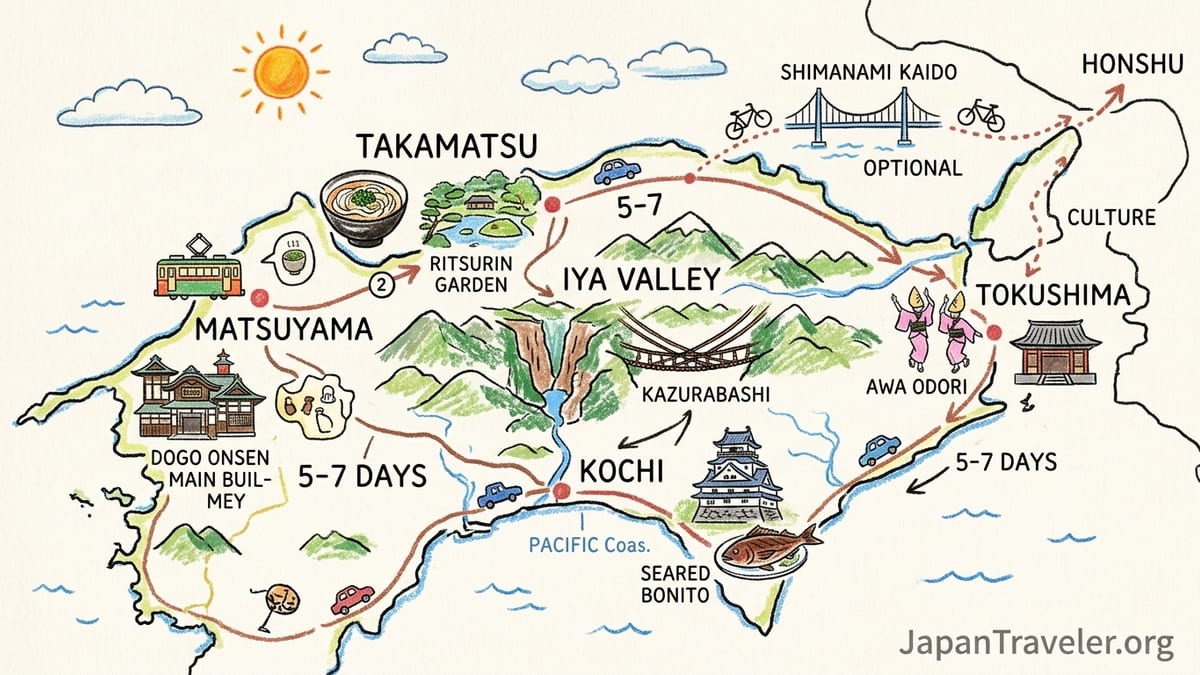
Shikoku rewards travelers who slow down. With deep gorges, onsen towns and fishing ports stitched together by scenic rail and coastal highways, it is best explored over five to seven days. Recent itineraries from tour companies, bloggers and the Japan National Tourism Organization converge on a similar rhythm: Takamatsu, Iya Valley, Kochi and Matsuyama as the core loop, with Shimanami Kaido or Tokushima as an optional extension. This guide shows how to turn those model routes into a concrete plan, with real travel times, hotel change strategies and where a short car rental makes more sense than trying to do everything by train.
How Many Days You Really Need on Shikoku
If you search for Shikoku itineraries in 2026, you will see the same pattern again and again: five-day and seven-day loops, plus a six-day circuit promoted by the Japan National Tourism Organization that strings together Takamatsu, Kochi and Matsuyama by rail. Travel agencies selling “6 days Shikoku” packages, independent road-trip blogs with “7-day Shikoku” titles and recent rail-focused sample routes all cluster between five and seven days. That sweet spot reflects how long it actually takes to cross the island without turning the trip into a blur of bus transfers.
In practice, five days is enough for a brisk Takamatsu–Iya–Kochi–Matsuyama circuit if you are happy with one night in most places and do not attempt Shimanami Kaido. Six days feels closer to the official JNTO pacing, giving you time for a full afternoon in Iya Valley and an evening soak in Dogo Onsen in Matsuyama. Seven days is the point where most current itineraries bolt on either Shimanami Kaido cycling from Imabari or a Tokushima section focused on the Awa Odori Kaikan and nearby pilgrimage temples.
If you have less than five days on Shikoku, it usually makes more sense to focus on just two bases, such as Takamatsu plus Matsuyama or Takamatsu plus Kochi, using day trips. Above seven days, travelers increasingly add side islands such as Naoshima, Shodoshima or Teshima from Takamatsu rather than continuing the main loop more slowly. For the classic first visit, though, a 5–7 day arc between Takamatsu and Matsuyama covers most highlights without constant packing and unpacking.
A 5–6 Day Core Route: Takamatsu, Iya, Kochi and Matsuyama
The most realistic short itinerary built from current examples keeps your nights to four or five hotels and does not attempt Shimanami Kaido. A common pattern, reflected in recent five-day sample routes, looks like this: start in Takamatsu, cut into the mountains for Iya Valley, drop south to Kochi on the Pacific, then curve back up the west coast to Matsuyama before leaving Shikoku by train or flight.
On a tight five-day schedule, one concrete layout could be: Day 1 Takamatsu, Day 2 Iya Valley, Day 3 Kochi, Day 4 Matsuyama, Day 5 departure. With six days you can split Kochi or Matsuyama into a two-night stay. That matches the official six-day rail itinerary that runs Takamatsu to Kochi to Matsuyama by train, with time for sights like Kochi Castle and Matsuyama’s Dogo Onsen before looping back to Kagawa.
In Takamatsu, most visitors stay either near JR Takamatsu Station for easy rail and ferry access or a short walk away around the shopping arcades. Mid-range hotels near the station, such as business-style chains with compact but modern rooms, typically run from about 7,000 to 12,000 yen per night for a double in 2026. From there you can walk or take a short local train ride to Ritsurin Garden and try Sanuki udon at no-frills shops that routinely charge under 500 yen for a basic bowl.
Iya Valley is where your hotel choices narrow but the experience deepens. Accommodation tends to be hot-spring ryokan clinging to the slopes above the gorge or small pensions around Oboke and Iya Onsen stations. Rates are usually higher than in the cities, often in the 20,000 to 35,000 yen range per person including dinner and breakfast for a room with valley views and access to a cable-car onsen. Because buses are infrequent, where you stay strongly affects what you can realistically see with or without a car.
Travel Times and How to Move Between Each Stop
Understanding travel times is the key to turning a pretty itinerary sketch into something that works on the ground. Takamatsu to Iya Valley by public transport typically means taking a limited express train from Takamatsu to Oboke or Awa-Ikeda on the JR Dosan Line, then a local bus into the valley. The fast trains take around 70 to 90 minutes, and the follow-on bus into central Iya or to attractions like the vine bridge often adds another 30 to 60 minutes, depending on where you are staying.
From Iya Valley to Kochi there is no direct Shinkansen or expressway train. Most people either backtrack by bus to Oboke or Awa-Ikeda then continue by limited express train on the JR Dosan Line to Kochi, or they drive the mountain roads. Typical public transport travel time for the whole leg is about 2.5 to 3 hours. If you rent a car in Iya and drive to Kochi using the expressway sections where available, the timing is similar on paper, but you gain the freedom to stop at viewpoints, riverside cafes and roadside michi-no-eki that buses will simply pass.
Kochi to Matsuyama highlights the difference between rail and highway bus. There is no direct single-train connection between the two cities, so rail involves a change and a fairly meandering coastal route. Many itineraries instead recommend the highway bus that runs across Shikoku’s interior. Scheduled travel time is commonly quoted around 4 hours, and it removes the hassle of luggage changes. Once in Matsuyama, JR trains and highway buses link on to Imabari for Shimanami Kaido or back toward Honshu via Okayama. The JR Yosan Line connects Takamatsu and Matsuyama along the Seto Inland Sea coast, but travel times are long enough that most travelers use it at the start or end of their loop rather than as a mid-trip transfer.
Within the cities, local trams and buses are straightforward. Kochi has a legacy streetcar network with flat fares that makes it easy to reach Hirome Market, Kochi Castle and the downtown hotels. Matsuyama’s tram and the retro Botchan train circulate between JR Matsuyama Station, city center and Dogo Onsen. In both cities, a prepaid IC card keeps things painless; you tap in, tap out and avoid dealing with coins on every short hop.
Where a Partial Car Rental Makes Sense
Most current itineraries that include Iya Valley and rural Kochi incorporate at least one short car rental segment instead of attempting to complete the whole loop by rail. There are two main stretches where renting a car for one to three days makes far more sense than relying on local buses and infrequent rural trains: inside Iya Valley itself, and between Iya or Kochi and the west-coast regions around Cape Muroto and the Shimanto River.
Inside Iya Valley, buses to key sights such as the historic kazurabashi vine bridges, Oku-Iya double vine bridge, peeing boy statue lookout and scattered onsen ryokan can run only a handful of times per day. Recent travelers report that missing the last afternoon bus can mean an expensive taxi ride back to your inn or a very long wait. Renting a compact car near Oboke Station or at Takamatsu or Kochi airport and driving into the valley gives you freedom to string together multiple stops in one day, even in winter when daylight is short.
Costs for a small automatic car in 2026 typically start around 7,000 to 10,000 yen per day from national rental chains, with another 1,000 to 2,000 yen per day for insurance add-ons. Fuel is rarely the dominant expense on such short distances. If you are comfortable driving Japan’s narrow, winding mountain roads and can handle occasional single-lane tunnels, a one-way rental from Takamatsu to Kochi via Iya or from Kochi to Matsuyama via the Shimanto River is one of the best-value upgrades you can make to your trip.
By contrast, trying to drive the entire loop from Takamatsu to Matsuyama and back simply adds fatigue. Expressway tolls between the cities, urban parking fees and the stress of navigating unfamiliar city streets tend to outweigh the benefits. A realistic hybrid strategy is to use trains and highway buses between Takamatsu, Kochi and Matsuyama, then pick up a car only for the rural segment, returning it in the next major city. That is the pattern followed by many organized “6 days Shikoku” tours, which switch to private vehicles only in the mountains.
Extending to 7 Days with Shimanami Kaido or Tokushima
When you have seven days, current 7-day Shikoku road trip and rail itineraries nearly always add either a Shimanami Kaido cycling day or a Tokushima segment. Shimanami Kaido is a roughly 70 kilometer cycling route across a chain of islands and sweeping bridges between Imabari on Shikoku and Onomichi on Honshu. Tourism offices describe it as typically taking a full day at an easy pace, with casual cyclists often choosing to ride only the central section and use buses or ferries to shortcut less interesting stretches.
From Matsuyama, you can reach Imabari by JR train in around 1 to 2 hours depending on the service, or about 80 minutes by highway bus. Most riders rent bicycles near Imabari Station or at the dedicated Shimanami Kaido rental terminals, where simple city bikes and cross bikes are the norm, and e-bikes are increasingly available at higher daily rates. Returning the bike on the other side in Onomichi and taking the Shinkansen from nearby stations toward Hiroshima or Osaka is a natural way to wrap up a Shikoku loop while continuing a wider Japan trip.
Tokushima, on the eastern side of Shikoku, provides a different kind of extension. Recent seven-day sample itineraries thread through Takamatsu, Tokushima, Iya Valley, Kochi and Matsuyama in a clockwise loop, emphasizing the cultural side of Shikoku more than the coastal scenery. Awa Odori Kaikan, with daily performances of the island’s famous dance festival, and nearby pilgrimage temples on the 88-temple route give Tokushima a spiritual and historical hook.
In both cases you will add at least one hotel change. A seven-day loop that includes Tokushima might look like: Day 1 Takamatsu, Day 2 Tokushima, Day 3 Iya Valley, Day 4 Kochi, Day 5 Matsuyama, Day 6 Matsuyama or Imabari with a side trip, Day 7 departure. If you prioritize Shimanami Kaido instead, you could do Day 1 Takamatsu, Day 2 Iya Valley, Day 3 Kochi, Day 4 Matsuyama, Day 5 Imabari and Shimanami, Day 6 extra night in Matsuyama or back to Takamatsu by train, Day 7 departure to Honshu.
Choosing Where to Change Hotels and How Long to Stay
One of the main questions in recent Shikoku trip reports is how many times to change hotels versus using one city as a base. Travelers often debate whether to stay two nights in Takamatsu and do Iya Valley as a long day trip or to overnight in Iya for hot springs and sunset views. With only five days, a single night in Iya is usually worth the extra packing. You trade one more hotel change for the ability to enjoy an outdoor bath and dinner in the valley rather than racing back to the city on the last bus.
In Kochi, many sample itineraries opt for a single night focused on Kochi Castle, the Sunday market if your dates align and dinner at Hirome Market’s food stalls. If you are driving the coast or want to see the Katsurahama beach area, a second night in Kochi or a coastal ryokan makes the schedule more forgiving. Conversely, Matsuyama is frequently used either as a one-night staging point before Shimanami Kaido or as a more relaxed two-night stay, allowing for a full evening at Dogo Onsen plus a half day for Matsuyama Castle and a tram ride through the compact downtown.
Takamatsu is the most flexible. If you are also visiting the art islands of Naoshima or Teshima, then recent five-day itineraries often dedicate two nights here at the start. You can then travel light when you detour into Iya Valley and continue around the loop. If you are skipping the islands, one night in Takamatsu is usually enough to see Ritsurin Garden, sample udon and stroll the waterfront before heading inland first thing the next morning.
For most travelers on a 5–7 day schedule, a workable hotel pattern is: 1–2 nights Takamatsu, 1 night Iya Valley, 1–2 nights Kochi, 1–2 nights Matsuyama, and 1 night near Shimanami Kaido or Tokushima if you add the extension. That keeps your hotel changes to four or five nights over a week, which is manageable while still letting you wake up and go to bed in very different corners of Shikoku.
Costs, Passes and Practical Tips
While exact prices change, 2026 trip reports and itineraries give a rough sense of what to budget. Mid-range business hotels in Takamatsu, Kochi and Matsuyama often run from about 7,000 to 12,000 yen per room per night, with breakfast sometimes included. Traditional ryokan in Iya Valley and smaller hot-spring towns are more expensive but include two elaborate meals, so comparing per-day food and lodging costs gives a fairer picture than looking only at the room rate.
For transport, JR Shikoku sells an All Shikoku Rail Pass that can make sense if you are stringing together multiple limited express rides within a short window. However, several current itineraries note that if you are adding highway buses and a rental car segment, individual tickets can be just as economical, especially for a five-day trip. Highway buses between major cities such as Kochi and Matsuyama are generally cheaper than equivalent rail journeys, and advance reservations are easy through hotel front desks or multilingual call centers.
Food and admission costs remain relatively modest away from the big cities. Entry to Ritsurin Garden, Kochi Castle or Matsuyama Castle is typically only a few hundred yen each. A generous lunch of katsuo no tataki seared bonito in Kochi or a set of local side dishes at a Matsuyama izakaya is often under 2,000 yen per person. One place where travelers consistently recommend not cutting corners is on booking comfortable, well-rated accommodation in Iya Valley and along more remote coastal stretches, where alternatives are limited and distances between villages are longer than they appear on the map.
Seasonally, late autumn and early spring are popular for clear views and comfortable hiking temperatures, while summer brings lush greenery and the chance to swim in Shikoku’s famously clear rivers. Winter travel is entirely possible on this loop, but daylight is short, and in the mountains you may face icy patches on smaller roads. That is another argument in favor of mixing trains and buses with only a carefully chosen car rental segment rather than trying to drive the entire circuit.
The Takeaway
Shikoku is not a place to be “done” in one rushed circuit. Yet the current crop of five-, six- and seven-day itineraries has converged on a pattern that works well for first-time visitors: start in Takamatsu, dip into the heart of Iya Valley, feel the Pacific in Kochi, soak in Dogo Onsen in Matsuyama, then, if time allows, glide over the islands of Shimanami Kaido or circle through Tokushima’s temples and dance halls.
Building your own version of this loop comes down to three decisions. First, how many nights you want to dedicate to each of the four anchor cities versus Iya Valley’s hot springs. Second, whether to plug in a one- to three-day rental car for the mountain and coastal sections instead of trying to stitch them together by bus. Third, whether your extra day or two goes to cycling between Imabari and Onomichi or tracing the roots of Awa Odori in Tokushima.
If you accept that crossings like Kochi to Matsuyama simply take the better part of half a day and plan around limited buses in Iya, Shikoku stops being logistically intimidating and becomes what it promises: a satisfying, slow-travel chapter in a wider Japan journey. With a realistic 5–7 day framework and a clear idea of when to switch from train to steering wheel, you can follow the same loop that guidebooks, tour operators and recent travelers have quietly been refining for years.
FAQ
Q1. Is five days really enough to see Takamatsu, Iya Valley, Kochi and Matsuyama?
Five days is enough for a brisk loop with one night in each main stop and minimal detours. You will see the highlights but have limited time for side trips or Shimanami Kaido.
Q2. Should I rent a car for my entire Shikoku trip?
For most travelers it is better to rent a car only for one to three days in rural areas like Iya Valley or between Kochi and the west coast, and use trains and buses for city-to-city transfers.
Q3. How difficult is driving in Iya Valley and rural Kochi?
Roads are generally well maintained but narrow, winding and steep in places, with occasional single-lane tunnels. Confident drivers who are used to mountain roads usually manage fine if they take it slowly.
Q4. Can I visit Iya Valley as a day trip from Takamatsu without a car?
It is possible using a limited express train and local buses, but the day will be long and tightly timed. Staying one night in Iya gives you a more relaxed visit and access to hot-spring ryokan.
Q5. Is Shimanami Kaido suitable for beginner cyclists?
Yes, many beginners ride all or part of the route using rental city bikes or e-bikes. The official route is about 70 kilometers, but you can shorten it by starting or finishing on one of the intermediate islands.
Q6. Which city is best as a base for Shimanami Kaido, Matsuyama or Imabari?
Matsuyama offers more accommodation and nightlife, while Imabari is more convenient for early-morning bike rental. Many travelers overnight in Matsuyama and take an early train or bus to Imabari.
Q7. Do I need a rail pass for this Shikoku itinerary?
A regional pass such as the All Shikoku Rail Pass can save money if you take several limited express trains, but if you use highway buses and a rental car, paying per ride is often just as economical.
Q8. When is the best season to travel this loop?
Spring and autumn offer mild temperatures and clear views, making mountain roads and cycling more pleasant. Summer is lush but humid, and winter has shorter days and possible ice in higher areas.
Q9. How far in advance should I book accommodation in Iya Valley?
Because options are limited, it is wise to book at least a few months ahead for popular seasons like autumn foliage, especially if you want a room with a valley view and in-room dinner.
Q10. Is it easy to travel around Shikoku without speaking Japanese?
Major stations, highway buses and city trams have enough English signage to manage, and staff are used to helping visitors. In rural areas, simple phrases, translation apps and printed addresses are very helpful.