


I didn’t fall for the Japanese Alps because I found one perfect “mountain town.” I fell for the region because it kept letting me choose my own difficulty level. One day I was stepping off a bus into a protected river valley where the views felt instantly world-class, the next I was in a castle town eating convenience-store onigiri on a bench because logistics were suddenly easy. After exploring the region, these are the places I would spend my time again, written the way I actually traveled: picking a few bases, pairing them with specific day trips, and accepting the trade-offs each location comes with.
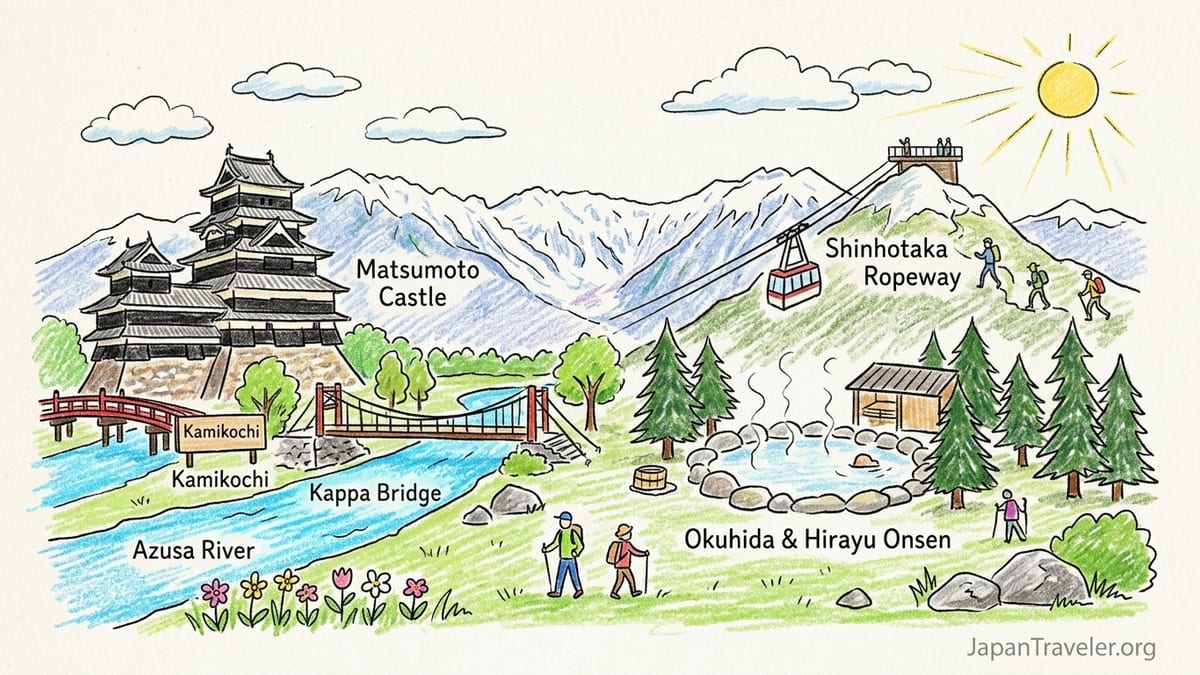
Matsumoto: The Easiest “Mountain Logic” Base (Even If It’s Not Wilderness)
I used Matsumoto as my reset button. In the Japanese Alps, it is the place where the logistics are dramatically easier than the high valleys, and that matters more than most itineraries admit. When I wanted an early start toward the mountains, I wanted a city where I could wake up, grab breakfast without stress, and be on a train or bus quickly. Matsumoto delivered that kind of trip: convenient base, approachable culture, and low-friction evenings.
I spent 2 nights in Matsumoto, and for me that was enough. I could see the castle area at a comfortable pace, and still keep one full day to position myself for the next leg. Matsumoto Castle is the obvious anchor, and it’s refreshingly straightforward to plan around because it’s a year-round, central attraction with clear visitor info and seasonal hour adjustments published by the official operators. I timed my visit for an early entry window and was glad I did because crowds and lines can build in peak travel weeks.
Reaching Matsumoto felt simple by Japanese Alps standards: it’s a true transport node, not a “hope the bus aligns” situation. I did not use a car here and didn’t miss one. Evenings were exactly what I needed after long days of transit: bright streets, plenty of casual restaurants, and the kind of walkability that lets you do a quick convenience-store run and still feel like you’re “on a trip.” The disappointment is also clear: if you are coming to Japan for raw alpine immersion, Matsumoto is not that. It is a place to sleep well, eat reliably, and set up the next morning’s move, not to step outside your hotel into wild scenery.
Kamikochi: Spectacular, Protected, And More Restrictive Than People Expect
Kamikochi gave me the “easy alpine scenery” version of the Japanese Alps, and I mean that as a compliment. The river, the peaks, and the famous walking corridors deliver instant payoff without requiring mountaineering skills. But it also gave me my clearest reminder that beautiful places can be operationally strict. Private cars are restricted inside the valley, and in practice your day is shaped by buses, ticket windows, and the rhythm of the last departures rather than your own whims.
I did Kamikochi as a long day trip rather than an overnight, and I’m glad I did it that way on my first visit. It felt like I could get a full dose of the scenery and the river walks without paying the “inside the park” lodging premium or stressing about limited evening options. The trade-off is that the day becomes structured around transport. If you like to linger until dusk or you want sunrise light without racing an early bus, that’s when an overnight starts to make sense.
Access was straightforward from the Matsumoto side using the published seasonal schedules, but it was not flexible. The bus window matters because service is seasonal and does not run year-round. I traveled with the mindset that Kamikochi would be effortless because it’s famous, then learned the more accurate truth: it’s effortless only if you accept the rules. If you want to bring your own car all the way in, you can’t, and if you want to spontaneously change plans late in the day, you may be negotiating the last bus.
My small disappointment was the feeling of being “managed” by infrastructure on a day I wanted to wander. Kamikochi is protected for good reasons, and the restrictions are part of why it stays beautiful. But it’s worth naming the trade-off honestly: this is not a valley where you drive in, pull over whenever you like, and build your own route. It’s a valley where you follow a system, then get rewarded with scenery that feels almost too perfect to be real.
Okuhida And Hirayu Onsen: My Favorite Onsen-First Mountain Base (Car Helpful, Not Mandatory)
When I wanted hot-spring evenings and a mountain-access vibe without chasing nightlife, I headed into the Okuhida area and based myself near Hirayu Onsen. This delivered my favorite “onsen plus mountains” version of the Japanese Alps: quiet nights, steam in the cold air, and the sense that you’re tucked into the folds of the range rather than skirting it.
I spent 2 nights in the Okuhida area, and I could have happily added a third if my schedule allowed. Two nights worked because it gave me one arrival evening, one full day for a major outing, and one morning where I didn’t have to sprint for a bus. In a region where travel times and connections can chew up your day, that extra slow morning felt like luxury.
This is one of the places where a car helps. Without a car, you are more dependent on bus corridors and timetables, and you need to think through which valley you’re sleeping in relative to your day trips. With a car, you gain freedom to pick a ryokan for the onsen quality and still move efficiently between trailheads and ropeway stations. I did it using buses, and it was doable, but it required more attention and earlier starts than I would need with a car.
Evenings were the point. After dinner, there isn’t much to “do” in the conventional sense, and that’s exactly why it worked. I planned for ryokan time: soaking, slow meals, and early sleep. The trade-off is that if you crave cafés, bars, or late-night wandering, this base can feel too quiet. Another trade-off is that some of the best mountain access requires additional buses or transfers, so it is not the “one ride and you’re there” simplicity that Matsumoto offers.
Shinhotaka Ropeway: Scenic Transport With A Real Alpine Feeling (But Weather Can Cancel You)
Shinhotaka Ropeway gave me the “scenic transport” day I wanted after several hiking-heavy days. I’m the first to say that ropeways can feel like a tourist shortcut, but in the Japanese Alps they also function as legitimate access to high-elevation views that would otherwise take serious effort. Shinhotaka felt like a smart compromise: big mountain payoff without committing to a full alpine route traverse.
I did Shinhotaka as a day trip from the Okuhida side, and I strongly recommend it in that format. It stacks perfectly with an onsen base because you can go up, take in the air and views, then come back down and spend the evening soaking. It’s also a day that works well when your legs need a break, or when your group has mixed ability levels and you want everyone to share a “wow” moment.
Getting there was easier from Okuhida than from a city base, but it still depended on bus timing. If you’re coming from farther away, you’ll feel the transit. One detail that stayed with me is how quickly weather can change the day. This is not the kind of attraction you can treat like a museum reservation. If conditions are poor, the experience can become “we rode up into fog,” and that is a real risk. I planned a flexible window rather than anchoring my whole trip on a single must-do time slot.
My honest trade-off: it is not a substitute for true ridge hiking if that’s what you came for. The views are incredible on a clear day, but the day still has a “managed” feel because you’re following ropeway operations. The upside is that it’s one of the cleanest ways to add altitude and drama to a Japanese Alps itinerary without adding a difficult hike.
Tateyama Kurobe Alpine Route: The Big-Budget, Big-Logistics Mountain Day I’d Still Do Again
The Tateyama Kurobe Alpine Route was the most transport-driven day of my Japanese Alps time, and also one of the most memorable. It delivered “high mountain scenery without a hike,” plus the sheer novelty of moving across the range using multiple modes of mountain transport. But it is not casual. You feel the structure: timed boarding, queues, and the pressure of keeping pace so you don’t miss connections.
I treated this as a 1-day traverse with 1 night on one side of the route before starting early, and that was enough for the experience I wanted. If I were traveling slower or if I wanted sunrise and sunset at altitude, I would consider adding an overnight near Murodo, but that is a different trip style and a different budget. For most travelers, the day traversal is the classic version: intense, scenic, and very schedule-dependent.
The reach factor is real. It is not difficult in the sense of “hard to figure out,” but it is difficult in the sense of “many steps.” To me, that’s the key distinction. The official route is seasonal, with operations running from mid-April through late November, and the official operators publish timetables and web-ticket sales schedules for specific years. If you’re the type who hates planning around fixed departure times, this route will test your patience. If you enjoy complex day trips the way some people enjoy puzzles, it will feel satisfying.
My biggest trade-off was cost and crowd pressure. This is a premium mountain experience, and the price can sting if you compare it to a normal bus-and-train day. The reward is that you get dramatic alpine terrain, engineered viewpoints, and a famous dam landscape without needing technical hiking skills. My disappointment was not the scenery, it was the feeling that I was always checking the clock. Next time, I would start even earlier and build in more slack, because the route is more enjoyable when you’re not rushing to the next vehicle.
Takayama: Culture, Crafts, And The Most Comfortable “Evenings” In My Alps Itinerary
Takayama was where I went when I wanted the Alps to feel human, not just scenic. After mountain valleys and tight transport windows, Takayama delivered the easiest evenings of my trip: strollable streets, lots of dinner choices, and that satisfying sense that you can wander without a plan and still have a good night.
I spent 2 nights in Takayama, and that was the sweet spot. One night would have felt like I only skimmed the surface, especially if you arrive midday and lose hours to check-in and settling. Two nights gave me one full day for the old-town atmosphere and food, and another day where I could use Takayama as a launch point for mountain-side trips without changing hotels.
It was also one of my easiest places to travel without a car. The bus center is set up for travelers, and the city works well on foot once you’re there. A car can be useful if you want to zigzag between remote valleys and stop at viewpoints, but in Takayama itself I didn’t need it, and parking would have been more hassle than help. The trade-off is that some of the best mountain access from this side can involve extra buses and transfers, so it’s convenient as a cultural base, but not the fastest way into the most protected wilderness.
My small disappointment in Takayama was that it can feel busy and a little “polished” in peak seasons, especially in the central walking areas. It is not a secret. But it earned its place in my itinerary because it made the Alps livable. If you want a base that blends culture with day-trip options into the mountains, Takayama is one of the easiest choices to justify.
The Takeaway: Matching My Personally Tried Stops To Your Travel Style
If your priority is easy alpine scenery with minimal skill requirements, I would steer you toward a Kamikochi day trip paired with a logistics-friendly base like Matsumoto. Kamikochi delivers the wow factor quickly, and Matsumoto makes the before-and-after days feel simple. The trade-off is accepting restrictions and schedules in the park, and accepting that your evenings are city evenings, not mountain nights.
If you want onsen-first relaxation with mountain access, the Okuhida and Hirayu Onsen area is where I’d spend your nights. It’s the version of the Alps where evenings are the main event, and where you wake up already in the mountains. The trade-off is that buses can add friction and a car helps, so it’s not the most plug-and-play base for travelers who dislike planning transfers.
If you want a big, iconic, transport-driven alpine experience without committing to serious hiking, Tateyama Kurobe Alpine Route is the day I’d tell you to budget for, and also the day I’d tell you to plan carefully. It’s spectacular, but it’s structured. You are buying into timetables and timed boarding. The trade-off is less spontaneity and a higher price for the privilege of moving through high terrain so efficiently.
If you want culture and comfortable evenings with the Alps as a backdrop, Takayama is the base I’d repeat. It’s the easiest place I stayed to enjoy dinner, take a slow walk after dark, and feel like I could travel at a human pace. The trade-off is that it’s not wilderness, and some mountain outings from here require extra transport steps. My best Japanese Alps itineraries weren’t about squeezing in every valley, they were about picking the right base for the kind of day I wanted, and then letting the region do what it does best.
FAQ
Q1. How many nights should I plan in the Japanese Alps if I want both scenery and culture?
For a balanced first trip, I’d plan about 6 to 8 nights total so you can use one city base, one onsen base, and still fit a major mountain day without rushing.
Q2. Is Kamikochi doable as a day trip, or do I need to stay overnight?
I did it as a day trip and felt satisfied, but an overnight helps if you want early-morning or late-evening light without racing the last bus.
Q3. What’s the biggest practical downside of Kamikochi?
It’s restrictive compared with other mountain areas: private cars are restricted inside the valley, and your day is shaped by shuttle transport and schedules.
Q4. Which base felt easiest for logistics?
Matsumoto felt the easiest because it functions as a true transport hub and offers straightforward evenings, even though it’s less wild than the high valleys.
Q5. Where should I stay if I care most about onsen and quiet nights?
The Okuhida and Hirayu Onsen area is the stay I’d repeat for onsen-first evenings and mountain atmosphere, with the caveat that buses can add friction.
Q6. Did you find a car necessary in the Japanese Alps?
Not necessary, but helpful in onsen valleys and for flexible day trips. In places like Matsumoto and Takayama, I found it easy to travel without one.
Q7. Is Shinhotaka Ropeway worth it if I’m not a big hiker?
Yes, it’s one of the best “high scenery without a hard hike” outings I did, but it’s weather-dependent and can be disappointing in fog or storms.
Q8. How hard is the Tateyama Kurobe Alpine Route to plan?
It’s not conceptually hard, but it’s structured. You need to respect seasonal operations, timetables, and timed boarding, especially in busy periods.
Q9. What kind of evenings did Takayama deliver compared with mountain valleys?
Takayama had the easiest evenings of my trip: lots of dinner choices and a pleasant walkable center. Mountain valleys were quieter and more ryokan-focused.
Q10. If I only choose two places, what pairing makes the most sense?
If you want convenience plus a big scenic hit, pair Matsumoto with a Kamikochi day trip. If you want culture plus relaxing nights, pair Takayama with an Okuhida onsen stay.