


Tohoku stretches across the northern part of Japan’s main island, a region of deep snow, quiet hot spring villages, coastal scenery and historic castle towns. For a first trip, the choice of destinations can feel overwhelming, especially if you are combining it with time in Tokyo or Kyoto. This guide focuses on the strongest first-time picks in each of Tohoku’s six prefectures, explaining why to go, when the region really shines, how hard each place is to reach, how long to stay and which spots link together naturally on the same route.
How to Think About a First Tohoku Itinerary
For many visitors, Tohoku is an add-on to a Japan trip focused on Tokyo and Kansai. That usually means you have three to seven days to work with, accessed via the Tohoku and Akita Shinkansen lines from Tokyo. A practical way to plan is to anchor the route around one or two cities that are easy rail hubs, such as Sendai or Morioka, then add one onsen stay and one or two heritage or nature stops within a 60 to 90 minute radius of those hubs.
Distances in Tohoku are larger than they look on the map, but the high-speed trains are fast. Tokyo to Sendai takes around 90 minutes by shinkansen in standard class, while Tokyo to Shin-Aomori is about three hours. Inside the region, local trains and buses are slower and less frequent than in central Japan. For example, the bus from Oishida Station to Ginzan Onsen runs roughly every one to two hours and takes about 35 minutes, so building in slack time is important if you are connecting from a shinkansen.
Seasonality also shapes a Tohoku itinerary more than in many other parts of Japan. Deep winter brings heavy snowfall and the classic image of steaming outdoor baths surrounded by snowbanks, but some rural buses can be limited and driving is only realistic for experienced winter drivers. Late April to early November offers more reliable public transport and hiking options. Cherry blossom season arrives later than Tokyo and Kyoto, typically from mid to late April in many Tohoku cities, and up to early May at higher elevations.
On a first visit, many travelers choose either a northbound route such as Sendai to Hiraizumi, then on to Kakunodate, Nyuto Onsen and finally Aomori, or a southbound route that starts around Aizuwakamatsu and Fukushima before looping up to Yamagata and Miyagi. With a Japan Rail Pass or JR East Tohoku Pass, it can be economical to cover multiple prefectures in four to seven days, but if you have only three days, picking one city and one onsen base is often more enjoyable than racing through every highlight.
Sendai and Matsushima: Easiest Gateway to Tohoku
Sendai is the largest city in Tohoku and the simplest entry point from Tokyo and from Sendai Airport. The city itself offers tree-lined avenues, modern shopping, the remains of Sendai Castle, and a well-developed hotel scene at a wide range of prices, from business hotels near the station to higher-end properties with larger rooms. It also functions as a relaxed base for day trips rather than as a sightseeing destination in its own right, which is ideal for travelers easing into the region after a long international flight.
Matsushima, about 30 minutes by local train from Sendai Station on the JR Senseki Line, is considered one of Japan’s classic scenic views. Around 260 small pine-covered islands dot Matsushima Bay, and visitors typically combine a bay cruise with visits to Zuiganji and Entsuin temples plus a walk across the red bridge to Fukuura Island. A standard sightseeing cruise ticket is typically priced in the low thousands of yen per adult and runs about 50 minutes, operating throughout the day in most seasons.
Spring and autumn are particularly attractive seasons for Sendai and Matsushima. In April, cherry blossoms frame the ruins of Sendai Castle and line the rivers, while in late October and early November, the mossy gardens of Zuiganji and Entsuin turn deep shades of red and gold. Summer is warm and humid but coastal breezes make Matsushima pleasant, and the famous Sendai Tanabata Festival in early August fills the city with elaborate paper decorations. Winter can be crisp but generally less extreme than inland Tohoku, and rail connections usually remain reliable.
Access to both Sendai and Matsushima is straightforward, which makes them a natural introduction for first-time visitors to Tohoku. From Tokyo Station, frequent shinkansen services reach Sendai without changes. From Sendai, you can day trip to Matsushima, then continue north by rail to Hiraizumi or Morioka the following day. Many travelers find that two nights in Sendai are enough: one full day for Matsushima and city wandering, another for onward travel or a secondary day trip such as the hillside temple town of Yamadera in neighboring Yamagata Prefecture.
Hiraizumi: World Heritage Temples and Quiet Countryside
Hiraizumi, in Iwate Prefecture, offers one of Tohoku’s most significant historical landscapes. It flourished in the 11th and 12th centuries as the capital of the Oshu Fujiwara clan and is today recognized as a UNESCO World Heritage site. The main draw is Chusonji, a temple complex on a forested hilltop that culminates in the golden Konjikido hall, along with Motsuji and its Pure Land garden. The atmosphere is rural and contemplative, very different from the crowds of Kyoto’s major temples.
Hiraizumi is most enjoyable in spring and autumn. In late April, cherry trees around Motsuji’s pond reflect in the water, while October and early November bring vivid foliage to the temple approaches and surrounding rice fields. Summer can be hot but remains green and quiet, while winter visits can be atmospheric with light snow on the thatched roofs and temple paths. Unlike more remote mountain destinations, access roads and trains to Hiraizumi are generally maintained year-round, although snowy days may still slow local transport.
From Sendai Station, a common route is to take the Tohoku Shinkansen to Ichinoseki, then transfer to the local JR Tohoku Line for the short hop to Hiraizumi. Total travel time is roughly one to one and a half hours depending on connections, and this makes Hiraizumi feasible as a long day trip from Sendai. However, an overnight stay in nearby Ichinoseki or a local ryokan allows a slower pace and dinner featuring regional dishes such as wanko soba or Maesawa beef in Iwate.
In a broader Tohoku itinerary, Hiraizumi combines naturally with both Sendai and Akita-bound destinations. A realistic pattern would be to spend one or two nights in Sendai, then move to Hiraizumi or Ichinoseki for a night, visiting the temples the afternoon you arrive and finishing any remaining sites the following morning. From there, you can continue north by shinkansen to Morioka or west toward Kakunodate in Akita Prefecture, using the same rail corridor rather than backtracking.
Yamagata Highlights: Ginzan Onsen and Yamadera
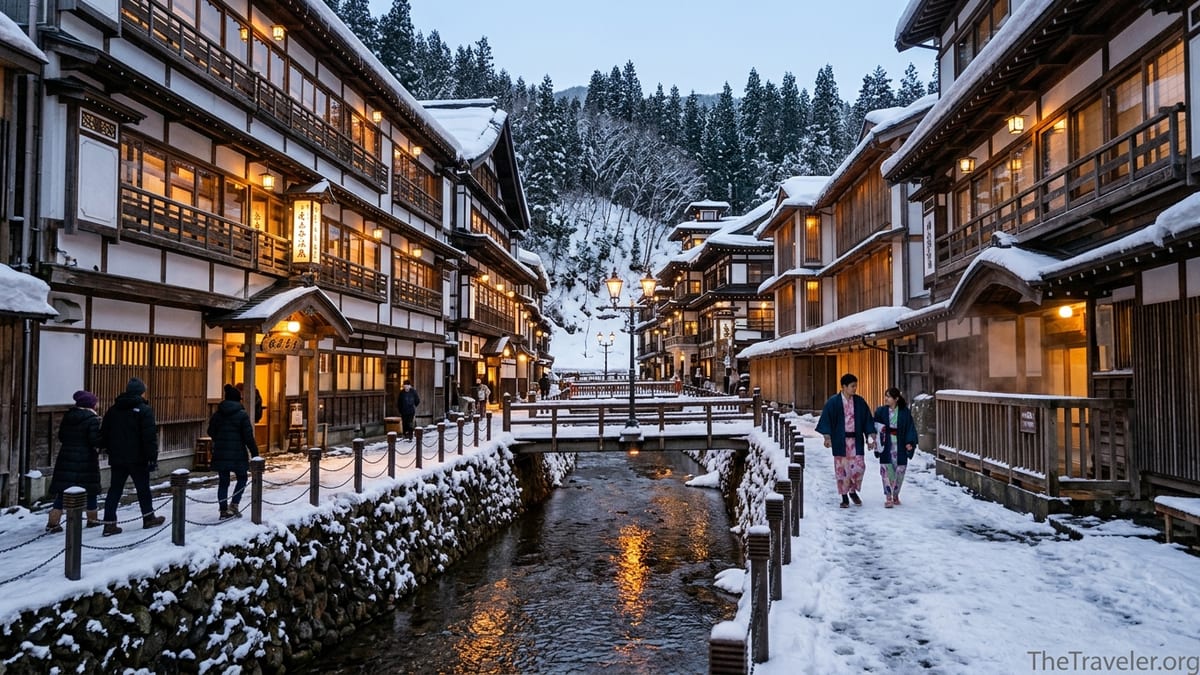
Yamagata Prefecture offers a classic combination of mountain onsen and dramatic hillside temples. Ginzan Onsen is one of Japan’s most photographed hot spring towns, a narrow valley lined with wooden Taisho era ryokan facing a small river. In winter, the multi-story timber inns are capped with thick snow, while gas lanterns and warm interior lights reflect off the water and snowbanks. Access is via shinkansen from Tokyo to Oishida Station, about three and a half hours depending on train type, then a bus ride of around 35 minutes up into the hills.
Winter, roughly from late December to early March, is widely considered the most magical season in Ginzan Onsen. Heavy snowfall transforms the entire village into a snow-globe scene, but this is also the busiest period, with ryokan rates often running from the low 20,000s of yen per person including dinner and breakfast at the more modest properties, and significantly higher at the most famous inns. Spring and autumn offer a quieter alternative, with melting snow in April and May and colorful foliage in October and early November. Summer is less visited but can be appealing for travelers who prefer greenery over snow and are willing to travel in warmer weather.
Recent seasons have seen Ginzan Onsen introduce limits on day-trippers during peak times, because the village is small and has only limited bathing facilities for non-staying guests. That makes an overnight stay the most rewarding way to experience it. Most visitors find that one night is enough, arriving by afternoon, walking the short main street, soaking in the baths and then enjoying kaiseki style dinner at their ryokan. The next morning, you can walk short forest trails to the old silver mine site and waterfalls before catching a mid-morning bus back to Oishida.
Yamadera, officially Risshakuji, complements Ginzan Onsen perfectly and is much easier to access. Located about 20 to 40 minutes by local train from Yamagata Station, Yamadera is built into a steep mountainside, with around a thousand stone steps leading up through cedar forest to wooden halls clinging to the cliffs. Many visitors go as a half-day trip from Sendai or Yamagata. Summer and autumn are particularly beautiful, with green valleys or red and gold leaves spreading out below the upper viewing platforms. In a first-time itinerary, you might spend a night in Yamagata city, visit Yamadera in the morning, then continue to Ginzan Onsen for an overnight stay, or base in Sendai and do Yamadera as a day trip before a separate night in Ginzan.
Akita’s Heritage and Hot Springs: Kakunodate and Nyuto Onsen
Akita Prefecture offers a balance of well-preserved samurai history and secluded hot spring experiences. Kakunodate, known as “Little Kyoto of Tohoku,” is a former castle town with a samurai district of dark wooden residences along broad streets. Several houses are open to the public, furnished with armor, household tools and gardens that give a sense of life in the Edo period. In late April and early May, cherry trees along the nearby riverbank and inside the samurai quarter create one of Tohoku’s most famous blossom displays, drawing visitors from across Japan.
Kakunodate is conveniently located on the Akita Shinkansen line, roughly three hours from Tokyo and about 40 minutes from Morioka. This makes it easy to visit even on a tight schedule. A common pattern for rail travelers is to arrive around midday, store luggage in station coin lockers or at a tourist information counter, and walk 10 to 20 minutes to the samurai district for an afternoon visit before returning to the station or checking into a local inn. Outside blossom season, Kakunodate is much quieter, and a half day is usually sufficient for most first-time visitors.
Nyuto Onsen, by contrast, offers a set of rustic hot spring lodges scattered in the forests near Lake Tazawa. The onsen area consists of several ryokan, some with mixed outdoor baths and milky, mineral-rich waters. Buses run from Tazawako Station, on the same Akita Shinkansen line as Kakunodate, up to Nyuto Onsen, but services are limited and journey times are around 45 to 60 minutes depending on route and stop. In winter, snow piles high around the outdoor baths, creating the quintessential Tohoku onsen scene, while autumn brings colorful leaves over the valleys.
Many travelers link Kakunodate and Nyuto Onsen in a one or two night loop. One practical approach is to visit Kakunodate for several hours after arriving by shinkansen, then continue by local train to Tazawako and onward by bus to a Nyuto ryokan for one or two nights. Another is to reverse the order, spending a night or two soaking in Nyuto’s baths before using Kakunodate as a half-day stop on the way to your next city. For Nyuto, at least one full day and one night is recommended because check-in times are mid-afternoon and dinner is served early in the evening, often around 18:00, leaving little time for baths if you arrive late.
Aomori’s Nature and Castle Town Charm: Oirase and Hirosaki
Aomori Prefecture anchors the northern end of Tohoku with deep forests, clear streams and one of Japan’s atmospheric castle towns. The Oirase Gorge is a 14 kilometer stretch of river connecting Lake Towada to lower valleys, lined with waterfalls, mossy rocks and walking trails. During the green season from late May through October, buses run along the gorge with frequent stops so visitors can walk shorter sections between trailheads and use the bus to skip others. Autumn foliage, usually peaking in late October, turns the entire gorge into a corridor of red and yellow leaves, making it one of Tohoku’s classic nature walks.
Reaching the Oirase area typically involves taking a shinkansen to Shin-Aomori or Hachinohe and then transferring to a highway bus toward Lake Towada and Oirase. The bus ride can take around two hours from Hachinohe, so many travelers choose to spend at least one night at a lakeside hotel or a ryokan near the gorge trail to avoid rushing. Room rates for lakeside properties vary widely but expect typical onsen hotel pricing, often in the low to mid range of tens of thousands of yen per person, including meals in high season.
Hirosaki, about 40 minutes by limited express or local trains from Aomori city, provides a strong contrast with its well-preserved castle grounds, traditional streets and café culture. Hirosaki Castle is famous for its cherry blossoms, with moats filled with petals in late April, while autumn illuminations in the castle park highlight the maples. The compact city center makes it easy to explore on foot, from old samurai residences to local coffee shops housed in early 20th century buildings. Winter brings heavy snow and a seasonal snow lantern festival in the castle park, which can be a memorable experience for those prepared for cold weather.
In a first-time route, Oirase and Hirosaki often appear at the northern end of a Tohoku loop. For example, you might travel from Sendai to Hiraizumi, then to Kakunodate and Nyuto Onsen, before continuing by shinkansen to Hachinohe and bus to Oirase, finishing with a night in Hirosaki or Aomori city. Another option is to fly into Aomori or nearby airports and focus only on Aomori Prefecture and neighboring Akita. In both cases, allow at least one full day for Oirase and Lake Towada, plus a half to full day for Hirosaki, which means two to three nights in the northern Tohoku region.
Fukushima’s Historic Routes: Aizuwakamatsu and Ouchijuku
Fukushima Prefecture, forming Tohoku’s southern gateway, offers a compelling mix of samurai history and old post towns. Aizuwakamatsu is a castle town known for Tsuruga Castle, samurai residences, and its role in the Boshin War in the late 19th century. The castle tower houses exhibits on the area’s history and offers views over the city, especially attractive in cherry blossom season around April, when pale pink trees surround the white walls. Sake breweries and small shops selling lacquerware and local crafts add to the appeal of wandering the town.
Ouchijuku, about an hour by bus from Aizuwakamatsu or regional train stations depending on route, is a preserved Edo period post town with thatched-roof houses lining a gently sloping street. Many of the houses now operate as soba restaurants, inns and souvenir shops, but the overall feel remains that of a rural highway stop from centuries past. Visitors typically climb a short hillside behind the town for a view back over the thatched roofs. The signature local dish is negi soba, eaten with a long green onion used as both garnish and chopstick, and priced similarly to standard soba dishes at countryside eateries.
Spring and autumn are the most comfortable seasons for Aizuwakamatsu and Ouchijuku, with cherry blossoms and fresh greens from April into May, and foliage coloring the nearby hills from late October. Winter brings a different charm: the Ouchijuku Snow Festival in February, when the thatched roofs are covered in snow and lit by lanterns, is a highlight for photographers and those seeking a classic snowscape. However, winter access can be affected by snow, so checking current transport conditions and building in extra time for buses is important if you are traveling without a car.
In terms of logistics, Aizuwakamatsu is usually reached by limited express or local trains from Koriyama, which in turn sits on the Tohoku Shinkansen line between Tokyo and Sendai. This means it meshes easily with broader Tohoku itineraries. For a first-time trip, one or two nights in Aizuwakamatsu let you visit Tsuruga Castle, samurai residences, and nearby onsen areas, plus enjoy a half-day or full-day excursion to Ouchijuku. From there, you can loop north toward Yonezawa and Yamagata city, or return to Koriyama to rejoin the main shinkansen corridor toward Sendai or Tokyo.
Combining Routes Across All Six Prefectures
Putting the pieces together, a first Tohoku trip is often about balancing ambition with realistic travel times. One classic five to seven day rail route starts in Tokyo and heads first to Sendai for two nights, using one day for Matsushima and perhaps Yamadera. From there, you might continue to Hiraizumi and spend a night near Ichinoseki, then move on to Kakunodate for a half day of samurai houses before staying in Nyuto Onsen. Finally, you could end in Aomori Prefecture, with one night near Oirase Gorge or Lake Towada and a last night in Hirosaki or Aomori city before returning to Tokyo by shinkansen.
A different pattern uses Fukushima and Yamagata as the core. You could travel from Tokyo to Koriyama and on to Aizuwakamatsu for two nights, visiting Ouchijuku on a day trip. From Aizuwakamatsu, move north by local trains and buses to Yonezawa or Yamagata city, spend a day at Yamadera, then finish with an overnight stay at Ginzan Onsen before returning to Tokyo via the Yamagata Shinkansen. This south-central loop suits travelers who prefer shorter hops and more time in each destination rather than covering every corner of the region.
Access difficulty varies across the destinations mentioned. Cities and larger towns such as Sendai, Aizuwakamatsu, Kakunodate and Hirosaki are easy to reach by rail, with frequent services throughout the day. Heritage sites like Hiraizumi and Matsushima require simple local train transfers. More remote onsen areas, including Ginzan Onsen, Nyuto Onsen and parts of the Oirase region, depend on buses that may run only a few times per day in shoulder seasons. Booking accommodation ahead and checking current bus timetables just before travel reduces the chance of missed connections, especially in winter.
Minimum useful stays are also worth considering. For the cities and major towns on this list, one to two nights each is usually enough for a first visit. For onsen villages, one night can be sufficient if you arrive by mid-afternoon and leave late the following morning, but two nights allow time for slower bathing, short walks and recovery from long travel days. By combining a few one-night city stops with one or two two-night onsen stays, you can experience both the movement of a rail journey and the slower rhythm that makes Tohoku special.
The Takeaway
Tohoku rewards travelers who are willing to trade a little convenience for quieter landscapes and deeper seasonal experiences. A well-planned first trip might include Sendai and Matsushima for an easy coastal introduction, Hiraizumi for World Heritage temples, Ginzan Onsen and Yamadera for Yamagata’s mountain atmosphere, Kakunodate and Nyuto Onsen for Akita’s samurai streets and rustic baths, Oirase and Hirosaki for Aomori’s forests and castle park, and Aizuwakamatsu with Ouchijuku for Fukushima’s historical routes. You do not need to visit every one of these in a single journey, but understanding how they fit together helps you choose the ones that match your interests.
By aligning your route with the seasons, factoring in realistic travel times, and building in at least one stay where the priority is simply soaking in an outdoor bath and watching snow or leaves fall, you get closer to why many people fall in love with Tohoku. The region feels both distinctly Japanese and slightly apart from the country’s busiest circuits. Whether you come for winter snowscapes, late-blooming cherry blossoms, or quiet temple paths in the rain, the right combination of places across its six prefectures can turn your first visit into the start of a longer relationship with northern Japan.
FAQ
Q1. How many days do I need for a first trip to Tohoku?
Most first-time visitors find that four to seven days is enough to visit two or three regions, such as Sendai and Matsushima plus one onsen stay and one heritage town. With less than four days, it is usually better to focus on a single hub like Sendai or Aomori with one nearby side trip.
Q2. What is the best season to visit Tohoku for onsen and scenery?
Winter from late December to early March is ideal for snow-covered onsen villages like Ginzan Onsen and Nyuto Onsen, while late April brings cherry blossoms to towns such as Kakunodate and Hirosaki. Autumn from late October into early November is excellent for foliage in Oirase Gorge, Hiraizumi and temple sites like Yamadera.
Q3. Is it realistic to visit Ginzan Onsen as a day trip from Tokyo?
It is technically possible using the Yamagata Shinkansen to Oishida and a bus to Ginzan Onsen, but total travel time in each direction is around three and a half to four hours, leaving little time on the ground. For most travelers, an overnight stay is more relaxing and allows you to experience the lantern-lit streets after day visitors leave.
Q4. Can I combine Kakunodate and Nyuto Onsen in one night?
It is possible to visit Kakunodate for a few hours and then continue on to Nyuto Onsen for a single overnight, especially if you arrive by shinkansen before midday. However, this can feel rushed. Many travelers prefer to spend one night in Nyuto Onsen and treat Kakunodate as a half-day stop either on the way in or on the way out.
Q5. Do I need to rent a car to enjoy Tohoku?
A car offers more flexibility, especially for rural onsen and lake areas, but is not essential. All of the destinations in this guide are reachable by a combination of shinkansen, local trains and buses. In winter, public transport is often safer for those without experience driving in heavy snow.
Q6. How far in advance should I book ryokan in places like Ginzan Onsen and Nyuto Onsen?
For peak seasons such as winter weekends, New Year and major holidays, booking three to six months ahead is common, especially for famous ryokan with limited rooms. Outside peak periods, one to two months’ notice is often enough, but small properties can still fill early on Saturdays and during local festivals.
Q7. Are Tohoku’s onsen towns suitable for travelers with tattoos?
Policies vary by property. Some traditional ryokan still restrict visible tattoos in shared baths, while others have become more flexible or offer private baths that can be reserved by the hour. If you have tattoos, it is worth emailing or calling ahead, or choosing accommodation that explicitly welcomes tattooed guests.
Q8. Which destinations in Tohoku work best for families with children?
Sendai and Matsushima are easy for families, with short train rides, boat cruises and plenty of casual dining. Hirosaki’s castle park, Oirase Gorge’s shorter walking sections, and onsen hotels with family rooms near Lake Towada or Nyuto Onsen can also work well, provided children are comfortable with basic onsen etiquette.
Q9. Is the JR East Tohoku area rail pass good value for this kind of itinerary?
If you plan to ride shinkansen or limited express trains on at least four or five separate days within its validity period, the JR East Tohoku area pass can offer good savings compared with individual tickets. For shorter trips that focus on one area such as Sendai and Matsushima, regular tickets or local passes may be more economical.
Q10. How should I pack for a winter trip to Tohoku?
For winter visits, especially to Ginzan Onsen, Nyuto Onsen or Oirase, pack waterproof boots with good traction, warm layers, gloves, a hat and a wind-resistant outer jacket. Many ryokan provide indoor yukata and coats for moving between buildings, but you will still need proper outdoor gear for walking to stations, buses and viewpoints in snow and ice.