


The Tokai region sits between Tokyo and Kyoto and is one of Japan’s most rewarding areas for travelers who like to mix mountains, hot springs, coastal scenery and big-city food. With shinkansen access via Nagoya and multiple scenic branch lines, it is ideal if you want a slower, more atmospheric alternative to the classic Tokyo–Kyoto dash. This guide compares the main Tokai destinations – from Takayama and Shirakawa-go to Mount Fuji, Izu, Gero Onsen, Nagoya, Ise-Shima and nearby Inuyama and Toba – so you can choose the right bases, understand transport difficulty, and stitch them into a realistic itinerary.
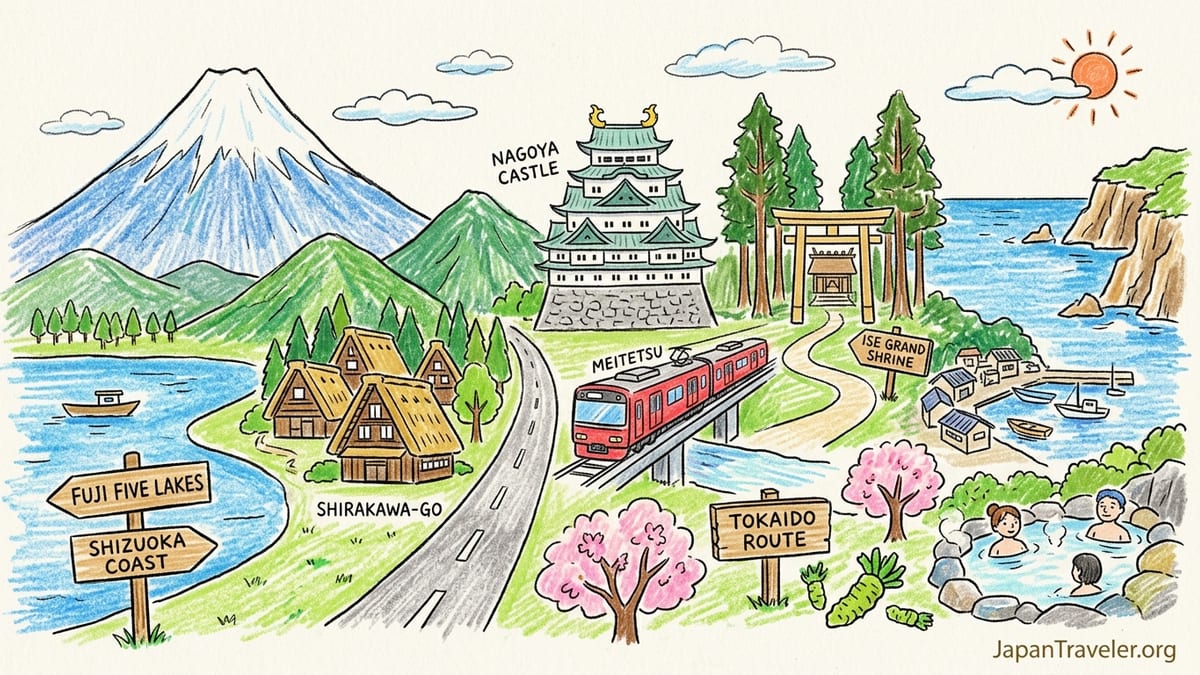
How to Use This Tokai Destination Guide
Think of Tokai as a web with Nagoya at the center. From Nagoya you can fan out to the Hida mountains for Takayama, Shirakawa-go and Gero Onsen, or head southeast for Ise-Shima and Toba. The Mount Fuji area is best reached from Tokyo, while Izu works naturally as a coastal detour between Tokyo and Nagoya or as a loop out of Tokyo before continuing west. Rather than trying to “collect” every stop, pick two or three hubs that match your interests and travel pace.
For each destination below you will find its strongest reason to visit, transport difficulty, realistic minimum stay, ideal seasons and the nearby places it combines best with. Transport notes focus on what a first-time visitor is likely to experience in practice: for example, whether you are dealing with reserved-seat highway buses that sell out in peak leaf season around Takayama, or frequent shinkansen trains that can be decided on the day between Tokyo and Shizuoka.
Prices and timings here are ballpark examples based mainly on current timetables and typical limited express or shinkansen fares in 2025–2026. Always cross-check the latest schedules before you commit, especially for mountain buses and seasonal services that can change from year to year.
Takayama & Shirakawa-go: Classic Historic Mountain Japan
Strongest reason to visit: Takayama and nearby Shirakawa-go offer some of Japan’s most atmospheric historic streets and thatched-roof farmhouses in a compact, easily walkable mountain setting. In Takayama’s Sanmachi Suji district you can wander preserved Edo-period merchant houses, sample Hida beef skewers from street stalls, and step into sake breweries for tastings. Shirakawa-go’s gassho-zukuri farmhouses, many operating as minshuku, give a rare chance to sleep surrounded by traditional architecture and mountain scenery.
Transport difficulty: Takayama is straightforward by rail: from Nagoya, JR limited express trains on the Takayama Line take around 2 hours 20 minutes with reserved seats recommended in busy seasons. From Tokyo, a typical route is shinkansen to Nagoya then the same express north, taking about 4.5 to 5 hours door to door. Shirakawa-go is more involved, as access is by highway bus from Takayama, Kanazawa or Nagoya with limited departures and mandatory seat reservations in peak times. Buses from Takayama are roughly 50 minutes to 1 hour, while from Nagoya or Kanazawa you are looking at about 2.5 hours. Winter snow and busy autumn weekends can lead to sold-out buses, so plan Shirakawa-go dates early.
Useful minimum stay & season: For Takayama, one night gives you time to explore the old town and visit the Miyagawa morning market, but two nights is more comfortable if you want to add a half-day trip to Hida Folk Village or a full-day side trip to Shirakawa-go. Many travelers do Shirakawa-go as a 4–6 hour stop on the way between Takayama and Kanazawa, but an overnight farmhouse stay gives a quieter experience once day-trippers depart. Spring and autumn are ideal for pleasant temperatures and festivals; the Takayama Spring Festival in mid-April and the Autumn Festival in October fill the town and push up prices and availability. In winter, expect deep snow, occasional bus disruption and magical thatched roofs lit up at night on special illumination dates, which require even more advance planning.
Best combinations: Takayama combines naturally with Shirakawa-go and the wider “Japanese Alps” circuit including Kanazawa and Matsumoto. From Nagoya, a popular loop is Nagoya → Takayama → Shirakawa-go → Kanazawa → Kyoto or Tokyo. Gero Onsen on the same JR line makes for an easy hot-spring night either before or after Takayama. Confident drivers sometimes rent a car at Takayama Station to explore more remote villages, but in winter you should be prepared for snow and possibly icy mountain roads.
Nagoya: Food Hub, Castles and Urban Convenience
Strongest reason to visit: Nagoya is Tokai’s transport heart and a seriously underrated city for food and modern attractions. Many visitors treat it as a transfer point, but it rewards at least a full day for local specialties like hitsumabushi (grilled eel over rice), miso katsu (pork cutlet with rich red miso sauce) and tebasaki chicken wings at chains such as Sekai no Yamachan, which are especially popular with travelers looking for a casual late-night meal. Nagoya Castle and its rebuilt Honmaru Goten palace offer a polished introduction to samurai history, while newer draws like the Nagoya City Science Museum with its planetarium and the Ghibli Park just outside the city give families and pop-culture fans a reason to linger.
Transport difficulty: As a major shinkansen stop on the Tokaido line, Nagoya is one of Japan’s easiest cities to reach. It is about 1 hour 40 minutes from Tokyo by Nozomi, a little longer on slower services, and under 1 hour from Kyoto. Central Japan International Airport (Centrair) is connected by frequent μ-SKY limited express trains taking around 30 minutes into the city. Within Nagoya, subways and local private railways like Meitetsu make reaching outlying attractions relatively simple; day-trippers often use Meitetsu trains to Inuyama or Kintetsu or JR lines down toward Ise-Shima.
Useful minimum stay & season: If you are using Nagoya mainly as a hub for the Alps, Ise-Shima or Gero, an overnight stay gives you time for one or two key sights and a proper meal. Two nights work well if you want a full day for the Ghibli Park or to combine Nagoya Castle, Osu shopping district and a food-focused evening. Nagoya is essentially a year-round destination; summers can be hot and humid, while winter is cold but not usually extreme compared with mountain areas. During Golden Week, New Year and major events at nearby venues, hotel prices climb and central restaurants can require longer waits.
Best combinations: The city is the obvious connector for Takayama, Gero, Inuyama and Ise-Shima. A popular pattern is to fly into Nagoya, spend one or two nights tasting local cuisine and visiting Nagoya Castle, then head north to Takayama or Gero, before looping back through Nagoya toward Ise-Shima and on to Kyoto or Tokyo. Thanks to the dense rail network, Nagoya also pairs neatly with Kiso Valley post towns like Magome and Tsumago for travelers tracing sections of the old Nakasendo route.
Yamanashi & Shizuoka: Choosing a Mount Fuji Base
Strongest reason to visit: Yamanashi and Shizuoka flank Mount Fuji on the north and south sides and give very different Fuji experiences. On the Yamanashi side, the Fuji Five Lakes area around Kawaguchiko is focused on lakeside views and easy access to the Fuji Subaru Line 5th Station for climbers in summer. The Shizuoka side offers coastal and city viewpoints such as Nihondaira near Shizuoka City or Miho no Matsubara, along with routes up to the Fujinomiya or Gotemba trailheads. Travelers who want to climb Fuji typically base themselves for a night near Kawaguchiko or Fujinomiya, while those more interested in scenic views pair a Shizuoka stop with onward travel to Nagoya or Kyoto by shinkansen.
Transport difficulty: Yamanashi’s Kawaguchiko area is most commonly reached from Tokyo by a mix of JR or private railway and local lines, often via Otsuki, taking around 2 to 2.5 hours depending on transfers. Buses from Shinjuku add another convenient option. Shizuoka City and nearby Fuji or Shin-Fuji Stations sit directly on the Tokaido Shinkansen, usually around 1 to 1.5 hours from Tokyo and under 1 hour from Nagoya. From these shinkansen stops, local trains or buses take you toward trailheads or viewpoints. Access to actual climbing routes is highly seasonal, with private car restrictions on some roads during official climbing months and mandatory use of shuttle buses from designated parking areas.
Useful minimum stay & season: If you just want Fuji views from trains and viewpoints, an overnight stop in either Kawaguchiko or Shizuoka City can be enough. Climbers often spend one night near the trailhead and one night on the mountain in a hut, though some attempt the climb in a single long push overnight from the 5th station and back. The official climbing season usually runs from early July to early September, with specific dates and any private vehicle restrictions changing slightly each year depending on conditions. Outside this window, most huts are closed and routes can have snow or ice, so independent climbs are not recommended. For photography and relaxed lake walks, clear winter days from December to February can offer some of the sharpest views, albeit with colder temperatures.
Best combinations: A classic route is Tokyo → Fuji Five Lakes or Shizuoka → Nagoya, using the shinkansen between Shizuoka and Nagoya before transferring north to Takayama or west to Kyoto. Travelers with more time sometimes create an arc: Tokyo → Kawaguchiko → Matsumoto → Takayama → Nagoya, capturing both Fuji and the Alps. Shizuoka also combines well with Izu, as many limited express and local trains from Tokyo pass through Atami or Mishima on the way south to Izu Peninsula resorts.
Izu Peninsula: Beaches, Onsen and Slow Coastal Days
Strongest reason to visit: The Izu Peninsula is where many Tokyoites go for weekend hot-spring breaks and beach escapes. Eastern Izu towns like Atami and Ito offer classic seaside resort vibes, while the interior Shuzenji area is a small onsen town with a bamboo grove and historic temple, especially attractive for travelers who prefer riverside walks to big hotel complexes. Southern Izu has some of the region’s best beaches, including white-sand coves that feel far away from the Tokaido shinkansen corridor.
Transport difficulty: Compared with alpine areas, Izu is relatively easy to reach but demands more time for local transfers. Shinkansen trains from Tokyo to Atami or Mishima generally take under 1 hour, after which you transfer to local or limited express services down the peninsula. For instance, reaching Shuzenji from Mishima on the local line is roughly 30 to 40 minutes, while trains toward Ito or Shimoda on the coast follow the rugged shoreline and are often part of the scenic appeal. Services are reasonably frequent, but because Izu is a popular weekend destination for domestic visitors, limited express seats can sell out on Friday evenings and Sunday afternoons.
Useful minimum stay & season: Two nights is a comfortable minimum if you want to actually relax rather than simply check into a ryokan, bathe and leave again. With two nights in Shuzenji, for example, you can spend one day walking along the Katsura River and bamboo forest and another doing a loop by bus or car to nearby viewpoints or wasabi farms. Beach-focused visitors in southern Izu often plan three nights or more to account for possible cloudy days or afternoon showers. Summer is peak beach season, particularly during Japan’s school holidays in late July and August, while spring and autumn are less crowded and still pleasant for onsen and coastal walks. Winter stays can be very atmospheric, with crisp air and clear Pacific views from outdoor baths.
Best combinations: Izu works naturally either as a detour between Tokyo and Nagoya or as a loop out of Tokyo before continuing west to Shizuoka, Fuji and on to Nagoya. One realistic sequence is Tokyo → Atami or Ito → Shuzenji → return to Mishima → Nagoya by shinkansen → Takayama or Ise-Shima. For drivers, a counterclockwise loop of the peninsula, watching for narrow coastal roads and slower speeds, lets you sample several onsen towns and viewpoints before handing the car back at Mishima or Atami.
Gero Onsen: Dedicated Hot-Spring Retreat
Strongest reason to visit: Gero Onsen is often ranked among Japan’s classic hot spring towns and is ideal if you want to slow down between more intense sightseeing days in Takayama or the Kiso Valley. The town is compact along the Hida River, with large ryokan lining the bank and smaller public baths dotted through side streets. Many ryokan provide riverside rotenburo baths, elaborate kaiseki dinners and yukata for strolling the town in the evening. Travelers who find Hakone crowded or expensive sometimes prefer Gero’s quieter, more local atmosphere.
Transport difficulty: Gero is located on the JR Takayama Main Line between Nagoya and Takayama, which makes it relatively simple to slot into a rail itinerary. From Nagoya, limited express trains typically take around 1 hour 40 minutes to 2 hours to reach Gero, while from Takayama it is under 1 hour southbound. Some travelers use local trains to save money at the cost of longer journey times. Once in town, you can walk from the station to most ryokan within 10 to 15 minutes, though several higher-end properties offer station pick-up. Because there is no shinkansen stop, you always connect via Nagoya or occasionally via other regional hubs if coming from the north.
Useful minimum stay & season: One night in Gero can be enough to soak in the hot springs and enjoy a full dinner-and-breakfast ryokan experience, but two nights will let you try multiple baths, wander the small streets, and possibly use a local onsen pass that grants access to several facilities. Gero is particularly appealing in winter when snow dusts surrounding hills and the hot water feels most restorative, and in shoulder seasons when it is less crowded than more famous hot spring areas. Summer can be fairly hot, though riverside breezes and evening baths still hold appeal.
Best combinations: Gero slots perfectly between Nagoya and Takayama for travelers wanting to break up the journey and add a pure relaxation segment. A classic pairing is Takayama for two nights, Gero for one or two nights, then back to Nagoya and on to Ise-Shima or Kyoto. It also works as a hot-spring complement to a Kiso Valley hike, since you can route via Nagoya and then up the Takayama Line, although the cross-connections in the mountains are not as simple as they appear on the map and are usually best planned as separate segments rather than a tight loop.
Ise-Shima, Inuyama & Toba: Shrines, Coast and Castles
Strongest reason to visit: The wider Ise-Shima area in Mie Prefecture is Japan’s spiritual heartland, anchored by Ise Grand Shrine, one of the country’s most important Shinto sites. Walking under the cryptomeria trees between the inner and outer shrines feels very different from visiting busy urban temples. Nearby, the coastal town of Toba and the Shima Peninsula offer rugged bays, pearl-cultivation history and small fishing communities. North of Nagoya in Aichi Prefecture, Inuyama adds one of Japan’s few remaining original wooden castles and a pretty riverside setting, making it a satisfying day trip if you like compact historic towns.
Transport difficulty: From Nagoya, access to Ise-Shima is by Kintetsu or JR trains, with many visitors preferring the faster limited express services on the private Kintetsu line. Typical journey times from Nagoya to Ise or Toba are around 1.5 to 2 hours, depending on the train type and stops. There is no shinkansen station in Ise-Shima, so long-distance travelers almost always route through Nagoya first. Once in the region, local trains and buses connect Ise, Toba and Shima’s scattered viewpoints; services are reasonably good but not as frequent as in major cities, so it helps to note return times if you visit more remote observation decks. Inuyama is significantly easier: Meitetsu limited express trains from central Nagoya reach Inuyama Station in roughly 25 to 30 minutes, and it is a 15 to 20 minute walk or short taxi ride to the castle and old streets.
Useful minimum stay & season: For Ise-Shima, two nights is a practical minimum if you want a full day at Ise Grand Shrine and another to explore Toba or the Shima coast. Some travelers stay in Toba seaside ryokan, enjoying seafood kaiseki with locally harvested shellfish and pearls featured in the hotel shops. Inuyama can be comfortably done as a day trip from Nagoya, even allowing time to explore the castle keep, riverside promenade and perhaps an evening riverside cormorant fishing viewing boat in summer, if available. The shrine forests of Ise are appealing year-round, though high summer can be hot and humid; spring and autumn bring milder temperatures, and New Year or festival periods see large domestic crowds.
Best combinations: One common pattern is Nagoya → Ise-Shima (Ise or Toba) → return to Nagoya → Takayama, which balances coastal and mountain experiences. Inuyama day trips slot naturally into any Nagoya stay and can even serve as a soft landing on your arrival day if you land at Centrair in the morning and check into a Nagoya hotel by lunchtime. Travelers who like to minimize hotel changes sometimes base themselves in Nagoya for four or five nights and do Ise-Shima, Inuyama and perhaps Gero as separate day or overnight excursions.
Putting It Together: Sample Pairings and Practical Tips
When you compare these destinations, the key trade-off is between depth and breadth. Travelers with about 7 to 10 days in central Japan often pick one mountain base (Takayama or Gero, plus perhaps Shirakawa-go) and one coastal or shrine base (Ise-Shima or Izu), using Nagoya as the rail hub. For example, you might fly into Nagoya, spend one night exploring local food, then take the limited express north for two nights in Takayama, a side trip or overnight at Shirakawa-go, and then route back via Gero Onsen for a night of hot springs before returning to Nagoya and continuing south to Ise-Shima or west to Kyoto.
If Mount Fuji views or climbing are a priority, consider entering Japan via Tokyo and starting with Yamanashi or Shizuoka before continuing to Nagoya and deeper into Tokai. A two-week itinerary might look like this in practice: Tokyo → Kawaguchiko for Fuji views → Matsumoto → Takayama and Shirakawa-go → Nagoya → Ise-Shima → Kyoto. In such a plan, Gero Onsen or Izu become optional extras depending on whether you prefer more onsen time or more coastal scenery. Careful pacing matters: mountain bus links and rural trains do not always line up perfectly, so avoid planning same-day connections that rely on tight windows between highway buses and limited express trains.
Cost-wise, individual tickets often make more sense than national rail passes in this specific region, especially as some of the key routes, such as buses to Shirakawa-go or private railways to Ise-Shima, are not covered by nationwide passes. Instead, look for regional tickets from JR Central, Kintetsu or local bus companies that bundle common routes, and always factor in the value of flexibility when deciding whether to pre-book everything or to keep some segments open for weather-dependent decisions, particularly around Mount Fuji and beach days on Izu.
FAQ
Q1. If I only have three full days, which Tokai base should I choose?
If you have just three days, base yourself in either Takayama or Nagoya. Takayama gives you historic streets and easy access to mountain scenery, while Nagoya offers efficient day trips to Inuyama or Ise plus excellent food. Trying to include both the Alps and Ise-Shima in three days usually leads to rushed transfers.
Q2. Is Shirakawa-go worth the extra transport compared with staying only in Takayama?
Yes, if you enjoy traditional architecture and rural landscapes. Takayama’s old town is beautiful but feels like a compact city center, whereas Shirakawa-go is an actual village of thatched farmhouses in a valley. A half-day visit works for many travelers, but staying overnight in a farmhouse gives a quieter, more atmospheric experience once buses leave.
Q3. How difficult is it to navigate trains and buses in the Tokai region without Japanese?
Most long-distance trains and many highway buses have basic English signage, and ticket machines in major stations usually offer English menus. The main challenge is in smaller bus stations or rural stops where timetables may only be in Japanese. Screenshots of route names, using station numbers where available, and allowing extra time for connections can offset language barriers.
Q4. When is the best season to visit Takayama and Gero Onsen?
Spring and autumn are ideal for comfortable temperatures and scenery. April and October are especially popular in Takayama due to festivals and foliage, so reservations are important. Winter visits to Gero Onsen are also rewarding, as colder air makes outdoor baths feel particularly pleasant, but you should pack warm clothing and expect occasional snow.
Q5. Can I visit Mount Fuji, Takayama and Ise-Shima in one week?
It is technically possible but will feel rushed. A realistic one-week plan might be two nights around Fuji, two in Takayama and two in Nagoya or Ise-Shima, with travel days in between. You will spend a significant amount of time on trains and buses, so this kind of itinerary suits travelers who are comfortable with early starts and do not mind frequent hotel changes.
Q6. Do I need to rent a car for Izu, Gero or Ise-Shima?
A car is not essential for any of these, but it can increase flexibility. Izu’s coastal buses and trains reach the main towns, Gero is very walkable from the station, and Ise-Shima’s rail and bus network connects the core attractions. A car helps mainly if you want to reach more remote beaches in southern Izu or lesser-known viewpoints along the Shima Peninsula where public transport is infrequent.
Q7. How far in advance should I book buses to Shirakawa-go?
For peak foliage weeks in late October and national holiday periods, many travelers aim to book seats several weeks in advance, especially for midday departures. Outside those busy windows, you can often find seats a few days before travel, but leaving it to the day of travel can be risky if your schedule is tight or you have large luggage that cannot easily be re-routed.
Q8. Is Nagoya a good base for day trips or should I keep moving hotels?
Nagoya works very well as a base city if you prefer fewer hotel changes. Fast trains and private railways connect it to Inuyama, Gero, Ise and Toba within roughly 30 to 120 minutes. Travelers who dislike re-packing often spend four or five nights in Nagoya, doing day trips outward, while those seeking quieter evenings prefer to sleep in smaller towns like Takayama, Gero or Ise itself.
Q9. Which side of Mount Fuji is better for first-time visitors?
Many first-timers choose the Yamanashi side at Fuji Five Lakes because it concentrates hotels, viewpoints and access to a main trailhead. However, the Shizuoka side is better if you plan to continue toward Nagoya or Kyoto on the shinkansen and prefer combining Fuji views with coastal scenery. Your choice should reflect whether climbing, photography or onward logistics matter most.
Q10. How should I split time between Izu and other hot spring towns like Gero?
If you enjoy coastal scenery as much as bathing, spend at least two nights in Izu and one in Gero, using the former for seaside walks and the latter for a concentrated ryokan experience on your way between Nagoya and the mountains. If your focus is purely on soaking and ryokan cuisine, you might give Gero or another onsen town two nights and leave Izu for a future, more beach-centered trip.