


Mount Fuji’s perfect cone rises between two prefectures, Yamanashi to the north and Shizuoka to the south. Both sides are beautiful, and both claim to be the “best” way to experience Japan’s iconic peak. For travelers with limited time, that choice can feel surprisingly high stakes. This guide compares the two sides in practical detail so you can decide which works better for your itinerary, style and budget.
Mount Fuji’s Two Faces: What Actually Differs?
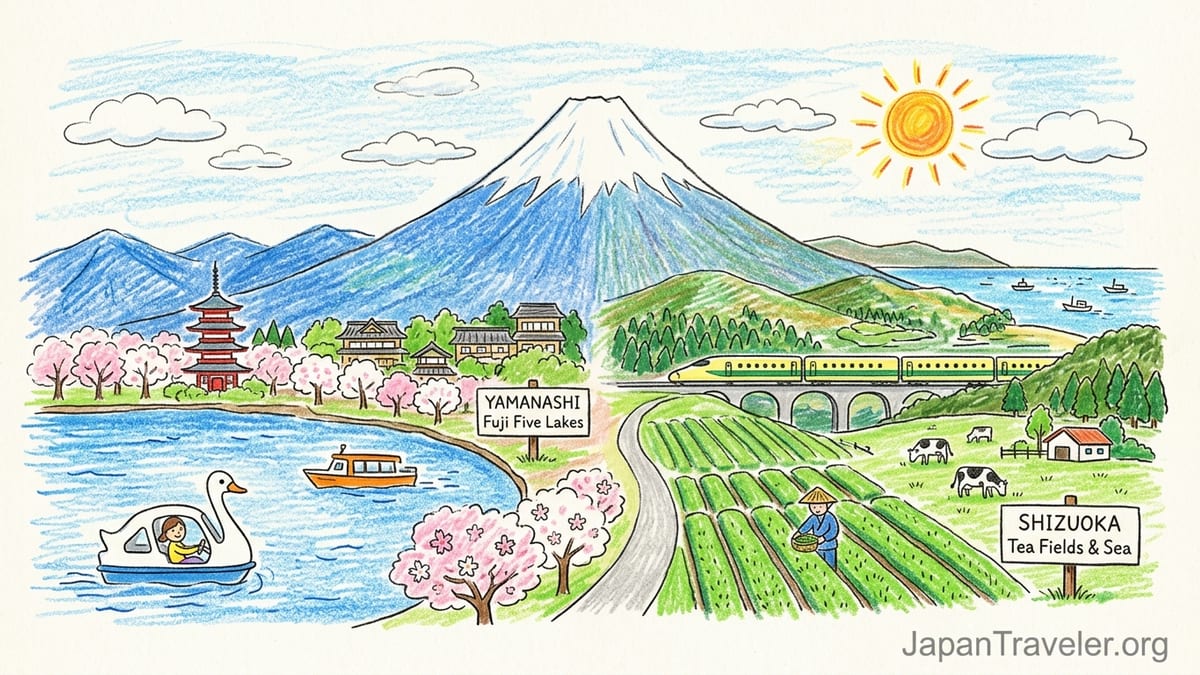
Official tourism information confirms that Mount Fuji straddles Yamanashi and Shizuoka, and that each side offers distinct visitor experiences in scenery, access and facilities. On the map, the Yamanashi side covers the northern base, anchored by the Fuji Five Lakes region, while Shizuoka wraps around the south and southwest, looking across Suruga Bay and wide tea fields toward the mountain. In practice, this means very different foregrounds for your photos and very different bases for day trips.
Yamanashi’s Fuji Five Lakes area, especially Kawaguchiko and Yamanakako, feels like a compact resort region built around the mountain. Many hotels, ryokan and cafés are positioned so that Fuji fills the view across calm lakes. By contrast, Shizuoka’s main Fuji hubs such as Fujinomiya, the Asagiri Highland and Shizuoka City offer broader landscapes: dairy pastures on high plateaus, green tea terraces rolling toward the sea, and urban centers with Fuji as a distant but dramatic backdrop.
Climbing routes are split as well. The most popular Yoshida Trail rises from the Yamanashi side, while the Fujinomiya, Subashiri and Gotemba routes start in Shizuoka or skirt the prefectural border. Facilities, congestion levels and trail character vary, which matters if you are planning to climb overnight to catch sunrise from the summit.
For most visitors, the decision comes down to priorities: do you want classic postcard reflections and easy transport from Tokyo, or do you prefer quieter highlands, tea-field scenery and a convenient link onward toward Nagoya and Kyoto?
Access from Tokyo and Nagoya: Which Side Is Easier?
From Tokyo, Yamanashi is usually simpler for non-drivers. The limited express Fuji Excursion runs several times per day from Shinjuku to Kawaguchiko, taking around two hours without a transfer. You can also take a JR Chuo Line limited express (Azusa or Kaiji) to Otsuki and change to the private Fujikyuko Line for Kawaguchiko. Highway buses run from Shinjuku, Shibuya and Tokyo Station directly to Kawaguchiko in roughly two to two and a half hours, often at lower cost than trains.
Reaching Shizuoka’s Fuji areas from Tokyo involves a different pattern. For Fujinomiya or Shin-Fuji, many travelers ride the Tokaido Shinkansen from Tokyo or Shinagawa to Shin-Fuji or Shizuoka Station, then switch to local trains or buses. The ride from Tokyo to Shin-Fuji by shinkansen takes about one hour on a Kodama or Hikari service, plus 30 to 60 minutes on local connections to Fujinomiya or Shizuoka City. For the Asagiri Highland, people often combine JR trains with local buses or self-drive.
For travelers arriving from Nagoya or heading west toward Kyoto and Osaka, Shizuoka has the advantage. The Tokaido Shinkansen runs straight through Shizuoka Prefecture, with frequent stops at Shizuoka and Shin-Fuji. You can break your journey for a night in Shizuoka City, visit Nihondaira for sweeping Fuji and Suruga Bay views, then continue to Kyoto the next day without backtracking. By contrast, Yamanashi’s Fuji Five Lakes require a detour off the main rail corridor, so they fit more naturally into itineraries that focus on Tokyo and the Kanto region.
If you are renting a car, both sides are very reachable. From Tokyo, expressways lead either toward Kawaguchiko via the Chuo Expressway or toward Gotemba and Fujinomiya via the Tomei Expressway. Driving times are broadly similar in good traffic, but parking availability and seasonal road closures near the 5th stations can differ, so climbers should check current restrictions before committing.
Landscape, Views and Photography: Lakes vs Tea Fields and Sea
For classic “Fuji with a lake” scenery, Yamanashi is the clear winner. Lake Kawaguchiko offers some of the most famous views, particularly from the north shore where the mountain appears perfectly framed over the water. In spring, cherry blossoms around the Kawaguchiko lakeshore and at places like Chureito Pagoda create the archetypal pink-and-white Fuji shots. In autumn, maple leaves at spots such as the Momiji (Maple) Corridor add deep reds to the foreground of the peak.
Lake Yamanakako, farther east, gives a more open, breezy feel with wide water vistas and fewer buildings. On calm winter mornings, photographers often capture near-perfect mirror reflections of a snowcapped Fuji on the lake surface. Yamanakako’s Swan Lake-style pedal boats and simple pensions at the shore give images a low-key, countryside atmosphere that contrasts with the slightly more developed Kawaguchiko town.
Shizuoka counters with different visual drama. Near Shizuoka City, viewpoints such as Nihondaira and Miho no Matsubara present Fuji rising above meticulously clipped tea fields, pine groves and Suruga Bay. On clear days, you may see fishing boats and port facilities far below, with the mountain towering beyond. Inland at the Asagiri Highland in Fujinomiya, photo spots often combine dairy cows grazing on bright green fields with Fuji’s massive south face dominating the horizon.
For variety in a short radius, many photographers prefer the Yamanashi side, where multiple lakes, hot-spring ryokan and vantage points sit within a short bus or taxi ride. For more original compositions that pair Fuji with tea terraces, sea and working farms, Shizuoka offers a fresher angle, especially for repeat visitors who already have lake-reflection images.
Staying Overnight: Town Feel, Ryokan and Budgets
Yamanashi’s Kawaguchiko is heavily geared to overnight visitors. Along the lake’s north and east shores, you will find a dense strip of midrange hotels, traditional ryokan with onsen baths, guesthouses and newer boutique properties. Many advertise “Fuji-view rooms” at a premium; for example, a midrange lakefront hotel might charge a moderate increase per night for a guaranteed mountain-facing room compared with a rear-facing one. Budget hostels and business hotels sit closer to Kawaguchiko Station, convenient for people catching early buses.
Lake Yamanakako has more pensions, cottages and family-run inns, often with free parking and a more suburban feel. Because the lakeshore is more spread out and the town center smaller, you are more likely to rely on a car or infrequent local buses in the evening. Prices can be a little lower than Kawaguchiko, but there are fewer restaurants within walking distance from some accommodations.
In Shizuoka, accommodation clusters differently. Fujinomiya City has business hotels and a growing number of guesthouses, making it a practical base for those using the Fujinomiya climbing route or exploring Shiraito Falls and Asagiri Highland. Shizuoka City offers a full mid‑size urban experience, with high-rise hotels near the station, izakaya-lined streets and department store dining floors, plus the option of day trips to tea fields and coastal viewpoints.
Shizuoka’s rural stays can be especially rewarding for travelers seeking local flavor. Farm-stay style lodgings around Asagiri Highland may include simple dinners centered on local milk, cheese and vegetables, and some tea-growing areas around Shizuoka and Kakegawa promote guesthouses where you can walk in tea fields at sunrise with Fuji in the background. However, these options generally require a car and some Japanese language ability to book and enjoy comfortably.
Transport on the Ground: Buses, Trains and Road Trips
Around Kawaguchiko and the Fuji Five Lakes, public transport is designed for tourists. Sightseeing loop buses circle the lakes with color-coded routes, stopping at museums, ropeways and photo spots. Trains on the Fujikyuko Line link Kawaguchiko to Otsuki, making it easy to move on to Tokyo. For popular viewpoints such as Chureito Pagoda in Shimoyoshida, you can ride the Fujikyuko Line to Shimoyoshida Station and walk around 10 to 15 minutes uphill.
For non-climbers wanting a taste of high altitude, buses from Kawaguchiko Station go up to the Fuji Subaru Line 5th Station on the Yamanashi side in season. At roughly 2,300 meters, this is a quick way to experience cooler air, short nature walks and shrines without committing to a full ascent. During the main climbing season, private cars are usually restricted on this road, so shuttle buses are the norm.
On the Shizuoka side, public transport exists but is more dispersed. Fujinomiya Station has buses to the Fujinomiya 5th Station when the climbing route is open, as well as to Shiraito Falls and Asagiri Highland. However, service frequency can be limited, especially outside peak dates. Travelers who want to connect several Shizuoka sights in one day, such as Nihondaira, Miho no Matsubara and a tea plantation viewpoint, often find a rental car from Shizuoka Station more efficient.
For road-trippers, Shizuoka is particularly appealing. You can drive scenic routes along the foothills, stopping at roadside stations for local ice cream made with Asagiri milk, then continue down toward the coast for seafood dinners. Yamanashi also works well by car, especially for visiting multiple lakes, nearby fruit farms and quieter onsen towns, but it is more feasible to rely on buses and trains there than in many of Shizuoka’s rural areas.
Climbing Mount Fuji: Comparing North and South Routes
Most first-time climbers use the Yoshida Trail on the Yamanashi side. It starts from the Fuji Subaru Line 5th Station and offers many mountain huts, relatively frequent rescue access and clear route markings. Official information notes that this route attracts the highest number of climbers, partly because of direct buses from Tokyo and the many tour packages that standardize arrival and departure times. The downside is crowding, especially on weekends in late July and August, when sunrise queues can form near the summit.
The Fujinomiya Trail, on the Shizuoka side, starts from the highest of the 5th stations and is the shortest of the main routes in distance and elevation gain. That can sound attractive, but the path is steep, rocky and shared by both ascending and descending climbers, which can create bottlenecks. For fit, time‑pressed travelers coming from Nagoya or Kyoto via the Tokaido Shinkansen, basing in Fujinomiya and using this route can still be efficient.
The Subashiri and Gotemba routes, starting from the east and southeast, are quieter, longer and more rugged. Subashiri initially passes through forest and merges with the Yoshida Trail around the 8th station. Gotemba is the longest and least crowded, with long sections of volcanic gravel and fewer huts. On descent, some sections allow you to semi‑run down sandy slopes, which some experienced hikers enjoy but which can be demanding on knees and ankles.
Whichever route you choose, note that recent seasons have seen tighter regulations. Both Yamanashi and Shizuoka have introduced or are introducing climbing fees and limits on night-time departures, particularly on the Yoshida Trail, to address congestion and safety concerns. Reservations for mountain huts are increasingly essential, and novice climbers are strongly advised to tackle Fuji within the official season from early July to early September, when buses, shelters and patrols operate regularly.
Best Choices for Sightseers, Families and Photographers
For first-time Fuji sightseeing from Tokyo, the Yamanashi side is usually the simplest recommendation. A one- or two-night stay in Kawaguchiko offers a high chance of seeing Fuji, with many lakefront promenades, ropeways, cafés and museums that remain enjoyable even if clouds cover the summit. Families can combine a short cruise on the lake, a visit to a music or art museum, and a gentle ropeway ride to a nearby viewpoint without complex planning.
Yamanakako suits visitors who prefer a quieter, more outdoorsy vibe. There are lakeside cycling paths, swan boats and simple picnic areas with wide mountain panoramas. Because the town is less concentrated than Kawaguchiko, it is ideal for those renting a car or staying in a lakeside cottage with self-catering facilities.
Shizuoka’s strengths emerge for repeat visitors and photographers seeking different angles. A day based in Shizuoka City or Shin-Fuji can combine early-morning views of Fuji over tea fields at Nihondaira, a stroll through the historic Kunozan Toshogu Shrine precincts, and seafood dinners sourced from Suruga Bay. Families might enjoy dairy farms and paragliding schools at Asagiri Highland, where children can see cows and horses with the mountain looming behind them.
If you are traveling through on the Tokaido Shinkansen between Tokyo and Kyoto, a one-night stop in Shizuoka can deliver a satisfying Fuji experience without the detour north to Yamanashi. On a clear evening, you might even glimpse Fuji from your hotel room or from observation decks near the station, framed by city lights.
Continuing Your Journey: Itinerary Fit Toward Nagoya and Kyoto
Route planning matters as much as views. Travelers with a classic “Tokyo–Fuji–Kyoto–Osaka” itinerary often ask whether it is better to backtrack from Kawaguchiko to Tokyo and then ride the shinkansen west, or to visit Fuji from Shizuoka along the main line. If your time in Japan is short and you dislike multiple transfers, experiencing Fuji via Shizuoka is usually more efficient for a linear journey between Tokyo and Kyoto.
A common pattern is to arrive in Tokyo, spend two or three days, then ride the Tokaido Shinkansen to Shizuoka or Shin-Fuji for one or two nights. During that stop, you visit Nihondaira, Miho no Matsubara or Fujinomiya and Asagiri Highland, then continue west by shinkansen to Nagoya, Kyoto or Osaka. This keeps luggage logistics straightforward and avoids the branch line to Kawaguchiko.
On the other hand, if your trip focuses on Kanto, the northern Fuji side dovetails nicely with visits to Hakone, Matsumoto, or even the Kiso Valley. You can travel from Tokyo to Kawaguchiko, stay one or two nights, then continue by bus or train toward Matsumoto or Nagano without needing to return to the Tokaido corridor immediately. Rail passes that prioritize JR Chuo Line services can pair well with a Yamanashi-based Fuji visit.
For travelers determined to get the very best Fuji view, some choose to visit both sides: a night in Kawaguchiko for lakeside sunrise, followed later in the trip by a Shizuoka stopover for tea-field and sea views. While this takes more time, it highlights how different Fuji can feel when approached from different landscapes.
The Takeaway: Which Side Should You Choose?
If you want an easy, Fuji-focused side trip from Tokyo with strong chances of postcard views, choose Yamanashi. Base in Kawaguchiko or Yamanakako, ride the Fuji Excursion or highway bus, and use the well-developed lakeside infrastructure. This side is especially suitable for first-time visitors, families, and anyone who values walkable sightseeing and frequent buses over driving.
If you are traveling along the Tokyo–Nagoya–Kyoto corridor or want Fuji framed by tea fields, dairy farms and the sea, choose Shizuoka. Stay in Shizuoka City, Shin-Fuji or Fujinomiya, use the Tokaido Shinkansen for fast access, and plan day trips to Nihondaira, Miho no Matsubara, Shiraito Falls and Asagiri Highland. This side suits photographers seeking less common compositions, climbers approaching via Fujinomiya or Subashiri, and travelers continuing west without backtracking.
For climbers, the Yoshida Trail on the Yamanashi side remains the most convenient and supported route, especially if you are nervous about conditions or want structured tour options. The Shizuoka-side trails appeal to more independent or experienced hikers who accept longer approaches, steeper sections or fewer huts in exchange for thinner crowds and different vistas.
In simple terms: first-time Fuji sightseeing and classic lake views point strongly to Yamanashi; onward journeys toward Nagoya and Kyoto, tea and sea scenery and alternative climbing routes point to Shizuoka. If your schedule allows, seeing Fuji from both sides on one trip is a memorable way to understand just how varied Japan’s most famous mountain can be.
FAQ
Q1. For a first-time visitor who just wants to see Mount Fuji up close, which side is better?
Yamanashi is usually better for first-timers. Kawaguchiko and Yamanakako offer very direct, classic views, simple access from Tokyo and a dense cluster of visitor facilities.
Q2. Which side has the more famous Mount Fuji climbing route?
The Yamanashi side hosts the Yoshida Trail, which is the most popular route with the most huts and services. Shizuoka’s Fujinomiya Trail is the second most used and is the shortest in distance.
Q3. If I am traveling from Tokyo to Kyoto by shinkansen, which side fits my route better?
Shizuoka fits better. You can stop at Shizuoka or Shin-Fuji on the Tokaido Shinkansen, visit nearby Fuji viewpoints, then continue west without returning to Tokyo.
Q4. Where are the best reflection photos of Mount Fuji on a lake?
The best-known reflection spots are on the Yamanashi side, especially along the north shore of Lake Kawaguchiko and around Lake Yamanakako on calm mornings.
Q5. Where can I see Mount Fuji with tea fields in the foreground?
Shizuoka is the place for tea-field views. Areas such as Nihondaira and other tea-growing hills around Shizuoka City and Kakegawa offer classic scenes of green tea rows with Fuji behind.
Q6. Is it possible to visit both Yamanashi and Shizuoka sides of Fuji in one trip?
Yes, many travelers spend a night or two at Kawaguchiko, then later add a Shizuoka stopover when moving between Tokyo and Kyoto. It takes extra time but offers very different perspectives.
Q7. Which side is better for families with children?
Yamanashi usually works better for families. Kawaguchiko and Yamanakako have compact lakefront areas, easy ropeways, sightseeing boats and shorter transfers, which reduce logistics with kids.
Q8. I plan to rent a car and do a scenic drive. Which side should I choose?
Both sides are good, but Shizuoka is particularly rewarding for road trips that link coastal views, tea fields, Asagiri Highland farms and waterfalls with flexible timing.
Q9. If I do not plan to climb, is it still worth going up to a 5th station?
Yes, especially on the Yamanashi side. The Fuji Subaru Line 5th Station offers cool air, short walks and shrines. Shizuoka’s Fujinomiya 5th Station is also scenic but requires more planning for buses.
Q10. Which side gives me a better chance of actually seeing Mount Fuji, considering the weather?
Neither side can guarantee clear views, but staying at least one night on either side raises your chances. Yamanashi’s lakeside towns concentrate many viewpoints close together, which helps you react quickly when clouds part.