


Sitting between Tokyo and Kyoto, Japan’s Tokai region is one of the easiest parts of the country to explore on a first trip, yet many visitors rush past it on the Tokaido Shinkansen without stopping. Centered on the major hub city of Nagoya and stretching across Yamanashi, Shizuoka, Gifu, Aichi and Mie, Tokai combines views of Mount Fuji, historic post towns, hot spring resorts and coastal shrines into one highly connected corridor. With a bit of planning, you can turn your transfer between Tokyo and Kyoto into a journey through some of Japan’s most rewarding landscapes.
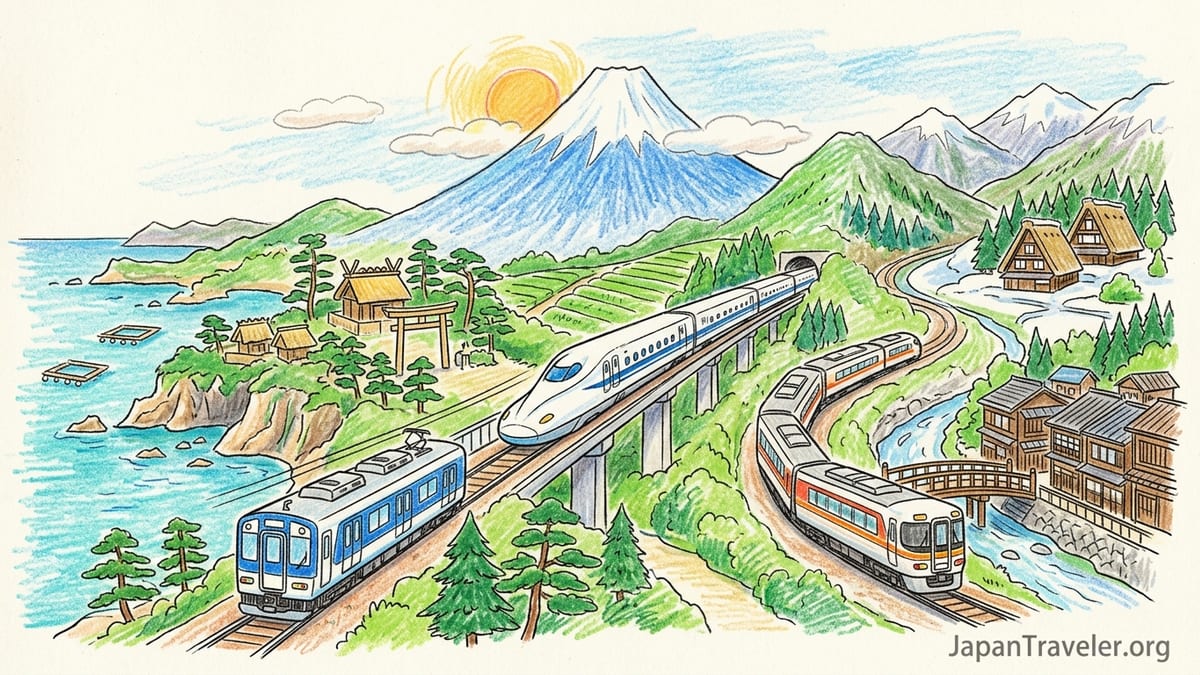
Nagoya: The Natural Hub of the Tokai Region
Nagoya sits almost halfway between Tokyo and Kyoto on the Tokaido Shinkansen, which makes it the most practical base for exploring the wider Tokai region. Most Nozomi and Hikari services between Tokyo and Osaka stop here, with journey times of about 1 hour 40 minutes from Tokyo and under an hour from Kyoto or Shin-Osaka in standard class. Many travelers simply pass through Nagoya Station, but spending one or two nights in the city lets you connect more comfortably to the Limited Express Hida for Takayama, highway buses to Shirakawa-go, Kintetsu trains to Mie and local lines into Shizuoka and Gifu.
For first-time visitors, staying near Nagoya Station keeps logistics easy. The area has a wide choice of business hotels and mid-range chains within a 5 to 10 minute walk of the Shinkansen platforms. A typical double room at a business hotel here might run around 9,000 to 14,000 yen per night outside peak seasons, with Western-style beds, private bathrooms and coin laundry on-site. Being close to the station means you can take an early Hida train to Takayama or catch a Kintetsu limited express to Ise-Shima without worrying about cross-city transfers during rush hour.
Nagoya is also the main interchange between JR and private railways in the region. JR Central handles the Shinkansen and conventional lines, including the Takayama Main Line toward Gero Onsen and Takayama. Next door, Kintetsu Nagoya Station is the gateway to Mie Prefecture and the Ise-Shima coast, while Meitetsu Nagoya Station connects directly to Central Japan International Airport. In practice, this means you can arrive at Nagoya on the Shinkansen, walk a few minutes inside the same complex to Kintetsu, and be on your way to coastal Mie or the Suzuka area with only one ticket purchase at a machine.
Although this guide focuses on the wider region, plan at least half a day to see Nagoya itself. Nagoya Castle, the Toyota Commemorative Museum of Industry and Technology, and the Osu shopping district are easy to combine. They also provide a gentle first look at Tokai before you head into more rural stretches, which can help ease jet lag if you have flown into Tokyo or Osaka only a day or two earlier.
Planning Your Route Through Tokai
Because Tokai lies on the main corridor between Tokyo and Kyoto, it works well both as a linear route and as a hub-and-spoke itinerary from Nagoya. A classic first-time route is to start in Tokyo, stop in the Mount Fuji and Izu Peninsula area in Shizuoka Prefecture, continue to Nagoya for Takayama and Shirakawa-go or Gero Onsen in Gifu, then drop down to Mie for Ise-Shima before finishing in Kyoto or Osaka. This forms a broad loop that uses the Tokaido Shinkansen for the long jumps and regional trains or buses for local travel.
For example, you might take a morning Kodama or Hikari Shinkansen from Tokyo to Shin-Fuji or Mishima to explore Mount Fuji or Izu, spend a night, then ride onward to Nagoya the next afternoon. From there, two nights in Takayama with a half-day side trip to Shirakawa-go give you enough time for the historic town and the thatched-roof village. Returning to Nagoya, you could then use a Kintetsu limited express to reach Ise in about 80 minutes, stay one or two nights near Ise-Jingu or Toba, and continue to Kyoto via Kintetsu or back on the Shinkansen.
When deciding which destinations are good as day trips versus overnights, factor in both travel time and the type of experience you want. Areas like the Fuji Five Lakes or Ise-Jingu can technically be visited from Tokyo or Nagoya in a single long day, but you will be on tight schedules with limited time to relax at onsen baths or enjoy quieter evening hours. In contrast, Nagoya Castle or the Toyota museum make easy half-day outings from a base in Nagoya, leaving you with plenty of time to transfer to an evening train.
Rail passes can be useful, but they are not mandatory. Some travelers use regional JR passes for the Tokaido Shinkansen and Hida trains, while others combine point-to-point Shinkansen tickets with private railway passes such as the Kintetsu Rail Pass when focusing heavily on Mie. If you are only making one or two long-distance moves, point-to-point tickets with reserved seats are often straightforward, and you can buy them from English-capable ticket machines at most major stations on the day before travel.
Mount Fuji and Shizuoka: Scenery Along the Tokaido Shinkansen
The Shizuoka stretch of the Tokaido Shinkansen is where many travelers catch their first real glimpse of Mount Fuji. On a clear day, sitting on the right-hand side of a Tokyo to Nagoya train gives you views of the mountain beyond the factories and rivers between Shin-Fuji and Shizuoka stations. For most first-time visitors, though, it is worth stepping off the Shinkansen to experience the Fuji area more fully, either around the Fuji Five Lakes in Yamanashi or the southern foothills and coast of Shizuoka.
From Tokyo, you can reach Shin-Fuji by Hikari or Kodama in roughly 1 hour. Local buses from Shin-Fuji Station connect to viewpoints and tea fields on the Shizuoka side. Alternatively, Mishima Station is the jumping-off point for the Izu Peninsula and also offers bus connections toward Gotemba and the Fuji area. Staying one night in a ryokan in Fujinomiya or a lakeside hotel in Kawaguchiko (reached more easily from Tokyo than from the Shinkansen) lets you see sunrise or sunset on Mount Fuji and gives you time to try simple local specialties like Fujinomiya yakisoba or green tea sweets.
Shizuoka City itself works well as a quieter overnight stop between Tokyo and Nagoya. The Shinkansen station is in the city center, and mid-range hotels around the north exit typically range from about 8,000 to 13,000 yen per night. With half a day you can walk to Sumpu Castle Park and sample fresh seafood and green tea at local markets. Then you can catch a Kodama train from Shizuoka to Nagoya in under 90 minutes, often with more seats available than on the faster Hikari services at peak times.
If you are tight on days, you can treat Shizuoka and Mount Fuji as a scenic extension rather than a deep dive. For instance, you might leave Tokyo in the morning, stop at Shin-Fuji or Shizuoka for three or four hours to see views and have lunch, and then continue to Nagoya in late afternoon. This gives you more flavor than simply watching Fuji flash by the window but avoids needing additional nights in your schedule.
Izu Peninsula: Coastal Detour Between Tokyo and Nagoya
South of Mount Fuji, the Izu Peninsula offers rugged coastlines, hot springs and seaside towns. It belongs to Shizuoka Prefecture and is easily reached as a one to two night detour when traveling from Tokyo toward Nagoya or Kyoto. While you could theoretically rush Izu as a day trip from Tokyo, staying overnight in an onsen town like Ito, Izu-Kogen or Shimoda creates a very different experience, with time to soak in hot baths and walk quiet coastal paths after day-trippers have left.
From Tokyo Station, take the Tokaido Shinkansen to Atami in about 40 to 50 minutes, then transfer to the JR Ito Line for Ito and Izu-Kogen or to the Izu Kyuko Line for Shimoda. A common pattern is to leave Tokyo in late morning, arrive in Ito early afternoon, check into a ryokan with dinner and breakfast included, and spend the rest of the day in open-air baths overlooking the ocean. Ryokan rates vary, but it is realistic to find two-meal plans in the 18,000 to 30,000 yen per person range in smaller properties, with higher prices at sea-view resorts and luxury options.
The Izu Peninsula is well suited to those who like slow travel. Coastal buses cover sections like the Jogasaki Coast, Kawazu’s early-blooming cherry blossoms and Cape Irozaki, but services are less frequent than trains on the main Honshu corridor. If you only have one or two weeks in Japan and are already visiting other coastal or onsen areas such as Hakone or Kanazawa, you may choose to skip Izu on a first trip. However, for travelers who want to break up the Tokyo to Nagoya run with seaside walks and hot springs, Izu can be the most relaxing link in the chain.
When returning to the main line, you simply retrace your steps to Atami and rejoin the Tokaido Shinkansen toward Nagoya. Many people plan an early check-out from their Izu ryokan, catch a mid-morning local to Atami, and be in Nagoya by early afternoon. This timing leaves enough room in the same day to stroll around Nagoya Castle or head straight onto the Limited Express Hida to reach Takayama by evening, though that requires careful checking of departure times.
Takayama, Shirakawa-go and Gero Onsen: Mountain Routes in Gifu
Heading north from Nagoya into Gifu Prefecture, the Limited Express Hida is the key train for reaching Takayama, Gero Onsen and further on to Toyama. Operated by JR Central, the Hida runs from Nagoya along the Takayama Main Line with roughly hourly departures during the day. The journey to Takayama takes around 2 hours 20 minutes to 2 hours 40 minutes depending on the service, and many trains offer reserved seat-only cars with large windows designed for enjoying the river and forest scenery.
Takayama itself deserves at least one night, and two nights is comfortable for most first-time itineraries. The compact old town area, with its preserved wooden merchant houses and morning markets, is easy to explore on foot in half a day, but staying overnight lets you experience quieter evenings once bus groups have left. Mid-range hotels and ryokan in Takayama often range from around 9,000 yen per room for simple business hotels near the station to 20,000 yen or more per person for ryokan with kaiseki dinners and hot spring baths.
Shirakawa-go, famous for its steep thatched-roof farmhouses, is not on a rail line. Instead, highway buses link it to both Takayama and Nagoya. From Takayama Bus Center, buses reach Shirakawa-go in roughly 50 minutes each way, which makes a half-day trip possible if you are based in Takayama. Many travelers spend three or four hours walking the village, visiting one or two open-house farm museums and hiking up to the viewpoint. In winter, overnight stays in minshuku inside the village can be atmospheric, but bookings are competitive in peak seasons.
South of Takayama, Gero Onsen is another key stop along the Hida route. The Limited Express Hida reaches Gero from Nagoya in about 90 minutes. Gero is best treated as an overnight destination rather than a rushed day trip, since the whole point is to soak in its alkaline hot springs and enjoy ryokan hospitality. A typical pattern is to arrive in early afternoon, check into a riverside ryokan, take a long bath before dinner, and leave on a late-morning train the next day. If you are combining Takayama, Shirakawa-go and Gero, a three night sequence such as Nagoya to Takayama, Takayama to Shirakawa-go day trip, then Takayama to Gero and finally back to Nagoya or onward to Kyoto works smoothly.
Ise-Shima and the Mie Coast: Shrines, Bays and Kintetsu Trains
East and south of Nagoya, Mie Prefecture offers a very different side of Tokai: sacred shrines, indented bays and a quieter Pacific coastline. The heart of the region is Ise-Shima, home to Ise-Jingu, Toba’s pearl heritage and the resort bays around Kashikojima. Kintetsu Railway is the most convenient way to reach these areas from Nagoya, Kyoto or Osaka. Direct Kintetsu limited express trains link Kintetsu Nagoya Station and Iseshi or Ujiyamada Stations in Ise in about 80 minutes, with many services continuing through Toba to Kashikojima on the Shima Line.
For a comfortable first visit, plan one to two nights in the Ise-Shima area. One option is to stay near Iseshi or Ujiyamada Station to focus on Ise-Jingu’s Inner and Outer Shrines, Okage Yokocho’s restored streets and local specialties like tekone-zushi, a marinated tuna rice bowl once popular with fishermen. Another is to book a resort hotel or ryokan along the Ago Bay coast around Kashikojima, where many properties include dinner featuring Ise lobster and local seafood. In both cases, room rates vary widely, but it is common to see two-meal plans starting around 18,000 to 25,000 yen per person in midrange coastal ryokan, with higher prices at luxury resorts.
Within the region, Kintetsu’s local and limited express trains, along with local buses, provide access to major sites. The CAN bus in Ise connects stations with Ise-Jingu’s Geku and Naiku shrines, the Meoto Iwa “wedded rocks” on the Futami coast and theme attractions, running roughly once or twice an hour. Around Toba and Kashikojima, sightseeing boats and coastal buses let you reach observation points and islands. Schedules are less dense than big-city transit, so it is worth checking the next day’s bus times at your hotel reception or tourist information desk in the evening.
Kintetsu also operates the premium sightseeing limited express Shimakaze, which runs from Nagoya, Osaka and Kyoto to Kashikojima several days a week. The Shimakaze offers wide leather seats, cafe service and private compartments, and it is often booked more for the train ride itself than for transport alone. Tickets cost more than standard limited express fares and require seat reservations, so for budget-conscious first-timers the regular Kintetsu limited express is usually sufficient. However, if you are a rail enthusiast or celebrating a special occasion, planning your Ise-Shima visit around a Shimakaze departure can turn the transfer from Nagoya into one of the highlights of your trip.
Using the Tokaido Shinkansen, Limited Express Hida and Kintetsu Trains
Three main rail pillars hold together most Tokai itineraries for first-time visitors: the Tokaido Shinkansen, JR’s Limited Express Hida and Kintetsu’s limited express network. Understanding how they relate helps you string together very different landscapes without complicated planning. The Tokaido Shinkansen is your long-distance backbone between Tokyo, Shizuoka, Nagoya, Kyoto and Osaka. The Limited Express Hida carries you from Nagoya into the Hida mountains, while Kintetsu trains spread toward Ise-Shima and the broader Mie coast.
The Tokaido Shinkansen is operated entirely by JR Central. For most foreign travelers, Hikari and Kodama trains are the most practical, particularly if using a JR pass or wanting to stop at intermediate stations like Shin-Fuji, Shizuoka or Hamamatsu. Hikari services are faster and stop at fewer stations, while Kodama trains stop at all stations but may be less crowded and can be easier for flexible same-day seat reservations. On a typical day, you could leave Tokyo at 9:00 on a Hikari, arrive in Nagoya around 10:40, and be on the 11:40 Limited Express Hida to Takayama with time to buy a bento lunch on the platform.
The Limited Express Hida links Nagoya to Gero Onsen, Takayama and sometimes Toyama. Reserved seats are strongly recommended, especially in foliage and snow seasons. You can buy tickets from JR ticket machines that offer English menus or at a midori-no-madoguchi ticket counter. Prices vary with distance, but a reserved seat supplement on top of the base fare for Nagoya to Takayama is typically in the several thousand yen range per person. The trains offer both standard reserved cars and sometimes green car seats with extra space. Large windows on the river-facing side make the journey feel like part of the sightseeing rather than just a transfer.
Kintetsu trains handle most tourist traffic into Mie. From Kintetsu Nagoya Station, regular limited express trains reach Iseshi and Ujiyamada in around 1 hour 20 minutes, and Kashikojima in about 1 hour 50 minutes. Unlike JR, Kintetsu tickets are sold as a base fare plus a limited express surcharge, which you can buy at vending machines or ticket counters. You do not need to buy days in advance, but seats on specific trains such as the Shimakaze or popular weekend departures can sell out. Some travelers purchase a Kintetsu rail pass to cover several days of travel between cities like Nagoya, Osaka and Ise-Shima, then pay only the limited express supplements as they go.
For places not directly on rail lines, such as Shirakawa-go or parts of the Ise-Shima coast, buses fill the gap. Highway buses run from Nagoya and Takayama to Shirakawa-go, and tourist-oriented buses like the CAN bus in Ise connect major shrines and coastal spots. On a first trip, it is usually enough to confirm departure times one or two days ahead and arrive at bus terminals 20 to 30 minutes early to buy tickets. If you prefer to travel with minimal planning, focusing your overnights in cities with stations on the Shinkansen, Hida or Kintetsu lines minimizes dependence on less frequent rural buses.
How Long to Stay: Day Trips vs Overnight Destinations
Working out where to sleep and which places to treat as day trips is essential in Tokai, because distances between Tokyo, Nagoya and Kyoto are short enough that you can compress too much into a single day if you are not careful. As a rule of thumb, anywhere that revolves around onsen bathing, coastal scenery or evening atmosphere rewards an overnight stay, while compact cities on main lines can be enjoyed as half-day stops.
In practice, Mount Fuji and the Fuji Five Lakes, the Izu Peninsula, Gero Onsen and Ise-Shima are all better experienced with at least one night. For example, a one-night stay near Kawaguchiko lets you see Fuji at dawn and dusk, while a night in Ito or Shimoda gives you time to enjoy ryokan dinners and late-night baths. Gero Onsen comes into its own when you can soak in the hot springs in the evening and again after breakfast, rather than rushing back to Nagoya on a late train. Around Ise-Shima, staying overnight near the shrines or on Ago Bay allows you to visit Ise-Jingu in the early morning, when worshippers outnumber tour groups.
On the other hand, Nagoya, Shizuoka City and even Takayama can be integrated flexibly as part of travel days. Nagoya works well as a one-night base or a long transit stop: you might arrive by Shinkansen, store your luggage in a coin locker for 700 to 1,000 yen depending on size, visit Nagoya Castle and have a miso katsu lunch, then continue to Gero or Ise by late afternoon train. Shizuoka City is similar. Takayama almost always justifies at least one night, but if your schedule is very tight, a fast day trip from Nagoya on the Hida is feasible, arriving late morning and returning after dinner.
If you are using Tokai as a bridge between Tokyo and Kyoto, a balanced first-time itinerary of around five to six nights in the region might look like this: one night near Mount Fuji or Shizuoka, one or two nights in Nagoya including a side trip to nearby sites, two nights in Takayama with a half-day visit to Shirakawa-go, and one or two nights in Ise-Shima before arriving in Kyoto. Adjust up or down depending on interest in hot springs, hiking and coastal scenery. The key is to avoid chaining two long mountain or coastal transfers back-to-back without a city-based night in between, which can leave you tired and less able to enjoy the subtle experiences Tokai is known for.
FAQ
Q1. Is Nagoya a good base for exploring the Tokai region, or should I just pass through?
Nagoya is an excellent base because it sits on the Tokaido Shinkansen and connects directly to the Limited Express Hida, Kintetsu trains to Mie and buses toward Shirakawa-go. Spending at least one night lets you make early departures without long cross-city transfers and gives you time to see Nagoya’s own sights.
Q2. How many days should I spend in the Tokai region on a first trip to Japan?
For a first visit, five to six nights in Tokai is a comfortable minimum if you want to see Mount Fuji or Shizuoka, Takayama and either Gero Onsen or Ise-Shima. With seven to ten nights, you can slow the pace and add the Izu Peninsula or longer stays in hot spring towns.
Q3. Can I visit Shirakawa-go as a day trip from Nagoya?
It is technically possible using highway buses, but it makes for a long day with limited time in the village. A more relaxed option is to base yourself in Takayama, then take a 50-minute bus to Shirakawa-go for a half-day visit and return in the afternoon.
Q4. Is the Limited Express Hida worth taking instead of buses or rental cars?
For most first-time visitors, yes. The Hida offers comfortable reserved seating, large windows and a scenic route along rivers and mountains, without the stress of driving unfamiliar roads. It is also more weather-resilient than mountain roads in winter, when snow can affect car travel.
Q5. Do I need to reserve seats on the Tokaido Shinkansen and regional limited express trains?
Seat reservations are recommended on the Tokaido Shinkansen during busy periods such as weekends and holidays, and are strongly recommended on the Limited Express Hida and Kintetsu limited express trains. You can usually book a day or two ahead at ticket machines or counters in major stations.
Q6. Is Ise-Shima better as a day trip or an overnight stay?
Overnight is strongly recommended. A single day from Nagoya leaves little time to enjoy Ise-Jingu, coastal viewpoints and local food. With one or two nights, you can visit the shrines in the early morning, ride coastal boats and relax at a ryokan or resort.
Q7. Can I use a Japan Rail Pass for all trains in the Tokai region?
A Japan Rail Pass covers JR services such as the Tokaido Shinkansen and Limited Express Hida, but it does not cover private railways like Kintetsu or Izu Kyuko. For Mie and parts of Izu, you will need separate tickets or a private railway pass in addition to any JR pass.
Q8. Is the Izu Peninsula essential for a first-time itinerary between Tokyo and Kyoto?
Izu is not essential, but it is a rewarding detour if you enjoy coastlines and hot springs and have an extra night or two. If your schedule is tight or you are already visiting other onsen and seaside areas in Japan, you may choose to prioritize Mount Fuji, Takayama and Ise-Shima instead.
Q9. Is it easy to travel in the Tokai region without speaking Japanese?
Yes, with some preparation. Major stations such as Tokyo, Nagoya, Shizuoka, Takayama, Ise and Toba have English signage and ticket machines. Bus timetables and smaller stations may be less multilingual, but staff are generally helpful and smartphone translation apps work well for checking details.
Q10. When is the best time of year to visit the Tokai region?
Spring and autumn are the most comfortable, with mild temperatures and clear skies that favor Mount Fuji views and mountain travel. Summer can be hot and humid in cities and lowlands but is pleasant in higher-altitude areas around Takayama. Winter brings snow to the Hida region, creating beautiful scenes in Takayama and Shirakawa-go, while coastal Mie and Shizuoka remain relatively mild.