


Kyushu is Japan’s most volcanically active island, and nowhere is that more obvious than in its onsen towns. Steam rises from street corners in Beppu, rivers run milky blue in Kurokawa, and in Ibusuki you are buried in hot black sand warmed by the earth itself. Choosing where to stay can be overwhelming, especially if you want a memorable ryokan, private open-air bath, or a child-friendly, tattoo-tolerant stay. This guide compares Kyushu’s headline hot spring destinations and highlights concrete ryokan examples to help you decide where to book, how long to stay, and what kind of onsen experience fits your trip.
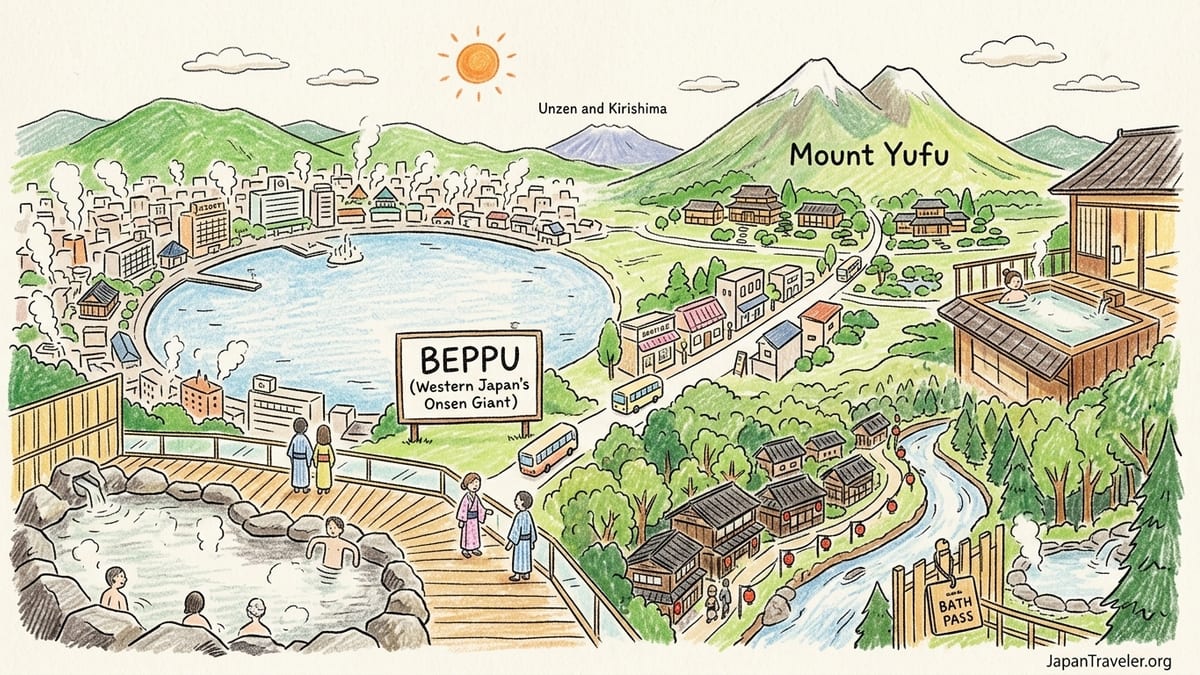
Beppu: Western Japan’s Onsen Giant
Beppu, in Oita Prefecture, is often described by Japan’s national tourism officials as western Japan’s largest hot spring resort, with eight major districts collectively called Beppu Hatto and roughly 3,000 vents releasing steam and hot water across town. This scale gives Beppu a different feel from a sleepy onsen village. Expect a compact city wrapped around the bay, with neighborhood bathhouses, large resort hotels, family-oriented attractions and an impressive range of water types, from simple clear baths to iron-rich rusty pools and mud baths. If you want choice above all else, Beppu is the most versatile base in Kyushu.
Most visitors stay near Beppu Station or in the Kannawa and Myoban areas in the hills. Giant properties like Suginoi Hotel operate multiple pools, terraced open-air baths with ocean views and even integrated entertainment facilities, appealing to families or groups who like resort-style convenience. At the other end of the spectrum, smaller inns such as Chobonoyado Shiori in Kannawa keep the focus on quiet rooms, landscaped gardens and private baths, with per-person rates that typically start around mid-range city hotel levels and climb with the quality of kaiseki meals and room categories. This range allows budget-conscious travelers to still enjoy genuine hot-spring bathing.
Beppu is also one of Kyushu’s more accessible bases for travelers with tattoos and for those traveling with children. Many ryokans and public facilities that restrict tattoos in large communal baths still offer bookable private onsen or in-room baths where tattoos are not an issue. For example, well-known day-use complexes such as Hyotan Onsen combine large gender-separated baths with rentable family baths, making it easy for a couple or family with tattoos to enjoy an authentic soak in privacy. Children are widely accepted, and non-staying day visitors are common, so the overall atmosphere is informal compared with more exclusive onsen villages.
For most itineraries, one or two nights in Beppu works well. A one-night stay with two meals at a mid-range ryokan allows you to arrive in the afternoon, tour a few of the “hells” for sightseeing, enjoy a long evening soak and a full kaiseki dinner, then try a different bath before breakfast. Two nights make sense if you want to explore nearby Yufuin as a day trip, visit mountain viewpoints, or slowly sample several of Beppu’s distinct districts without rushing. Luggage is easy to manage here; coin lockers and takkyubin counters at Beppu Station let you send bags ahead if you plan to move on by train or highway bus.
Yufuin: Pastoral Views and Intimate Ryokan
About an hour inland from Beppu by train or bus, Yufuin is smaller and more pastoral, set in a basin beneath Mount Yufu. The main street is lined with cafés, small museums and boutiques, and many visitors stroll in yukata from their inns into town. Compared with Beppu, the onsen scene here is quieter and more ryokan-focused, with fewer giant hotel complexes and more mid-sized or boutique properties that emphasize views and food as much as the baths themselves.
Ryokan such as Yama no Hotel Musouen and Yufuin Gettouan illustrate what Yufuin does best: spacious grounds, open-air baths with sweeping mountain views, and a blend of traditional rooms and modern comforts. Musouen’s hillside outdoor baths are known for their panorama of Mount Yufu, while Gettouan spreads a limited number of villas across large forested grounds, each with a private open-air bath fed by hot spring water. Other inns like Yufu no Sato Makiba no Ie and YUFU-Inn Fujimatsu offer private or semi-private baths that can be reserved, ideal for couples who want a quieter soak without sharing a large facility.
Most Yufuin ryokan build the experience around kaiseki dinners and Japanese breakfasts. Expect multi-course meals featuring Oita beef, local river fish and seasonal vegetables served either in-room or in private dining spaces. Prices often reflect this focus; even mid-range ryokan typically quote per-person rates comparable to higher-end city hotels once two meals are included. Travelers who want to control costs can look for plans that omit dinner and instead explore the town’s restaurants, but the full half-board stay is still the classic way to experience Yufuin.
Yufuin tends to be calmer in the evenings once day trippers leave, which suits couples and small groups more than late-night social travelers. Families with young children are welcomed at many properties, but it is worth confirming child age policies and whether there are family rooms or Western beds if you are not used to futons. Tattoo policies vary more than in Beppu due to the emphasis on shared baths, so guests with large tattoos may find it easiest to choose a ryokan that provides in-room rotenburo or multiple bookable private baths. One or two nights here pair well with Beppu: a night in each gives you a sense of both Kyushu’s biggest onsen city and its more rural counterpart.
Kurokawa Onsen: Classic Village and Deep Nature
Kurokawa Onsen in Kumamoto Prefecture offers perhaps the most classically “storybook” onsen atmosphere in Kyushu. The village clusters along a river in a wooded valley, with narrow lanes, lanterns at night and over two dozen ryokan hugging the banks. Many of these inns are mid-sized, owner-operated properties that focus heavily on the baths themselves, often with multiple outdoor pools built into the riverbank or carved into the forested slopes. It feels more like a retreat than a resort town.
Ryokan such as Yamamizuki, Fumoto Ryokan and Yamabiko Ryokan are frequently highlighted for their settings and outdoor baths. Yamamizuki, for example, has a riverside rotenburo that sits almost at water level, with surrounding forest that glows with autumn colors or fresh green depending on the season. Per-person rates here, including dinner and breakfast, are typically in the mid to upper range for rural Kyushu, reflecting the combination of elaborate kaiseki, room quality and bath access. Some higher-end properties also offer villa-style rooms with private open-air baths for guests who want more seclusion.
Unlike Beppu or Yufuin, much of Kurokawa’s appeal lies in rotemburo-hopping. Guests can purchase a wooden pass that gives access to a selection of outdoor baths across multiple ryokan during the day, walking from inn to inn in yukata along the river and through the woods. This makes Kurokawa especially enjoyable for travelers who want to spend most of their stay in the water, sampling different mineral qualities, depths and views rather than focusing on town attractions. It is less convenient for visitors who dislike changing baths or who prefer a city’s range of shops and cafés.
Kurokawa ryokan are generally traditional and can be more conservative about tattoos in communal baths. Many inns either request that tattoos be covered or restrict use of large public baths to non-tattooed guests, although some offer private baths or in-room rotenburo where tattoos are not an issue. Families are accepted, but the quiet atmosphere and focus on relaxation means it suits patient children and those used to Japanese style more than very young, noisy toddlers. Given the rural location and bus-based access, one or two nights is ideal; a single night lets you enjoy an afternoon and morning of bathing, while two nights provide time for onsen-hopping and perhaps a short walk in the surrounding Aso countryside.
Unzen: Historic Volcano Spa in the Clouds
Unzen Onsen, perched in the mountains of Nagasaki Prefecture within Unzen-Amakusa National Park, feels different again from Beppu, Yufuin and Kurokawa. The town grew as a highland summer resort and spa area, and it is surrounded by billowing steam vents, sulfurous white rocks and mountain hiking trails. The air is cooler than coastal Kyushu, and mornings can bring fog drifting through the trees, especially outside of midsummer.
The onsen here are rich in sulfur and often milky white, with a distinctive smell and smooth feel on the skin. Traditional ryokan such as Unzen Fukudaya or more Western-style resort hotels typically offer multiple baths, sometimes including outdoor pools overlooking the geothermal fields. Compared with Beppu, the scale is smaller and the town feels more compact, with paths that loop through steaming “hell” zones that are used not only for sightseeing but also as part of the spa culture, echoing the area’s historic role as a retreat for recuperation and mountain walking.
Unzen works particularly well for travelers who want to combine onsen with hiking or cooler air. Day walks from town reach viewpoints on Mount Unzen and nearby peaks, and in winter there can even be snow around the baths, creating a photogenic contrast with the hot water. Because public transport is less frequent than in Beppu or Yufuin, many visitors arrive by bus from Nagasaki and stay at least one night, sometimes two, to make the travel time worthwhile. Luggage forwarding services are available from major cities, which is useful if you do not want to haul large suitcases up mountain roads.
Policies around tattoos and children vary by property, and there is no single pattern for the town, so advance confirmation is important if you rely on communal bath access. Some hotels that cater to international guests may be more flexible, while smaller, older inns might hold to stricter conventions. Unzen’s higher-altitude, quieter setting means it feels more like a nature retreat than a shopping or dining destination; travelers mainly come for hot springs, mountain air and the novelty of soaking beside active geothermal fields.
Kirishima: Forested Retreats and Volcano Views
Kirishima Onsen, spread across the slopes of the Kirishima mountain range in Kagoshima Prefecture, is another destination where hot springs and volcanic landscapes go hand in hand. The area has multiple clusters of ryokan and hotels set among cedar forests, ravines and highland plateaus, often with distant views of active volcanoes and, on clear days in some locations, even glimpses toward Sakurajima. Compared with Beppu or Ibusuki, Kirishima feels more like a scattered collection of retreats than a single town.
Many Kirishima ryokan emphasize outdoor baths in natural surroundings. Large properties may have expansive rock pools overlooking forests, while smaller inns pride themselves on secluded rotenburo tucked into ravines. The water here can be slightly sulfurous or iron-rich depending on the source, and different districts in Kirishima have varying mineral compositions. Some hotels add features like mist saunas, cascading waterfall baths or walking trails through their own wooded grounds, making the property itself a place you do not need to leave during your stay.
Because Kirishima is more spread out, having a rental car is convenient, especially if you want to combine onsen stays with visits to nearby trailheads, shrines, or viewpoint decks. For travelers reliant on public transport, it is usually easiest to reach one of the main bus-accessible hotel zones from Kagoshima or Miyazaki and stay put for one or two nights. Luggage forwarding again reduces stress, as hauling large suitcases on local buses and up hills can be tiring.
Ryokan in Kirishima vary widely in style and modernity, from long-established inns with tatami rooms and traditional kaiseki dining to resort hotels with both Japanese and Western room types. Families will find many properties that welcome children, and some offer mixed-gender family baths by reservation. Tattoo policies are mixed; some modern hotels quietly tolerate tattoos in large pools, while others steer tattooed guests toward private baths. Given the spread-out nature of the area, travelers most interested in walking, forest views and the feel of a mountain onsen tend to be happiest here.
Ibusuki: Sand Baths by the Sea
Ibusuki, at the southern tip of Kagoshima Prefecture, is famous for an onsen experience that is unusual even in Japan: suna-mushi, or hot sand bathing. Here, geothermal heat warms the black volcanic sand along parts of the coast to temperatures generally around the mid-50s Celsius. Visitors lie down in light cotton robes while staff shovel warm sand over them, leaving only the head exposed. After ten or fifteen minutes of this full-body warmth, you shower off and typically finish with a soak in a regular hot-spring bath.
Large beachside resorts such as Ibusuki Hakusuikan pair traditional onsen facilities with their own sand bath sections, allowing guests to try suna-mushi without visiting public facilities. Rooms often face the ocean, and the properties commonly include multiple indoor and outdoor baths, gardens and museum-like displays on regional culture. Mid-sized ryokan closer to the station or along the coast might focus more on standard hot-spring experiences but still arrange sand bath sessions at nearby public facilities for their guests.
The sea-facing setting gives Ibusuki a different mood to the mountain towns further north. Palm trees, mild winters and sea breezes make it feel almost subtropical at times. Kaiseki dinners here feature Kagoshima specialties such as Kurobuta pork and local seafood, and some hotels organize sunrise or sunset bathing sessions in open-air pools overlooking the ocean. Because the main attraction, the sand bath, is physically intense and not for everyone, Ibusuki can work well as a one-night stop on a broader Kagoshima or southern Kyushu trip, letting you experience suna-mushi once and then move on.
Families and tattooed travelers generally find Ibusuki manageable, particularly at larger resorts with a mix of private and public facilities. As always, policies about tattoos in big communal pools differ by property, but private sand bath sections and family baths offer flexibility. Public transport access is straightforward by train from Kagoshima, though travel times mean that an overnight stay feels less rushed than a day trip. Luggage forwarding from Kagoshima or other Kyushu hubs can simplify connections if you are continuing on by rail afterward.
Practical Tips: Private Onsen, Tattoos, Kids, Luggage and Nights
Across Kyushu, private onsen and in-room baths are the most reliable way to guarantee a relaxed soak if you have tattoos, are traveling as a mixed-gender couple who want to bathe together, or are managing small children. In Beppu and Yufuin, it is relatively easy to find ryokan and hotels that offer bookable family baths by the hour or rooms with attached rotenburo. Kurokawa and Kirishima also have properties with in-room baths, but availability is more limited and often tied to higher room categories. In Ibusuki, choosing a large resort with its own sand bath facilities usually means more flexibility around private or semi-private use.
Tattoo rules remain inconsistent from one property to the next. Urbanized areas like Beppu and more internationally focused resorts tend to be more accommodating, often allowing tattoos in private baths while asking that they be covered or avoided in large public pools. In more traditional villages like Kurokawa, many ryokan still maintain strict policies in communal areas even for small tattoos. When booking, it is worth sending a brief message in simple English or via your booking platform to confirm whether tattoos are accepted in public baths, and whether private options are available if not.
Families with children are generally welcome in Kyushu’s onsen towns, but the atmosphere and room layout can significantly affect comfort. Large hotels in Beppu, Unzen and some parts of Kirishima often provide Western beds, kids’ play corners and buffet-style meals, which can be less stressful for first-time visitors. Smaller ryokan in Yufuin, Kurokawa and rural Kirishima rely more on tatami rooms with futon bedding and quiet, course-style kaiseki dinners. If your children are very young or picky eaters, it can be useful to ask about simpler meal options or to consider stays where breakfast only is included so you can eat dinner in town.
For luggage, the most practical approach is to travel light between onsen towns and use Japan’s nationwide takkyubin delivery services to send large suitcases between major cities or airports. This is especially helpful when moving to or from remote spots such as Kurokawa, Unzen and some pockets of Kirishima, where walking from bus stops to ryokan may involve slopes or narrow roads. Most onsen stays are comfortable at one or two nights per location. One-night stays work well in Beppu, Yufuin and Ibusuki, where you can combine an arrival afternoon and departure morning with bathing and one kaiseki dinner. In more remote or activity-focused areas like Kurokawa, Unzen and Kirishima, two nights give you time to enjoy both hot springs and hiking or onsen-hopping without feeling rushed.
The Takeaway
Choosing the best ryokan and onsen in Kyushu comes down to the kind of experience you want. Beppu delivers scale and variety, with countless vents and water types spread across a full-fledged city. Yufuin offers pastoral views and intimate ryokan that blend hot springs with art galleries and cafés. Kurokawa concentrates on atmospheric riverside baths and onsen-hopping in a classic wooden village setting. Unzen and Kirishima bring you closer to highland forests and volcanic landscapes, while Ibusuki trades mountains for seaside sand baths that you are unlikely to find anywhere else.
For a first visit focused on comfort and convenience, a combination such as Beppu plus Yufuin or Beppu plus Ibusuki can balance easy access with distinct moods. Travelers who prioritize deep relaxation and nature might instead choose Kurokawa or Kirishima for a two-night retreat, perhaps adding Unzen for hiking or cooler air. Whatever mix you choose, booking at least one stay with an in-room or private open-air bath, planning around tattoo policies if relevant, and keeping luggage light will help you make the most of Kyushu’s hot-spring wealth.
FAQ
Q1. How many nights should I spend in a Kyushu onsen town?
Most travelers are happy with one or two nights per town. One night works in Beppu, Yufuin and Ibusuki if you mainly want a single kaiseki dinner and a few soaks. Two nights are better in quieter, more remote spots like Kurokawa, Unzen and Kirishima, where you can enjoy onsen-hopping, walks and relaxed mornings without rushing your transit.
Q2. Which Kyushu onsen town is best for first-time visitors?
Beppu is usually the easiest starting point thanks to its large number of baths, wide range of accommodation and good train and bus connections. Pairing Beppu with nearby Yufuin gives a strong contrast between a busy onsen city and a quieter, more ryokan-focused town while keeping travel logistics simple.
Q3. Where can I find the most traditional onsen village atmosphere?
Kurokawa Onsen is often considered the most atmospheric, with wooden ryokan lining a river, lantern-lit lanes and a focus on outdoor baths nestled in the forest. Many guests walk around in yukata, using a bath pass to try rotenburo at different inns, which reinforces the classic onsen-town feel.
Q4. Are tattoos accepted in Kyushu’s ryokans and onsen?
Policies vary widely. Beppu and some larger resorts in places like Ibusuki and Kirishima are relatively accommodating, especially if you book private or in-room baths. More traditional villages such as Kurokawa can be stricter in communal baths. If you have tattoos, it is wise to confirm each property’s rules and prioritize stays with private onsen options.
Q5. Which onsen area is best if I want a private or in-room open-air bath?
Yufuin and Beppu offer many ryokan and hotels with bookable family baths or rooms that have their own rotenburo, ranging from mid-range to high-end. Kurokawa, Kirishima and Ibusuki also have properties with in-room baths, but these tend to be limited to certain room types and book up quickly, so early reservations are recommended.
Q6. Is Ibusuki’s sand bath suitable for everyone?
Ibusuki’s hot sand baths are a unique experience, but the heat and weight of the sand can feel intense, especially for people with circulation or heart issues. Sessions are generally short and staff keep watch, but you should listen to your body, avoid staying buried longer than recommended and skip the experience if you have medical concerns that make heat exposure risky.
Q7. Which onsen towns are most family-friendly with children?
Beppu, Yufuin and many parts of Kirishima and Ibusuki are family-friendly, especially at larger hotels that offer Western-style rooms, buffets and bookable family baths. Kurokawa and Unzen also welcome children, but the quieter atmosphere, traditional meals and focus on long soaks may suit older or calmer kids better than toddlers who struggle with sitting still.
Q8. Do I need a car to visit these onsen areas?
You can reach Beppu, Yufuin, Kurokawa, Unzen, Kirishima and Ibusuki by a combination of trains and highway or local buses, and many travelers manage without a car. That said, a rental car makes it much easier to explore scattered areas like Kirishima and rural surroundings near Kurokawa or Unzen, especially if you want to visit viewpoints and trailheads beyond the main towns.
Q9. How should I handle luggage when moving between onsen towns?
The simplest approach is to travel light between onsen stops and use Japan’s luggage delivery services to send large suitcases between major city hotels or airports. Many ryokan will accept forwarded bags if they arrive on your check-in date. For short bus transfers to places like Kurokawa or Unzen, a small carry-on plus a daypack is usually easiest to manage.
Q10. What is the typical price range for a ryokan stay with kaiseki meals?
Prices vary by town and season, but a mid-range ryokan with dinner and breakfast often costs similar to an upscale city hotel per person, while high-end properties with in-room rotenburo and elaborate kaiseki can be significantly more. To control costs, consider staying midweek, choosing smaller rooms, or booking plans that include breakfast only and dining in town where possible.