


Choosing a traditional stay in Japan’s Kansai region is no longer as simple as picking “a ryokan with an onsen.” Around Kyoto, Arima Onsen, Kinosaki Onsen and Koyasan you will find everything from intimate, family-run inns with creaking tatami floors to polished resorts with private open-air baths and multicourse kaiseki dinners. Each area rewards a slightly different style of stay, and understanding how onsen baths, meals, room types, tattoo rules and even luggage logistics work in practice will help you spend your money where it matters most.
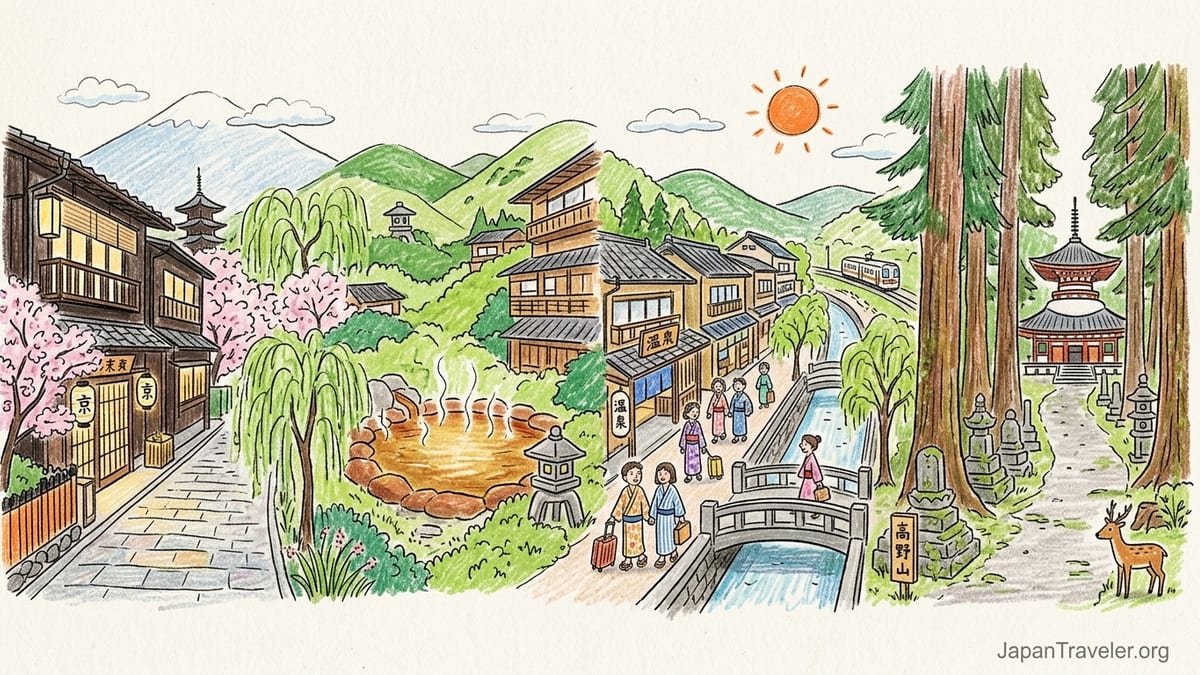
Kyoto Ryokans: Atmosphere First, Onsen Second
Kyoto is rich in traditional townhouses and historic inns, but relatively poor in natural hot springs compared with other regions. That means many central Kyoto ryokans focus on atmosphere and kaiseki cuisine, while bathing is often in a shared indoor bath rather than a true volcanic onsen. In popular areas like Gion and Higashiyama you can expect to pay the equivalent of a mid to high-range city hotel night for a modest tatami room with shared baths and dinner, often starting around the upper mid-hundreds of US dollars for two in peak season, with top-tier properties rising well above that.
Travelers who want private soaking should look toward small ryokans and villa-style properties that advertise in-room open-air baths or “family baths” reserveable by the hour. For example, several Kyoto inns in the Arashiyama and Yunohana onsen areas market rooms with cedar or stone tubs on balconies, filled with hot spring or heated water, where you can bathe without sharing space with strangers. These rooms often carry a clear premium, but for couples or families who value privacy, the extra cost can transform the stay.
Kaiseki dinners remain a cornerstone of the Kyoto ryokan experience. Even simpler inns usually provide seasonal multicourse menus with sashimi, simmered dishes and local vegetables, while high-end ryokans highlight Kyoto specialties like yudofu, bamboo shoots in spring and delicate wagashi sweets at the end of the meal. When comparing plans, check whether dinner is served in-room on low tables or in a private dining room, and whether the price includes both dinner and Japanese breakfast. Many first-time visitors underestimate how filling these meals are and do not need to plan additional restaurant dinners on ryokan nights.
For families and travelers with tattoos, Kyoto ryokans vary widely. Some small properties are run by owners who are more flexible about ink, especially if you reserve a room with a private bath and agree not to use any shared facility. Others still follow strict no-tattoo policies in communal baths. Children are generally welcome at mid-range Kyoto ryokans, though the quiet, pared-back style of top kaiseki-focused inns can feel better suited to older children who can sit through long dinners and respect late-night quiet hours.
Arima Onsen: Easy Onsen Escape from Osaka and Kobe
Arima Onsen sits in the hills just behind Kobe and is one of the oldest hot spring areas in Japan. It is easy to combine with a Kansai city base because you can reach it by train, bus or ropeway from Kobe or the Kobe side of Osaka in roughly an hour or less in total travel time. That makes Arima a good choice for visitors who do not want to commit to a long detour but still want an authentic onsen ryokan stay with proper hot spring water.
Many Arima ryokans operate more like full-service resorts, with multiple large communal baths, some offering both the area’s famous reddish-brown “gold” water and clearer “silver” water. When you book, pay attention to whether your room has only a standard unit bath, a private hot spring bath indoors, or a private open-air bath on a terrace. Rooms with private onsen-style baths are typically found at the higher end, where per-person prices including two meals can reach the upper hundreds of dollars in busy seasons. Mid-range ryokans without in-room springs still provide access to spacious public baths, often segregated by gender, that rotate morning and evening so guests can try different tubs.
Arima’s kaiseki dinners tend to be slightly more elaborate than at many small countryside inns, with some properties featuring Kobe beef or Tajima beef grilled at the table, alongside seasonal seafood and vegetables from the surrounding Hyogo region. It is common to dine in private rooms or partitioned spaces rather than in your guest room, especially in larger ryokans with 50 or more rooms. For guests with dietary needs, advance communication is crucial; many kitchens can accommodate pescatarian or no-beef menus with notice, but strict vegan or allergy requests may narrow your options.
Accessibility and logistics are straightforward in Arima. Larger ryokans usually offer shuttle services between the town’s bus stops, ropeway station or parking areas and the property, which can be a relief if you are arriving with suitcases after a long city stay. Some will hold luggage before check-in or after check-out so you can stroll the compact town, soak in day-use baths, or shop for local carbonated spring snacks and beauty products. Policies around tattoos vary, but because Arima attracts a mix of domestic and international guests, you will increasingly find inns willing to accept tattooed bathers in either private-family baths or during less crowded hours in communal baths if tattoos are small.
Kinosaki Onsen: The Classic Overnight Ryokan Experience
Kinosaki Onsen, on the northern coast of Hyogo Prefecture, is one of the few places in Japan where the entire town revolves around a network of public baths. There are seven main bathhouses scattered along the river and side streets, each with different interiors and pools. Guests staying at most local ryokans receive a pass that allows unlimited entry to these baths during operating hours, usually until mid-afternoon on the day of check-out. Many inns also provide a yukata robe and wooden geta sandals so you can wander from bath to bath in traditional dress, which is part of the appeal.
Because Kinosaki is relatively far from Kyoto and Osaka, many visitors plan a dedicated overnight stay, arriving by midday to have time for at least two or three baths before dinner. Journey time from Kyoto Station or Osaka is often around two and a half to three hours by train, including limited express services, so a one-night stay already feels like an immersive mini-break. Ryokan prices range widely, from small family inns with compact rooms and simple communal baths to high-end properties offering spacious tatami suites with in-room open-air tubs and multicourse crab feasts in winter.
In Kinosaki, the distinction between private and public bathing is especially important. Some ryokans focus on sending guests out to the town’s seven baths and maintain only modest in-house facilities, while others invest in stylish indoor and outdoor baths and add reserveable private-family onsen rooms. If you have tattoos and want to enjoy the public baths, you will need to research carefully. Some bathhouses and inns in Japan remain conservative about visible tattoos, but in an area with many international tourists, staff may provide flesh-colored covers for small tattoos or direct heavily tattooed guests toward private baths only. Policies can change, so checking in advance or asking your ryokan to clarify the latest rules is advisable.
Kinosaki is notably welcoming to families. Walking the lantern-lit streets in the evening you will see children in mini yukata clattering along in small geta, stopping for soft-serve ice cream or carnival-style games. Most ryokans accept children, and some offer slightly shortened or simplified kaiseki meals for younger guests. One practical tip is to check whether futons for children are included in the quoted price or charged separately, and whether babies can share existing bedding. The town’s flat layout and compact size make it manageable even with a stroller, though navigating narrow ryokan staircases with heavy luggage can still be challenging.
Koyasan Temple Lodging: Shukubo as a Different Kind of Stay
Unlike Kyoto, Arima or Kinosaki, Koyasan is not primarily a ryokan destination but a center of Shingon Buddhism where more than fifty temples operate shukubo, or temple lodgings. An overnight stay here is less about hot springs and luxury amenities and more about experiencing monastic rhythms, vegetarian Buddhist cuisine and the quiet of a mountain town after day-trippers leave. Many visitors describe their single night at Koyasan as one of the most memorable parts of a Kansai trip, but it is important to understand how it differs from a classic onsen ryokan stay.
Rooms in Koyasan temples are usually simple tatami spaces with sliding doors, shared toilets and either shared or semi-private wash areas. Bathing takes place in communal baths that are opened for limited evening hours, and water is not geothermal onsen but standard heated water. You sleep on futons laid out by temple staff, typically in the early evening, and instead of kaiseki that mixes meat and fish, you eat shojin ryori, an elaborate but entirely vegetarian cuisine built around tofu, mountain vegetables and seasonal produce. Dinners and breakfasts are often served in common tatami dining halls at fixed times.
In a shukubo, your schedule partly follows the temple’s. Many include optional or mandatory early-morning services where guests can sit quietly in the main hall to observe chanting and rituals, plus occasional fire ceremonies or guided cemetery walks to Okunoin in the evening. Curfews are strict compared with ryokans. It is not unusual for temple gates or main doors to lock around 9 pm, which matters if you plan to join a night tour or explore the town after dark. When booking, look carefully at stated curfew times and ask how late guests can return if they join an official guided tour.
Families and tattooed travelers can both stay at Koyasan temples, but expectations are different. Children are generally accepted, though the quiet, communal nature of the stay suits families who feel comfortable keeping noise down in thin-walled tatami rooms and during early morning services. Tattoos are rarely an issue in the same way they are in onsen towns, because baths are smaller and less central to the experience, but it is still courteous to cover large or striking designs if possible. Prices at Koyasan can feel similar to mid-range ryokans, with per-person rates including two vegetarian meals commonly landing in the same broad band, but you are paying for immersion rather than luxury or hot springs.
Rooms, Futons and What “Traditional” Really Means
Across Kyoto ryokans, onsen inns and Koyasan temples, the core elements of a traditional stay repeat: tatami mat floors, sliding paper doors, low tables and futons brought out at night. For some travelers, this is delightful; for others, kneeling or sitting on the floor and sleeping on futons can become uncomfortable after a few nights. When comparing options, check whether any rooms offer low chairs with backrests, raised dining tables or even Western-style beds in hybrid rooms. In Arima and Kyoto, it is increasingly common to find mixed-style rooms with beds plus a small tatami sitting area, while in Kinosaki and Koyasan, pure tatami layouts still dominate.
Futons at reputable ryokans and shukubo are thicker and more supportive than simple guest bedding, often layered with additional pads in colder months. Staff usually store them in a closet during the day and lay them out while you are at dinner, which means your sleeping area might be the same room where you relax in the afternoon. If you prefer a dedicated sleeping room, look for suites described as two-room or three-room tatami spaces. Guests with back issues may want to request extra padding in advance or bring a simple travel support such as a small inflatable cushion for sitting.
Sound insulation is one of the most common surprises for first-time visitors. Traditional construction means that noise travels easily between rooms and along corridors. In Kinosaki and central Kyoto, where streets can hum late into the evening, you may hear footsteps on wooden floors or doors sliding open and shut. Families with early-sleeping children may prefer corner rooms or properties noted for their quieter environment. Earplugs and eye masks are sensible additions to any ryokan packing list, particularly if you are a light sleeper.
Bathrooms are another point of variation. In Arima, mid to high-range inns often offer en suite toilets and sinks, with some higher categories adding private soaking tubs. In Kinosaki and Koyasan, especially in older buildings, it is still normal to have shared toilets and separate gendered bath areas. Travelers who strongly prefer private facilities should look specifically for “toilet and bath in room” in English descriptions when booking and expect to pay more for those categories.
Onsen, Tattoos, Children and Practical Logistics
Hot springs are where Kansai’s traditional stays really diverge. Kinosaki is centered on its seven public bathhouses, while Arima focuses on its high-mineral gold and silver springs within ryokan complexes, and Kyoto largely relies on heated water or suburban onsen pockets. Koyasan, by contrast, does not offer onsen at all, so if soaking in volcanic water is a priority, focus your budget and time on Arima or Kinosaki rather than temple lodging. A common strategy is to pair a single night at Koyasan with one or two nights at an onsen town so that you experience both sides of traditional Japanese hospitality.
Tattoo policies can still cause anxiety. In many Arima and Kinosaki properties, rules are set by each ryokan and by individual public bathhouses. Some remain strict and may refuse entry to guests with visible tattoos in shared baths, while others are gradually relaxing, especially where overseas visitors are a major part of the market. As a rule of thumb, small tattoos that can be covered with a patch or sports tape are less controversial, and booking a room with a private bath removes most concerns. Families with tattooed parents often find that a private-family bath, reserveable by the hour, is the easiest solution, allowing everyone to bathe together regardless of ink.
For children, the main considerations are safety and schedule. Very hot water, hard wet tiles and unisex changing spaces can be overwhelming for younger kids in busy baths. In Kinosaki’s public facilities, water is typically cooled to comfortable soaking temperatures, but it is still important to ease children in and limit their time. Ryokans may offer child-sized yukata and simplified meals, but they may also expect children to follow quiet hours, especially after dinner when other guests are bathing or relaxing. In Koyasan, temple staff often welcome curious children at morning services, yet early wake-up times and simple vegetarian meals can be challenging for picky eaters.
Luggage and transfers are easy to overlook when planning, yet they shape how relaxed your stay feels. Arima’s compact scale and shuttle buses make it convenient even with larger suitcases. Kinosaki’s streets are mostly flat, but many ryokans lack elevators, so consider leaving large bags in Kyoto or Osaka using station luggage forwarding services and traveling to the onsen town with smaller cases. In Koyasan, narrow lanes, stairs and gravel paths between temples and bus stops mean that less is more. Many travelers forward their main luggage from Kyoto or Osaka to their next hotel and carry only an overnight bag up the mountain, which makes navigating temple corridors and shared baths far simpler.
The Takeaway
Planning a traditional stay in Kansai is as much about matching your expectations to each destination as it is about finding a pretty tatami room. Kyoto excels at atmosphere and cuisine, with a scattering of private-bath ryokans for those who want to soak in solitude without leaving the city. Arima Onsen delivers a classic hot spring resort feel within easy reach of Osaka and Kobe, making it ideal for a one-night escape with rich kaiseki meals and large communal baths. Kinosaki Onsen offers the archetypal yukata-clad stroll between multiple public baths and is best appreciated as an overnight or two-night stay despite the longer journey.
Koyasan stands apart as a place to slow down and briefly live inside a temple rhythm, trading onsen water and hotel-like service for vegetarian cuisine, morning prayers and lantern-lit walks among ancient cedar trees. The right combination might be one night in a Kyoto ryokan, one night at Koyasan and one or two at Arima or Kinosaki, depending on how much time you have and how strongly you value hot springs. By paying attention to onsen style, meal format, room layout, tattoo and child policies, and the simple realities of stairs and suitcases, you can turn a traditional stay in Kansai from a checklist item into one of the most rewarding parts of your journey.
FAQ
Q1. Is it better to choose Arima or Kinosaki Onsen for a first-time Kansai trip?
For a short itinerary, Arima is easier to reach from Osaka and Kobe and works well as a one-night add-on. For a slower, more immersive bath town experience with yukata walks between multiple public baths, Kinosaki is worth the longer train ride and at least one overnight stay.
Q2. Can I enjoy an onsen experience in Kyoto itself?
Central Kyoto has limited true hot springs, but several ryokans and small hotels offer private or shared baths using heated water, and there are onsen areas on the city’s outskirts. If natural geothermal water is important, it is better to plan at least one night in Arima or Kinosaki.
Q3. How many nights should I spend at an onsen ryokan?
One night is enough to enjoy the core experience of afternoon check-in, bath, kaiseki dinner, a final soak and breakfast before departure. If you are visiting in a quiet season or want to unwind fully, two nights in Kinosaki or Arima lets you use more baths, explore the town and avoid feeling rushed.
Q4. Are tattoos allowed in Kansai onsen baths?
Policies vary by ryokan and bathhouse. Some still prohibit visible tattoos in communal baths, while others are more flexible, especially with small designs that can be covered. Booking a room with a private bath or reserving a family bath is the simplest way for tattooed travelers to enjoy soaking without stress.
Q5. Is a Koyasan temple stay suitable for children?
Many Koyasan temples welcome families, but the stay suits children who can handle early mornings, vegetarian meals and quiet shared spaces. If your child is very energetic or a picky eater, you might prefer a more conventional ryokan first, then choose a temple known for being family-friendly.
Q6. What is the main difference between ryokan kaiseki and Koyasan temple meals?
Ryokan kaiseki usually includes fish and sometimes meat, with a focus on regional specialties and presentation. Koyasan temple meals are shojin ryori, entirely vegetarian, based on tofu, seasonal vegetables and subtle flavors that reflect Buddhist dietary principles rather than indulgence.
Q7. Do I need to bring my own yukata or amenities to a ryokan?
Most ryokans in Kyoto, Arima and Kinosaki provide a yukata robe, obi sash, towels and basic toiletries. In Kinosaki, inns often supply an outer coat and wooden geta for walking to public baths. At Koyasan temples, you usually receive basic amenities but not always a full yukata set, so check the details before packing.
Q8. How should I manage luggage when visiting Koyasan or Kinosaki Onsen?
Because both destinations involve stairs, narrow streets and older buildings without elevators, it is practical to send large suitcases ahead using luggage forwarding services from Kyoto or Osaka. Traveling with just an overnight bag makes temple corridors, onsen changing rooms and small ryokan entrances much easier to navigate.
Q9. Can I stay at a ryokan without taking any meals?
Some Kyoto and Arima properties offer room-only or breakfast-only plans, but in classic onsen towns like Kinosaki many ryokans still center their business around dinner-inclusive stays. Skipping kaiseki can save money but also means missing an important part of the experience, so consider including at least breakfast and one full dinner.
Q10. How far in advance should I book ryokans and Koyasan shukubo?
For popular seasons such as late March to early April and November foliage weeks, booking several months ahead is wise, especially for private onsen rooms or well-regarded temples at Koyasan. Outside peak periods, you may find availability a few weeks in advance, but last-minute choices will be more limited and may not match your ideal style or budget.