


The Chugoku region in western Honshu is one of Japan’s most rewarding areas to explore by mixing high-speed rail with targeted rental car days. Hiroshima and Okayama are best reached by Shinkansen, but once you head toward Tottori’s sand dunes, the slopes of Mount Daisen, or the fishing villages of rural Shimane and western Yamaguchi, a car rapidly becomes the most practical tool. This guide explains how to build a hybrid rail and road itinerary, where to pick up a car, and what to know about permits, tolls, vehicle types and seasonal conditions.
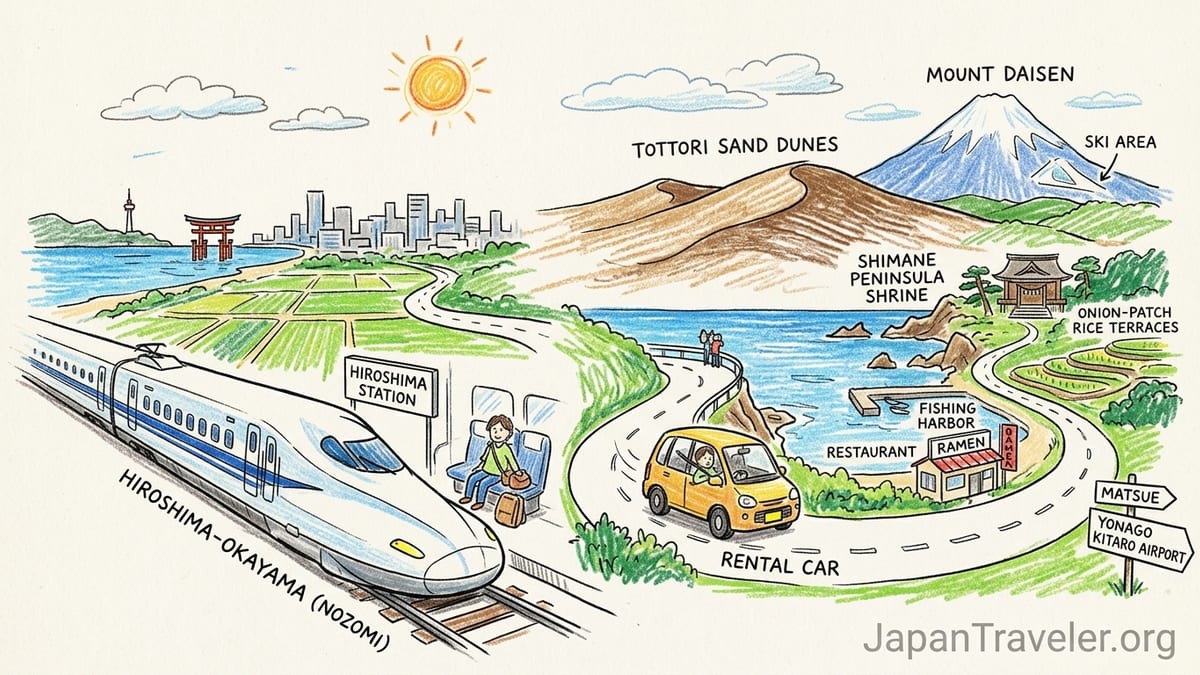
Why a Hybrid Rail + Car Strategy Works in Chugoku
The core Hiroshima–Okayama corridor sits right on the Sanyo Shinkansen, with trains running frequently and covering Hiroshima to Okayama in roughly 40 minutes on a Nozomi or Mizuho service. For most travelers, taking the Shinkansen into the region is faster, more relaxing and often cheaper than driving long distances. You skip highway tolls, avoid city traffic, and arrive at major hubs such as Hiroshima Station or Okayama Station rested and ready to start exploring.
Once you leave that main line, however, public transport thins out. Reaching places like the Tottori Sand Dunes, Mount Daisen’s ski and hiking areas, or the coastal shrines of the Shimane Peninsula often requires infrequent local trains plus buses with limited timetables. The Japan National Tourism Organization notes that rental cars are the easiest option in rural areas such as Tottori, where attractions are spread out and buses do not always run early or late in the day. In practice, this means that combining rail for long hauls with a rental car for rural sections offers the most efficient and flexible way to see Chugoku.
A typical hybrid itinerary might start with a Shinkansen ride from Osaka or Kyoto to Hiroshima for city sightseeing and Miyajima using trains and ferries. After a few days, you could ride the Sanyo Shinkansen to Okayama, then connect by limited express train to Yonago or Matsue. From there, you pick up a rental car to reach Mount Daisen, small onsen towns, or coastal viewpoints that lie far from stations. At the end of the loop, you return the car at a local airport such as Yonago Kitaro Airport or Tottori Airport and fly back to Tokyo or another hub.
This strategy keeps you off the wheel in dense urban traffic yet gives you full control in the countryside, where a car lets you chase clear views, pull over at photogenic rice terraces or fishing harbors, and duck into family-run restaurants that would be awkward to reach with luggage on local buses.
Where to Rent: Hiroshima and Okayama vs Local Hubs
Hiroshima and Okayama both offer dense rental markets, particularly at their airports, which makes them logical starting points if you want to drive directly from your arrival flight. Hiroshima Airport has a dedicated rental car facility called RENT-A-Car.Port, linked to the terminal by a pedestrian bridge. Major brands such as Toyota Rent a Car, Nissan Rent a Car, Nippon Rent-a-Car, Orix, Mazda Rent-a-Car, Times and J-net all operate counters here, so international travelers can compare vehicle classes and hours in one place.
Okayama Momotaro Airport also concentrates rental car companies on the first floor of the terminal, with a shared counter area where you check in before being escorted to the car lot. Operators commonly include Toyota Rent-a-Lease Okayama, Nippon Rent-a-Car, Nissan, Orix and Times. The airport sits north of Okayama City, connected by airport buses to Okayama Station, so you can either pick up a car right after landing or ride the bus into the city and rent near the station if you first want to explore Kurashiki or Okayama’s Korakuen Garden on foot.
For deeper rural access, it often makes more sense to rent in smaller hubs closer to the mountains and coast. Tottori City, Yonago and Matsue each have multiple rental outlets around their stations and regional airports. At Tottori Airport or Tottori Station you might find Toyota Rent a Car, Nippon Rent-a-Car or local firms offering compact hatchbacks and kei cars geared to domestic visitors heading for the dunes. Yonago Kitaro Airport and Yonago Station tend to attract travelers bound for Mount Daisen’s ski fields or hiking trails, and several companies there specifically advertise winter tire options in colder months. Matsue Station, midway between the Japan Sea coast and Lake Shinji, works well as a base for driving loops that combine Izumo Taisha Grand Shrine, small lakeside onsen towns and coastal viewpoints.
In practical terms, if you are only planning urban sightseeing in Hiroshima and Okayama followed by a straightforward rail transfer to Tottori or Shimane, renting at Tottori, Yonago or Matsue keeps driving time focused where it adds the most value. On the other hand, if you want to explore the Seto Inland Sea coast, rural Okayama highlands or western Yamaguchi en route, starting your rental at Hiroshima Airport or Okayama Airport gives you greater flexibility to detour through places like the Kintaikyo Bridge area, the old town of Hagi, or the islands off Okayama’s Ushimado coast.
Do You Really Need a Car? When It Helps and When It Does Not
Within Hiroshima and Okayama cities, a rental car is often more of a liability than an asset. Hiroshima’s Peace Memorial Park, central shopping streets and ferry to Miyajima are all connected by city tram lines and JR trains, with frequent services and clear English signage. Parking in the city center can cost the equivalent of several hundred yen per hour and hotel parking is not always included. In Okayama, the castle, Korakuen Garden and Okayama Station form a compact triangle easily navigated by tram and on foot, while Kurashiki’s Bikan Historical Quarter is a short local train ride away and best explored on foot or by bicycle.
Once you move north toward Tottori and Shimane or west into Yamaguchi’s coastal areas, the dynamic shifts. The Tottori Sand Dunes lie a short bus ride from Tottori Station, but nearby viewpoints, the sand museum and small coastal walks quickly become easier with a car, especially if you want to arrive for sunrise or stay for sunset. JNTO guidance highlights that in regional areas like Tottori, rental cars are the most convenient way to move between scattered attractions, since bus routes are limited and many small stations have only a few trains per hour.
A car is especially powerful for accessing Mount Daisen trailheads, ski areas and roadside onsen lodges, which can sit several kilometers uphill from the nearest station. In Shimane, sites such as Hinomisaki Lighthouse, remote coves on the Shimane Peninsula or tiny fishing villages around the Nakaumi and Lake Shinji area are much easier to string together in a single day by car. Western Yamaguchi’s highlights, from Motonosumi Shrine’s cliffside torii gates to the karst plateau of Akiyoshidai and the caves of Akiyoshido, are also spread out in ways that favor driving.
For many travelers, the ideal compromise is to use trains and trams exclusively in Hiroshima and Okayama, then schedule two to five rental days clustered around Tottori, Yonago, Matsue and perhaps a one-way drop in western Yamaguchi or back at a regional airport. This approach keeps costs and stress down, while opening up areas that would otherwise demand intricate bus research and long waits at rural stops.
Licensing, International Driving Permits and Basic Rules
Japan takes documentation for foreign drivers seriously. Visitors from most countries need an International Driving Permit based on the 1949 Geneva Convention, obtained in their home country before arrival, along with their valid national driving license. The Japan National Tourism Organization stresses that the permit must be issued by an authorized body such as an automobile association and that it is only valid when presented together with your actual license. Travelers from certain places, such as Switzerland or Germany, may instead drive on an official Japanese translation of their license; always confirm the rules for your nationality before booking a car.
At the rental counter in Hiroshima, Okayama, Tottori, Yonago or Matsue, you will typically be asked for your passport, your physical home-country license, your International Driving Permit and a credit card. Most companies require the main driver to be at least 18 or 20 years old, though some categories or foreign interfaces may carry higher minimums. If your permit is not in the correct format, staff are likely to refuse the rental even if you have a reservation, so it is wise to double-check the wording on your permit matches the Geneva Convention specifications.
Once on the road, remember that Japan drives on the left. Rural Chugoku roads are generally well maintained and less congested than major city expressways, but you will encounter narrow lanes, blind curves and occasional single-lane bridges. Speed limits on ordinary roads are often 50 or 60 kilometers per hour, dropping lower through villages and school zones. Seat belts are mandatory for all passengers, and using a mobile phone while driving is strictly forbidden. Many rental cars provide English-friendly navigation menus, though in more basic kei cars the onboard navigation may be Japanese only, in which case using your phone with offline maps is useful.
Insurance is another non-negotiable item. Basic collision damage waivers may be included in quoted rates, but supplemental coverage that lowers your out-of-pocket responsibility for accidents or scratches is strongly recommended, particularly on narrow rural roads or in winter conditions around Mount Daisen. When comparing quotes from companies serving Hiroshima or Yonago airports versus smaller in-town outlets, check whether these insurances are bundled or add-on extras to avoid surprises at pickup.
ETC Cards, Expressway Tolls and One-Way Rental Fees
Chugoku’s expressway network makes long-distance driving between Hiroshima, Okayama and Tottori possible, but tolls can add up quickly. Most local drivers use ETC cards, contactless payment cards that slot into an onboard unit and let you pass through ETC lanes without stopping. For visitors, many rental companies in Hiroshima, Okayama, Tottori, Yonago and Matsue offer ETC cards as an optional rental item. You pay a small daily fee for the card and then settle the accumulated tolls in a lump sum when returning the car.
Using an ETC card simplifies your journey in several ways. You avoid fumbling for cash at toll gates, and you can follow the same purple-marked ETC lanes as local drivers instead of hunting for the few remaining cash booths. Some expressway discounts also only apply when using ETC, which can slightly reduce costs on longer hops such as Hiroshima to Tottori or Okayama to Yonago. If you are planning to stick mostly to local roads in Shimane or around Mount Daisen, you may decide to skip expressways altogether, but for airport transfers or days with longer distances the card quickly justifies its modest fee.
One-way rentals are another key consideration in a hybrid rail plus car trip. Many major brands, including Toyota, Nippon, Orix and Times, allow you to pick up a car in one prefecture and drop it in another, but they usually charge a one-way or drop-off fee that varies by distance and vehicle class. For example, renting in Okayama and returning in Tottori or Shimane may incur a moderate fee that some travelers consider a fair trade for saving several hours of backtracking. In online examples for other regions, drop charges in Japan often run in the range of several thousand yen for cross-prefecture one-way trips, though exact amounts differ by company and route.
When planning, compare scenarios such as picking up in Hiroshima and returning at Yonago Kitaro Airport, or starting in Tottori and ending at Okayama Airport before catching a flight. Sometimes rearranging a loop so you start and finish in the same city can eliminate one-way fees entirely, at the cost of an extra rail segment. Local booking aggregators and the international sites of Japanese rental chains allow you to preview one-way charges during the quote process without committing to a reservation.
Choosing the Right Car: Kei Cars, Compacts and Seasonal Gear
Japanese rental fleets in Chugoku lean heavily toward small, fuel-efficient vehicles. Kei cars, which are light vehicles with small engines and distinctive yellow license plates, are popular around towns like Yonago and Tottori because they are inexpensive to rent, easy to park and frugal on fuel. A typical kei hatchback offers enough space for two adults and light luggage, making it a reasonable choice for couples planning short day trips around Tottori’s coastline or Matsue’s lakes.
For most international visitors, however, a standard compact or subcompact car offers a more comfortable balance. These cars, commonly branded as “compact” or “class C” in booking systems, provide more engine power and better stability on expressways, as well as enough trunk space for two medium suitcases. If you are driving from Hiroshima Airport into the Chugoku Mountains, or planning to climb toward Mount Daisen’s ski areas with three or four people, stepping up to a compact class minimizes strain on the engine and driver alike.
Winter conditions, typically from December through March around Mount Daisen and higher inland roads, make tire choice critical. Rental outlets in Yonago, Matsue and Tottori usually offer vehicles fitted with studless winter tires during the colder months, particularly those marketed for ski trips. If you expect snow or ice, specifically reserve a car with winter tires and confirm at pickup that they are installed. Travelers who visited Tottori in early spring have described sudden heavy snowfalls near the dunes; having the right tires can make the difference between a scenic adventure and a stressful slide down a mountain road.
Accessories also matter. If you are carrying ski or snowboard gear or traveling with children, ask about roof racks, child seats and additional drivers at the booking stage. These add-ons may carry per-day fees but are usually easy to arrange at larger locations such as Hiroshima Airport, Okayama Momotaro Airport or the main stations in Yonago and Matsue, while smaller outposts may have limited stock.
Fuel, Parking and Everyday Practicalities in Rural Chugoku
Fueling a car in western Japan is straightforward once you know what to expect. Most rental cars in Chugoku run on regular unleaded gasoline, and stations are usually called “gasoline stand” or “service area” in English materials. Around Hiroshima, Okayama, Tottori, Yonago and Matsue, you will find both full-service and self-service stations. Attendants at full-service stations will often guide you where to stop, handle the fueling and take payment at your window. Self-service kiosks have menus in Japanese, but some offer English prompts; if you are unsure, staff are generally happy to help.
In rural Shimane or deeper into western Yamaguchi, stations can be farther apart and close earlier in the evening than in cities. It is sensible to refill when your tank drops below half, especially if you are heading into the hills around Mount Daisen or along isolated coastal stretches. Rental companies expect you to return the vehicle with a full tank, typically verified by a final receipt from the last fuel stop, so leave a few minutes at the end of your rental to top up before arriving back at Yonago Kitaro Airport, Tottori Airport or a city office.
Parking logistics vary between city and countryside. In Hiroshima and Okayama, hotel parking may be offered in underground garages or mechanical stack systems and can involve additional nightly charges. Public parking near popular sights operates on timed pay-and-display or gated systems that charge by the hour, with clearly posted maximum daily rates. In smaller towns and at rural attractions, you are more likely to find free or low-cost parking lots, particularly at onsen ryokan, roadside michi-no-eki service areas, shrines and trailheads.
Always pay attention to signage when leaving your car on local streets. Unauthorized parking in Japan can result in fines and potentially a call to the rental company. When in doubt, look for designated coin-operated lots near stations or commercial areas. Around tourist sites like the Tottori Sand Dunes or Izumo Taisha, large paid lots near the main entrances make it clear where you should park, and fees are usually modest relative to the convenience.
Example Itineraries: Putting Rail and Rental Together
One realistic week-long itinerary could start with two nights in Hiroshima reached by Shinkansen from Osaka. You explore the Peace Memorial Museum, Hiroshima Castle and Miyajima entirely on public transport, avoiding the cost and hassle of a car in the city. On day three, you ride the Shinkansen to Okayama and enjoy an afternoon in Korakuen Garden and the Bikan Historical Quarter of Kurashiki, again on foot and by local rail.
On day four, you travel by limited express train from Okayama to Yonago, picking up a compact rental car near Yonago Station or Yonago Kitaro Airport for three days. With the car, you drive up to Mount Daisen for forest walks or skiing, then continue around Lake Shinji and Lake Nakaumi, staying in a lakeside onsen hotel near Matsue. The next day you reach Izumo Taisha, detouring along small coastal roads to fishing villages and viewpoints that would be nearly impossible to visit in a single day by bus.
On day seven, you drop the car at Izumo or Yonago Airport and fly back to Tokyo, or continue by limited express and Shinkansen to your next destination. Over the course of the week, you have paid for only three days of car rental rather than seven, used trains where they are strongest, and still reached remote corners of Shimane and Tottori at your own pace.
Another pattern might appeal to travelers arriving from abroad into Hiroshima Airport. After landing, you collect a rental car at the airport and drive westward over several days toward Iwakuni, Hagi and the coastal landscapes of western Yamaguchi, visiting the Kintaikyo Bridge area, castle ruins and remote beaches. You finish by dropping the car at a rental office near Shin-Yamaguchi Station and boarding the Shinkansen back toward Osaka or Tokyo. Throughout, you are using the car primarily in rural and small-town contexts where its benefits clearly outweigh the costs.
The Takeaway
For most visitors, the smartest way to see the Chugoku region is to pair Japan’s efficient rail system with targeted bursts of driving. Within the Hiroshima–Okayama corridor, Shinkansen and local trains cover nearly every need, and in-city driving often introduces more problems than it solves. Beyond that core, however, particularly around Tottori, Mount Daisen, rural Shimane and western Yamaguchi, the flexibility of a rental car quickly becomes invaluable.
By timing your pickup at hubs such as Hiroshima Airport, Okayama Momotaro Airport, Tottori, Yonago or Matsue, equipping yourself with a valid International Driving Permit, understanding ETC toll systems and one-way fees, and choosing the right car and tires for the season, you can turn Chugoku into a region of spontaneous detours and easy access rather than missed connections. Plan your rail legs first, then drop in rental days where public transport thins out, and you will see a side of western Japan that many travelers never reach.
FAQ
Q1. Do I need a car for sightseeing in Hiroshima and Okayama cities?
For most travelers, no. Hiroshima and Okayama are well served by trams, local trains and buses, and major sights cluster around central stations, making public transport and walking more convenient than driving.
Q2. Where is the best place to pick up a rental car for visiting Tottori and Mount Daisen?
Many travelers ride the train to Tottori, Yonago or Matsue, then rent a car near the station or at local airports such as Tottori Airport or Yonago Kitaro Airport to stay close to the mountains and coast.
Q3. Do I need an International Driving Permit to rent a car in the Chugoku region?
Most foreign visitors do. In addition to your home-country license, you usually need an International Driving Permit based on the 1949 Geneva Convention, obtained before arriving in Japan.
Q4. Is it worth renting an ETC card for tolls?
If you plan to use expressways between cities such as Hiroshima, Okayama and Tottori, renting an ETC card simplifies toll payments and may unlock small discounts, making it a practical add-on.
Q5. How expensive are one-way car rentals between different Chugoku prefectures?
One-way fees vary by company and distance but are typically a modest extra charge. Many travelers find them worthwhile if it saves hours of backtracking to return to the original pickup point.
Q6. Should I choose a kei car or a compact car for rural driving?
Kei cars are cheap and easy to park, good for solo travelers or couples with light luggage. For expressway driving, mountain roads and multiple passengers, a compact car is usually more comfortable and stable.
Q7. Do I need winter tires around Tottori and Mount Daisen?
From roughly December to March, snow and ice are common around Mount Daisen and inland roads. In that period, you should reserve a car equipped with studless winter tires.
Q8. Are fuel stations easy to find in rural Shimane and western Yamaguchi?
Fuel stations exist but are more spread out and may close earlier in the evening. It is wise to refill when your tank reaches half, especially before driving into mountains or remote coastal areas.
Q9. Is parking difficult around major attractions like the Tottori Sand Dunes or Izumo Taisha?
These sites generally provide large visitor parking areas, sometimes with modest fees. In rural zones, free or low-cost lots at shrines, onsen and viewpoints are common and easy to use.
Q10. How far in advance should I book my rental car in Chugoku?
Booking at least a few weeks ahead is sensible, especially in busy seasons such as cherry blossom, summer holidays and winter ski periods, or if you need extras like child seats or winter tires.