


Straddling the space between Kansai’s big cities and Kyushu’s hot‑spring heartland, Japan’s Chugoku region remains surprisingly under‑visited. For first‑time travelers willing to go a little beyond the usual Tokyo–Kyoto–Osaka triangle, Chugoku offers peace and coastal scenery, historic castle towns, powerful World War II history, iconic shrines and some of Japan’s best cycling, hiking and onsen. This guide explains how the region fits into a wider Japan itinerary and introduces key destinations on both the Sanyo side along the Seto Inland Sea and the quieter San’in side facing the Sea of Japan.
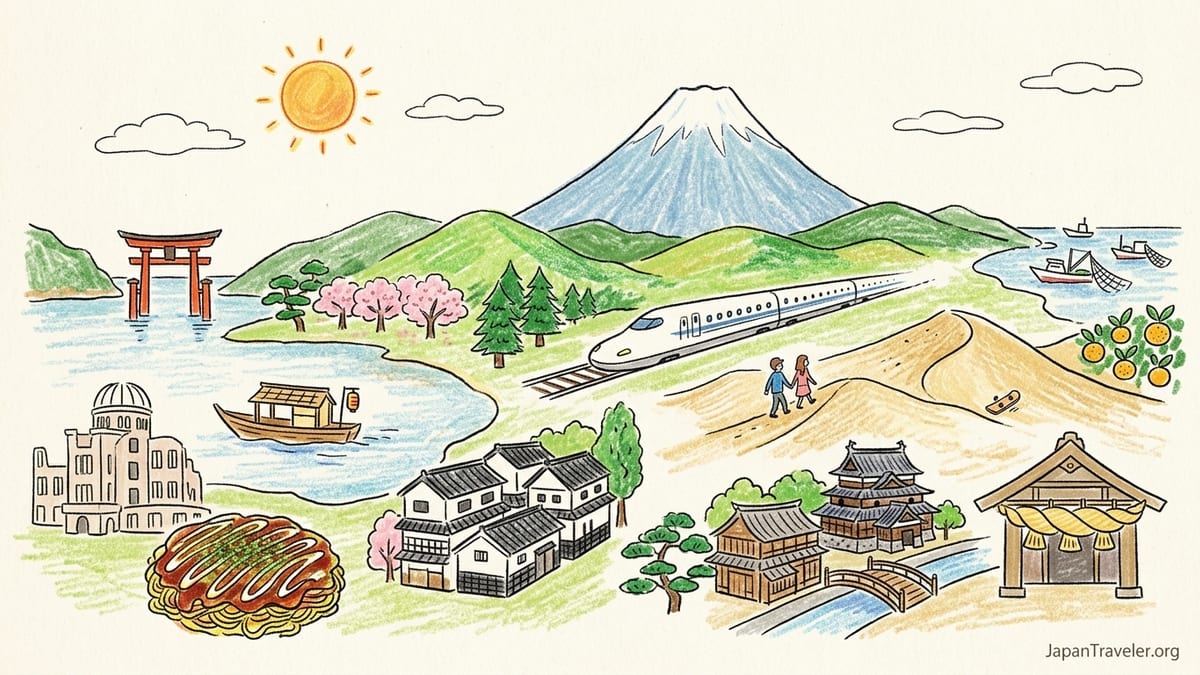
Understanding Chugoku: Between Kansai and Kyushu
Chugoku occupies the western end of Japan’s main island of Honshu, bridging Kansai to the east and Kyushu to the southwest. On most rail maps, you will see it between Osaka and Fukuoka, anchored by Hiroshima and Okayama on the Sanyo side and by Tottori, Matsue and Hagi on the San’in coast. For many visitors, the easiest way to picture Chugoku is as the stretch of land the Sanyo Shinkansen crosses on its way from Shin‑Osaka to Hakata, with slower trains and highways peeling off north toward the Sea of Japan.
Because of this location, Chugoku is straightforward to slot into a longer Japan trip. A common first‑timer route is Tokyo to Kyoto and Osaka, then continue by shinkansen to Okayama and Hiroshima, before carrying on to Fukuoka in Kyushu. With 3 to 5 extra days, you can divert north to San’in highlights such as Tottori Sand Dunes, Matsue’s castle town and the shrine complex of Izumo Taisha, or trace the Japan Sea coast to Hagi and on to Shimonoseki for ferries and train links to Kyushu.
Japan National Tourism Organization materials highlight Hiroshima and Miyajima, Okayama Korakuen Garden, the castle town of Hagi, the volcanic peak of Mt. Daisen, Iwami cultural sites and the island‑hopping Shimanami Kaido cycling route as key draws in the region. These spots collectively give a good sense of what Chugoku offers: coastal scenery, traditional neighborhoods, spiritual sites and outdoor travel that is accessible without specialist gear.
For most visitors, the main decision is how to divide time between Sanyo and San’in. Sanyo, fronting the Seto Inland Sea, is easier to reach, well connected by shinkansen and dotted with cities such as Hiroshima, Okayama and Kurashiki. San’in on the Sea of Japan side is quieter, more rural and slower to traverse, but rewards you with sand dunes, onsen resorts and castle towns that often feel far removed from Japan’s biggest urban centers.
Sanyo Coast Highlights: Hiroshima, Miyajima, Okayama, Kurashiki and Onomichi
Most first‑time journeys into Chugoku begin along the Sanyo corridor. Hiroshima is around 1 hour 40 minutes from Shin‑Osaka by Sanyo Shinkansen, making it realistic as either a long day trip from Kansai or, better, a one‑ or two‑night base. In Hiroshima, travelers usually start at the Peace Memorial Park, the Atomic Bomb Dome and the excellent museum that documents the 1945 bombing. Nearby streets offer a softer side of the city, with local chains and small counters serving up Hiroshima‑style okonomiyaki layered with noodles, cabbage and pork, often for 1,000 to 1,500 yen per plate.
From central Hiroshima, Miyajima is a straightforward half‑day or full‑day excursion. Local JR trains or trams run to Miyajimaguchi in around 30 to 45 minutes, followed by a 10‑minute ferry ride to the island. Many visitors time their trip for mid‑tide, when the giant vermilion torii of Itsukushima Shrine stands in shallow water, or stay overnight in a ryokan so they can see it lit softly after day‑trippers leave. Beyond the shrine, there are walking trails up Mt. Misen, quiet coastal paths and simple grilled oyster and momiji‑manju stalls along the town’s main street.
East of Hiroshima, Okayama is about 35 minutes away by shinkansen and functions as a key rail junction for both Sanyo and San’in. First‑time visitors usually come for Okayama Korakuen, considered one of Japan’s three great landscaped gardens. In practice, this means broad lawns, borrowed scenery toward Okayama Castle and teahouses that feel surprisingly open compared with more compact gardens in Tokyo or Kyoto. A typical visit pairs the garden with a walk through the reconstructed black‑and‑white keep of Okayama Castle just across the river, then a lunch of local specialties such as barazushi, a colorful scattered sushi bowl with vinegared rice and seasonal seafood.
Nearby Kurashiki, around 20 minutes from Okayama Station on local trains, offers one of Chugoku’s most atmospheric townscapes. The Bikan Historical Quarter is a preserved canal district where warehouses with white walls and black tile patterns have been converted into cafes, small museums and craft shops. Renting a kimono for an hour or two and taking a short boat ride along the willow‑lined canal has become popular, especially in the late afternoon when the light softens over the white plaster and old storehouses.
Onomichi sits on the Sanyo line between Fukuyama and Mihara and feels far smaller and more intimate than Hiroshima or Okayama. Trains from Hiroshima take about 1 hour, making it a convenient overnight stop for travelers aiming to cycle the Shimanami Kaido or simply wander its hillside temples. The town’s appeal comes from steep lanes, small shrines and a relaxed waterfront. Many visitors ride the short ropeway to Senkoji Park for a view of the Seto Inland Sea, then descend on foot through residential backstreets before ending the day in a simple izakaya near the harbor.
San’in Coast Highlights: Tottori, Mt. Daisen, Matsue, Izumo Taisha and Hagi
Compared with Sanyo, the San’in side of Chugoku feels more remote and less hurried. It is reachable by train, car or a combination of both, and rewards the extra effort with quieter towns and landscapes shaped by the Sea of Japan. Tottori is the best known entry point from Kansai, with limited express trains running from Osaka in roughly 2.5 to 3 hours. Once in Tottori, most visitors head straight for the Tottori Sand Dunes, an expanse of wind‑shaped sand hills that can reach up to several tens of meters in height, looking more like a small desert than the Japan many travelers expect.
At the dunes, you can simply walk along the ridges and down toward the sea or join activities such as sand boarding and paragliding, which various local operators offer seasonally. A small chairlift and a sand museum showcasing large‑scale sand sculptures round out the experience. Many travelers combine a half‑day at the dunes with a soak in nearby onsen towns such as Kaike Onsen or Misasa Onsen, both reachable by regional trains and buses, and known for traditional ryokan stays that include kaiseki dinners and access to communal baths.
Southwest of Tottori, Mt. Daisen rises above the surrounding plains. On clear days it has a profile often compared to Mt. Fuji when seen from certain angles, and it serves as a major hiking and skiing area in the region. Summer and early autumn bring day hikers to trails that start around Daisen Temple, with options ranging from gentle forest walks to more strenuous routes near the summit ridges. In winter, small ski resorts operate with a handful of lifts, catering primarily to domestic travelers with modest expectations compared with larger Japanese ski areas.
Further along the Sea of Japan coast, Matsue sits on a network of lakes and canals and preserves one of the few original wooden castles remaining in Japan. The compact keep of Matsue Castle, with its dark wooden exterior, can be explored in about an hour, and small boat cruises around the inner moat give a different perspective on the town’s samurai district and traditional residences. Matsue also works as a base for exploring nearby onsen areas and for a day trip to Izumo Taisha, one of Japan’s oldest and most revered Shinto shrines.
Izumo Taisha is particularly associated with matchmaking and relationships, and it is famous among Japanese visitors for its enormous shimenawa straw rope that hangs across the hall. From Matsue, local trains take roughly an hour to reach the Izumo area, after which a short bus or walk leads to the shrine entrance. Continuing west along the San’in coast, Hagi offers another layer of history. This former castle town is known for well‑preserved samurai districts, low earthen walls, citrus trees and pottery workshops turning out Hagi‑yaki ceramics in muted glazes. Many travelers walk or cycle between the castle ruins, old domain school sites and coastal viewpoints, often staying in simple inns converted from older merchant houses.
Getting Around: Trains, Regional Rail Passes and Rental Cars
For first‑time visitors, the west Japan rail network makes Chugoku relatively approachable. The Sanyo Shinkansen connects Shin‑Osaka with Okayama, Hiroshima and onward to Kokura and Hakata in Kyushu, while conventional JR lines fan out toward San’in. From Okayama, the Hakubi Line runs north toward Yonago and Mt. Daisen, and from there you can continue to Matsue and Izumo along the San’in Main Line. Local and limited express trains link Tottori with both Osaka and Matsue, though frequencies are more modest on the Sea of Japan side than along the Sanyo corridor.
Regional JR passes can keep travel costs manageable if you plan several long train rides over a few days. Options change periodically, but passes in the Sanyo–San’in or Okayama–Hiroshima–Yamaguchi areas typically cover unlimited travel on designated JR lines, including segments of the Sanyo Shinkansen and key limited express routes, for a fixed number of consecutive days. As an example of how these passes can be used, a traveler might buy a regional pass, then ride the shinkansen from Shin‑Osaka to Okayama and Hiroshima, take local JR lines to Miyajima and Onomichi, and finish with a limited express up to Matsue and Izumo before looping back toward Kansai or onward to Kyushu.
Rental cars become increasingly practical once you move into San’in and rural parts of Yamaguchi and Shimane. While you can reach places like Tottori Sand Dunes, Mt. Daisen trailheads and some coastal onsen towns by bus, service may be limited to a few departures per day and time‑consuming to navigate in English. Picking up a compact rental car near major stations such as Tottori, Yonago, Matsue or Shin‑Yamaguchi simplifies access to dispersed sites and allows flexible detours. For example, with a car you could leave Matsue in the morning, stop for several hours at Izumo Taisha, then continue along scenic coastal roads to Hagi, checking into a family‑run ryokan that might be awkward to reach by bus.
If you prefer to avoid driving, plan your itinerary with timetables in mind. It is realistic to explore Sanyo almost entirely by train and tram, including Hiroshima, Okayama, Kurashiki, Onomichi and Miyajima, and then choose one specific San’in base such as Matsue or Tottori reached by a single long train ride. From that base, consider guided tours or occasional taxis to fill gaps in bus coverage. In practice, many visitors find that mixing a regional rail pass for long‑distance hops with selective taxi rides for short local transfers keeps the experience straightforward without the stress of driving on the left.
On Foot, By Bike and Onsen Hopping: Outdoor Experiences
Chugoku is particularly appealing for travelers who like to be outdoors without committing to multi‑day treks. The Shimanami Kaido, highlighted by JNTO as a regional star, is a roughly 70 kilometer cycling route across the Seto Inland Sea between Onomichi in Hiroshima Prefecture and Imabari in Ehime. Dedicated cycle paths and gentle gradients make it approachable for casual riders, and a blue line painted on the road helps keep you on route. Bicycle rental terminals along the way offer standard bikes, e‑bikes and child seats, with one‑day rentals commonly starting at a few thousand yen and optional drop‑off fees if you complete the ride in the opposite city.
First‑time visitors often break the Shimanami Kaido into two easier days, overnighting in simple guesthouses or small hotels on one of the islands, then returning bikes at the far end and catching a highway bus or train back. A typical pattern is to stay in Onomichi, pick up rental bikes soon after opening, take the five‑ to ten‑minute ferry across to the first island, ride 30 to 40 kilometers with breaks at cafes and viewpoints, then finish the remaining distance the next morning. Others choose a shorter taster loop on one of the central islands, combining a half‑day ride with a visit to a local shrine or beach.
Inland, Mt. Daisen offers a different style of outdoor travel. Trails here range from family‑friendly forest paths near Daisen Temple to more demanding routes near the ridgelines. On a clear summer day, you might hike for three to four hours, then descend to a local onsen such as those at Daisen’s base accommodations or nearby hot‑spring towns. Similarly, around Hiroshima and Yamaguchi, shorter coastal walks and viewpoints encourage unstructured exploration, whether it is climbing to Senkoji Park above Onomichi or walking between coastal shrines and rock formations in western Yamaguchi.
Onsen culture extends across Chugoku, and weaving hot‑spring stops into your journey is both practical and memorable. On the San’in side, Kaike Onsen near Yonago faces the sea and pairs naturally with Mt. Daisen hikes, while Matsue’s local onsen districts and nearby Tamatsukuri Onsen offer traditional inns with tatami rooms and seasonal multi‑course dinners. In Yamaguchi Prefecture, Yuda Onsen and more rustic baths near Akiyoshidai provide options after a day of visiting caves and karst landscapes. Even if you are not staying in a ryokan, many onsen towns have public baths that welcome day visitors for a modest entry fee, typically under 1,000 yen.
Akiyoshidai, Iwami Culture and Yamaguchi’s Quiet Charms
Yamaguchi Prefecture, occupying the western tip of Honshu, often slips under the radar despite being threaded by the Sanyo Shinkansen and home to distinctive landscapes. Inland, the Akiyoshidai plateau presents one of Japan’s best known karst terrains, with rolling grasslands studded by limestone outcrops and sinkholes. Walking and cycling routes trace the ridges, and viewpoints overlook the plateau’s gently undulating fields. Beneath Akiyoshidai, Akiyoshido Cave extends for several kilometers, with illuminated walkways that guide visitors past underground formations and pools. The combination of open plateau and cool cave makes this area appealing on hot summer days.
On the Sea of Japan side, Iwami is associated with traditional culture including Iwami Kagura, a dynamic form of Shinto theatrical dance characterized by colorful costumes and fast rhythms. Performances are sometimes held at local shrines or cultural centers, particularly on weekends or during festival periods. Travelers interested in regional crafts and folk art can look for workshops and exhibitions that spotlight Iwami pottery, paper and metalwork produced in small communities inland from the coast.
Yamaguchi City itself has a calm atmosphere, sometimes compared locally to a small Kyoto because of its temples, white‑walled streets and riverside paths. It can be used as a stopover between Hiroshima and Kyushu, especially if you plan to explore Akiyoshidai or the nearby coast. Continuing to the west and north, the coastline toward Hagi and then Shimonoseki is dotted with fishing villages, viewpoints and beaches that reward travelers with extra time and a willingness to navigate local trains, buses or a rental car.
Food in Yamaguchi often leans toward fresh seafood. Along the coast, you will see pufferfish dishes prominently advertised, especially in and around Shimonoseki, which is one of Japan’s main centers for this delicacy. At casual level, travelers might try fugu in the form of hot pots, sashimi sets or lightly fried pieces at mid‑range restaurants that specialize in it. Elsewhere in the prefecture, coastal markets and small restaurants serve seasonal catches, from squid in summer to richer fish stews in winter, complemented by local sake produced in small breweries across Chugoku.
Food and Local Flavors Across Chugoku
Beyond specific destinations, Chugoku’s food helps tie the region together. Hiroshima’s layered okonomiyaki, cooked on large steel griddles, ranks high on many visitor lists. It is easy to sample at multi‑stall buildings near Hiroshima Station or in dedicated okonomiyaki villages where individual counters specialize in different toppings. Elsewhere along the Seto Inland Sea, grilled oysters, simple seafood rice bowls and citrus‑forward desserts feature heavily, reflecting the mild climate and abundant coastal harvest.
Okayama promotes itself as a “fruit kingdom,” and depending on the season you may find parfaits and desserts piled with white peaches, muscat grapes or strawberries in cafes near Okayama and Kurashiki stations. In San’in, hearty dishes suited to colder winters become more common, including hot pots with crab or other shellfish near Tottori and Matsue. Izumo soba, buckwheat noodles served in stacked lacquer bowls with dipping sauces and condiments, is a regional specialty around Izumo Taisha and Matsue and provides an easy, affordable lunch between shrine visits or castle exploration.
Chugoku also offers opportunities to experience traditional kaiseki meals at ryokan, particularly in onsen towns. A typical dinner might include seasonal sashimi, grilled local fish, simmered vegetables, tempura and rice, carefully plated and served course by course in your tatami room. While these stays can be a splurge, prices in parts of Chugoku are often more moderate than in heavily touristed Kyoto or Hakone, especially in smaller San’in onsen villages. For budget travelers, simple set meals at family‑run restaurants, station bento boxes and convenience store options ensure you can eat reasonably well without spending heavily.
For drinks, local sake from Chugoku’s breweries is widely available. Hiroshima and neighboring prefectures have long histories of sake production, with tasting flights offered at some breweries and specialist bars. Matsue is also known for its tea culture, combining matcha with traditional sweets at teahouses near the castle and along the lakeside, giving visitors an atmospheric pause between sightseeing stops.
FAQ
Q1. How many days should a first‑time visitor spend in the Chugoku region?
Most first‑time visitors find that 4 to 7 days works well, for example 2 days around Hiroshima and Miyajima, 1 day in Okayama and Kurashiki, and 1 to 3 days split between San’in highlights such as Tottori Sand Dunes, Matsue and Izumo Taisha or Hagi.
Q2. Is the Shimanami Kaido cycling route suitable for beginners?
Yes, the Shimanami Kaido is designed to be accessible for casual cyclists, with gentle gradients, a clearly marked route and rental bikes available, including e‑bikes. Beginners often either tackle shorter sections or spread the full distance over two relaxed days with an overnight stay on one of the islands.
Q3. Do I need a rental car to explore Chugoku?
You can comfortably explore the Sanyo side, including Hiroshima, Miyajima, Okayama, Kurashiki and Onomichi, by train, tram and bus. A rental car becomes more useful on the San’in side for reaching places such as Mt. Daisen trailheads, smaller onsen towns, Akiyoshidai and rural parts of Yamaguchi and Shimane where buses are infrequent.
Q4. Which rail pass is best for visiting Chugoku?
Several JR West regional passes cover parts of Chugoku and can be cost‑effective if you plan multiple long train rides in a few days. In practice, many first‑time visitors choose a Sanyo–San’in pass or an area pass that includes Okayama, Hiroshima and Yamaguchi, then add individual tickets for any outlying journeys not covered.
Q5. When is the best time of year to visit Chugoku?
Spring and autumn are generally the most comfortable, with mild temperatures, flowers or autumn foliage and lower humidity than mid‑summer. Summer brings lush greenery and good conditions for Shimanami Kaido cycling, while winter can be appealing along the coast and for Mt. Daisen’s ski slopes, though some rural transport options may be reduced.
Q6. Can Chugoku be combined easily with trips to Kansai and Kyushu?
Yes, Chugoku sits directly between Kansai and Kyushu, with the Sanyo Shinkansen connecting Osaka to Hiroshima and onward to Fukuoka. Many itineraries route from Tokyo through Kyoto and Osaka, into Chugoku for several days, then continue by shinkansen to Kyushu or return to Kansai for flights home.
Q7. Are English signs and services common in the Chugoku region?
In major hubs like Hiroshima, Okayama, Kurashiki, Onomichi and Tottori’s dunes area, you will find English signage at stations and main attractions, and some staff who can communicate in basic English. In smaller San’in towns and rural areas, English is less common, but smartphone translation apps, clear signage at major sites and generally helpful locals make independent travel feasible.
Q8. What kind of onsen experience can I expect in Chugoku?
Chugoku offers a range of onsen, from larger seaside resorts like Kaike Onsen near Yonago to compact riverside towns near Matsue and rustic baths around Akiyoshidai. Expect gender‑segregated communal baths, simple washing etiquette and the option to stay in ryokan where access to the baths is included in your room rate, often alongside multi‑course dinners and Japanese‑style breakfasts.
Q9. Is Hagi worth visiting for a first‑time trip?
Hagi is a rewarding stop if you appreciate history, traditional streetscapes and ceramics, especially if you already plan to travel along the San’in coast or through Yamaguchi Prefecture. Its preserved samurai district, castle ruins and pottery workshops offer a quieter, more contemplative experience than larger cities, though reaching Hagi can take additional planning by bus or car.
Q10. How can I fit both Sanyo and San’in into a limited itinerary?
With about 5 days, one practical approach is to spend 2 days based in Hiroshima for the city and Miyajima, 1 day in Okayama and Kurashiki, then travel north to Matsue for 2 days covering Izumo Taisha and a short San’in coastal segment before returning toward Kansai or continuing to Kyushu.