


The Chugoku region of western Honshu often slips under the radar of first time visitors to Japan, yet it is one of the country’s best areas for a road trip. Rail and bus links cover the major cities, but a car opens up quiet fishing ports, scenic coastal byways and mountain shrines that are hard to reach otherwise. This guide focuses on a practical self drive route linking Hiroshima, Iwakuni and Yamaguchi, Iwami Ginzan, Izumo and Matsue, and finally Daisen and Tottori, with options to extend east toward Okayama or the Seto Inland Sea. It explains where driving adds real value beyond the Shinkansen, how to handle expressways and ETC tolls, and the realities of winter snow on the Japan Sea side.
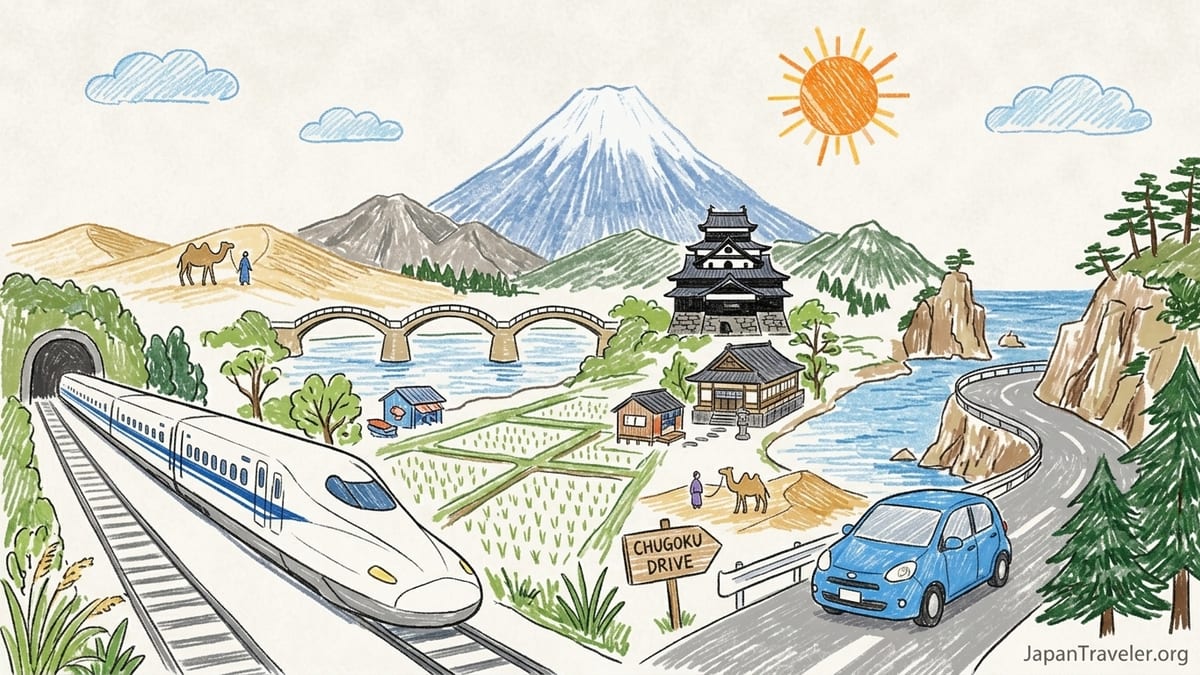
Why Drive Chugoku Instead of Just Taking the Train
Chugoku’s cities are well connected by the Sanyo Shinkansen and limited express trains, so it is natural to ask whether renting a car is worth the effort. The answer depends on where you want to go. Hiroshima, central Yamaguchi City and Okayama are efficiently reached by rail and navigated on foot or tram. In contrast, coastal hamlets on the Japan Sea, rural hot spring towns and the hilltop mining village of Iwami Ginzan require multiple bus transfers or slow local trains. A car turns these into relaxed point to point drives rather than complicated day trips with tight connections.
Think of the Shinkansen as your long distance backbone and the rental car as a tool for side trips across Shimane and Tottori. For example, going from Hiroshima to Izumo by train usually means traveling first to Okayama or Yonago then taking the Yakumo limited express and a bus to Izumo Taisha. With a car, you can leave Hiroshima after breakfast, detour to Iwakuni’s Kintaikyo Bridge, drive coastal Route 191 with stops at small beaches and reach Izumo by evening without watching timetables.
Driving is also about the character of the journey. The north coast of Chugoku has rugged cliffs, pine backed coves and small port towns that you glimpse only briefly from the Sanin Main Line. On Route 9 between Hamada and Matsue you can pull into roadside seafood shacks, photograph terraced rice paddies above the sea and visit minor shrines that never make it into English guidebooks. In places like Daisen’s foothills, where buses may run only a few times a day, a car lets you hike longer and return on your own schedule.
Finally, a car can be more economical for small groups once you leave the Shinkansen corridor. A compact rental shared between two or three people for several days, plus fuel and tolls, can work out similar to multiple long distance train tickets and taxis to out of the way ryokan. You are also spared the hassle of hauling suitcases on and off rural buses, a real consideration if you are carrying ski gear for Daisen or traveling with children.
Planning Your Route: Hiroshima to Tottori in 5 to 7 Days
A logical route starts in Hiroshima, where you arrive by Shinkansen, then heads west to Iwakuni and Yamaguchi before turning north toward Shimane and east to Tottori. A compact but satisfying version spans five days of driving, which mirrors regional itineraries promoted by local tourism offices. With a week you can slow down, add extra nights at hot springs or extend east to Okayama and the art islands of the Seto Inland Sea.
One practical five day outline begins with picking up a car in Hiroshima after you have already explored the Peace Memorial Park and Miyajima by tram, ferry and train. On Day 1 drive to Iwakuni to see the multi arch Kintaikyo Bridge and riverside castle, continuing on to stay in Yamaguchi City or the onsen town of Yuda Onsen. Day 2 takes you across the mountains toward the Japan Sea, breaking the journey in Hamada or another Shimane coastal town before overnighting near Iwami Ginzan or at Yunotsu Onsen. Day 3 explores Iwami Ginzan’s historic streets and mine trails before you carry on to Izumo Taisha and spend the night in Izumo or Matsue.
On Day 4 base yourself in Matsue, with its original wooden castle keep and lakeshore samurai quarter, taking a loop drive around Lake Shinji and Lake Nakaumi to Sakaiminato or to the Shimane Peninsula’s coastal shrines. Day 5 climbs into the Daisen area for short hikes or views of the mountain’s north face, then continues to Tottori City for the famous sand dunes and a final night. From Tottori you can return the car and take a limited express train east to Himeji or Okayama, connecting back to the Shinkansen for Osaka, Kyoto or Tokyo.
With seven or more days you can insert extra stops that benefit from a car. These include Hagi on Yamaguchi’s north coast, a preserved castle town that requires several bus changes from the nearest Shinkansen station but is easy to reach by road, and lesser known onsen villages such as Misasa Onsen in Tottori. An eastern extension from Tottori to Okayama allows you to thread the Tottori and Okayama countryside before joining the Sanyo Shinkansen again, or to skirt the coast and then take ferries to Naoshima or Shodoshima in the Seto Inland Sea.
Picking Up a Car and Handling One Way Rentals
For most travelers the smoothest plan is to arrive in Hiroshima by Shinkansen, spend one or two nights car free, then pick up a vehicle from a depot near Hiroshima Station. Major brands such as Toyota Rent a Car, Nippon Rent A Car and Times Car Rental have offices within a short walk of the shinkansen exits, and JR affiliated rental firms cluster around the station as well. Booking online in advance is highly recommended, particularly if you prefer an English navigation system or need a larger vehicle for a family.
One way rentals are common across Chugoku. It is usually possible to collect a car in Hiroshima and drop it in Tottori, Yonago, Matsue or Okayama, though a surcharge applies. For instance, JR Rent A Car and other nationwide companies clearly advertise that you may return your vehicle to a different branch within the same region, such as picking up in Hiroshima and dropping in Matsue or Tottori, subject to availability. The one way fee between neighboring prefectures is often on the order of a few thousand yen, rising for longer cross regional drops.
Before confirming a one way booking, check whether the rental firm allows ETC card loans on such contracts. Some discount passes that bundle unlimited expressway use with rental cars do not apply to one way rentals, and certain companies will only lend ETC cards for cars that are returned to the same outlet. If an ETC card is unavailable you can still use the expressways by paying cash or card at toll gates, but you lose out on automatic discounts and must stop at each toll plaza.
For timing, aim to pick up your car mid morning and drop it off by late afternoon. This avoids driving in rush hour around Hiroshima and Tottori, keeps you within standard office hours for vehicle return checks and minimizes the risk of late fees. Many travelers schedule their final driving day so they can drop the car at Tottori Station by 17:00, then board an evening limited express train to Osaka or Okayama, continuing by Shinkansen if necessary.
Expressways, ETC Tolls and Parking in Practice
The expressway network across Chugoku is dense, but you do not need to memorize route numbers. In simple terms, the Sanyo Expressway runs along the south coast linking Hiroshima with Yamaguchi and Okayama, while a series of expressways and major highways such as the Chugoku Expressway, Onomichi Expressway and Matsue Expressway connect inland and to the Japan Sea side. A typical long haul drive like Hiroshima to Tottori using the main expressways covers roughly 300 kilometers and incurs a standard toll of a little under 6,000 yen for a regular car, according to recent toll calculators that draw on NEXCO data. This gives you a rough benchmark for budgeting other segments that use similar distances.
The ETC system is worth using if your rental company offers a card. With ETC you drive through designated lanes at the toll plazas and the system automatically calculates your fee and applies any time based discounts. For instance, some late night and weekend discounts still apply on parts of the Chugoku expressways, although exact conditions change periodically. Without ETC you must slow to a stop at manned or automatic booths at each toll gate, take a ticket when entering and pay when exiting. This is not difficult, but it eats into driving time on days when you are covering several prefectures.
Parking is generally straightforward outside major city centers. In small coastal towns and around rural attractions like Iwami Ginzan, you will often use designated visitor car parks that charge modest flat fees. At Iwami Ginzan, for example, you typically leave your car at the large parking area near Omori village’s entrance and either walk or take a local shuttle bus deeper into the valley, since the historic streets themselves are largely closed to private vehicles. At Izumo Taisha there are expansive free parking lots on the shrine’s outskirts, while Matsue Castle has paid lots within a short walk of the main gate.
In cities, coin operated parking lots are plentiful around stations and entertainment districts. Expect to pay somewhere in the region of a few hundred yen per hour or a capped daytime rate. Hiroshima’s downtown has multi story car parks where day caps might run around 1,500 to 2,000 yen. Hotels in places like Izumo, Matsue and Tottori frequently provide on site parking, often for a modest nightly charge. Confirm parking arrangements when booking, especially in older ryokan where spaces may be limited.
Driving Conditions and Winter Snow in Chugoku
For most of the year, driving conditions in Chugoku are straightforward. Speed limits on expressways are commonly 80 kilometers per hour, though traffic often flows somewhat faster, and limits on rural highways are usually around 50 to 60 kilometers per hour. Japanese drivers are generally disciplined, and road signage on expressways and major routes includes English place names. Service areas are well spaced and offer fuel, food courts, convenience stores and clean restrooms.
Winter is a different story on the Japan Sea side. From around late December through early March, areas such as northern Shimane, the foothills of Mount Daisen and Tottori Prefecture can experience significant snowfall and icy roads. Local road offices and prefectural governments maintain dedicated winter information pages and road camera networks that show current conditions, which residents consult frequently in mid winter. For visitors this translates into the need for proper equipment: in snowy months rental cars in these regions are typically fitted with studless winter tires, and in heavier snow chains may be required in mountainous sections.
If you plan to visit Daisen for skiing or to see the mountain’s snow covered slopes, factor in slower driving times and possible road closures on steep approaches. Lodgings in the Daisen area often warn guests that roads to higher altitude temples and trailheads can be slippery between November and March and advise extra caution. When conditions are poor, consider parking lower down and taking local shuttle buses on the last stretch to ski resorts or temples, where available, rather than attempting narrow, snow packed side roads in a standard rental car.
On the Sanyo side near Hiroshima and Yamaguchi, snowfall is much lighter and usually melts quickly along the coast, though inland passes can still see ice. If your trip is in deepest winter and your main goal is city sightseeing plus a brief look at the Japan Sea, you might shorten the self drive portion and rely more heavily on trains and buses. In shoulder seasons such as late November or March, a road trip is usually manageable with occasional caution on higher passes, but always check conditions locally when passing into Shimane and Tottori.
Where a Car Truly Adds Value Along the Route
The power of a car in Chugoku lies in the small detours that are cumbersome by public transport. Between Hiroshima and Iwakuni you can leave the expressway to visit Yanai, a compact historic town in Yamaguchi Prefecture known for its white walled merchant houses and distinctive goldfish lantern decorations. Local trains do reach Yanai, but with a car you can pair it with side trips to coastal beaches or inland viewpoints without watching train timetables. Continuing toward Yamaguchi City, you can call in at Hofu Tenman-gu Shrine on a hill with broad views over the Seto Inland Sea.
North of Yamaguchi, the roads crossing to Shimane take you through quiet mountain valleys that ordinary itineraries skip. A common route passes near Tsuwano, another atmospheric town with a small castle ruin, white walls and koi filled canals. Limited express trains do run to Tsuwano from Yamaguchi, but buses between onward destinations are infrequent, so having a car lets you add it as an unhurried lunch stop on your way to the Japan Sea coast. From there, following the shoreline west or east along Route 9 reveals fishing harbors and pocket beaches you would never bother to reach with multiple bus transfers.
A car also transforms your time around Izumo and Matsue. Izumo Taisha, one of Japan’s most important Shinto shrines, sits about a 20 minute drive from JR Izumoshi Station. While there is a local train and bus, driving lets you combine the shrine with minor coastal shrines and viewpoints in a single loop. Around Lake Shinji and Lake Nakaumi, scenic roads link small hot spring enclaves, such as those with lakeside rotenburo, and vantage points over rice fields and oyster rafts. On the Shimane Peninsula you can trace the dramatic coast, stopping for short walks to sea caves or viewpoints that might see only a handful of visitors each day.
Near Daisen and Tottori the advantage is even clearer. The Tottori Sand Dunes are a short bus ride from Tottori Station, but a car allows you to arrive early, then continue to nearby viewpoints along the Sea of Japan coast, onsen with ocean views and lesser known dunes and beaches beyond the main visitor zone. In Daisen’s foothills, trailheads and small lodges are scattered, and public transport may run only a few times daily. With your own wheels you can choose hikes that match the weather and your energy instead of tailoring your day to bus timetables.
When to Return the Car and Switch Back to Rail
Because the Shinkansen is so efficient along the Sanyo corridor, it rarely makes sense to keep a rental car just to travel between big cities like Hiroshima, Okayama and Osaka. A smart strategy is to start and finish your driving in places where trains are slower or less direct, then hand back the keys before covering long expressway stretches that parallel the bullet train. In practice this means picking up the car at Hiroshima Station after your city sightseeing is complete, using it for the rural loop through Yamaguchi, Shimane and Tottori, then dropping it in Tottori, Yonago, Matsue or Okayama before taking rail onward.
For instance, one common pattern is to travel by Shinkansen to Hiroshima, spend two nights there without a car, then rent a vehicle for five or six days to loop through Yamaguchi, Izumo, Matsue and Daisen, finally returning it at Tottori Station. From Tottori you ride the Super Hakuto or Super Inaba limited express to Himeji or Okayama, then reconnect with the Shinkansen for Kyoto, Osaka or Tokyo. This way you avoid both the expressway tolls and the fatigue of driving long distances past scenery you could cover more quickly by train.
If you choose an eastern extension, you might drive from Matsue or Daisen across Tottori and northern Okayama, then drop the car in Okayama City. This works well if you plan to visit Kurashiki’s Bikan Historical Quarter or continue to the Seto Inland Sea islands like Naoshima, which are better explored on foot, bicycle and ferry. In Kurashiki, narrow alleys and pedestrian zones mean a car quickly becomes a liability, and many guesthouses have limited parking, another argument for returning the vehicle at the edge of the dense urban belt.
On the western end, holding a car while you are staying in central Hiroshima usually does not pay off. The city’s tram and bus system, combined with local JR trains to Miyajimaguchi, make it easy to see the Peace Memorial Park, Hiroshima Castle and Miyajima without worrying about urban parking. If your only reason to keep a car is to drive between hotels in Hiroshima and Fukuoka or Kyoto, reconsider and run that leg by Shinkansen instead. The time you gain and tolls you save will generally outweigh the convenience of door to door driving in dense city traffic.
FAQ
Q1. Do I really need a car to visit Hiroshima, Izumo and Tottori, or can I rely on trains and buses?
It is possible to visit all three by public transport, especially if you focus on city centers and a few headline sights, but a car makes the rural stretches between them far more flexible and enjoyable. Rail is excellent for reaching Hiroshima and Okayama, while a car really pays off once you cross from Yamaguchi into Shimane and Tottori, where buses can be infrequent and scenic detours are hard to manage without your own wheels.
Q2. How much should I budget for expressway tolls on a Chugoku road trip?
Exact costs depend on your precise route, but as a benchmark, a journey of roughly 300 kilometers between major cities in the region using expressways can approach 6,000 yen in tolls for a regular car. Shorter hops between adjacent prefectures cost proportionally less. Using an ETC card may unlock time based discounts on some sections, while sticking to scenic national routes instead of expressways can reduce toll costs at the expense of longer driving times.
Q3. Is winter driving in Shimane, Daisen and Tottori safe for visitors?
Winter driving can be safe if you are prepared and cautious. Rental cars in snow prone areas are usually equipped with winter tires during the coldest months, and roads are regularly cleared. However, the Japan Sea side, especially around Mount Daisen and inland Shimane, can see heavy snowfall and ice between about late December and early March. If you are uncomfortable with winter conditions, consider limiting your driving to the Sanyo side or scheduling your trip for a milder season.
Q4. Can I rent a car in Hiroshima and return it in Tottori or Matsue?
Yes. Major rental companies and JR affiliated agencies commonly allow one way rentals within the Chugoku region, including combinations such as Hiroshima to Tottori, Hiroshima to Matsue or Hiroshima to Okayama. A one way surcharge usually applies and is higher for longer distances, so it is wise to compare quotes from a couple of companies and factor this into your budget.
Q5. Do I need an ETC card or can I just pay cash at toll booths?
You do not need an ETC card; you can always pay cash or, at many booths, by credit card. However, an ETC card is convenient because you pass through dedicated lanes without stopping fully and any eligible discounts are applied automatically. If your rental company can lend you a card for a modest daily fee, it is usually worth taking, especially if a significant portion of your driving will be on expressways.
Q6. What is parking like in small towns such as Iwami Ginzan and around Izumo Taisha?
Parking in these areas is generally well organized. At Iwami Ginzan visitors are directed to large car parks near the entrance to the historic zone, then explore on foot or by local shuttle. Izumo Taisha maintains expansive parking lots on the shrine’s outskirts, and most are free or modestly priced. As you move into denser cities like Matsue and Tottori you will find metered lots and multi story car parks, with hotel parking often available for an additional nightly fee.
Q7. When is the best season for a Chugoku road trip?
Spring and autumn are ideal. April and May offer mild temperatures and fresh greenery, while October and early November bring clear air and autumn foliage in the mountains. Summer can be rewarding along the coast for beach stops and sea swims, though it is hot and humid inland. Deep winter has its own appeal around Daisen and the Japan Sea coast if you enjoy snow, but it demands more cautious driving and a flexible schedule.
Q8. How difficult is it to navigate if I do not read Japanese?
On expressways and major roads, signage includes English place names, and most rental cars can be equipped with navigation systems that accept phone numbers or map codes for destinations. Many travelers also rely on smartphone navigation. Rural side roads may have limited English signage, but if you set destinations in advance and keep a list of addresses and phone numbers for your lodgings and key sights, navigation is usually manageable.
Q9. Should I keep the car while staying in Hiroshima city itself?
In most cases, no. Hiroshima city is compact, and its tram, bus and JR lines make it easy to reach major sights and Miyajima without a car. Parking in central districts adds extra cost and hassle. It is more efficient to finish your Hiroshima sightseeing first, then collect a rental car from near Hiroshima Station when you are ready to drive toward Yamaguchi and the Japan Sea side.
Q10. How many days do I need to drive from Hiroshima to Tottori without rushing?
A minimum of five driving days allows a relaxed route from Hiroshima through Iwakuni or Yamaguchi, up to Iwami Ginzan and Izumo, on to Matsue and finally Daisen and Tottori. With seven or more days you can add extra nights in onsen towns, detour to Hagi or Misasa Onsen and include an eastern extension to Okayama or the Seto Inland Sea before returning the car and rejoining the Shinkansen network.