


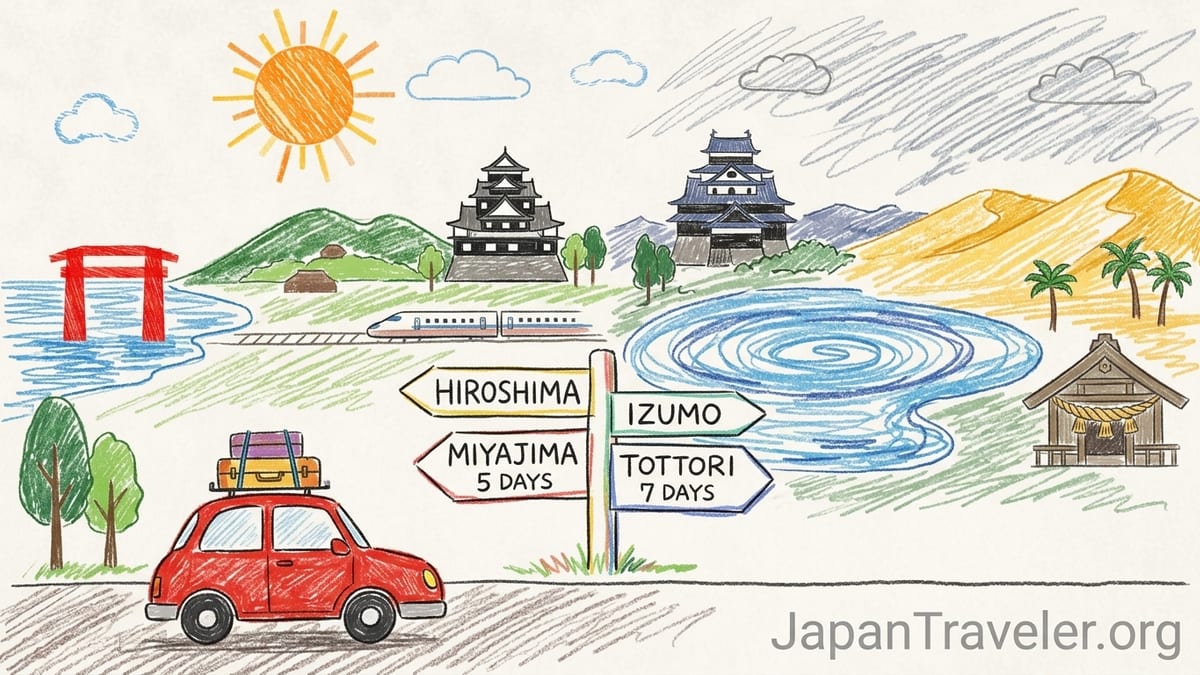
The Chugoku region on Japan’s main island of Honshu remains largely under the radar, even as Hiroshima and Miyajima draw steady international crowds. Look just beyond those familiar names and you find riverside merchant towns in Okayama Prefecture, quiet castle cities on the Sea of Japan, and coastal shrines that feel far removed from the country’s big-city circuits. This guide outlines a practical 5 to 7 day route through Okayama, Kurashiki, Hiroshima, Miyajima, Tottori, Matsue and Izumo, with clear advice on where trains are ideal and where a rental car can save hours of backtracking.
How Long Do You Need in Chugoku and Where Should You Start?
Recent sample itineraries published by regional tourism boards and rail companies typically recommend five days for a compact Chugoku circuit focused on Okayama, Kurashiki, Hiroshima and Miyajima, and seven days if you want to add the Sea of Japan side around Tottori, Matsue and Izumo. A six day middle ground is increasingly common among independent travelers, allowing one extra night on the Sanin coast without making the trip feel rushed. In practice, the choice comes down to how quickly you want to move and whether you are willing to rent a car for the northern coast.
Most visitors start from Kansai, flying into Osaka or arriving by shinkansen from Tokyo. From Shin-Osaka, the Sanyo Shinkansen reaches Okayama in around 45 minutes on the fastest services, which makes Okayama an efficient first base. With luggage-friendly hotels clustered around Okayama Station and straightforward connections to Kurashiki and Hiroshima, the city works better as a gateway than trying to jump straight to Hiroshima on your arrival day.
Official model routes used by Hiroshima and Okayama tourism offices often place Hiroshima and Miyajima in the middle of a multi-day Setouchi journey, rather than at the very start or end. That pattern is useful: beginning in Okayama and Kurashiki eases you into the region at a relaxed pace, and finishing on the Sea of Japan side in Izumo or Tottori gives you quieter days before you head onward or back to Tokyo. If you only have five days, you can simply trim the Sanin segment while keeping the same overall flow.
Season also matters. The inland Seto Inland Sea side around Okayama and Hiroshima has relatively mild winters and hot, bright summers, while the Sea of Japan side can see heavy snow, strong winter winds and more frequent train disruptions. In July and August, coastal nights in Matsue or Izumo are often a few degrees cooler than inland cities, which can be a welcome contrast if you plan to walk a lot.
Day 1–2: Okayama and Kurashiki by Train
For a five or seven day Chugoku route, a common pattern is to spend your first night in Okayama and your second in Kurashiki or again in Okayama with a day trip. From Shin-Osaka or Kyoto, you can ride the Sanyo Shinkansen to Okayama, then drop bags at a hotel such as Hotel Granvia Okayama or one of the business hotels directly connected to the station concourse. Staying adjacent to the station makes it easy to head out early the next morning for Kurashiki or to catch a later shinkansen toward Hiroshima.
In Okayama, the focus is Korakuen Garden and Okayama Castle, which local tourism guides frequently package together as a half-day course. Recent example itineraries show visitors taking a short five minute tram ride from Okayama Station to the “Shiroshita” stop, then walking to Korakuen in about ten minutes. Combo tickets for the garden and castle are typically only a few hundred yen more than individual admission and save you queueing twice. Plan at least two to three hours to stroll the garden, cross the bridge over the Asahi River and tour the reconstructed castle keep.
Kurashiki’s Bikan Historical Quarter, preserved with white-walled storehouses and a willow-lined canal, sits about 15 minutes from Okayama by local JR train. The quarter itself is compact, but recent rail-based itineraries still allocate a full afternoon or more so that people can visit Ohara Museum of Art, sample local fruit parfaits and wander the side streets without rushing. You can easily do this as a round-trip from Okayama, but many travelers now choose to spend one night in Kurashiki in traditional-style accommodation, so that they can experience the streets before and after day-trip crowds arrive.
For this part of the trip, trains are clearly more efficient than driving. The line between Okayama and Kurashiki runs frequently, and urban traffic and parking in both cities can be slow and more expensive than a couple of short train journeys. If you plan to cover Okayama, Kurashiki, Hiroshima and Miyajima within five days and are coming from Kansai, a regional JR West rail pass such as the Kansai Hiroshima Area Pass or the Okayama Hiroshima Yamaguchi Area Pass often undercuts the cost of buying separate shinkansen and local tickets while keeping your travel flexible.
Day 3–4: Hiroshima and Miyajima on the Sanyo Line
From Okayama, high speed rail makes Hiroshima an easy third stop. The Sanyo Shinkansen runs from Okayama to Hiroshima in roughly 40 minutes on a Nozomi or slightly longer on a Hikari or Sakura service. Model itineraries used by Hiroshima’s visitors bureau typically pair Hiroshima city and Miyajima as a two day, one night or three day, two night block, and that planning fits neatly into a five to seven day Chugoku route. Base yourself near Hiroshima Station or in the downtown Hatchobori area for quick tram links to the Peace Memorial Park.
In Hiroshima, allocate a full day to the Peace Memorial Park, the museum and nearby sites such as the Atomic Bomb Dome and Shukkeien Garden. Recent trip reports highlight that queues for the museum can be significant in peak seasons; buying timed tickets in advance where available or arriving close to opening time reduces waiting. Downtown, okonomiyaki restaurants clustered in multi-floor buildings near the entertainment district offer a chance to try Hiroshima-style layered pancakes, an experience that anchors many visitors’ evenings.
Miyajima is a straightforward day trip by train and ferry, though spending a night on the island remains one of the most memorable ways to experience Chugoku. From Hiroshima Station, JR local trains to Miyajimaguchi take about 25 minutes, and the JR-operated ferry then takes around 10 minutes to reach the island. Many JR West rail passes cover both the train and the ferry, which keeps costs predictable. Day trippers typically visit Itsukushima Shrine, walk the main shopping street, and ride or hike up Mount Misen. Those who stay overnight in a ryokan enjoy quieter shrine visits after most visitors have departed.
Here again, public transport beats driving for most travelers. Parking near Miyajimaguchi can be tight and priced for commuters, and taking a car onto Miyajima by car ferry is rarely necessary unless you are on a long road trip. A five day rail-only Chugoku loop often looks like Osaka to Okayama and Kurashiki on days one and two, Hiroshima on day three, Miyajima and back to Hiroshima on day four, and then either a return to Kansai or a detour into Yamaguchi on day five.
Extending to Yamaguchi or the Sanin Coast in 5–6 Days
If you have a fifth or sixth day but not enough time to go all the way to Tottori and Izumo, current sample routes suggest two options: add a taste of Yamaguchi Prefecture along the Sanyo coast, or make a quick foray onto the Sea of Japan side around Matsue and Izumo using express trains. Yamaguchi’s attractions, such as Iwakuni’s Kintai Bridge or Hagi’s old castle town, are reachable by train and bus from Hiroshima, although connections tend to be slower and less frequent than the main Sanyo line.
Travelers who choose the Sanin side for a short extension often use the limited express Yakumo between Okayama and Matsue or Izumo. This route takes around three hours from Okayama to Matsue through the mountains and then another half hour along Lake Shinji to Izumo. Some itineraries show this ride as a highlight in itself, with views of rural valleys and, in autumn, changing leaves. A five or six day plan might backtrack from Hiroshima to Okayama on day four, then continue to Matsue on day five and Izumo Taisha before flying out from Izumo Airport or Yonago.
At this stage, renting a car becomes a realistic consideration. On the Sanin coast, local trains and buses can be spaced an hour or more apart, and connections from small stations to coastal viewpoints, shrines or onsen towns may require long walks. Several recent route reports from travelers who combined Hiroshima with Matsue and Izumo note that rental cars gave them enough flexibility to reach lesser known sites such as Hinomisaki Lighthouse, small fishing villages, or quiet onsen areas in the hills. For a five or six day itinerary, however, it is usually simpler to stick to trains and focus on a smaller set of stops.
For those who prefer to remain entirely on the Sanyo side, another common pattern is to use a Hiroshima and Okayama rail pass to add Onomichi or Kure for a day of small port town exploration, or to push west into Yamaguchi for one night in Yamaguchi city or Shimonoseki. These variants stay entirely on well served rail corridors, which is appealing to first time visitors who do not want to worry about driving or weather affected mountain roads.
Seven Day Route: Adding Tottori, Matsue and Izumo
A full seven day Chugoku route that incorporates both the Seto Inland Sea and the Sea of Japan sides typically retains the Okayama and Hiroshima core and then adds two or three nights along the Sanin coast. Current suggested routes by regional tourism organizations and independent travel planners often follow a sequence like Osaka to Okayama and Kurashiki, Hiroshima and Miyajima, then Tottori, Matsue and Izumo in either order, with travelers exiting via an airport or shinkansen station nearer Kansai at the end.
One practical pattern is to spend days one and two in Okayama and Kurashiki, days three and four in Hiroshima and Miyajima, day five in Tottori, day six in Matsue, and day seven in Izumo with outbound travel. Tottori is known for the Tottori Sand Dunes and the Sand Museum, both located a short bus ride from Tottori Station. Recent Sanin road trip itineraries see visitors pairing the dunes with seafood at the nearby fishing port and, in season, detours to Mount Daisen for hiking or views. If you arrive from Hiroshima via Okayama and the Chizukyu line, you can manage the dunes and city highlights in one full day and a single night.
From Tottori to Matsue, travelers face a choice between the coastal express train and renting a car. The limited express train between the two cities generally takes around two hours and runs a few times per day. By car, the drive often takes around the same total time but allows stops at viewpoints and small beaches, or detours through the Mount Daisen area. If you are comfortable driving on the left and want to reach scattered sites like Uradome Coast or smaller onsen towns, picking up a car in Tottori and dropping it in Matsue or Izumo can be worthwhile.
Matsue itself is compact but rewarding. Current seven day Chugoku and Sanin itineraries give at least one full day to Matsue Castle, one of Japan’s few remaining original wooden castle keeps, and the surrounding samurai district along the Horikawa River. Visitors often combine the castle with a short cruise on the castle moat or Lake Shinji, timing the latter around sunset. Staying overnight also allows time for a visit to the nearby Adachi Museum of Art in Yasugi, reachable by shuttle bus from Matsue or Yasugi Station, famous for its meticulously designed Japanese gardens.
Izumo, usually the final stop in a seven day route, centers on Izumo Taisha, one of Japan’s most important Shinto shrines. Many visitors arrive from Matsue in under an hour by train, visit the shrine and the nearby historical district, then continue to Izumo Airport or back toward Okayama by train. With a car, it becomes easier to also visit coastal spots such as Hinomisaki Lighthouse or small coves along the Sea of Japan. If you prefer not to drive, local buses connect these sites, but schedules may require careful planning and can limit how many stops you fit into a single day.
When Trains Are Best and When a Rental Car Saves Time
For the southern half of this itinerary, trains are the clear default. The Sanyo Shinkansen between Osaka, Okayama and Hiroshima is fast, frequent and rarely affected by weather for long periods. Within Okayama and Hiroshima, tram and bus networks connect stations with gardens, castles and peace memorial sites. The JR line and ferry combination between Hiroshima and Miyajima is especially convenient, with departures often every 15 to 20 minutes in daytime. For many visitors on a five day route, buying a JR West area pass and relying solely on rail for city to city travel keeps logistics simple.
Once you cross into the Sanin region, however, the calculus changes. Local trains between smaller stations along the Sea of Japan coast can run only once or twice per hour, and bus routes from those stations to dunes, shrines or viewpoints may be similarly infrequent. For instance, reaching both the Tottori Sand Dunes and a more remote coastal spot like Uradome Coast by public transport in one day is possible but leaves little margin for delays. A small rental car picked up at Tottori Station gives you considerable flexibility and can turn a day of waiting for buses into a relaxed loop along the coast.
Driving also makes it easier to combine inland stops such as Mount Daisen or lesser known hot spring areas with coastal highlights. Several recent trip reports from travelers who relied solely on trains around Matsue and Izumo describe missing smaller sites because buses did not match their timing or because of service suspensions during heavy rain. Others who did rent cars highlight the need to budget for tolls and fuel but generally report that the freedom to adjust plans outweighed those costs, especially on itineraries of seven days or more.
For many visitors, a hybrid strategy works best. Use trains and shinkansen for legs between Kansai, Okayama and Hiroshima, where road traffic can be dense and parking in central districts is relatively expensive. Then, if your route includes Tottori, Matsue and Izumo, pick up a rental car for two to three days on the Sanin side, returning it before you rejoin the shinkansen network. Major Japanese rental brands such as Toyota Rent a Car, Nippon Rent a Car and Times have offices near key stations in Tottori, Matsue and Izumo, and one way rentals within the same region are commonly available for an additional fee.
Typical Costs, Passes and Practical Tips
While exact prices change regularly, some broad ranges can help with planning. A one way shinkansen ticket from Shin-Osaka to Okayama in ordinary class often falls in the range that makes a multi day regional rail pass good value if you also travel onward to Hiroshima and back. Area passes that cover portions of Kansai, Okayama and Hiroshima as well as Miyajima are commonly priced to break even or better if used for two or three medium length shinkansen rides plus local trains. It is worth checking current JR West pass options that specifically mention Sanyo and Sanin coverage if you know you want to reach Tottori, Matsue or Izumo by rail.
Rental cars in the region typically charge by the calendar day, with compact models the most economical. Travelers report paying in the equivalent of tens of US dollars per day for small cars in Tottori or Matsue, plus fuel and any expressway tolls. Many foreign visitors opt for standard automatic transmission vehicles, and English navigation is usually available on in car systems or via smartphone apps. An International Driving Permit based on the 1949 Geneva Convention is required for many nationalities; you need to obtain this before arriving in Japan.
Accommodation ranges widely, from business hotels around major stations to traditional ryokan in smaller towns. In Okayama and Hiroshima, mid range chain hotels near the station often include simple breakfasts and coin laundry facilities, which can be useful midway through a week long trip. In Kurashiki, Matsue and Izumo, staying in smaller inns or guesthouses closer to historical districts can make evening walks more atmospheric, although you should book early in peak domestic travel periods such as Golden Week or the mid August Obon holidays.
Travelers should also keep an eye on weather, particularly on the Sea of Japan side in winter and early spring, when snow and strong winds can affect train and bus operations. Even in summer, heavy rain can cause temporary suspensions of local lines. Building some flexibility into the seven day plan and avoiding tight last train connections between remote areas and major hubs reduces stress. If you do rent a car, ask the rental agency staff about any current road advisories and whether snow tires or chains are necessary in the season you plan to visit.
The Takeaway
A five to seven day Chugoku itinerary linking Okayama, Kurashiki, Hiroshima, Miyajima, Tottori, Matsue and Izumo offers a compact cross section of western Honshu, from reconstructed castles and riverside gardens to sand dunes, seaside shrines and relatively quiet castle towns. Current model routes used by local tourism boards and rail companies confirm that you do not need more than a week to experience the region’s highlights, provided you make a few clear choices about where to linger and how to move between coasts.
For most travelers, the backbone of the trip should be built around trains. The Sanyo Shinkansen and main JR lines efficiently link Kansai with Okayama and Hiroshima, and ferries and trams handle the short transfers to Miyajima and city sights. Once you step onto the Sanin side, however, adding a rental car for two or three days can turn a rigid schedule into a more relaxed exploration of Tottori’s dunes, Matsue’s waterways and Izumo’s coastline. A hybrid approach lets you enjoy stress free high speed rail where it makes sense and the freedom of the open road where public transport thins out.
Whether you choose a tight five day loop through Okayama, Kurashiki, Hiroshima and Miyajima or a fuller seven day journey that arcs north to Tottori, Matsue and Izumo, the key is to keep your route focused and realistic. Rather than trying to collect every coastal town and mountain temple, pick two or three bases, allow time for evening walks and local meals, and treat the journeys between them as part of the experience. In a region that still feels overlooked compared with Tokyo and Kyoto, that slower pace is part of the reward.
FAQ
Q1. Is five days enough to see Chugoku’s main highlights?
Five days is enough for a focused route that covers Okayama, Kurashiki, Hiroshima and Miyajima using trains, but you will not have time to add Tottori, Matsue and Izumo without rushing.
Q2. How many days do I need if I want to include Tottori, Matsue and Izumo?
Plan on seven days if you want to start in Okayama, visit Hiroshima and Miyajima, then continue to Tottori, Matsue and Izumo with at least one full day on the Sea of Japan coast.
Q3. Do I really need a rental car for the Sanin coast?
You can reach Tottori, Matsue and Izumo by express trains and local buses, but a rental car for two or three days makes it easier to visit dunes, lighthouses and small onsen towns without long waits.
Q4. Which direction is better: start in Hiroshima or Okayama?
Starting in Okayama and Kurashiki then moving to Hiroshima, Miyajima and finally the Sanin side is practical because shinkansen access to Okayama is faster from Kansai and the route then flows west and north.
Q5. Are regional JR passes worth it for this itinerary?
Regional JR West passes that cover Kansai, Okayama, Hiroshima and in some cases the Sanin area can be good value if you plan multiple shinkansen legs plus local train travel within five to seven days.
Q6. Can I visit Miyajima as a day trip from Okayama?
It is technically possible but not recommended, as the round trip takes several hours. Staying in Hiroshima and visiting Miyajima from there is more relaxed and matches common model itineraries.
Q7. What time of year is best for this Chugoku route?
Spring and autumn are generally most comfortable, with cherry blossoms and autumn leaves adding scenery. Winter can bring snow to the Sea of Japan side, and midsummer can be very hot inland.
Q8. Is driving difficult for foreigners in this region?
Roads in the Sanin area are generally quiet outside city centers, but you must be comfortable driving on the left, understand basic Japanese road signs, and hold the correct International Driving Permit.
Q9. Where should I base myself if I prefer slower travel?
Consider using Okayama or Kurashiki for two nights at the start, Hiroshima for two nights in the middle, and then either Matsue or Izumo for two nights at the end, trimming stops rather than adding more.
Q10. Can I fly out of the region instead of returning to Osaka or Tokyo by train?
Yes, airports near Tottori, Yonago, Izumo and Hiroshima offer domestic flights to major hubs such as Tokyo’s Haneda or Osaka’s Itami, which can shorten your return travel at the end of the itinerary.