


Jomon Sugi is the most famous tree in Japan’s ancient cedar forests and one of the hardest single-day hikes on the main Japanese islands. Deep in Yakushima’s UNESCO-listed interior, reaching this enormous yakusugi cedar is a 22 kilometer round-trip that usually takes 10 to 11 hours. In 2026, strict access rules, frequent weather disruptions and a mandatory shuttle system mean that anyone hoping to see Jomon Sugi needs to plan their day with care, from where they sleep the night before to which bus they catch before dawn.
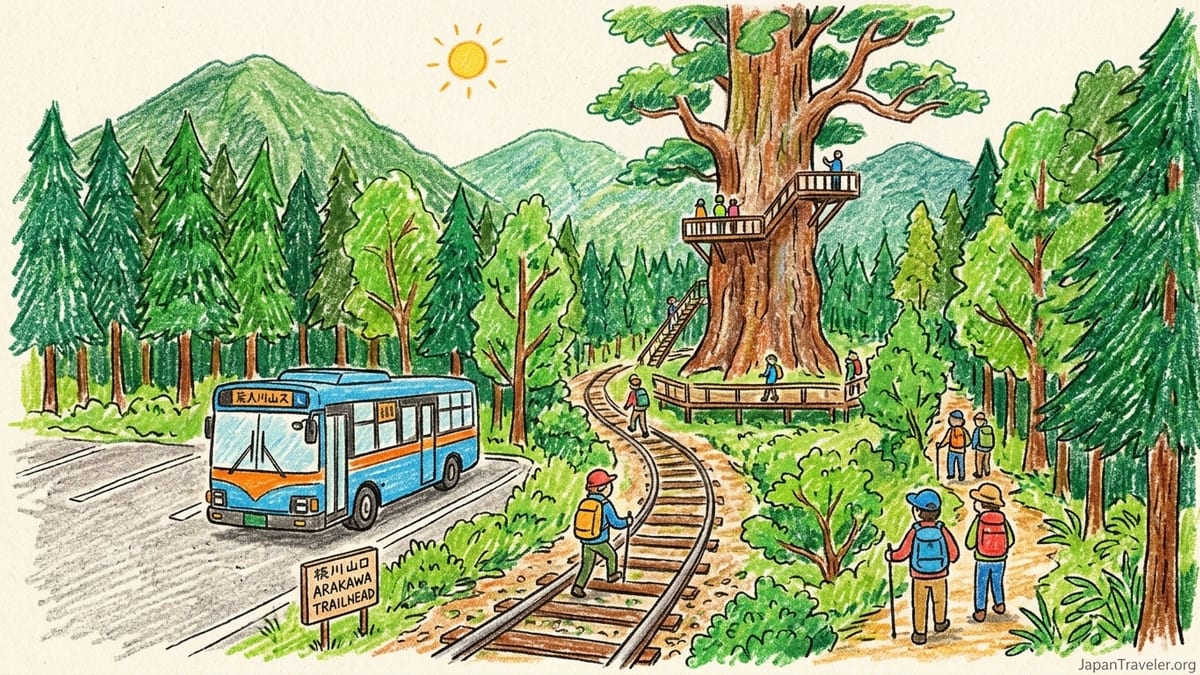
Understanding the Jomon Sugi Hike from Arakawa
The standard and most controlled route to Jomon Sugi begins at the Arakawa trailhead, reached by a dedicated mountain shuttle bus. From this point the return route covers roughly 22 kilometers with about 700 meters of total elevation gain, and most visitors take between 10 and 11 hours to complete it. Local authorities and experienced guides describe it as a demanding long day rather than a casual forest walk, suitable only for reasonably fit hikers accustomed to full-day treks.
The first half of the route follows a disused logging railway, which tempts many people to underestimate the challenge. While the gradient is gentle, the old sleepers, metal bolts and uneven gaps underfoot require concentration, especially in dim morning light. After the final station at Wilson Stump, the trail steepens and turns into a series of rock, root and wooden stair sections through dense, wet forest. This upper section is where fatigue, slippery mud and time pressure on the return trip can catch hikers off guard.
Most visitors start hiking around first light and turn back at Jomon Sugi no later than early afternoon to be sure of catching the last shuttle. On busy spring and autumn weekends, you will see headlamps on the first stretch as groups leave the trailhead just after dawn. Even in peak season, the forest feels serious and remote once you leave the railway and climb toward the tree itself.
Jomon Sugi’s age is still debated by scientists, but estimates range into several thousand years and the tree has become a symbol of Yakushima’s ancient ecosystem. Visitors see it from purpose-built viewing decks to protect its roots and the surrounding soil. This means the emotional impact comes not from touching the tree, which is prohibited, but from the long effort it takes to stand quietly before it after many hours on the trail.
Shuttle Buses, Access Rules and Why Your Base Matters
Between 1 March and 30 November each year, private vehicles, rental cars and motorcycles are not allowed to drive the Arakawa forest road to the trailhead. During these 275 days, hikers must use the Arakawa Mountain Bus or other authorized transport. Official guidance makes clear that the aim is to limit traffic in the fragile mountain area and to manage parking, congestion and emissions along the narrow access road.
In practice, the key point for travelers in 2026 is that you should plan to park at or reach the Yakusugi Museum area in the lowlands very early in the morning. From here the Arakawa Mountain Bus runs up to the trailhead. Recent information from Yakushima town and local hiking operators indicates that the shuttle typically starts running before 5 am on busy days, with the last return bus from Arakawa in the late afternoon. Exact times can shift slightly each season, so it is essential to check the latest timetable at the Yakushima Tourism Association office or your accommodation the afternoon before your hike.
Official documents show that round-trip bus fares sit in the low thousands of yen, with a recent example quoting about 700 yen one way from the Yakusugi Museum zone and a conservation charge around 1,000 yen per day hiker collected alongside bus tickets. These figures can change, but they provide a realistic benchmark for budgeting. The environmental contribution supports trail maintenance, toilets, safety signage and erosion control, and is strongly encouraged by local authorities even when voluntary.
Because the first buses depart extremely early, staying near Anbo or Miyanoura simplifies logistics. Both towns have accommodation within a short drive of the Yakusugi Museum and are served by local buses and taxis in the very early morning if booked in advance. By contrast, travelers staying at remote coastal lodges or in the far north-west of the island often face longer night-time drives on dark, wet roads just to reach the shuttle departure point, increasing pre-dawn stress on what is already a long day.
Guided Tours vs Independent Hiking in 2026
By 2026, English-speaking guided tours to Jomon Sugi are well established and cater to different budgets. Companies such as Yakushima Experience, Yakushima Geographic and several smaller local offices advertise one-day Jomon Sugi hikes that include hotel pickup around Anbo or Miyanoura, guiding, safety equipment and help with bus tickets. Recent online listings show prices for small-group English tours commonly starting around 15,000 to 18,000 yen per person, with private tours for couples or solo travelers ranging significantly higher depending on group size and inclusions.
Guided options reduce stress for first-time visitors who may be unfamiliar with Japanese-language bus timetables, local weather patterns or the pace needed to complete the hike within daylight. A typical guided day begins with pickup before 4:30 am, assistance with buying shuttle and environmental contribution tickets at the Yakusugi Museum, steady pacing with regular short breaks, and support on the steep, slippery stair sections near the top. Many guides also carry radios or satellite communicators, first-aid kits and extra lights, which can be reassuring in poor weather or low visibility.
Independent hiking works best for people with mountain experience who are comfortable following waymarked trails for 10-plus hours and managing their own safety decisions. The Arakawa route is well signposted, and thousands of visitors walk it without guides each year, but it is still a serious mountain environment with changing conditions. Independent hikers should be prepared to navigate in mist, gauge when to turn back if they fall behind schedule, and deal with minor injuries or gear failures without immediate professional support.
Another factor is group dynamics. Some travelers prefer the social aspect and information a guide brings, including explanations of forest ecology, yakusugi history and local stories at landmarks such as Wilson Stump. Others value the freedom to walk in near silence, adjust their own pace, and linger at viewpoints as long as they wish. In 2026, both options remain viable, but anyone with doubts about their stamina, language skills or confidence in emergency situations should give serious consideration to booking a reputable guide in advance.
Gear, Trail Conditions and On-Route Facilities
Yakushima is famous for heavy rain, with annual totals far above most parts of Japan. In practical terms this means hikers should expect wet or humid conditions year-round on the Jomon Sugi trail. Waterproof hiking boots with substantial grip are strongly recommended, since much of the route involves wet sleepers, slick roots, wooden walkways and muddy stairs. Simple sneakers or running shoes, even high-end brands, can become dangerously slippery and cold after hours in standing water and mud.
A full set of rain gear is considered standard equipment by local guides. This usually means a waterproof, breathable jacket with hood, waterproof over-trousers and a backpack rain cover. Many visitors rent gear from outfitters around Anbo and Miyanoura if they do not want to carry heavy boots on the rest of their Japan trip. Renting is common enough that tour operators like YES Yakushima openly offer assistance arranging boots and rainwear for their guests, and hotel owners can often point independent hikers to local rental shops.
Because much of the approach along the railway happens before sunrise or in deep shade, a headlamp with fresh batteries is essential. Smartphone flashlights are not a safe substitute, both because of limited beam spread and the high risk of dropping a phone on the railway or in the mud. Trekking poles help many people on the steeper stair sections and reduce knee strain during the long descent. Lightweight gloves, a warm layer even in summer, and a hat for light drizzle or sun at the lower altitudes also improve comfort over the long day.
There are no food concessions on the trail to Jomon Sugi. Most hikers carry 2 to 3 liters of water or sports drink and pack rice balls, sandwiches, energy bars, nuts and chocolate. Some inns and guesthouses near Anbo offer early-morning hiking bentos that guests can order the night before and pick up around 4 am. Toilet facilities consist of basic flush or compost toilets at limited locations, including the trailhead and several points higher up, but queues can form on busy days and toilet paper may run out. Local authorities encourage hikers to carry tissue, small plastic bags and to follow posted guidelines to keep the forest clean.
Safety, Weather Closures and Emergency Planning
Yakushima’s interior mountains react quickly to rain, snow and typhoon damage. Official guidance from Yakushima town states that roads to major trailheads, including Arakawa, Yakusugi Land, Yodogawa and Shiratani Unsuikyo, may be closed when 24-hour rainfall exceeds a set threshold, such as around 220 millimeters, when snow accumulates, or when freezing is expected. During such closures, the Arakawa Mountain Bus is suspended and the Jomon Sugi trail becomes temporarily inaccessible.
After major typhoons, authorities publish bilingual maps marking closed trail segments and damaged bridges. In recent years, documents have noted partial closures beyond Jomon Sugi toward Yodogawa and safety inspections on routes around Yakusugi Land and Shiratani Unsuikyo. Even if your visit is months away from the last major storm, it is important to confirm up-to-date information at the Yakushima Tourism Association, on the town’s official notice boards, or with your accommodation the day before your hike. Relying on old blog posts or guidebooks has led some travelers to arrive at shuttered trailheads with no backup plan.
Mobile reception is patchy along the Jomon Sugi route, stronger near open clearings and weaker inside dense gullies. Hikers should not rely on constant data coverage for navigation or emergency calls. The safest practice is to bring a printed map from the tourism office, store key phone numbers for local police and rescue services before leaving, and write your planned route and return time in your accommodation’s guest log if available. Guided groups benefit from their leader’s ability to coordinate rescue efforts, but independent hikers must be prepared to make calm decisions themselves if conditions deteriorate.
Falls on slippery sleepers, twisted ankles on stairs and mild hypothermia from long exposure to cold rain are among the most common issues on the trail. A compact first-aid kit with bandages, blister care, pain relief and an emergency foil blanket fits easily into a daypack and can make a large difference in comfort and safety. Above all, hikers should be ready to turn back early if they are moving too slowly to reach Jomon Sugi and return in daylight. Arriving safely at the shuttle bus a little disappointed is far better than risking a descent in darkness without proper lighting.
Where to Stay: Anbo, Miyanoura and Pickup Zones
Choosing the right base on Yakushima shapes your entire Jomon Sugi day. Anbo on the island’s east coast is particularly convenient for the Arakawa route. It sits closer to the Yakusugi Museum area than Miyanoura and has a cluster of small guesthouses, business hotels and self-catering apartments. Recent listings show basic guesthouses with shared facilities from roughly 5,000 to 7,000 yen per person per night, while more comfortable inns and small hotels rise into the 10,000 to 15,000 yen range with breakfast included.
Miyanoura, the main port and largest town, offers a wider range of restaurants, supermarkets and rental car outlets, and it is where many visitors arrive by ferry or jetfoil. Accommodation options run from simple hostels to polished seaside hotels. While you will need a slightly longer pre-dawn drive or taxi ride to the Yakusugi Museum compared with Anbo, the convenience of having supermarkets, bakeries and gear rental within walking distance can compensate, especially for travelers planning multiple hikes like Shiratani Unsuikyo or coastal walks on different days.
Many guided tours include hotel pickup within designated zones around Anbo and Miyanoura. For example, operators may state that pickups are possible at major hotels near Miyanoura Port, guesthouses along the main road through Anbo, and occasionally at Yakushima Airport. Travelers staying in more isolated coastal lodges often need to meet their guide at central points such as the Yakusugi Museum or a town bus stop, which can be awkward before dawn without a rental car. When comparing accommodation, it is worth asking specifically whether Jomon Sugi tour pickups are available and whether staff can help you check bus timetables or arrange early-morning taxis.
For those traveling without a car, staying within a short walk of a main bus stop in Anbo or Miyanoura simplifies not only the Jomon Sugi day but also alternative hikes if weather or trail closures force a last minute change of plan. Several guesthouses highlight their proximity to Yakushima Kotsu bus lines and even sell or explain local bus passes, which helps visitors move between trailheads, hot springs and town centers over a 2 or 3 night stay.
Easier Alternatives: Yakusugi Land and Shiratani Unsuikyo
Not every traveler to Yakushima needs to commit to the full Jomon Sugi trek. Two standout alternatives, Yakusugi Land and Shiratani Unsuikyo, offer access to impressive old-growth forest, mossy ravines and yakusugi cedars with significantly less distance and elevation gain. These areas are sometimes recommended for families, older hikers or anyone unsure whether they can complete a 10 to 11 hour day.
Yakusugi Land, reached by road inland from Anbo, is a managed forest park with several loop trails ranging from short boardwalk circuits to longer, steeper courses that can occupy three to four hours. Visitors pay a modest entrance fee at the gate and can choose routes that match their ability on the day. Local tour companies even offer guided half-day trips here, sometimes combined with nearby waterfalls, and note that rental boots and rain gear can be arranged for guests who prefer not to travel with heavy equipment.
Shiratani Unsuikyo, accessed from a separate mountain road above Miyanoura, is famous for the mossy, atmospheric forest that inspired scenes in the film Princess Mononoke. Its trails include relatively short walks to suspension bridges and viewpoints as well as longer routes that climb toward Taiko Iwa, a rocky overlook with wide views across the island. Fit, experienced hikers sometimes link Jomon Sugi and Shiratani in extended routes, but for most visitors the ravine works best as a separate half or full-day hike.
Both Yakusugi Land and Shiratani Unsuikyo are also affected by weather-related road closures and maintenance after typhoons or heavy snow. In early spring and during or after major storms, access roads may be temporarily closed while safety inspections are carried out. This makes it essential to maintain a flexible itinerary, perhaps planning one main objective such as Jomon Sugi and keeping these alternative forests as options for other days depending on the latest information from town offices or your accommodation.
Sample Budgets and Short Itineraries
Costs for a one-day Jomon Sugi hike in 2026 will vary, but recent price examples allow for a realistic budget outline. An independent hiker staying in Anbo or Miyanoura might expect to spend roughly 3,000 to 4,000 yen on shuttle fares and environmental contributions, including the Arakawa Mountain Bus and recommended conservation donation. Add 1,000 to 1,500 yen for a prepared bento and trail snacks from a local supermarket or convenience shop, and perhaps 500 to 800 yen for drinks or a hot meal after returning to town. Gear rental, if needed, can add several thousand yen for boots and rainwear for the day, depending on the shop.
Accommodation costs are usually the largest variable. For a budget one-day Jomon Sugi excursion, a traveler might book a simple guesthouse around 6,000 yen for one night, rent boots and a jacket for 3,000 to 4,000 yen, set aside about 3,500 yen for shuttle and conservation costs, and spend 2,000 yen on food and drinks. This places a realistic independent one-day budget in the area of 14,000 to 18,000 yen, excluding travel to and from Yakushima itself. A comparable guided small-group tour, including hotel pickup and guiding but not necessarily bus fares or food, might add 15,000 to 20,000 yen per person on top of accommodation and meals.
A compact two-night Yakushima plan centered on Jomon Sugi might look like this in practice. On Day 1, arrive in Yakushima by jetfoil or ferry from Kagoshima in the afternoon, check into a guesthouse in Anbo, buy snacks and water, preorder a hiking bento and confirm the next morning’s shuttle times. On Day 2, wake around 3:30 am, drive or take a pre-booked taxi to the Yakusugi Museum, buy Arakawa bus and environmental tickets, complete the Jomon Sugi hike, then return to Anbo for an evening soak and meal. On Day 3, check out and either visit Yakusugi Land or Shiratani Unsuikyo for a shorter forest walk, then board an afternoon ferry or flight back to the mainland.
Travelers with more time often extend this to three or four nights, adding a coastal onsen visit, a waterfall circuit or a second full hiking day on the island’s interior peaks. Given Yakushima’s unpredictable weather, building at least one “backup” day into any itinerary that includes Jomon Sugi is wise. If road closures, strong rain or high winds make the Arakawa route unsafe on your chosen date, you can swap hiking days or switch to lower-altitude activities without leaving the island feeling that you missed your main objective.
The Takeaway
By 2026, Jomon Sugi remains one of Japan’s most iconic but demanding day hikes. The combination of a 22 kilometer round trip, strict access rules on the Arakawa road, early shuttle departures and heavy rainfall means that it suits serious hikers more than casual strollers. Those willing to plan carefully, carry proper rain gear and commit to a very early start are rewarded with a deep immersion in Yakushima’s ancient cedar forests and a glimpse of one extraordinary tree that has stood for millennia.
For strong, experienced hikers who enjoy long days and quiet trails, independent trekking from a base in Anbo or Miyanoura offers maximum flexibility, provided they stay on top of the latest shuttle timetables and weather advisories. Couples and photographers may appreciate the additional support and storytelling that a private guide brings, along with help pacing the day to allow time for careful shots in the dim forest light. Families and less confident walkers can still experience Yakushima’s magic by focusing on Yakusugi Land and Shiratani Unsuikyo, which deliver impressive forests and mossy ravines with more moderate distances.
Whatever your travel style, the key to a successful Jomon Sugi visit is respect: respect for the island’s volatile weather, for the effort required to complete such a long day, and for the rules that protect the mountain environment through shuttle systems and conservation funds. Plan a realistic schedule, carry proper gear, and listen closely to local advice. Do that, and your 2026 Yakushima journey can balance ambition with safety and leave you with vivid memories of one of Japan’s great forest landscapes.
FAQ
Q1. How long does the Jomon Sugi hike actually take from the Arakawa trailhead?
The standard return route is about 22 kilometers, and most visitors take 10 to 11 hours including short breaks, starting around first light and finishing by late afternoon.
Q2. Can I drive my rental car to the Arakawa trailhead in 2026?
No. From 1 March to 30 November private vehicles, including rentals and motorcycles, are restricted from the Arakawa access road, so you must use the mountain shuttle or other authorized transport.
Q3. Where does the Arakawa Mountain Bus depart and how do I buy tickets?
The main access point is around the Yakusugi Museum area inland from Anbo, where you buy shuttle tickets and pay the environmental contribution before boarding the early morning buses to the trailhead.
Q4. How much should I budget for transport and fees for a one-day Jomon Sugi hike?
Recent examples suggest planning several thousand yen for shuttle fares plus around 1,000 yen per day hiker for the conservation fund, with exact figures confirmed locally just before your hike.
Q5. Do I really need a guide, or is it safe to hike to Jomon Sugi independently?
The trail is well marked and experienced hikers often go without guides, but English-speaking guided tours add safety, pacing and logistical support that many first-time visitors appreciate.
Q6. What gear is essential for the Jomon Sugi trail?
Waterproof hiking boots with good grip, full rainwear, a headlamp, warm layers, trekking poles, sufficient food and water, and a small first-aid kit are considered standard equipment.
Q7. Are there toilets or places to buy food on the trail?
There are basic toilets at limited points including the trailhead, but no shops, so you must bring all your own food, snacks and drinks for the full day.
Q8. How do weather and typhoons affect access to Jomon Sugi?
Heavy rain, snow or typhoon damage can temporarily close roads to trailheads like Arakawa, suspending the shuttle and blocking access until safety inspections are complete.
Q9. Is Jomon Sugi suitable for children or older travelers?
Only very fit, experienced families should attempt it with older children; many visitors instead choose easier forest walks in Yakusugi Land or Shiratani Unsuikyo.
Q10. How does Jomon Sugi compare with Yakusugi Land and Shiratani Unsuikyo?
Jomon Sugi is a long, strenuous day focused on reaching one legendary tree, while Yakusugi Land and Shiratani Unsuikyo offer shorter, more flexible forest hikes with impressive scenery and less physical strain.