


Planning a nature focused trip in southern Japan, many travelers quickly encounter the same fork in the road: Yakushima or Amami Oshima. Both are UNESCO listed, both promise lush subtropical greenery and wildlife, and both sit only a short hop from Kyushu. Yet after spending three nights on each island on a recent trip, I found they offer very different styles of holiday. This is a firsthand comparison of what I actually experienced on the trails, in the mangroves and on the beaches, and how that translated into cost, convenience and overall enjoyment.
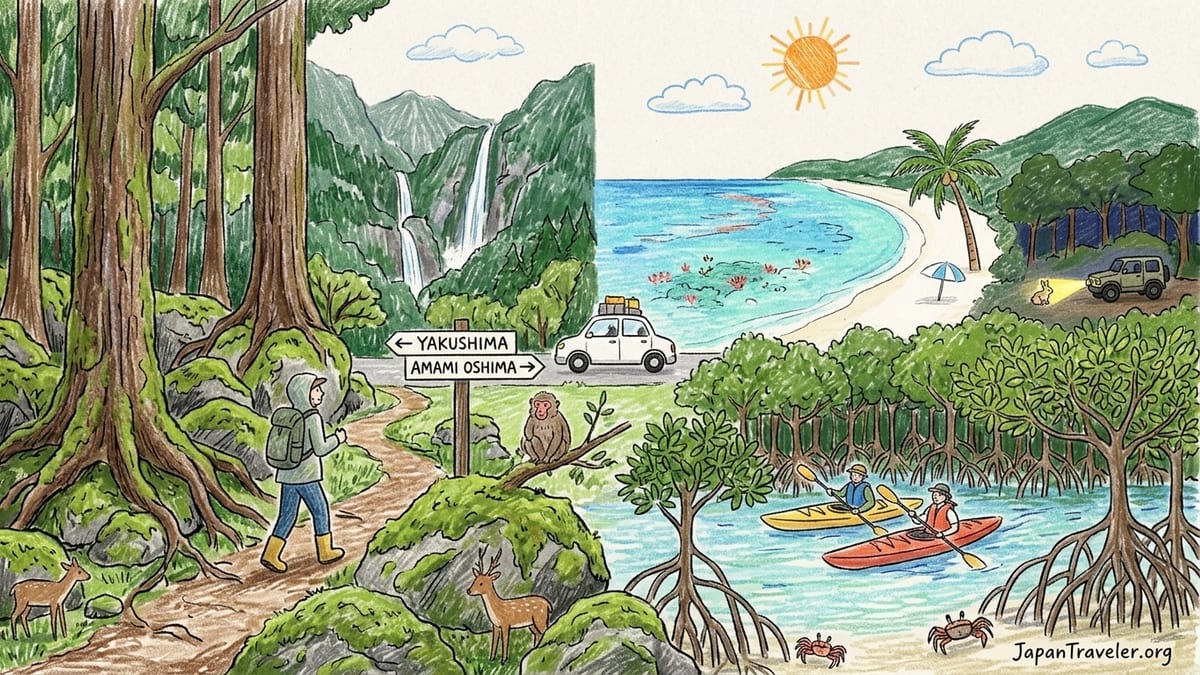
Setting the Scene: Why I Visited Both Islands
I began this trip with a simple question in mind. If I only had time for one major nature destination in southern Japan after Kyushu, should it be Yakushima’s ancient mountain forests or the mangroves and reefs of Amami Oshima. Rather than rely on secondhand advice, I committed to three nights on each island in a single journey, travelling in late spring to catch relatively stable weather but still manageable humidity.
On Yakushima I stayed in Anbo, which gave me access to the Jomon Sugi and Yakusugi Land trailheads, as well as the waterfalls on the island’s south and the bus connections to Shiratani Unsuikyo. On Amami Oshima I based myself first near the mangroves in Sumiyo, then shifted to the north coast close to Ohama Seaside Park, to balance forest and beach time and still be within reach of a night wildlife tour meeting point.
Across both islands I kept my planning consistent. I booked midrange accommodation with private rooms and breakfast, rented a compact car when it felt necessary, used public buses wherever reasonably workable, and joined locally run guided activities at standard advertised rates. The goal was not to travel as cheaply as possible but to reflect the way many independent visitors actually move through these islands.
By the end of six nights I had hiked in Yakushima’s high forest, kayaked Amami’s mangroves, driven both coast roads, joined a nocturnal wildlife excursion and spent a few salty, sand coated afternoons on each island’s beaches. The contrasts were sharper than I expected, particularly in how relaxed each island felt and how much effort it took to see the landscapes that make them famous.
Inside Yakushima’s Forest: A Real Day on the Trails
Yakushima is famous for giant cedar trees and moss drenched ravines, and I wanted at least one substantial hike to justify coming. After checking local guidance and weather, I decided against doing the full Jomon Sugi return via the classic Arakawa logging railway, which typically involves a very early start and nine to ten hours of walking for most people. Instead I opted for a full day in Shiratani Unsuikyo, combined with shorter walks in Yakusugi Land on a separate day, to experience both of the most accessible ancient cedar areas.
My Shiratani Unsuikyo day began with an early but manageable bus from Anbo to the ravine entrance. The ride took about an hour along a winding mountain road and I arrived just after the gate opened. After paying the modest entrance fee at the hut, I followed the stone path into the forest, where the atmosphere changed almost immediately. The air turned cool and damp, the sound of the river grew louder and every surface seemed to be wrapped in a thick layer of emerald moss. This is the landscape that inspired the animators of Princess Mononoke, and it feels that way in person, down to the gnarled roots and mist snagged in the branches.
I chose the longer trail via Taikoiwa, a rocky viewpoint that looks across an amphitheater of ridges and deep green valleys. The route combined some maintained path and boardwalk with uneven roots, boulders and short but steep sections that required hands for balance. Even without reaching Jomon Sugi, the day felt like a serious hike rather than a forest stroll. Cloud rolled in and out all morning, and a brief shower turned the moss electric but also left sections slippery. I carried full rain gear and was glad of it, as Yakushima’s reputation for heavy rainfall is not an exaggeration; showers can blow through even on an otherwise fair forecast.
Yakusugi Land offered a different, slightly more controlled experience. After driving up from Anbo on a separate day, I paid the entrance fee at the information building and followed one of the intermediate circuits that loops through dense cedar forest and crosses several small bridges. Here the trails are better defined and more family friendly, with clear distance markers and options to turn back, but the terrain remains uneven and damp. I met mostly Japanese families and small guided groups, many carrying trekking poles and wearing proper hiking boots. Even on these shorter loops, Yakushima’s forest demands attention with every step.
Yakushima’s Coast, Waterfalls and Where I Stayed
Outside the forest, Yakushima wraps its steep interior mountains in a narrow ring of coastline where most accommodation, roads and services are concentrated. With a rental car for two of my three days, I was able to visit the south coast waterfalls of Senpiro and Toroki, and drive the western Seibu Rindo coastal road where monkeys and deer often graze by the verge. The contrast with the interior is striking. One minute I was in dripping forest, the next I was parked by a cliff edge, looking out over the Pacific with white spray hitting black volcanic rock far below.
Senpiro Waterfall, viewed from a roadside lookout, plunges into a smooth granite bowl that looks almost polished. Toroki Falls flows directly into the sea beside a small bridge, rewarding only a short walk from the parking area. Neither spot demands much physical effort, which made them good choices on a rest afternoon after my Shiratani hike. I also visited Inakahama on the west coast, a long sandy beach known for sea turtle nesting in early summer, although strong currents and the lack of lifeguards made it feel more like a place to walk and watch the surf than to swim.
For my three nights I stayed in a small, midrange inn in Anbo with simple tatami rooms, private bathrooms and breakfast included. My nightly rate worked out at roughly the price of a business hotel in a Japanese regional city. Dinner, when I ate on site, featured locally caught fish and flying fish sashimi, and otherwise I relied on a couple of modest restaurants and a supermarket in town. Compared with mainland Japan, dining options on Yakushima are thin once you leave the main settlements of Miyanoura, Anbo and Onoaida, which is worth bearing in mind if you stay in a more rural minshuku or pension without half board.
Transport on Yakushima is a mixed picture. For forest access I used the scheduled buses to reach Shiratani Unsuikyo and could have done the same for Yakusugi Land, though departure times are limited and often bunched early in the morning. For getting around the coast and reaching waterfalls efficiently, the rental car was far more convenient and allowed flexible stops. I met a few travelers relying entirely on buses and taxis and most described their days as dictated by timetables, especially for early starts to the main trailheads and last return services in the afternoon.
Amami Oshima: Mangroves, Beaches and a Night in the Forest
Amami Oshima sits further south and feels subtly closer to Okinawa in climate and culture. Instead of a single central mass of mountains, it stretches lengthwise with deeply indented bays, mangrove lined rivers and long curves of white sand broken by rocky headlands. For my first full day I booked a guided mangrove kayaking session in Sumiyo, home to Japan’s second largest mangrove forest. Paddling here is one of the island’s signature experiences and several operators cluster around the riverside park.
Out on the water the kayaking proved gentler and more beginner friendly than any of my Yakushima hikes. The guide gave a short safety briefing on shore, handed out life jackets and dry bags, then we slid into stable double kayaks from a sheltered launch area. Within minutes we were gliding over brackish water between tall mangrove roots, with mudflats alive with tiny crabs and wading birds. The tour followed the tide, allowing us to paddle upriver with minimal current and drift back as the water fell. The focus was on observation rather than physical exertion, with frequent stops to explain how mangroves filter salt and host juvenile fish. By the time we returned to the dock after about an hour, I felt pleasantly worked without breaking into the kind of sweat that Yakushima’s steep trails produce.
Amami’s beaches formed the backdrop to most of my remaining daylight hours. Near my northern base I spent time at Ohama Seaside Park, where a gently curving sandy shore meets clear, often calm water and the infrastructure includes a small museum, picnic spaces and showers. Conditions during my visit were good for casual swimming, with minimal swell and quick depth changes that encouraged respect without feeling outright dangerous. Further afield I drove to a couple of smaller coves along the west coast, where coral heads sat close enough to shore that snorkelers could simply walk in from the sand. Compared with Yakushima, the beaches on Amami felt more inviting for in water time.
The standout experience on Amami, however, came after dark. I joined a nocturnal wildlife tour that departed from a roadside meeting point near the central mountains, riding in a guide’s four wheel drive along narrow forest roads. The focus was on finding the Amami rabbit, a chunky, ancient species found only here and on neighboring Tokunoshima, as well as frogs, snakes and other nocturnal life. Over about two and a half hours we spotted multiple rabbits foraging at the roadside, a couple of tree frogs clinging to leaves, and a non venomous snake crossing the asphalt. The guide kept lights to brief, side angled beams and explained recent conservation efforts and roadkill problems along the way. It was not a zoo like guarantee of sightings, but we saw enough to feel the forest’s nocturnal energy.
Staying on Amami: Villages, Roads and Practical Comfort
Accommodation on Amami Oshima ranged from family run guesthouses to beachside resorts, and I chose midrange options in both Sumiyo and near Ohama to mirror my Yakushima spending. My average nightly rate ended up similar to or slightly lower than Yakushima for private rooms with breakfast, and in both locations I was within a short walk of at least one local restaurant or izakaya. Food on Amami felt more varied, with island specialties like keihan, a chicken rice dish served with rich broth, appearing regularly on menus alongside fresh sashimi and tempura.
Where Amami diverged sharply from Yakushima was in how dependent I became on a rental car. The island is elongated, and while there are buses linking major settlements, services are infrequent and do not penetrate far into smaller bays or interior trailheads. For mangrove kayaking I could have stayed near the river and walked to a tour office, but reaching beach after beach, lookouts and the night tour meeting point without a car would have been logistically difficult and time consuming. Over three days I drove several hundred kilometers on mostly good roads, with plenty of signed roadside parking at viewpoints and beaches.
The flip side of this road network is that Amami feels less wild at first contact than Yakushima. Villages and scattered houses line much of the coastline, and even on the night drive, we were never more than a few minutes from a paved junction. Yet this accessibility has advantages for many travelers, especially families and those who prefer shorter walks to set viewpoints rather than committing to full day hikes. I spent one low energy afternoon simply cruising between coastal lookouts, stopping whenever a sign promised a view, and never felt pressured by bus departure times.
In terms of day to day comfort, my Amami stays were marginally more relaxed. Air conditioning handled the warmer, more humid evenings effectively, and I never had to lay out wet hiking gear across the room as I did after Yakushima’s showers. Most restaurants near my lodgings kept dinner hours that suited a leisurely schedule, instead of the early seatings some Yakushima inns favor to accommodate trekkers with pre dawn alarms.
Money, Transport and Effort: A Direct Comparison
Comparing costs and logistics across both islands, several patterns emerged over my six nights. On accommodation, my midrange, breakfast included stays clustered in a similar band on both islands, though Amami offered a slightly wider range of options near good beaches. Travelers on tight budgets will find that simple guesthouses and minshuku on either island can soften the accommodation line in their spreadsheet, especially if they are willing to share bathrooms or cook in a communal kitchen.
Transport was the major difference. On Yakushima I split my time between buses and a short rental car period. The coastal road is essentially a loop, and buses connect Miyanoura, Anbo, Onoaida and key visitor sights like Shiratani Unsuikyo and Yakusugi Land. Schedules are limited but workable if you plan precisely and accept early starts for popular trailheads. The cost of a bus pass smooths the expense over several days and helps with multiple forest outings. On Amami, in contrast, I rented a car for almost my entire stay, because the attractions are scattered and bus connections patchy. For a solo traveler the car cost is noticeable, but for a couple or family it spreads out and becomes easier to justify.
Guided activities also ate into my budget on both islands but in different ways. On Yakushima I hiked independently, incurring only trail related fees and a small additional cost for forest access and facilities. Travelers who prefer guided hikes will need to factor in a full day guide rate, which can be significant, especially for private English language guiding. On Amami I chose to go without a guide in the mangroves, joining a standard group session that included gear and instruction, and then committed to a paid night wildlife tour that required both a guide and a vehicle. For wildlife focused visitors especially, those night drives are almost mandatory, as self driving quietly and responsibly through sensitive habitat is both difficult and discouraged.
In pure physical effort terms, Yakushima demanded more from my body. Even my chosen loop in Shiratani Unsuikyo, which is not the island’s longest or steepest route, involved continuous uneven terrain, wet roots and exposed rock. Reaching Jomon Sugi on a typical Arakawa route would have added several more hours and an earlier wake up to catch special trekking buses. Amami, by contrast, offered shorter, more discrete bursts of activity. The kayaking required moderate paddling and upper body work, the beaches asked for short walks from car parks and the night tour meant mostly sitting in a vehicle and stepping out briefly at safe spots. Anyone with joint concerns or lower baseline fitness is likely to find Amami gentler day to day.
Nature and Wildlife: What I Actually Saw
Both islands are recognized within a wider UNESCO World Heritage listing for the forests of Amami and Ryukyu, but the ecosystems feel very different from a visitor’s perspective. On Yakushima my focus was firmly on the ancient mountain forest. In Shiratani Unsuikyo and Yakusugi Land I spent hours among towering cryptomeria trees, carpets of moss, trickling streams and mist. Wildlife encounters were incidental rather than guaranteed. I saw a few Yakushima macaques in the distance on the lower approach roads, and birdlife flitted through the canopy, but the stars were the trees themselves, some thousands of years old and supported by buttress roots thick as a person’s torso.
Amami offered more varied and frequent wildlife sightings, largely because I joined activities targeted at animals. In the mangroves my guide pointed out mudskippers, fiddler crabs and several herons stalking the flats. On the night tour we watched Amami rabbits nibbling by the roadside, their dark coats and rounded ears unmistakable. One even paused long enough to lift its head and sniff the air before hopping back into the undergrowth. We also saw a couple of frogs and one snake illuminated briefly in the guide’s beam. These observations came with context about roadkill, invasive predators and current threats, which made the sightings feel like part of a bigger story rather than a checklist.
Marine life differed too. While Yakushima has snorkeling and diving operators and I did see some fish close to shore, the combination of rocky entries, stronger swell and my already full hiking schedule meant I treated the sea mostly as a backdrop. On Amami I spent more time in the water, swimming from sandy beaches where coral patches were close enough for casual exploration without a boat. I did not book a formal snorkel tour on this trip, but the infrastructure and calm conditions made it feel like an easy addition for those with more days than I had.
The upshot is that wildlife photographers and animal focused travelers have a clearer path to meaningful sightings on Amami, particularly if they invest in at least one guided night excursion and a session in the mangroves. Tree and landscape photographers, or those drawn to atmospheric forests, will likely find Yakushima more compelling, with every turn on the trail revealing new compositions of trunks, roots and flowing water.
Rest Days, Relaxation and Where I Would Return
Rest days and downtime told me a lot about the emotional tone of each island. On Yakushima my non hiking hours still revolved around logistics. I checked bus departure boards, watched the weather for sudden shifts that might close higher trails, and coordinated inn dinners with early morning starts. Even when I sat by the river near Anbo with a coffee, listening to water rush over rocks, I was mentally rehearsing trail times and options if heavy rain made certain routes unsafe. The landscape is sublime, but the combination of early mornings, long days on foot and weather vulnerability creates a low background hum of planning.
Amami, by contrast, let me drop that mental load for long stretches. Once I had the rental car keys and a rough sense of the island’s layout, my days flowed more loosely. I could decide after breakfast whether to head for a new beach, revisit the mangroves or simply drive to a hilltop viewpoint and linger. My main fixed point each day was the night tour booking, which still left most of the daylight hours available for spontaneous swims and slow lunches. One afternoon I did little more than read in the shade near Ohama, getting up occasionally for a short swim, and felt no guilt about “wasting” an island day.
Swimming opportunities were also more satisfying on Amami. While I waded and briefly swam at one of Yakushima’s calmer beaches, the combination of stronger currents, fewer lifeguards and my personal caution kept me from extended sessions in the water. On Amami the shallow, clear bays, gentler surf on some coasts and visible local families playing in the shallows created a more inviting atmosphere. I still respected posted warnings and stayed within my limits, but I left feeling the sea had been a major part of the experience, not just a backdrop to hikes.
If I had to choose one island to return to with my own money and limited time, I would lean slightly toward Amami Oshima. The mix of gentle activity, accessible beaches, varied wildlife and relaxed day to day rhythm matched how I like to travel when I am not on a dedicated trekking trip. That said, Yakushima remains the more singular destination. Its ancient forests and cascading rivers feel like nowhere else in Japan, and for hikers in particular it can easily become the highlight of an entire itinerary.
Conclusion: Expectations, Highlights, Frustrations and Best Fit
Going into this trip I expected Yakushima to deliver the most powerful nature experience and Amami Oshima to be a pleasant but secondary stop focused on beaches. I also assumed Yakushima would be more demanding physically and logistically and that Amami would feel easier but perhaps less distinctive. Those expectations were only partially correct. Yakushima did indeed offer the most intense immersion in ancient forest, yet Amami surprised me with how rich and layered its landscapes and wildlife experiences felt, especially at night and among the mangroves.
The most memorable nature moment of the whole journey came on Yakushima, standing on the Taikoiwa viewpoint above Shiratani Unsuikyo as low clouds poured through the valleys and distant peaks emerged briefly like islands in a green sea. The stillness between showers, broken only by wind in the canopy, felt almost otherworldly. Amami’s equivalent high came during the night tour when an Amami rabbit paused just meters from the vehicle, illuminated softly in red filtered light before melting into the dark. Both memories are strong, but Yakushima’s forest edges ahead for sheer atmosphere.
The main inconveniences were different on each island. On Yakushima the early starts, limited bus schedules to key trailheads and the real risk that heavy rain could force trail closures or make routes unsafe weighed on my planning. I had to build backup plans for almost every day. On Amami the frustration centered on public transport. Without a rental car I would have been largely confined to a narrow slice of the island or dependent on taxis for even modest excursions, and the night wildlife tours effectively require joining an organized operator.
In terms of value, both islands can be visited on a similar overall budget for a three night stay, once you factor in accommodation, a modest selection of meals out, and at least one or two paid activities. Yakushima may involve higher guiding costs if you choose not to hike independently, while Amami may push up transport and tour expenses through its reliance on car rental and night drives. For my travel style, Amami felt like the better value because more of my spending translated directly into time in or near the water and wildlife viewing, whereas some of my Yakushima costs disappeared into weather hedging and long transport days.
Looking ahead, I would return to Yakushima for a purpose driven trekking trip focused on longer routes such as the full Jomon Sugi hike or a traverse between trailheads in stable weather. I would return to Amami Oshima more casually, perhaps with friends or family, planning a mix of beach days, a repeat night wildlife excursion and a couple of mangrove or lowland forest explorations. The choice between them is less about which is objectively better and more about what kind of nature holiday you want after Kyushu.
For hikers, especially those already comfortable with full day mountain walks and early starts, Yakushima is the clear priority. The combination of Shiratani Unsuikyo, Yakusugi Land and, for those prepared, the Jomon Sugi trail delivers a depth of forest experience that Amami does not attempt to match. Wildlife photographers and animal enthusiasts will often find Amami more rewarding, particularly if they book at least one targeted night drive and allow time around the mangroves and coastal wetlands.
Families and mixed ability groups may lean toward Amami Oshima, where beaches, short walks and vehicle accessed viewpoints keep everyone involved without forcing long days on steep, slippery paths. Couples seeking a romantic escape could go either way. Yakushima offers atmospheric inns, riverside onsens and misty forest walks that feel deeply intimate, while Amami provides sunset beaches, easy swimming and a slower rhythm ideal for unwinding together. Beach focused visitors who imagine multiple days of swimming and snorkeling should almost certainly favor Amami.
For travelers choosing a single island after Kyushu, the decision comes down to whether you picture yourself lacing up hiking boots before dawn to walk deep into an ancient cedar forest, or slipping into sandals for a drive between coves, mangroves and roadside viewpoints. If the first image excites you more, pick Yakushima and prepare for early mornings and possible rain delays. If the second sounds closer to your ideal holiday, Amami Oshima will likely feel like the island you had in mind all along.
FAQ
Q1. Is Yakushima or Amami Oshima easier to visit without renting a car
Both islands are technically accessible by public transport, but Yakushima is more workable without a car if you plan carefully around bus timetables, especially for reaching Shiratani Unsuikyo and Yakusugi Land. Amami’s sights are more spread out and its buses less convenient for beaches and night tours, so a car is strongly recommended there.
Q2. Which island is better if I only have three nights after Kyushu
If you want serious hiking in ancient forest and do not mind early starts or potential rain delays, choose Yakushima. If you prefer a mix of beaches, gentle activities like mangrove kayaking and an emphasis on wildlife viewing, Amami Oshima will probably feel more rewarding.
Q3. Can families with young children enjoy Yakushima’s forests
Yes, but it is important to select shorter, well maintained routes such as the easier circuits in Yakusugi Land and to be realistic about terrain, which is often uneven and slippery. Very long hikes like the full Jomon Sugi route are generally unsuitable for small children.
Q4. Are swimming and snorkeling better on Yakushima or Amami Oshima
Amami Oshima offers more consistently user friendly beaches, with sandy entries, often calmer water and coral accessible from shore in several bays. Yakushima has beautiful coastline and some swim spots, but stronger swell and rockier entries can limit casual swimming, particularly for less confident swimmers.
Q5. How much hiking experience do I need for Yakushima
For shorter forest walks in Yakusugi Land and the lower sections of Shiratani Unsuikyo, basic fitness and proper footwear are sufficient. For longer routes and the Jomon Sugi trail, you should be comfortable with full day mountain walks on uneven, often wet terrain and be prepared for early starts and changing weather.
Q6. Is a night wildlife tour on Amami Oshima worth the cost
For visitors interested in seeing endemic species like the Amami rabbit and experiencing the forest after dark, a guided night tour is one of the island’s highlights. It adds to overall expenses but significantly increases your chances of safe, responsible wildlife sightings.
Q7. How do hotel costs compare between Yakushima and Amami Oshima
Midrange hotels and inns with private rooms and breakfast are broadly similar in price on both islands, though Amami may offer more options directly near good beaches. Simple guesthouses and minshuku on either island can bring nightly costs down for budget conscious travelers.
Q8. When is the best time of year to visit these islands for nature
Late spring and autumn often provide a good balance of comfortable temperatures and fewer typhoons, though both Yakushima and Amami can receive heavy rain at any time. Summer brings warmer water for swimming on Amami but also higher humidity and more intense sun.
Q9. Do I need a guide to hike on Yakushima
You are not required to hire a guide for main trails like Shiratani Unsuikyo and Yakusugi Land, and many visitors hike independently after studying maps and safety advice. However, hiring a guide can be worthwhile if you are inexperienced in mountain hiking, want deeper natural interpretation or prefer not to manage navigation and timing yourself.
Q10. Which island feels more relaxed overall
Amami Oshima generally feels more relaxed for most visitors, with flexible days built around drives, beaches and shorter activities. Yakushima can feel more intense and schedule driven, particularly if you plan major hikes that require early starts and close attention to weather and transport.