


Running along Japan’s Sea of Japan coast between Tokyo and the Kansai region, the Hokuriku Arch route has become a popular alternative to the classic Tokyo–Hakone–Kyoto circuit. At the center of this “New Golden Route” is the 7-day Hokuriku Arch Pass, a joint rail pass from JR East and JR West that promises unlimited rides and easy stops in Nagano, Toyama, Kanazawa, Fukui and Kyoto or Osaka. With the price recently revised to 35,000 yen for adults, many travelers are asking a simple but important question: is the Hokuriku Arch Pass still worth it?
What the Hokuriku Arch Pass Is in 2026
The Hokuriku Arch Pass is a 7-day rail pass jointly sold by JR East and JR West for foreign visitors. As of the March 14, 2026 revision, the adult price is 35,000 yen and the child price is 17,500 yen. You choose a starting date and then have seven consecutive calendar days of unlimited travel within the designated area. The pass is aimed squarely at travelers who want to move between Tokyo and Kansai while stopping to explore Nagano’s mountains, Toyama Bay, Kanazawa’s gardens and tea districts, and the newly spotlighted Fukui and Tsuruga area.
The pass covers standard class travel on the Hokuriku Shinkansen between Tokyo and Tsuruga, as well as a wide network of JR conventional lines and a handful of private third-sector railways that took over parts of the old Hokuriku Main Line. In practice, it is designed so that you can fly into Tokyo, work your way along the Hokuriku coast, and fly home from Kansai International Airport or Osaka, or do the route in reverse. Seven days is enough to make that Tokyo–Nagano–Toyama–Kanazawa–Fukui–Kyoto or Osaka arc at a comfortable pace if you plan ahead.
This pass is different from the nationwide Japan Rail Pass in two key ways. First, it has a more limited geography, focusing on central Honshu rather than all of Japan. Second, it is currently cheaper than the 7-day national pass, which means it can be a strong value if most of your long-distance travel is between Tokyo and Kansai via Hokuriku rather than via Nagoya. As prices and coverage have been revised multiple times in recent years, it is important to base decisions on the current 35,000 yen tariff and the present service map.
Eligibility, Where to Buy and How Seat Reservations Work
The Hokuriku Arch Pass is restricted to tourists visiting Japan on a temporary visitor status. In concrete terms, that means you need to be entering Japan with a stamp or sticker in your passport that says “Temporary Visitor” and you cannot be a Japanese resident using a residence card. Immigration status is checked when you exchange your voucher or pick up the pass, so you should carry your passport when you collect it and when using it on trains.
You can purchase the pass online through the official JR East or JR West reservation systems or from participating overseas travel agencies before arriving in Japan, or buy it at major stations inside the coverage area such as Tokyo, Ueno, Shinjuku, Nagano, Kanazawa, Kyoto, Osaka and Shin-Osaka. The official price is now the same inside and outside Japan, so there is less incentive to wait and buy on arrival beyond flexibility. During busy seasons like late April’s Golden Week or the autumn foliage period in November, buying in advance and locking in your start date is strongly recommended.
Seat reservations are included at no extra cost for eligible trains, but they are not automatic. Once you have the physical pass, you can reserve seats on the Hokuriku Shinkansen, Limited Express Thunderbird between Tsuruga and Osaka or Kyoto, and other eligible limited express trains using JR East or JR West ticket machines, at ticket counters, or via their online reservation platforms where available. Many travelers find it practical to reserve several key long-distance legs in one go, for example Tokyo to Nagano, Nagano to Toyama, Toyama to Kanazawa and Kanazawa to Fukui, especially in peak travel weeks.
On non-reserved ordinary cars of shinkansen and rapid services you can simply show the pass at the ticket gate and sit in any unreserved seat, subject to availability. However, because the Hokuriku Shinkansen and the Thunderbird can be busy on Fridays, Sundays and holiday periods, relying solely on unreserved seating can mean standing for part of the journey. A realistic way to use the pass is to reserve seats in advance for the longest segments and use unreserved seating for short hops and side trips.
Routes, Railway Companies and What the Pass Covers
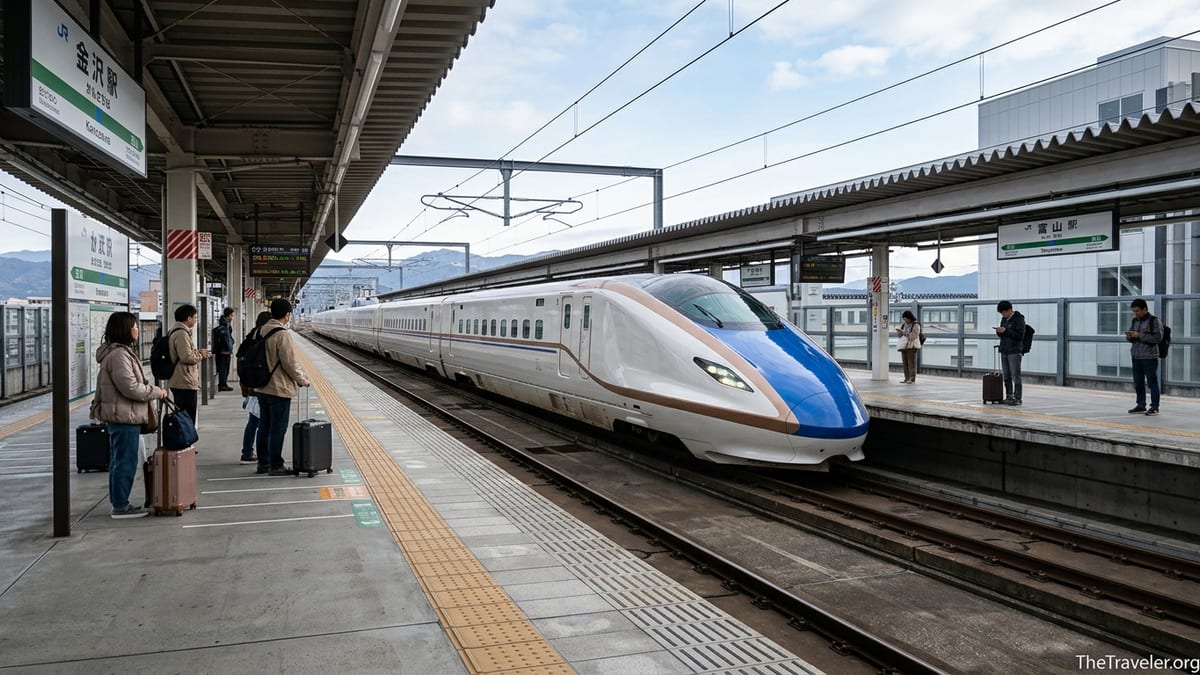
The backbone of the Hokuriku Arch Pass is the Hokuriku Shinkansen, which runs from Tokyo through Omiya, Nagano, Joetsumyoko, Toyama and Kanazawa to Tsuruga. With the recent extension, Tsuruga in Fukui Prefecture is now the western terminus of the shinkansen on this route, and from there conventional Limited Express Thunderbird services continue to Kyoto and Osaka. Your pass lets you use Hakutaka, Kagayaki and other Hokuriku Shinkansen services within the pass area in standard class, and then connect to the Thunderbird without extra fare as long as you travel on the permitted routes.
On JR lines, the pass is valid on local, rapid and limited express trains operated by JR East and JR West within the printed map area. That covers key stretches like Tokyo to Nagano, Nagano to Joetsumyoko, Toyama to Kanazawa, Kanazawa to Tsuruga, and Tsuruga to Kyoto or Osaka via the Thunderbird. Importantly, it also covers the Tokyo Monorail between Haneda Airport and Hamamatsucho, so travelers flying into Haneda can ride directly into central Tokyo on day one without extra cost once the pass is activated.
To maintain continuity where JR relinquished control of main-line segments to regional companies, the Hokuriku Arch Pass includes certain third-sector railways. These typically include IR Ishikawa Railway between Kanazawa and Tsubata, Ainokaze Toyama Railway between Toyama and Kurashiki or adjacent stations, and Hapi-Line Fukui near Fukui and Tsuruga. In practical terms, this means you can ride through from Nagano to Kanazawa, Kanazawa to Tsuruga and onward to Kyoto or Osaka without needing to buy separate tickets just because part of the line is technically not JR anymore.
Even with this broad coverage, the pass still has clear borders. For example, it does not cover Nozomi services on the Tokaido Shinkansen between Tokyo and Shin-Osaka, nor does it include private railway networks in Kansai such as Hankyu, Keihan, Kintetsu or Osaka Metro. If you stay in Kyoto and make daily use of city buses and subways, or ride private lines to Arashiyama or Nara, you will need local passes or pay as you go. The pass is primarily about intercity travel along the Hokuriku arc rather than a complete transport solution for every local journey.
Important Gaps and Limitations in Coverage
One of the most important limitations is that the Hokuriku Arch Pass is tied to specific routes, not to any train you like between Tokyo and Kansai. If your goal is simply to go from Tokyo to Kyoto and back via the faster Tokaido Shinkansen on a Nozomi service, this pass does not cover that line at all. You would be paying for Hokuriku coverage you are not using and still need to buy separate Nozomi tickets at full price. Travelers who are short on time and want the fastest route between Tokyo and Kyoto or Osaka often find point-to-point Tokaido Shinkansen tickets more appropriate.
Another practical gap is that the pass does not include all private and regional lines in the broader Hokuriku region. For instance, travel on the Noto Railway north of Anamizu, or certain local branches in Toyama and Ishikawa, requires additional tickets. If your itinerary heavily features side trips to remote onsen towns or small coastal villages that are off the Hokuriku Shinkansen corridor, the value of the pass can be diluted by frequent small add-on fares. Likewise, city trams in Toyama and Kanazawa, and most local buses, are not included.
Seat classes are also limited. The Hokuriku Arch Pass typically covers ordinary class reserved and unreserved seats, but not the Green Car first-class seats or Gran Class on the Hokuriku Shinkansen. If you prefer extra legroom and quieter cars and plan to upgrade to Green Car on several legs, you will have to pay the Green Car surcharge on top of the pass price. For budget travelers happy with standard class this is not a concern, but anyone considering frequent upgrades should factor those surcharges into their comparison.
Finally, the validity is strictly seven consecutive days from the chosen start date. You cannot spread the days out, and there is no option for a longer or shorter version of the Hokuriku Arch Pass. If your time in Japan stretches to two or three weeks and you only spend a portion of it moving along the Hokuriku route, you will need to cluster the long-distance travel within a one-week window to make the most of the pass. Travelers who prefer a slower pace with multi-day stays in each city may find that the required compression of long legs into seven days clashes with their ideal rhythm.
Current Price vs Individual Tickets: Real-World Itineraries
With the adult price now at 35,000 yen, the question becomes whether your planned rides add up to at least that much in regular fares. Full, exact fares vary slightly by date, train and seat type, but we can use current ballpark figures for reserved ordinary seats on shinkansen and limited express services to make realistic comparisons. These examples assume that you are traveling in 2026 and booking standard reserved seats at regular season prices.
Consider a classic one-way arc from Tokyo to Osaka with stops along the Hokuriku route over seven days. A reserved Hokuriku Shinkansen ticket from Tokyo to Nagano typically falls in the roughly 8,000 yen range. Nagano to Toyama on the shinkansen is around 9,000 to 10,000 yen, depending on the service. Toyama to Kanazawa reserved on the Hokuriku Shinkansen is shorter and cheaper, in the 4,000 to 5,000 yen range. Kanazawa to Fukui or Tsuruga via limited express or shinkansen segments may run roughly 5,000 to 7,000 yen. From Tsuruga to Kyoto on a reserved Thunderbird limited express seat, a fare around 6,000 yen is a realistic estimate, and Kyoto to Osaka on JR special rapid or limited express services adds approximately 1,500 to 2,500 yen for a reserved seat if you choose one over a local train.
Adding those segments together, even with conservative assumptions, the one-way Tokyo–Nagano–Toyama–Kanazawa–Fukui/Tsuruga–Kyoto–Osaka itinerary can easily total somewhere around 33,000 to 40,000 yen in standard reserved tickets. In this scenario the Hokuriku Arch Pass at 35,000 yen starts to look competitive if you are closer to the higher end of that range or if you insert a couple of bonus day trips. For example, adding a Kanazawa–Wakura Onsen round trip or a Toyama–Kurobe-Unazukionsen side trip on top of the main arc nudges the total cost of point-to-point tickets above the pass price.
By contrast, consider a simpler itinerary focused on a Tokyo–Kanazawa–Tokyo round trip over three or four days. A reserved Hokuriku Shinkansen ticket from Tokyo to Kanazawa often comes in around 15,000 to 17,000 yen one way in ordinary reserved class, depending on train and date. A straightforward return trip would therefore be in the ballpark of 30,000 to 34,000 yen. In that case, buying the 35,000 yen Hokuriku Arch Pass just for a single out-and-back trip to Kanazawa does not usually pay off, especially if you are not planning extra long-distance excursions within the seven-day window.
When the Hokuriku Arch Pass Clearly Saves Money
The pass delivers its best value when you build a multi-city itinerary that uses shinkansen and limited express trains several times within seven days. A good example is a traveler who lands at Haneda, spends one night in Tokyo, then travels Tokyo–Nagano–Toyama–Kanazawa–Fukui–Kyoto and finally flies out of Kansai International Airport. With realistic point-to-point reserved fares adding up to the mid-30,000s yen or more, the pass not only keeps total rail costs predictable but also includes useful extras like the Tokyo Monorail to and from Haneda and any short JR hops inside Tokyo, Kyoto or Osaka.
Another scenario where the pass shines is for travelers who want to base themselves in one or two cities along the route and still take several long day trips. For instance, you could stay four nights in Kanazawa and three nights in Kyoto. From Kanazawa, you might take a shinkansen day trip to Toyama and the Kurobe Gorge area, or ride to Fukui for the dinosaur museum and Eiheiji Temple. From Kyoto, you might use the pass on the Thunderbird to pop over to Fukui or back up the coast before heading on to Osaka. These repeat long-distance legs can quickly add up to more than 35,000 yen in regular tickets.
Travelers who enjoy flexibility also often find intangible value in the pass. Knowing that additional JR rides within the map area are effectively free once the pass is bought can encourage spontaneous detours: a late decision to stop in Nagano for onsen on the way to Kanazawa, or an unplanned half-day in Fukui when you see good weather in the forecast. Over seven days, these small opportunistic trips are likely to push the theoretical total beyond the pass price, even if you did not plan them when you first arrived.
Finally, small families and pairs traveling together can see amplified savings. Since each adult pass is priced individually, two adults using the Hokuriku Arch Pass on a busy, shinkansen-heavy itinerary can effectively save a combined amount that feels more substantial, especially if they are comparing against buying two separate last-minute reserved seats at peak times. Families with children under 12 benefit from the half-price child pass, which makes long distances like Tokyo–Toyama–Kanazawa considerably more affordable than purchasing child tickets piecemeal, particularly during holiday periods when flexibility in train choice is valuable.
When a Simple Ticket or Local Pass Is Better
There are also many situations where, in 2026, the Hokuriku Arch Pass does not make financial sense. The most obvious is when your long-distance travel consists of just one or two intercity journeys. A Tokyo–Kanazawa return, as noted, can often be completed for slightly under the 35,000 yen pass price if you are content with ordinary reserved seats and do not plan additional major side trips. Tokyo–Nagano return is even less, usually in the mid-teens to low 20,000s of yen for round-trip reserved standard class, which is well below the pass price.
Similarly, if you are using the Hokuriku route only in one direction and returning by a completely different route that the pass does not cover, it may be cheaper to buy single tickets for both legs. For example, imagine you go from Tokyo to Kanazawa via the Hokuriku Shinkansen, then later return to Tokyo from Kyoto on a Nozomi Tokaido Shinkansen. Since the pass does not cover the Nozomi and the total distance you are actually riding within the Hokuriku Arch area is modest, buying individual tickets for both directions is often more cost-effective and avoids paying for several days of unused validity.
Travelers who prefer to spend several nights in only one or two cities without many long day trips might also do better with local transport passes. In Kanazawa, for example, the main tourist districts are compact and largely served by buses and walking, so your JR usage might be limited to only the arrival and departure shinkansen. In Kyoto, many popular temples are accessed by city buses or private lines rather than JR, and a city bus or subway pass can be a better fit. In such cases, the Hokuriku Arch Pass can feel like an expensive solution to a problem that does not really exist.
Lastly, those who prioritize travel time over scenery often skip the Hokuriku route entirely and use the faster Tokaido Shinkansen between Tokyo and Shin-Osaka. A reserved Nozomi ticket between Tokyo and Kyoto or Osaka is more direct, and if you are only doing that route once in each direction, there is no need for a pass focused on a slower coastal arc. For business travelers or visitors with tight conference schedules, the convenience and speed of the direct Tokaido line generally outweigh the cost advantages of the Hokuriku Arch Pass, particularly when they are not stopping en route.
The Takeaway
With the March 2026 revision setting the 7-day Hokuriku Arch Pass at 35,000 yen for adults, the pass has moved firmly into “consider carefully” territory. It is no longer a low-cost default but a strategic tool that rewards the right kind of itinerary. If your plan involves hopping along the Hokuriku corridor from Tokyo all the way to Kyoto or Osaka with multiple stops, and you expect to ride the Hokuriku Shinkansen and Limited Express Thunderbird several times in seven days, the pass still offers solid value and welcome flexibility.
On the other hand, if you only plan a simple Tokyo–Kanazawa return or a single Tokyo–Nagano excursion, individual tickets remain cheaper in most realistic cases. The pass does not cover the Tokaido Shinkansen or most private urban railways, and it is limited to ordinary class, so travelers focused on speed, first-class comfort or concentrated city stays may find it does not align with their priorities.
A useful rule of thumb is to sketch out your likely long-distance segments, look up approximate current fares for each, and see whether the total comfortably exceeds 35,000 yen. If it does, the Hokuriku Arch Pass can simplify your trip and enable spur-of-the-moment side adventures along one of Japan’s most rewarding coastal routes. If it does not, then point-to-point tickets combined with local city passes will usually be the smarter financial choice.
FAQ
Q1. Who can use the Hokuriku Arch Pass in 2026?
Visitors who enter Japan on a temporary visitor status, typically marked as “Temporary Visitor” in their passport, are eligible. Residents of Japan using a residence card and holders of other long-term visas are not eligible to purchase or use this pass.
Q2. How much does the 7-day Hokuriku Arch Pass cost now?
As of the March 14, 2026 revision, the adult price is 35,000 yen and the child price for ages 6 to 11 is 17,500 yen. Prices are the same whether purchased inside or outside Japan, though exchange rates will affect the amount in your home currency.
Q3. Which main cities does the Hokuriku Arch Pass connect?
The pass primarily links Tokyo with Nagano, Toyama, Kanazawa, Fukui, Tsuruga, Kyoto and Osaka. Many travelers use it to travel between the Tokyo metropolitan area and the Kansai region while making stops in key Hokuriku destinations along the way.
Q4. Does the pass cover the Tokaido Shinkansen between Tokyo and Kyoto or Osaka?
No. The Hokuriku Arch Pass does not cover the Tokaido Shinkansen at all, including Nozomi, Hikari or Kodama services between Tokyo, Nagoya, Kyoto and Shin-Osaka. It is valid instead on the Hokuriku Shinkansen between Tokyo and Tsuruga and on connecting limited express services such as the Thunderbird between Tsuruga and Kyoto or Osaka.
Q5. Are seat reservations included with the Hokuriku Arch Pass?
Yes. Ordinary class seat reservations on eligible shinkansen and limited express trains within the pass area are included at no extra charge. You still need to make reservations in advance at ticket machines, ticket counters or online where available to guarantee a specific seat, especially during peak seasons.
Q6. Is the pass worth it for a simple Tokyo–Kanazawa round trip?
Usually no. A Tokyo–Kanazawa–Tokyo round trip on the Hokuriku Shinkansen with reserved ordinary seats typically costs slightly less than the 35,000 yen pass price. Unless you add significant extra long-distance travel within the seven-day period, individual tickets tend to be cheaper for that limited itinerary.
Q7. Can I use the pass for local transport in Kyoto and Osaka?
Only on JR lines within the coverage map. The pass does not include subways, city buses or most private railways such as Hankyu, Keihan or Osaka Metro. For intensive sightseeing within Kyoto or Osaka, a local bus or subway pass often pairs better with the Hokuriku Arch Pass or with simple intercity tickets.
Q8. Do I have to use the pass on seven consecutive days?
Yes. Once activated, the Hokuriku Arch Pass is valid for seven consecutive calendar days and cannot be paused or split. It is important to cluster your longer train journeys within that one-week window to maximize value, especially if your total time in Japan is longer.
Q9. How do I know if my planned itinerary will justify the pass cost?
A practical approach is to list each long-distance segment you expect to ride within the Hokuriku Arch area, look up approximate current fares for reserved ordinary seats, and add them together. If the total comes out comfortably above 35,000 yen, the pass is likely a good deal. If it is significantly below that figure, individual tickets or other passes may be more economical.
Q10. Has the price or coverage of the Hokuriku Arch Pass changed recently?
Yes. The pass has undergone revisions, with the latest price and validity changes taking effect in March 2026. Because JR occasionally updates both fares and coverage conditions, travelers should always verify the latest official information close to their travel dates, especially if they are planning trips for future seasons.