


For decades, Japan’s classic “Golden Route” has funneled first-time visitors from Tokyo to Hakone and on to Kyoto and Osaka along the busy Tokaido corridor. Now a rival has quietly emerged on the other side of the mountains: a Hokuriku route that curves from Tokyo through Nagano, Toyama, Kanazawa and Fukui to reach Kyoto and Osaka along the Sea of Japan coast. With the full reopening of the Hokuriku Shinkansen and expanded regional rail passes, more travelers are asking whether this longer, more scenic line is worth building into an itinerary. The answer depends on how you like to travel, how much time you have, and what you want Japan to feel like between its big cities.
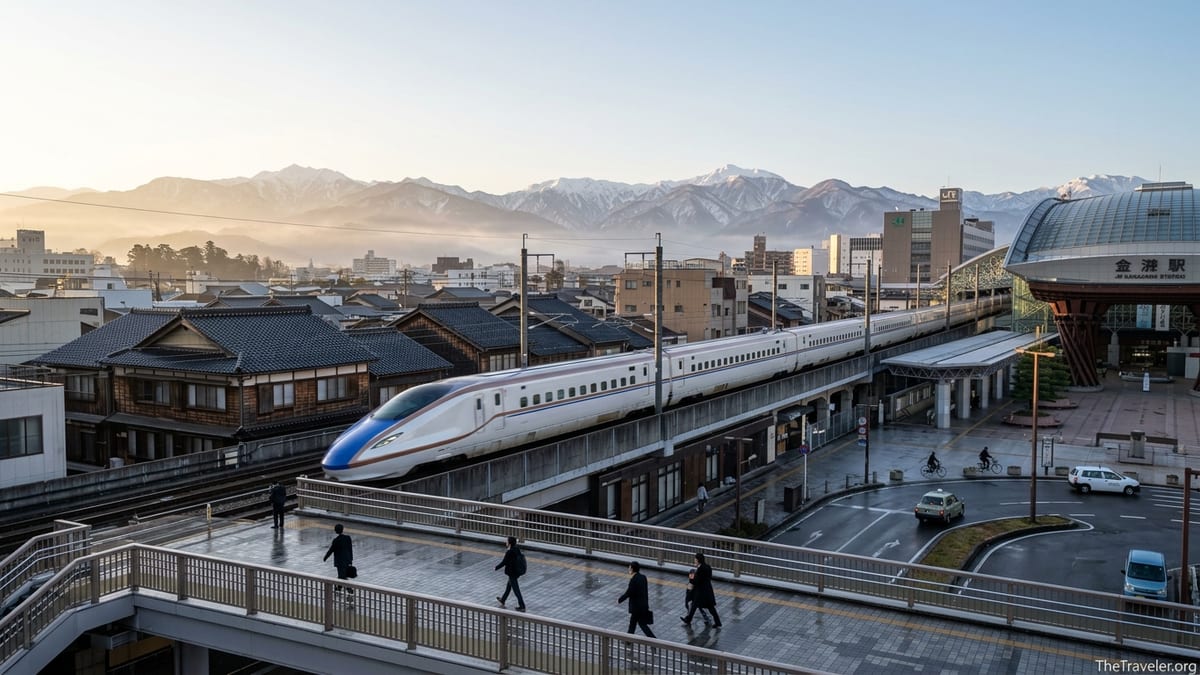
What the Hokuriku “New Golden Route” Actually Looks Like
The traditional Golden Route is simple: bullet train from Tokyo to Odawara for Hakone, onward by shinkansen to Kyoto, and finally a short hop to Osaka. On rail passes like the Japan Rail Pass, this chain is fast and intuitive. Travel time from Tokyo to Kyoto on the Tokaido Shinkansen is about 2 hours 15 minutes, with Tokyo to Osaka taking around 2 hours 45 minutes if you use the fastest Nozomi services, a little longer on Hikari trains.
The Hokuriku alternative replaces the Hakone detour with a sweep through the Japan Alps and the Sea of Japan coast. In practice, a typical route might be: Tokyo to Nagano on the Hokuriku Shinkansen, then on to Toyama and Kanazawa, before following the coast to Fukui and cutting south to Kyoto and Osaka. This can be done as a point-to-point dash in a single long day, but it only makes sense if you treat each leg as an opportunity to stop, explore and stay over.
Timings give a sense of scale. Tokyo to Nagano on the Kagayaki or Hakutaka services takes roughly 1.5 hours. Nagano to Toyama by Hokuriku Shinkansen adds just under an hour. Toyama to Kanazawa is around 25 minutes, and from Kanazawa to Fukui on the Hokuriku Shinkansen is about another 30 minutes. Limited express and rapid trains then carry you from Fukui to Kyoto in roughly 1.5 hours and on to Osaka in another 30 minutes or so, depending on the service. Even with transfers, the whole Tokyo to Osaka journey via Hokuriku can be done in under 6.5 hours of train time, but breaking it into 4 to 7 days is where it becomes rewarding.
In other words, the Sea of Japan route is not about shaving minutes. It is about trading a direct sprint for a string of medium-size cities, castle towns, onsen villages and high alpine detours that most first-time visitors never see.
Building a Practical Tokyo–Osaka Itinerary via Nagano and Kanazawa
A realistic Hokuriku itinerary for many travelers is 7 to 10 days folded into a broader Japan trip. One common pattern is to start with 3 or 4 nights in Tokyo, then head into the mountains. From Tokyo Station, ride the Hokuriku Shinkansen to Nagano. If you want to visit the famous snow monkeys at Jigokudani, Nagano deserves at least an overnight stay: half a day for Zenkoji Temple and old temple town streets, and half a day for the onsen and monkey park in nearby Yamanouchi.
From Nagano, you continue west to Toyama and Kanazawa. Many travelers simply ride straight through Toyama, but giving Toyama one night can make sense if you are planning to tackle the Tateyama Kurobe Alpine Route or want a quieter base. A hotel near JR Toyama Station puts you a short walk from the private Dentetsu Toyama station where early morning trains up into the Alps depart, and Toyama’s compact center has riverside promenades, glass art museums and casual seafood izakaya specializing in local firefly squid and masu trout.
Kanazawa is where almost every Hokuriku itinerary slows down. With Kenrokuen Garden, the restored Kanazawa Castle, well-preserved samurai and geisha districts, and contemporary museums like the 21st Century Museum of Contemporary Art, a single night can feel rushed. Two or even three nights allow you to explore at a gentler pace, linger in teahouses and side streets, and take a day trip to nearby fishing towns or the Noto Peninsula if transport has recovered enough for limited bus excursions.
After Kanazawa, a continuation along the Hokuriku Shinkansen to Fukui introduces a quieter side of the route. Some visitors pass through, but those interested in dinosaurs, Zen temples or rugged coastline might stay a night in Fukui or at least half a day. From there, it is an easy rail hop south to Kyoto and onward to Osaka, where you can either end your trip or loop back to Tokyo.
Where to Linger: Overnight Stop Recommendations
Not every Hokuriku stop deserves equal time. The question is where overnight stays add the most to your experience. For many itineraries, Nagano is worth at least one night, especially in winter and spring. An evening visit to Zenkoji Temple, with its lantern-lit approach and quiet streets, feels very different to Tokyo’s neon, and staying near Nagano Station makes early departures to mountain areas like Togakushi or the snow monkeys much simpler than trying to rush up and back from Tokyo in a single day.
Toyama is the most divisive stop. If you are not planning an Alpine Route detour or do not care much about smaller cities, you might simply connect through to Kanazawa. However, Toyama can be a smart overnight for travelers who like regional food and calmer downtowns. Business hotels near the station often price a little lower than comparable Tokyo or Kanazawa properties, and the city’s tram network makes it easy to access the waterfront and glass art museum. If you have a very tight schedule, Toyama might be skipped, but if you have 10 days or more it becomes a relaxed and convenient base.
Kanazawa is the place to linger. Two nights is a good minimum if you want to explore Kenrokuen Garden in the early morning before tour buses arrive, wander the Higashi Chaya teahouse district in the late afternoon, and still have time for the samurai quarter, Omicho fish market and a museum or two. Many travelers now choose three nights in Kanazawa as a replacement for Hakone or Takayama, especially outside cherry blossom and autumn foliage peaks.
Fukui tends to appeal most to travelers with specific interests. Families often stop for the Fukui Prefectural Dinosaur Museum (reached via a local line and bus), while others come for Eiheiji, a historic Zen training temple complex set in deep forest. If either of those interests you, one night in Fukui or nearby Onsen villages such as Awara makes sense. If not, you can treat Fukui as a daytime stop en route to Kyoto, visiting the rebuilt Fukui Castle ruins and downtown before continuing south in the evening.
Fitting the Hokuriku Arch Pass into the Journey
The Hokuriku Arch Pass is a regional rail pass jointly issued by JR East and JR West that ties this whole route together. As of spring 2026, the pass costs around 35,000 yen for 7 consecutive days of unlimited travel on designated JR lines linking Tokyo with the Hokuriku region and the Kansai area. It covers the Hokuriku Shinkansen between Tokyo and Tsuruga via Nagano, Toyama, Kanazawa and Fukui, as well as many connecting limited express and local trains in the region.
In practical terms, the pass is most cost-effective if you use it for at least one long hop from Tokyo to Kanazawa or Fukui plus several shorter rides between Hokuriku cities and on to Kyoto or Osaka. A typical calculation might look like this: a one-way non-reserved shinkansen ticket from Tokyo to Kanazawa can be around 15,000 yen; Kanazawa to Fukui and then on to Kyoto and Osaka, along with a few local side trips, can easily push the total over the price of the pass within a week. If you plan to move every day or two and are comfortable making seat reservations at ticket machines, the pass simplifies logistics and reduces ticket stress.
However, the Hokuriku Arch Pass is less ideal if you want to stay put in Kanazawa for four days and do little rail travel beyond that. In that case, buying individual shinkansen tickets and local fares may cost less overall. Travelers who also plan to spend time in other regions like Kyushu or Hokkaido may find that a broader national pass, if available during their travel dates, suits them better, even if it duplicates some Hokuriku coverage.
Because the pass is valid for a fixed 7-day window, itinerary design matters. One strategy is to handle Tokyo and Osaka on regular tickets or IC cards, then time your Hokuriku loop in the middle of your trip to fit entirely inside the pass period. For example, spend the first three nights in Tokyo, then activate the pass on the morning you leave for Nagano, use it continuously as you move through Toyama, Kanazawa and Fukui, and let it expire on the day you arrive in Osaka. From there, use local Kansai passes or individual fares around Kyoto, Nara and Kobe.
When to Add Onsen Towns and the Tateyama Kurobe Alpine Route
One of the main advantages of the Hokuriku route over the traditional Tokaido line is easy access to onsen and mountain detours. Nagano Prefecture alone has dozens of hot-spring towns such as Shibu Onsen, Nozawa Onsen and Yudanaka, many of which can be reached in under an hour by local train or bus from Nagano Station. Staying in a ryokan with dinner and breakfast can run from around 18,000 to 30,000 yen per person, but it bundles lodging, kaiseki-style meals and bath access into a single experience that many travelers remember more vividly than a standard hotel night in Tokyo.
For serious mountain scenery, the Tateyama Kurobe Alpine Route is the standout detour. Open roughly from mid-April to late November, it strings together cable cars, highland buses, tunnel buses and a ropeway across the Northern Japan Alps between Tateyama Station in Toyama Prefecture and Ogizawa in Nagano. A one-way ticket for the full route from Tateyama to Ogizawa, or vice versa, is typically in the low- to mid-10,000 yen range for adults, with slight seasonal adjustments. Round-trip options from Toyama or partial routes are cheaper but still represent a significant day’s outlay.
The Alpine Route is most worthwhile if you have an extra full day and decent weather. A round-trip from Dentetsu Toyama up to Kurobeko and back can easily take 8 to 10 hours once you factor in transfers, queues and time to walk across Kurobe Dam or explore the plateau at Murodo. On peak days when the famous snow corridor opens in April, crowds build quickly and advance reservations for key sections are strongly recommended. If your schedule is tight or you dislike line-ups, visiting in late May or autumn, when snow walls recede but scenery is still spectacular, can be more pleasant.
Importantly, the Alpine Route is not covered by the Hokuriku Arch Pass. You will need to purchase separate tickets, although some passes bundle JR segments with Alpine Route transport in discounted packages. For many travelers, the additional cost is justified by the chance to experience snow walls, high mountain marshlands, and Japan’s tallest dam all in a single day. Others may prefer to allocate that budget to extra ryokan nights or fine dining in Kanazawa instead.
How the Hokuriku Route Compares on Time, Scenery and Crowds
From a pure travel-time perspective, the Tokaido corridor wins. Taking a direct shinkansen from Tokyo to Kyoto, maybe with a brief Hakone side trip, simply involves fewer legs and transfers. If your Japan itinerary is only a week long and you want to spend as many nights as possible in Tokyo, Kyoto and Osaka, adding Hokuriku may feel like a detour too far.
Scenery flips that equation. The Sea of Japan side offers more variety than the Tokaido line, which parallels a broad urban and industrial belt between Tokyo and Nagoya. On clear days, the Hokuriku Shinkansen offers views of rice fields, river valleys and the snow-dusted Japan Alps, particularly between Nagano and Toyama. Kanazawa and Fukui introduce coastal landscapes, cliff-backed inlets and, if you take local trains or buses, small fishing villages and terraced fields that feel a world away from the bullet-train platforms of Shin-Osaka.
Crowds are another differentiator. Kyoto’s central temples, Nara Park and the Hakone loop around Lake Ashinoko can feel congested year-round, especially during cherry blossom weeks and autumn foliage season. In contrast, much of the Hokuriku route still sees fewer international visitors, even as domestic tourism remains strong. You may still share Kenrokuen Garden with tour groups, but side streets in Kanazawa’s geisha districts, Toyama’s riverfront paths or small onsen villages in Nagano often feel calmer than Arashiyama’s bamboo groves or the alleys of Gion.
For some travelers, that difference alone justifies the longer route. If you have already visited Kyoto and Tokyo and want a Japan that feels more local and less curated for visitors, Hokuriku’s mid-sized cities and countryside offer exactly that. First-timers who are nervous about venturing off the main line might still choose the Tokaido corridor, but repeat visitors often find Hokuriku a natural evolution of their travel style.
Culture, Food and Costs Along the Sea of Japan Coast
The cultural tone of Hokuriku is distinct from that of the Tokyo–Hakone–Kyoto corridor. Where Hakone emphasizes resort-style ryokan and Fuji views, Hokuriku leans into castle towns, samurai history and coastal livelihoods. In Kanazawa, traditional crafts such as gold leaf, Kaga yuzen dyeing and lacquerware are intertwined with the city’s identity. Small studios in the Higashi Chaya district offer short workshops where you can gild chopsticks or decorate small boxes, typically in the 2,000 to 5,000 yen range per person.
Food is another strong point. The Sea of Japan coast is famous domestically for its seafood, and winter snow crab from Fukui and Ishikawa is particularly prized. Even outside peak crab season, sushi counters in Kanazawa’s Omicho Market serve seasonal sashimi bowls in the 1,500 to 3,000 yen range, often using fish landed that morning at nearby ports. Toyama is known for white shrimp and firefly squid, while Nagano’s mountain cuisine highlights soba, wild vegetables and hearty hotpots. Compared with central Tokyo or Kyoto’s most famous kaiseki restaurants, prices for high-quality regional meals can feel surprisingly reasonable.
Overall costs along the Hokuriku route tend to be slightly lower for accommodation and mid-range dining than in major metropolitan centers, though shinkansen tickets and special mountain routes like Tateyama Kurobe add up quickly. Business hotels in Nagano, Toyama or Fukui often run from about 7,000 to 12,000 yen per night for a double room booked in advance, while atmospheric machiya-style townhouses in Kanazawa might cost from 20,000 yen and up per night depending on size and season. Compared with resort ryokan in Hakone or central Kyoto stays, travelers on a moderate budget can often stretch their money further by spending more nights in Hokuriku and fewer in ultra-popular areas.
At the same time, some attractions are inherently more expensive or logistically complex than their Tokaido counterparts. For instance, navigating multiple transport segments on the Alpine Route or connecting to more remote coastal areas may require advance reservations and a bit more tolerance for imperfect English signage. Those willing to trade some convenience for deeper immersion usually find that a worthwhile trade, but it is not for everyone.
The Takeaway
Choosing between the classic Tokyo–Hakone–Kyoto Golden Route and the Hokuriku “New Golden Route” is not simply a question of faster versus slower. It is a question of what you want your time between Tokyo and Osaka to feel like. The Tokaido corridor is direct, efficient and packed with marquee sights that match the postcard images many people hold of Japan. Hokuriku, by contrast, offers a string of smaller cities, quieter temples, rugged coastlines and alpine landscapes, stitched together by the Hokuriku Shinkansen and regional lines.
If your trip is 7 to 10 days and you want to maximize nights in Tokyo and Kyoto while minimizing luggage moves, the traditional Golden Route is likely the better fit. You can still add an overnight in Hakone for hot springs and Fuji views and reach Osaka without complex rail planning. On the other hand, if you have 10 days or more, are comfortable making a few extra transfers, and value lesser-seen regions and local food as highly as famous temples, the Sea of Japan route becomes compelling.
In practice, many travelers end up with a hybrid: Tokyo and Kyoto anchored by a Hokuriku arc through Nagano and Kanazawa, perhaps with one onsen stop and one big mountain day on the Tateyama Kurobe Alpine Route. When mapped around a Hokuriku Arch Pass, that combination offers excellent value, plenty of flexibility and a cross-section of Japan that feels both varied and coherent. For those willing to trade some speed and simplicity for scenery and breathing room, the New Golden Route via Hokuriku is more than worth the extra stops.
FAQ
Q1. Is the Hokuriku route from Tokyo to Osaka suitable for first-time visitors to Japan?
Yes, as long as you have at least 10 to 14 days and are comfortable with a few extra train transfers. If your trip is very short or you feel anxious about changing trains, the classic Tokyo–Hakone–Kyoto route is usually easier for a first visit.
Q2. How many days should I allocate specifically for the Hokuriku section?
A practical range is 4 to 7 days between leaving Tokyo and arriving in Osaka. That allows for one night in Nagano, one in Toyama or an onsen town, two or three in Kanazawa, and one in or near Fukui, without feeling rushed.
Q3. Does the Hokuriku Arch Pass cover all trains I need between Tokyo and Osaka?
It covers the Hokuriku Shinkansen and many JR limited express and local trains between Tokyo, Hokuriku and the Kansai area, but it does not cover private railways, subway systems or the Tateyama Kurobe Alpine Route. You may still need separate tickets for some segments.
Q4. Is the Tateyama Kurobe Alpine Route worth the cost and time?
For travelers who enjoy mountain scenery and do not mind a long, structured sightseeing day with multiple transfers, it is often a highlight. If you dislike queues, variable weather and higher one-day costs, you might prefer spending that time and money on extra nights in Kanazawa or an onsen town.
Q5. How does accommodation pricing along the Hokuriku route compare with Tokyo and Kyoto?
Business hotels and mid-range stays in Nagano, Toyama and Fukui generally cost a bit less than in Tokyo or central Kyoto, while Kanazawa is somewhere in between. Traditional ryokan with meals can still be expensive, but you tend to get more space or higher service levels for a similar price.
Q6. Are language barriers more challenging in Hokuriku than on the Tokaido corridor?
Major stations and attractions along the Hokuriku route have English signage and basic support, but smaller towns and buses may have less English than central Tokyo or Kyoto. Translation apps and simple phrases go a long way, and staff are usually helpful even if their English is limited.
Q7. When is the best season to travel the Hokuriku route?
Spring and autumn offer the most comfortable weather and attractive scenery, with cherry blossoms in April and foliage in late October and November. Winter brings snow and atmospheric coastal storms but requires warmer clothing, while midsummer can be hot and humid in the cities.
Q8. Can I still visit Hakone or Fuji if I choose the Hokuriku route?
Yes, but you will need to treat Hakone or the Fuji area as a separate side trip from Tokyo rather than a natural stop on the way to Kyoto. Many travelers spend one or two nights near Fuji, return to Tokyo, and then depart north to Nagano to begin the Hokuriku arc.
Q9. Is luggage forwarding useful on this route?
Takkyubin luggage forwarding can be very helpful if you are moving frequently. Many people send their large suitcase from Tokyo to Kanazawa or Kyoto and travel Hokuriku with only a small bag, especially if they are riding local lines or buses or navigating the Alpine Route.
Q10. Who is the Hokuriku “New Golden Route” best suited for?
It suits travelers who prioritize varied scenery, regional food, and quieter cities over checking off the most famous landmarks in the shortest time. Repeat visitors, slower travelers, and those interested in mountains and coastal culture often find this route especially rewarding.