


The Tateyama Kurobe Alpine Route is one of Japan’s most spectacular mountain journeys, connecting Toyama and Nagano across the Northern Japan Alps. A chain of cable cars, buses and ropeways replaces regular roads, carrying travelers past towering snow walls, high alpine plateaus and the immense Kurobe Dam. This guide explains exactly how to book tickets, move through each transport stage, handle luggage and decide whether to do a full crossing or a shorter out and back visit in 2026.
Overview: What the Tateyama Kurobe Alpine Route Actually Is
The Tateyama Kurobe Alpine Route is a 37 kilometer sightseeing corridor between Tateyama Station in Toyama Prefecture and Ogizawa in Nagano Prefecture. Rather than a continuous road, it is a sequence of mountain transport legs that climb to over 2,400 meters at Murodo before descending to Kurobe Dam and down to Nagano. Private cars cannot drive across the core section, so everyone must use the official cable cars, buses and ropeways that make up the route.
The route typically operates from mid April to late November each year, with exact dates published on the official website. For 2026, the timetable currently runs from 15 April to 3 November, which is a useful benchmark if you are planning spring snow viewing or autumn foliage trips. Outside these dates the core facilities, including the snow wall area at Murodo, are closed and you cannot traverse the route.
Travelers can start from either side. Many people come from Toyama, using the Toyama Chiho Railway to Tateyama Station, then work their way up to Murodo and beyond. Others approach from the Matsumoto or Nagano side, taking a bus to Ogizawa and heading first to Kurobe Dam. The experience is flexible: you can do a full one way crossing, or only tackle selected sections such as an out and back visit to Murodo from Toyama.
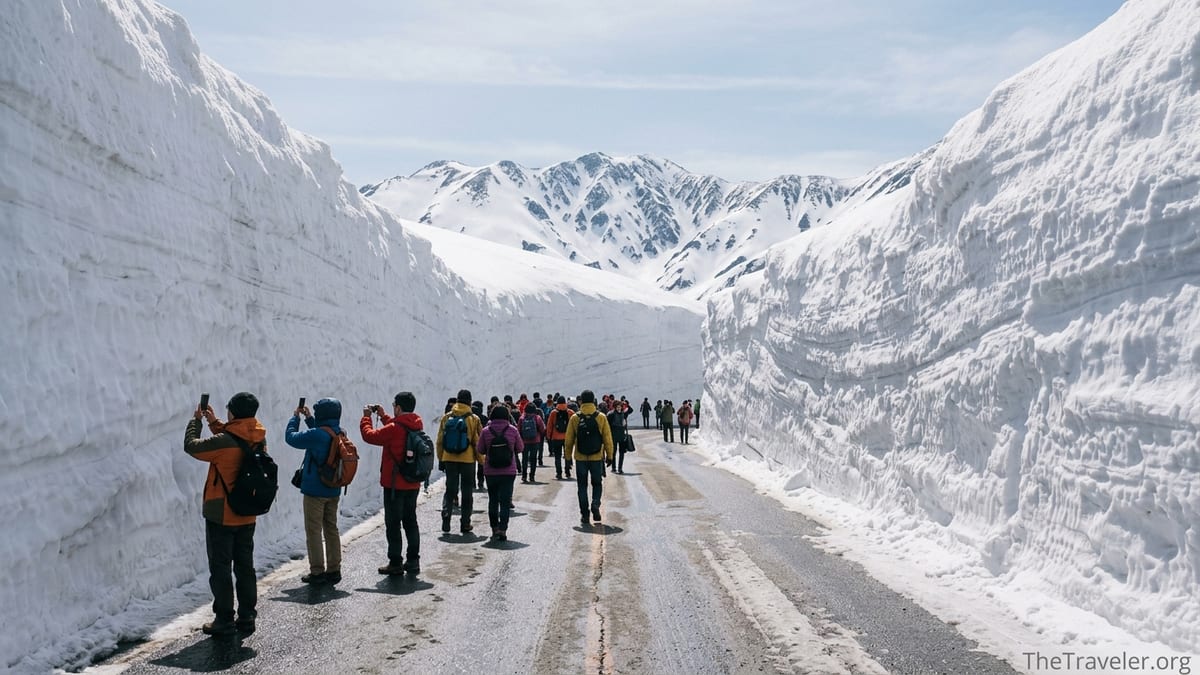
Because the Alpine Route sits high in the Northern Alps, conditions change dramatically by season. In late April and May the famous snow corridor at Murodo often towers over 10 meters high, while in late September and early October the same slopes glow with autumn color. In mid summer you will find patchy snow, alpine flowers and milder temperatures, though afternoon clouds and rain are common.
Understanding the Transport Stages and How Long They Take
From west to east, the standard direction runs from Dentetsu Toyama to Tateyama Station, then crosses to Ogizawa and down into Nagano. The core Alpine Route sections are usually described in six or seven segments, depending on how you count. The practical breakdown for travelers is: Tateyama Station to Bijodaira by cable car, Bijodaira to Murodo by highland bus, Murodo to Daikanbo by tunnel electric bus, Daikanbo to Kurobedaira by ropeway, Kurobedaira to Kurobe Dam by cable car, and Kurobe Dam to Ogizawa by electric bus.
Each leg is short but queues and sightseeing stops add time. The cable car from Tateyama to Bijodaira climbs steeply through forest and takes about 7 minutes. The highland bus from Bijodaira to Murodo is around 50 minutes if you ride nonstop, but drivers often slow for viewpoints like Midagahara wetlands and the snow walls in spring, so count on an hour. At Murodo you will almost certainly stop to walk through the snow corridor in April and May, or to circuit the crater ponds once trails open later in the season.
From Murodo, the tunnel electric bus to Daikanbo travels entirely inside the mountain in about 10 minutes. The Tateyama Ropeway then glides 1.7 kilometers over the valley with no supporting pylons, taking roughly 7 minutes but often requiring some waiting time at busy periods. After a short descent by cable car from Kurobedaira to Kurobe Dam of about 5 minutes, many visitors spend 45 to 90 minutes exploring the dam walkway, viewpoints and museum exhibits before taking the final 16 minute bus through the Kanden Tunnel to Ogizawa.
In pure transport terms, the full crossing from Tateyama Station to Ogizawa can be done in roughly 4 to 5 hours if you move briskly without long stops. In real life most travelers need 6 to 8 hours door to door, especially during snow wall season or autumn weekends when queues are common. For example, someone starting on the first morning departures from Toyama can realistically reach Ogizawa by mid to late afternoon, then continue by bus or train to Matsumoto or Nagano in the early evening.
Access from Toyama and Nagano: Getting to the Endpoints
On the Toyama side, most visitors base themselves in Toyama City or nearby Kanazawa. From central Toyama, the Toyama Chiho Railway runs to Tateyama Station in about one hour, using a private railway separate from the Japan Rail Pass. Morning trains are timed to connect with the opening of the Tateyama Cable Car, so a common pattern is to leave Dentetsu Toyama around 7:00 to 8:00 and arrive at Tateyama soon after 8:00.
Tateyama Station itself is small but well organized, with the cable car lower terminal, ticket counters, a convenience store style shop and a luggage forwarding desk in season. If you are staying at a hotel in Toyama the night before, many travelers have breakfast at the hotel and then buy simple snacks and drinks at the station kiosk to eat during the ride to Murodo or Kurobe Dam.
On the Nagano side, access usually runs through Shinano Omachi or Matsumoto. From Matsumoto Station, local trains on the Oito Line reach Shinano Omachi in about one hour. There you can either stay overnight, which is convenient for an early start, or transfer straight to a local bus that continues to Ogizawa in roughly 40 minutes. Some highway buses in peak season also link Nagano Station with Ogizawa, which can be convenient if you are coming directly from Nagano City.
Because private vehicles cannot cross the central Alpine Route, self drivers must park at one end, cross using public transport, and then return by train or bus to collect their car. For example, you might park at Ogizawa, do a one way crossing to Tateyama Station, overnight in Toyama, then use the Oito Line and buses via Shinano Omachi the next day to retrieve your car. Alternatively, some people choose to leave their car at one side and design a loop trip that ends in a different region, but this requires careful planning.
Tickets, Reservations and Typical Costs
The Alpine Route is sold as a through ticket that covers all stages between designated points. You can buy a one way ticket from Tateyama to Ogizawa or the reverse, or partial tickets just covering sections such as Ogizawa to Murodo return. Adult fares for a full one way crossing in 2026 are in the low ten thousand yen range, and children pay roughly half. Prices vary slightly depending on start and end points, so always check the current fare table when you book.
Tickets can be purchased on the day at major stations such as Tateyama, Ogizawa and Shinano Omachi, but in peak seasons this can mean long queues and the risk of delayed departure times. The operator also sells dated web tickets that allow you to secure space on key legs like the cable car and highland bus in advance. For example, a traveler planning to cross on a Saturday in late April during the height of snow wall season might reserve a web ticket that locks in boarding windows from Tateyama to Murodo in the morning.
It is important to understand that having a through ticket does not guarantee a specific seat on every segment unless you have explicit time reservations. At busy times staff may assign you a scheduled departure slot for each leg as you progress, and digital signboards display which groups can board. On quieter weekdays outside peak seasons, you usually move through each section with minimal waiting once you have purchased a through ticket at the starting station.
In addition to the core Alpine Route ticket, you may need separate tickets for connecting trains or buses to reach Tateyama or Ogizawa. For instance, the Toyama Chiho Railway fare from Dentetsu Toyama to Tateyama Station is an extra cost, as are JR or private railway tickets from Tokyo, Nagoya, Osaka or Kanazawa to Toyama or Matsumoto. Several regional rail passes and highway bus packages include discounts or bundled Alpine Route tickets, but these change frequently, so it is wise to compare passes and single tickets based on your exact itinerary and travel dates.
Luggage Forwarding and Traveling Light Across the Mountains
Because the route involves multiple transfers and often crowded vehicles, traveling with only a daypack makes the experience far more comfortable. To support this, luggage forwarding services operate at both ends of the route in season. The most commonly used provider is Yamato Transport, which runs counters at Tateyama Station and at drop off points on the Nagano side, often in Shinano Omachi or Ogizawa, depending on the year’s setup.
Typical same route forwarding fees are usually in the low 2,000 yen range per suitcase, with delivery between your departure and arrival hotels usually completed the following day rather than same day. For example, you might drop your large luggage at a Yamato counter in a Toyama city hotel on Monday evening or at Tateyama Station on Tuesday morning, then travel the route with just a daypack and check into your Matsumoto hotel that night using a small overnight bag. Your larger case would generally arrive by Wednesday.
Because same day delivery between the Toyama and Nagano sides is not guaranteed, it is best to pack one overnight bag that you can carry throughout the Alpine Route and the following night. Some travelers simply use standard nationwide takuhaibin services instead of the dedicated Alpine Route desks, sending luggage directly from a Tokyo hotel to a Kyoto hotel and carrying only a 20 to 30 liter daypack for the entire mountain segment. This avoids the risk of missing baggage counters that may close by mid morning.
Within the route itself, you must keep your luggage with you at all times, carrying it on and off each transport segment. There are no luggage holds on the ropeway or cable cars. Wheeled suitcases are permitted but awkward on stairs and in crowds, which is another reason most repeat visitors recommend traveling with minimal bags. For a concrete example, someone staying in Kanazawa could send a 25 kilogram suitcase from Kanazawa two days ahead to a Nagano hotel via regular courier, then ride the Alpine Route with only a 10 kilogram backpack containing clothes, snacks and a light jacket.
Seasonal Highlights: Snow Wall, Summer Hiking and Autumn Foliage
The Alpine Route changes character dramatically with the seasons, so timing your visit is essential. From the mid April opening until around late June, the star attraction is the snow corridor near Murodo, where walls of snow are cut through the roadside banks. In late April the walls are often at their highest, sometimes exceeding 15 meters in particularly heavy snow years, though by late May they gradually melt down to lower heights. Even when the official corridor display height drops, walking between snow banks taller than a person is still a memorable experience.
Spring visitors need to be ready for winter conditions at Murodo, even when cherry blossoms are blooming in Toyama or Nagano. Daytime temperatures at 2,400 meters can hover around freezing in April, with wind chill making it feel colder. Many travelers rent or bring waterproof boots, warm hats and gloves, as the walking area can be slushy. A common pattern is to ride from Tateyama to Murodo in the morning, spend one to two hours exploring the snow corridor and visitor center, then continue toward Kurobe Dam around midday when queues begin to build.
From July through early September, most of the deep snow around Murodo retreats to patches, and a network of walking paths opens around the crater ponds and surrounding ridges. This is the time for gentle alpine walks and more serious hikes for those with the right equipment and experience. Afternoon thunderstorms are common in mid summer, so starting hikes early and watching weather forecasts is essential. Families often combine a short 45 minute loop walk from Murodo with a picnic before continuing to Kurobe Dam in the afternoon.
By late September and October, the focus shifts to autumn foliage. The timing of peak color varies by altitude, usually starting around Murodo and Daikanbo in late September, then gradually descending to Kurobe Dam and lower elevations in early to mid October. On weekends and public holidays during this season, queues for ropeways and cable cars can rival those in snow wall season, so advance reservations and early starts are important. The route typically closes at the end of November, and after that mountain conditions become full winter with no tourist access on the main line.
Planning Your Itinerary: Full Crossings vs Partial Visits
Most first time visitors either do a full one way crossing between Tateyama and Ogizawa or a partial out and back centered on Murodo. Choosing between them depends on your base cities, time, budget and interest in dams and ropeways versus snow walls and high plateaus.
A classic full crossing example is Toyama to Matsumoto in one day. You might leave Dentetsu Toyama around 7:00, reach Tateyama Station around 8:00, and then take the cable car and bus to arrive at Murodo by about 10:00. After 90 minutes exploring the snow corridor and visitor center, you continue through the tunnel bus and ropeway to Kurobe Dam, spend another hour there, then exit at Ogizawa mid afternoon and continue by bus and train to arrive in Matsumoto around 18:00. This pattern works well for travelers moving east across Japan from Kanazawa or Toyama toward Tokyo.
A partial visit scenario might suit someone based in Kanazawa who only has one long day available. In that case you could take early morning trains from Kanazawa to Toyama and on to Tateyama, then ride as far as Murodo, spend several hours there walking the snow corridor and enjoying lunch at the mountain restaurant, and then return to Tateyama the same way in the afternoon. This Murodo out and back still delivers the signature snow wall experience without the cost and complexity of a full crossing.
Another common option is to stay overnight on or near the route. In previous years there were hotels right at Murodo, though availability changes season by season. In 2026 some long running properties are closed for renovation, so choices may be more limited and book out early. Staying at altitude allows you to walk the snow corridor or autumn trails early in the morning or late in the afternoon when day trip crowds are thinner, then cross the rest of the route at a more relaxed pace the following day.
Whichever pattern you choose, give yourself more time than the bare minimum transport times suggest, especially if you are traveling with children or carrying camera equipment. For a first full crossing, planning 8 to 10 hours between Toyama and Nagano side cities, including all transfers, is realistic. For a Murodo out and back, plan an entire day from your base city, with flexibility to cut your visit short if weather deteriorates.
Practical Tips for a Smooth 2026 Alpine Route Trip
The most important practical decision is which direction to travel. West to east, starting from Tateyama and ending at Ogizawa, is slightly more common, particularly in snow wall season when the corridor’s layout and signage are oriented to those arriving from Tateyama. This direction also places the steepest climbs at the start of the day when you are fresh. However, if you are touring the Japan Alps from Tokyo or Nagano toward Kanazawa, starting from Ogizawa and emerging at Tateyama can fit better.
Weather is another key factor. Conditions at Murodo are far more extreme than in the cities below, and local forecasts can change quickly. Check both the Alpine Route’s own daily status page and general mountain weather information the evening before and morning of your trip. If low clouds, high winds or heavy rain are predicted, visibility on the ropeway and around the snow wall may be limited. In such cases some travelers postpone their visit within their itinerary, particularly in shoulder season when crowds are thinner.
Food and drink are readily available but somewhat more expensive at altitude. There are cafeterias and small restaurants at Murodo, Kurobedaira and Kurobe Dam serving hot dishes such as curry rice, noodles and local specialties, along with vending machines stocked with drinks. Many people still bring simple snacks like onigiri, nuts or chocolate from convenience stores in Toyama, Nagano or Matsumoto to avoid queuing at peak meal times. Tap water inside buildings on the route is safe to drink, though outdoor fountains may be switched off in cold periods.
Finally, be flexible. The Alpine Route operates with strict safety margins, and staff can slow or temporarily pause certain segments if weather deteriorates or if crowds become difficult to manage. Build some buffer time into your schedule and avoid booking fixed time long distance trains such as afternoon shinkansen departures that leave you no margin for unexpected delays. A common strategy is to aim for an evening or even next morning departure from your onward city, using the arrival afternoon for a relaxed stroll and dinner instead.
FAQ
Q1. When is the Tateyama Kurobe Alpine Route open in 2026?
For 2026, the published operating period runs from 15 April to 3 November. Exact dates and any special closures are confirmed on the official information page closer to the season.
Q2. How much time do I need for a full one way crossing?
Theoretically the transport can be done in about 4 to 5 hours, but most travelers should plan 6 to 8 hours from Tateyama Station to Ogizawa, plus extra time to reach Toyama, Nagano or Matsumoto.
Q3. Can I drive my own car across the Alpine Route?
No, private cars cannot use the central Alpine Route. You must park at either Tateyama, Ogizawa or nearby towns and use the official cable cars, buses and ropeways to cross.
Q4. Do I need to reserve tickets in advance?
Advance web tickets or dated passes are strongly recommended during peak periods such as late April to early May snow wall season and popular autumn foliage weekends, but on quieter weekdays same day tickets are usually available.
Q5. What should I wear for the snow wall in spring?
In April and early May, dress for winter conditions at Murodo: warm layers, a waterproof outer shell, gloves, a hat and sturdy shoes or boots suitable for snow and slush.
Q6. Is luggage forwarding available on the route?
Yes, luggage forwarding counters operated by major delivery companies typically run at Tateyama Station and on the Nagano side. Bags are usually delivered the next day, so keep an overnight bag with you.
Q7. Can I visit only Murodo and skip the rest of the route?
Yes, many travelers do an out and back from Tateyama Station to Murodo, especially if they mainly want to see the snow corridor or enjoy easy alpine walks without paying for the full crossing.
Q8. Is the Alpine Route suitable for children and older travelers?
Most segments are gentle and accessible, and many families and older visitors ride the route. However, the altitude, temperature swings and occasional crowds mean that reasonable mobility and warm clothing are important.
Q9. Will my Japan Rail Pass cover the Alpine Route?
No, the core Alpine Route cable cars, buses and ropeways are operated by private companies and are not covered by nationwide JR passes. Some regional passes include discounts or bundles.
Q10. What happens if bad weather closes part of the route?
If severe weather or operational issues close a segment, staff may limit access or turn visitors back. In that case you would need to return the way you came, and refund or partial refund policies vary by situation.