


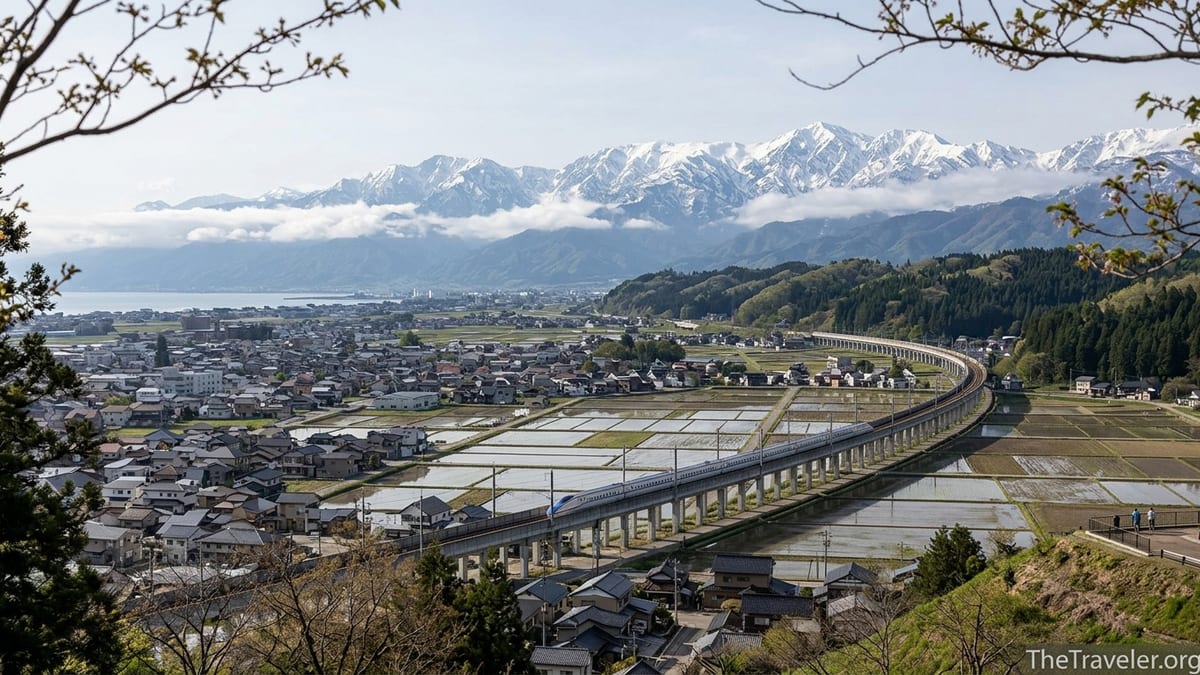
Hokuriku Shinetsu is where two very different Japans meet. To the west, the Sea of Japan coast serves up fresh crab, historic castle towns and quiet fishing ports in Niigata, Toyama, Ishikawa and Fukui. To the east, Nagano’s Japanese Alps rise abruptly into 3,000‑meter peaks dotted with ski resorts, onsen villages and highland hiking trails. With new Hokuriku Shinkansen extensions and well-timed local trains, it has never been easier for first-time visitors to combine both sides of the region into one balanced itinerary.
Understanding the Hokuriku Shinetsu Region
Hokuriku Shinetsu is a travel term more than an administrative unit, but it offers a useful way to think about this swath of central Japan. “Hokuriku” refers mainly to the Sea of Japan side of Honshu, including Niigata, Toyama, Ishikawa and Fukui. “Shinetsu” traditionally covers Nagano and Niigata, where rugged mountains form the backbone of the country. As a traveler, you will experience this contrast every time you leave a coastal city like Kanazawa or Toyama and in less than an hour find yourself in deep valleys or high ski resorts.
The Sea of Japan shapes the coastal climate and cuisine. Winter brings heavy snowfall and rough seas that produce famed snow crab in Fukui, buri yellowtail in Toyama Bay and plump Niigata rice and sake. By contrast, the interior mountains, including the Northern Japan Alps, create four distinct seasons. In Nagano and northern Niigata, powder snow routinely blankets resorts like Hakuba and Nozawa Onsen, while summer turns the same slopes into cool hiking bases far from Tokyo’s humidity.
Transport patterns follow this geographical divide. The Hokuriku Shinkansen runs roughly east to west between Tokyo and Tsuruga in Fukui, connecting major coastal and inland hubs like Nagano, Joetsu-Myoko, Toyama and Kanazawa. From these Shinkansen gateways, local private rail lines and highway buses climb into the mountains, and short car rentals open access to small onsen villages, farm stays and remote viewpoints that trains do not reach easily.
For a first visit, the main decision is how to balance coast and mountains. Many travelers spend two or three nights in a cultural base like Kanazawa or Toyama, then move inland to Nagano’s ski and onsen areas for another three or four nights. Others focus on a single season, like winter skiing or spring cherry blossoms plus the Tateyama Kurobe Alpine Route, and then add one extra coastal stop for seafood and gardens before returning to Tokyo or heading on to Kyoto and Osaka.
Key Gateways: Kanazawa, Toyama, Nagano, Niigata and Fukui
Kanazawa in Ishikawa Prefecture is the natural cultural anchor for Hokuriku. From Tokyo, Kagayaki-class Hokuriku Shinkansen services reach Kanazawa in about two and a half to three hours, depending on the train. Kanazawa rewards at least two nights with Kenrokuen Garden, samurai and teahouse districts and contemporary art at the 21st Century Museum. Because the city centre is compact, most first-time visitors rely on buses and walking rather than renting a car here.
Toyama City, about 20 minutes by Shinkansen from Kanazawa, is an underrated base for both coast and mountains. The compact station area has Toyama Castle Park, a riverside tram line and business hotels that are often cheaper than Kanazawa’s. More importantly, Dentetsu-Toyama Station, directly linked to the main JR station building, is the starting point for the Tateyama Kurobe Alpine Route, with local trains running to Tateyama Station for the ascent into the Northern Alps. Staying one night in Toyama before or after the Alpine Route makes early departures and luggage storage straightforward.
Nagano City is the main inland hub. Hokuriku Shinkansen trains from Tokyo reach Nagano in around 90 minutes, making it one of the fastest mountain gateways from the capital. From here, the Nagano Dentetsu private line connects to Yamanouchi for the Jigokudani Monkey Park and Shiga Kogen, while highway buses link Nagano to Hakuba, Nozawa Onsen and the Nagano-side entrance of the Tateyama Kurobe Alpine Route at Ogizawa and Omachi. Many travelers overnight near Nagano Station before an early start into the Alps.
Niigata City anchors the northern end of the Sea of Japan coast in this region. Joetsu Shinkansen services from Tokyo take roughly two hours to reach Niigata, which is known for its broad riverfront, sake breweries and day trips to Sado Island. In winter, many visitors pass through Niigata Prefecture’s inland ski towns such as Yuzawa without venturing to the coast, but first-time visitors with an interest in seafood and sake should consider adding a night here between Tokyo and Hokuriku or between Niigata and Nagano by limited express train.
Fukui, now newly connected to Tokyo by the extended Hokuriku Shinkansen, has become a more practical stop for first-time itineraries. The segment between Kanazawa and Tsuruga opened in March 2024, shortening the Tokyo to Fukui journey to under three hours on the fastest trains via the Hokuriku route. That makes it realistic to visit Fukui’s coastal scenery at Tojinbo Cliffs or the Buddhist temple complex of Eiheiji on the way between Kanazawa and the Kansai region, or as a loop from Tokyo that also includes Nagano and Kanazawa.
Sea of Japan Coast: Culture, Seafood and Onsen
Along the Sea of Japan, travel is defined by short hops between compact cities and onsen areas. From Kanazawa, local JR and private railway lines fan out to smaller hubs like Kaga Onsen in southern Ishikawa and Awara Onsen in Fukui. A typical pattern is to spend two nights in Kanazawa exploring the city, then take a limited express or local train for about 30 to 45 minutes to a coastal onsen town, arriving by mid-afternoon in time for a long soak and a kaiseki dinner heavy on local seafood.
Kaga Onsen, actually a cluster of traditional hot spring towns such as Yamashiro and Yamanaka, is one of the easiest onsen areas for first-time visitors. From Kanazawa Station, limited express and local trains reach Kaga Onsen Station in around 30 minutes. Many ryokan offer free shuttle pickups for overnight guests. While room rates vary widely, visitors can expect mid-range half-board plans with dinner and breakfast to start somewhere around the equivalent of 20,000 to 30,000 yen per person, with higher prices in peak leaf and snow seasons. These stays often include local specialties like crab in winter and Kutani ware ceramics on the table.
Farther along the coast, Toyama Bay is known for particularly rich fishing grounds. Toyama City’s seafood markets and sushi counters highlight winter buri yellowtail and firefly squid in early spring. From Toyama Station, short local train rides connect to towns like Himi and Shinminato, where small fishing ports and glassy bay views contrast with the more formal atmosphere of Kanazawa. Budget-conscious travelers often base themselves in Toyama and take inexpensive local trains for day trips rather than booking full ryokan packages in every onsen town.
Niigata’s coastal strip offers a different feel again. Niigata City spreads along the Shinano River, with high rises and a working port rather than a compact castle town layout. For first-time visitors, one practical route is to travel from Tokyo to Niigata by Joetsu Shinkansen, spend a night tasting sake at standing bars near the station, then continue the next day on the Limited Express Shirayuki toward Arai and on to Joetsu-Myoko for a Shinkansen connection into Nagano Prefecture. This pattern lets you fit the Sea of Japan coast into an itinerary that also includes Nagano’s mountains without large detours.
Japanese Alps: Mountains, Snow and Outdoor Travel
On the Shinetsu side, Nagano and northern Niigata are your main entry points into the Japanese Alps. In winter, Hakuba Valley, Nozawa Onsen and Myoko Kogen draw skiers from around the world with long runs and relatively affordable lift passes. For example, Nozawa Onsen’s one-day lift ticket is typically priced in the range of several thousand yen, with early-season and spring discounts that bring adult one-day tickets down significantly. Package deals combining lift passes, lunch vouchers and onsen entry are common, so first-time visitors should check resort websites or ask their accommodation about current bundle offers.
Hakuba, reached by highway bus in around one hour from Nagano Station or by bus and train combinations from Matsumoto and Toyama, sprawls across multiple ski areas such as Happo-one and Goryu. Because the valley is more spread out than compact onsen villages like Nozawa, many visitors either stay in accommodation close to the lifts or use shuttle buses to move between slopes. In the green season, Hakuba transforms into a hiking and mountain biking base, with gondolas operating as sightseeing lifts and trails leading to alpine lakes and ridge walks.
Nozawa Onsen combines a serious ski hill with a traditional onsen town atmosphere. Narrow streets lined with wooden inns and public bathhouses make it easy to forget the resort-scale infrastructure above. The village is reachable in about 70 to 90 minutes by bus from Iiyama Station on the Hokuriku Shinkansen, and luggage delivery services help visitors who want to travel light on the final leg. In winter, staying near the main Yu Road moving walkway or Nagasaka Gondola shortens the morning commute to the slopes.
Beyond the named resorts, Nagano is full of small highland plateaus and trailheads that reward short car rentals. Areas like Utsukushigahara, Norikura Kogen and the Tateshina highlands lack direct rail access but are reachable in one or two hours by car from Nagano or Matsumoto. Renting a compact car for a 24 or 48-hour loop from a Shinkansen station lets visitors overnight in remote pensions, access quiet day hikes and soak in rustic outdoor baths that buses might serve only a few times a day.
The Tateyama Kurobe Alpine Route and High-Altitude Experiences
The Tateyama Kurobe Alpine Route is one of the signature experiences in Hokuriku Shinetsu, connecting Toyama and Nagano Prefectures through the Northern Japan Alps using a chain of cable cars, highland buses, a ropeway and tunnels. The full crossing between Dentetsu-Toyama Station and Ogizawa typically operates from mid-April to late November, with the famous snow walls near Murodo at their highest in late April and early May. Travelers can ride the entire route in one long day, but overnighting at high-elevation hotels around Murodo or Midagahara turns the journey into a more relaxed mountain stay.
Tickets for the Alpine Route are sold as through passes, with separate prices for one-way and round-trip combinations. A one-way journey between Toyama-side and Nagano-side gateways costs on the order of ten thousand yen, which reflects the series of transport segments and the engineering required to maintain them at altitude. Because busy dates like Golden Week and autumn foliage weekends see large crowds, the operators encourage advance web ticket reservations, and certain promotional passes that include the route have quota restrictions.
Shinkansen access makes the Alpine Route easier to slot into a wider itinerary. For example, a traveler might leave Tokyo on an early Hokuriku Shinkansen to Toyama, drop large suitcases in coin lockers or at a hotel near the station, and then ride the local Toyama Chiho Railway to Tateyama for the ascent into the mountains. After completing the route and exiting at Ogizawa in Nagano, buses continue to Nagano Station, where onward Shinkansen services connect to Tokyo or Kanazawa. This pattern effectively links the Sea of Japan coast and the Japanese Alps in a single day.
JR rail passes and regional passes can reduce costs if you align your Alpine Route day with other train travel. Products like the Alpine-Takayama-Matsumoto Area Tourist Pass typically combine unlimited rides on designated JR lines with one passage over the Alpine Route during a set period. First-time visitors should double-check validity dates and covered segments, since these passes change conditions periodically and may not include every private bus or rail line needed for side trips.
Onsen Culture Across Coast and Mountains
Hot springs are one of the easiest ways to feel the cultural continuity between Hokuriku’s coast and Shinetsu’s mountains. On the Sea of Japan side, Kaga Onsen and Awara Onsen present the classic ryokan experience: large tatami rooms, multi-course dinners and indoor-outdoor baths that draw mineral-rich water from deep underground. In winter, standing in an open-air bath while sea-effect snow falls into the garden is a highlight, though even in other seasons the contrast between hot water and cool air remains a core attraction.
In the mountains, onsen culture shifts toward more compact villages and rustic baths. Nozawa Onsen is famous for its thirteen free public bathhouses, each fed by hot spring sources and maintained by the community. Etiquette is straightforward but important: guests should rinse thoroughly before entering the bath, avoid splashing and keep towels out of the water. Many ryokan here are simpler than the luxury properties on the coast, with shared toilets and basic rooms that keep prices manageable for longer ski stays.
Hakuba and the surrounding valleys feature a mix of hotel-style baths and standalone onsen facilities. While not as steeped in centuries-old tradition as Nozawa’s communal baths, these hot springs offer a practical way to ease sore legs after days of skiing or hiking. Some properties face the mountains directly, so guests can watch alpenglow on the peaks from the water. In shoulder seasons, day-use entry fees often run to the equivalent of a few hundred to one thousand yen, making onsen an affordable daily habit even for budget travelers.
For first-time visitors planning to rent a car, onsen can also serve as natural route markers. For instance, a two-day loop might start from Nagano Station, head to Yamanouchi for the monkey park and Shiga Kogen, continue over highland roads to Nozawa Onsen or Madarao for a night, and then return via rural hot springs to Nagano or Iiyama. Each leg ends with a soak, breaking up driving time and giving a rhythm to the journey that is quite different from city-based itineraries.
Practical Itineraries and How to Combine Prefectures
Because Hokuriku Shinetsu is stitched together by Shinkansen lines, local trains and a handful of key bus links, most first-time visitors can design routes that avoid the need for continuous car rental. One popular seven to nine day pattern starts in Tokyo, heads to Nagano by Hokuriku Shinkansen, continues by bus to Hakuba or Nozawa Onsen for several nights, then loops via bus to Ogizawa, over the Tateyama Kurobe Alpine Route to Toyama and finishes with two nights in Kanazawa before returning to Tokyo or moving on to Kyoto and Osaka via the extended Hokuriku Shinkansen and a transfer further west.
Another option begins on the Sea of Japan coast. Travelers can ride the Joetsu Shinkansen from Tokyo to Niigata, stay one or two nights to sample seafood and sake, then continue south and west by limited express and local trains along the coast through Itoigawa and Joetsu-Myoko to Toyama. After exploring Toyama and perhaps a side trip to Gokayama or Takaoka, they continue to Kanazawa and on to Fukui on the Hokuriku Shinkansen, adding a night in Kaga Onsen or Awara Onsen before heading south to the Kansai region.
Short car rentals work best as targeted tools rather than the default mode of travel. Renting a car at Kanazawa for a 24-hour round trip makes it easier to combine Kaga Onsen, local pottery kilns and rural viewpoints into one overnight excursion, then return the vehicle at the same station. From Nagano or Matsumoto, a one- or two-day rental opens up plateau areas and trailheads that would be cumbersome to reach by bus. In winter, visitors should confirm that vehicles are equipped with winter tires or chains, and recognize that heavy snow in Hokuriku can slow driving significantly compared with trains.
When weighing passes versus individual tickets, travelers should consider how intensively they will ride the Shinkansen. Long jumps such as Tokyo to Kanazawa, Tokyo to Niigata or Kanazawa to Tsuruga via the Hokuriku Shinkansen quickly add up in cost, so rail passes that cover consecutive days of long-distance travel can pay for themselves. On the other hand, if much of the trip involves staying several nights in a single area and moving mainly by bus or local trains, buying point-to-point Shinkansen tickets and focusing on regional bus and taxi budgets may be more economical.
FAQ
Q1. How many days do I need for a first trip to Hokuriku Shinetsu?
For most first-time visitors, seven to ten days is enough to combine at least one coastal city such as Kanazawa or Toyama with one or two mountain bases like Hakuba, Nozawa Onsen or Nagano, plus a day for the Tateyama Kurobe Alpine Route if it is in season.
Q2. Is it better to start from Tokyo or from Kansai when visiting this region?
Starting from Tokyo is generally more straightforward because both the Hokuriku Shinkansen and Joetsu Shinkansen provide direct access to Nagano, Niigata, Toyama and Kanazawa. Travelers coming from Osaka or Kyoto can still reach the region efficiently by transferring to the Hokuriku Shinkansen at Tsuruga or other major junctions.
Q3. Do I need to rent a car to enjoy Hokuriku Shinetsu?
No. The main highlights for first-time visitors, including Kanazawa, Nagano, Hakuba, Nozawa Onsen, Kaga Onsen and the Tateyama Kurobe Alpine Route, are all accessible by train and bus. Short car rentals are useful for reaching smaller onsen villages or hiking areas without frequent public transport.
Q4. When is the best time to ride the Tateyama Kurobe Alpine Route?
If you want to see the tallest snow walls near Murodo, aim for the period from mid-April to early May, avoiding the most crowded national holiday days if possible. For hiking and clearer weather, late summer and early autumn are attractive alternatives when the route is still open.
Q5. How should I divide my time between the coast and the mountains?
A simple guideline is to spend roughly one-third of your days along the Sea of Japan coast and two-thirds in the mountains, especially if you are interested in skiing or hiking. For example, on a nine-day trip you might plan three nights in Kanazawa and Toyama and six nights spread between Nagano City, Hakuba and Nozawa Onsen.
Q6. Are ryokan stays in places like Kaga Onsen worth the cost?
For many visitors, one or two nights in a ryokan with dinner and breakfast is a highlight of the trip. While prices are higher than standard hotels, the experience typically includes elaborate seasonal meals, spacious tatami rooms and access to quality hot springs, which can justify the expense as a special occasion.
Q7. Can I visit ski resorts like Hakuba or Nozawa Onsen if I do not ski or snowboard?
Yes. In winter, non-skiers can enjoy onsen, snowshoeing, village walks and cafes, and many accommodations offer mountain views even if you never set foot on the slopes. In warmer months, these areas become bases for hiking, cycling and gondola rides to highland viewpoints.
Q8. How far in advance should I book accommodation during peak seasons?
During busy periods such as New Year, Chinese New Year, school holidays and the peak of cherry blossom or autumn foliage, it is wise to secure key stays like Kanazawa hotels, ski resort lodgings and Alpine Route-area hotels two to three months ahead. Outside those peaks, a few weeks is often sufficient, especially in larger cities.
Q9. Is seafood along the Sea of Japan coast noticeably different from Tokyo?
Many travelers find that winter seafood in places like Toyama, Kanazawa and Niigata is exceptionally rich due to cold currents and local fishing traditions. Seasonal specialties such as snow crab and buri yellowtail are strongly associated with the Hokuriku coast and can be a compelling reason to visit between late autumn and early spring.
Q10. Are there language barriers for first-time visitors in this region?
Major stations, Shinkansen lines and popular destinations like Kanazawa, Nagano, Hakuba and the Alpine Route have extensive English signage and some English-speaking staff. Smaller onsen towns and rural guesthouses may have limited English, so using simple phrases, translation apps and written confirmations helps smooth communication.