


The Tateyama Kurobe Alpine Route is one of Japan’s most memorable day journeys, but one key decision shapes how smoothly it runs: should you cross from Toyama to Nagano, or from Nagano’s Ogizawa side to Toyama? Both directions traverse the same spectacular chain of cable cars, highland buses and alpine tunnels, yet they feel quite different in practice. This guide compares the two directions using current timetables and on-the-ground logistics so you can choose the side that best fits where you are coming from and where you want to go next.
Understanding the Route and Today’s Operating Patterns
The Tateyama Kurobe Alpine Route links Tateyama in Toyama Prefecture with Ogizawa in Nagano Prefecture, crossing the 3,000 meter peaks of the Northern Japan Alps. Most travelers cover it between mid April and early November, when the full route is typically open. On a normal day it takes around 6 to 8 hours with stops for viewpoints, simple meals and the famous Kurobe Dam. The core transports and their order are the same regardless of direction: cable car, highland bus, tunnel trolleybus, ropeway, and the Kanden Tunnel electric bus at the Nagano end.
In 2026 the operators strongly steer visitors toward reserving an official Web Ticket that fixes the starting time from either Tateyama Station on the Toyama side or Ogizawa Station on the Nagano side. Same-day tickets are still sold, but the most popular morning departure slots can sell out in peak periods such as the late April snow corridor and the mid October foliage season. That reality makes your starting point and access timing more important than in the past, especially if you want to avoid spending your morning in queues instead of on the mountain.
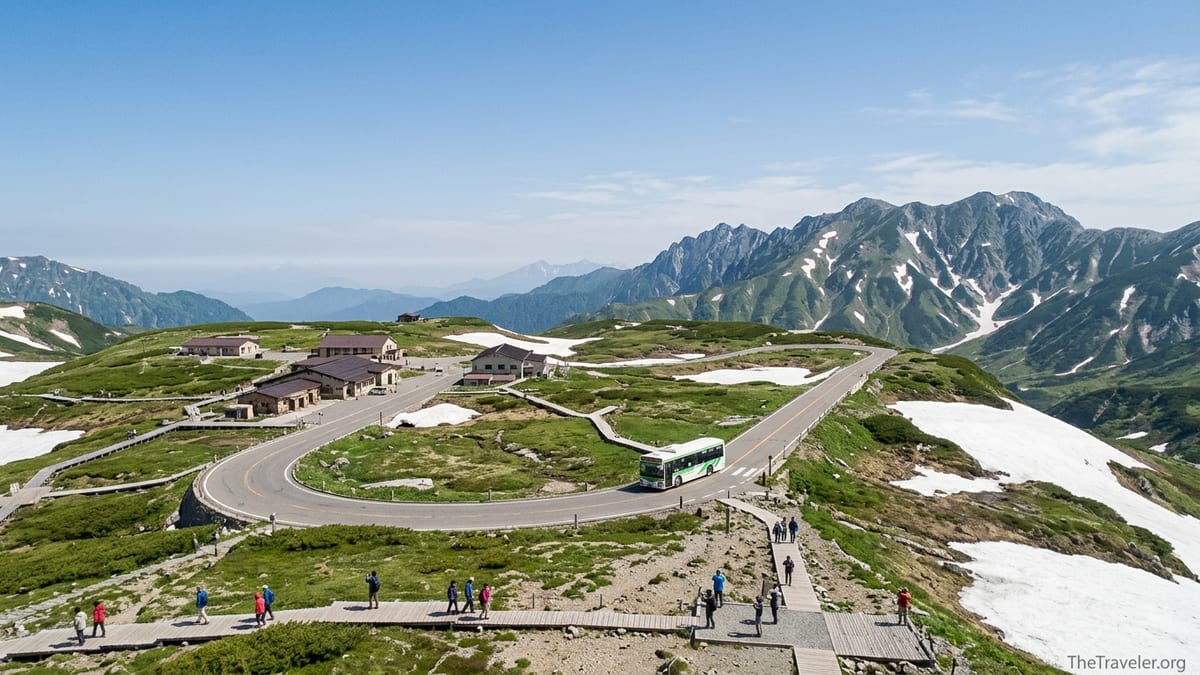
Murodo, the high plateau where you see the snow walls in spring and walk among summer alpine ponds, is always the “hub” of the day. From Toyama side you generally reach Murodo by late morning, while from Ogizawa you normally arrive around midday or early afternoon. How much lingering time you want at Murodo, and whether you prefer to end the day in a big city like Tokyo or a regional base such as Kanazawa or Matsumoto, should guide your choice of direction.
First Departures and Queue Patterns: Toyama vs Ogizawa
On the Toyama side your journey effectively begins at Dentetsu Toyama Station, next to JR Toyama. From there it is about one hour by Toyama Chiho Railway to Tateyama Station, where you change to the Tateyama Cable Car. On recent timetables, the first workable combination that suits most travelers has you leaving Dentetsu Toyama around 6:00 to 6:30 and boarding one of the early morning cable cars at Tateyama shortly after 7:00. Morning departures are staggered every 20 to 30 minutes in busy seasons, but these earliest slots fill quickly with tour groups, especially during Golden Week.
At Tateyama Station the ticket office opens roughly 20 minutes before the first cable car departure of the day. The operator explicitly recommends arriving early and, if you want a specific time, using the Web Ticket system in advance. Travelers who show up at Tateyama around 9:00 in late April often find themselves pushed to a much later cable car, which can compress their time at Murodo or force them to rush the eastern half of the route.
On the Nagano side, the starting station is Ogizawa, reached by a 40-minute Alpico bus from Shinano-Omachi. Ogizawa’s ticket office opens about 40 minutes before the first Kanden Tunnel electric bus departure, and again, early morning slots book up fastest. In practice, queues at Ogizawa can feel more concentrated because almost everyone arriving by the first two buses from Shinano-Omachi is trying to board the same morning departures toward Kurobe Dam. Tour groups sometimes dominate these first services, so independent travelers who arrive after 9:00 may find the earliest available slot has already moved on to late morning.
If you care most about reducing stress around queuing, starting from the side where you slept the night before usually helps. For example, if you stay in Toyama city, you can walk to Dentetsu Toyama around 5:45, get in line as the office opens, and be among the first through Tateyama. If you stay in Shinano-Omachi, you can be on the very first bus to Ogizawa and secure an early slot east to west. Trying to reach either gateway on the very first train from Tokyo or Kyoto often puts you in the late-morning crowd instead.
Access From Tokyo, Kanazawa, Kyoto and Matsumoto
From Tokyo, both sides are practical, but Nagano and Ogizawa are usually more forgiving for same-day crossings. The Hokuriku Shinkansen from Tokyo to Nagano takes around 90 minutes on a Kagayaki or Hakutaka service. From there you transfer to a JR local or limited express to Shinano-Omachi, which usually takes about 70 to 90 minutes, followed by the 40-minute Alpico bus up to Ogizawa. If you catch an early shinkansen leaving Tokyo around 7:30, you can realistically reach Ogizawa late in the morning and still clear the route in daylight, ending in Toyama for the night.
Reaching the Toyama gateway from Tokyo also uses the Hokuriku Shinkansen, but you stay on the train another 40 to 50 minutes to Toyama. Then you must transfer to the private Toyama Chiho Railway for the roughly one-hour ride up to Tateyama. In concrete terms, leaving Tokyo Station around 6:00 and catching a direct Kagayaki often gets you to Toyama around 8:15 to 8:30, then to Tateyama close to 9:30. In busy seasons this usually means missing the very first cable cars, although you can still comfortably cross to Ogizawa before evening.
For Kanazawa and Kyoto the Toyama side is far more natural. Kanazawa sits one shinkansen stop west of Toyama. A morning departure from Kanazawa around 7:00 typically delivers you to Toyama before 8:00, giving you time to connect to the Tateyama line and still enjoy an early start on the mountain. From Kyoto, the most straightforward route is generally via the Thunderbird or its successor limited express to Kanazawa, then the Hokuriku Shinkansen to Toyama. In practice, many travelers leaving Kyoto around 7:00 arrive at Toyama in late morning, making it easiest to overnight in Toyama and cross the route the following day.
Matsumoto is a special case and the reason many people choose to start from the Nagano side. From Matsumoto it is about 50 minutes by JR Oito Line to Shinano-Omachi, then the 40-minute bus to Ogizawa. This allows a relaxed departure from Matsumoto after breakfast, a crossing toward Toyama in the heart of the day, and an onward shinkansen from Toyama back toward Tokyo or Kanazawa in the evening. If your broader Honshu itinerary includes a loop like Tokyo – Matsumoto – Alpine Route – Kanazawa – Kyoto, starting from Ogizawa and moving west keeps backtracking to an absolute minimum.
Luggage Forwarding and Travel Light Strategies
Dragging a suitcase across multiple cable cars and mountain buses quickly drains the romance from the Alpine Route, especially on crowded days. The route’s official baggage forwarding service is designed precisely for this. As of the 2026 season, you can drop a suitcase in the morning at selected hotels and stations near the gateways and pick it up the same evening on the opposite side, for an additional fee per piece that is usually comparable to nationwide courier prices. The official route website lists partner hotels around Shinano-Omachi and Tateyama where same-day forwarding is available, including several well-known onsen hotels and business hotels in the valleys.
On the Nagano side, travelers commonly forward bags from their Shinano-Omachi accommodation to hotels in Toyama city or even to onsen lodgings in Unazuki or the wider Toyama area. This allows them to ride the Ogizawa cable cars with only a daypack. On the Toyama side, visitors staying in Toyama or Tateyama-machi can hand suitcases to the forwarding counter in the morning and collect them in Shinano-Omachi or at a participating hotel that night. The service is particularly useful for those moving from the Hokuriku region to central Nagano and then deeper into the Japanese Alps around Kamikochi or Matsumoto.
However, the forwarding network is limited to specific properties and stations along or near the route. If your next stop is Tokyo, Kanazawa or Kyoto, you will often find it simpler to use a regular nationwide courier service like Yamato from your previous hotel directly to your next city hotel, and carry only an overnight bag through the Alpine Route. Many travelers, for instance, send large luggage from Tokyo to Kanazawa two days ahead, spend a night in Matsumoto with a small bag, cross the route from Ogizawa to Toyama, then continue luggage-free to Kanazawa to reunite with their suitcases.
If you do decide to bring a rolling suitcase on the route itself, aim to keep it to carry-on size. While the transports technically accommodate larger luggage, space is limited and at busy times staff may ask you to wait for a less crowded departure. The combination of stairs, narrow boarding platforms and sometimes wet or icy surfaces at Murodo also makes light packing the safer and more comfortable choice, whichever direction you take.
Where Murodo Falls in Your Day and How That Changes the Feel
Murodo is the emotional highlight of the Alpine Route. It sits at around 2,450 meters, surrounded by Tateyama’s peaks, with walking trails radiating out to Mikurigaike Pond, geothermal vents and in early season the famed snow corridor. Whether you reach Murodo before or after lunch has a big impact on how your day feels, and that timing depends on your starting side.
From Toyama and Tateyama, an early start puts you into Murodo by late morning. For example, leaving Dentetsu Toyama around 6:30 and catching one of the first cable cars from Tateyama, you might find yourself stepping onto the plateau around 9:30 to 10:00. That gives ample time for a hot drink in Hotel Tateyama’s lobby, an unhurried walk out to the snow walls or pond, and perhaps an extended hike if the trails are open. You then continue eastward after lunch, descending gradually through Daikanbo, Kurobedaira and Kurobe Dam before reaching Ogizawa and Shinano-Omachi in the late afternoon.
From Ogizawa, especially if you are arriving from Tokyo or Matsumoto on the same morning, Murodo often becomes a midday or even early afternoon stop. A realistic pattern is bus from Shinano-Omachi to Ogizawa mid morning, then electric bus and cableways past Kurobe Dam and Kurobedaira, arriving at Murodo sometime between noon and 14:00. This still allows time to walk the main promenade and visit the viewpoints, but long hikes become less practical unless you are staying the night at Murodo, Midagahara or Tengudaira lodgings.
Travelers who value flexible, almost retreat-like time at Murodo usually prefer starting from Toyama and sleeping in Toyama the night before, then continuing down to Nagano for onward travel the following day. Those focused on efficiently chaining cities in a loop often accept shorter time at Murodo from the Ogizawa side as the trade-off for a cleaner overall route, for example Tokyo – Matsumoto – Alpine Route – Toyama – Kanazawa – Kyoto.
Weather is another consideration. Because clouds often build in the afternoon, starting from Toyama can give you a better chance at clear morning skies over Murodo. On the other hand, if your plans already have you in Nagano Prefecture and you can start early enough from Shinano-Omachi, you still have a good shot at bright conditions on the plateau even when traveling east to west.
Onward Hotel Options and the All-Important Last Buses
The day does not end at Ogizawa or Tateyama. Where you can realistically sleep the night after your crossing should influence your choice of direction. On the Toyama side, finishing in Tateyama mid to late afternoon lets you ride the Toyama Chiho Railway back to Toyama city, where you have a wide range of business hotels and midrange chains around the station. Many travelers choose to splurge on a night in nearby onsen towns in Toyama Prefecture or to continue as far as Kanazawa by shinkansen on the same evening, since Kanazawa is only about 25 minutes away by fast train.
On the Nagano side, the key link is the Alpico bus between Ogizawa and Shinano-Omachi. Current timetables list multiple buses through the afternoon, with the last service usually leaving Ogizawa around late afternoon in high season. Missing that last bus effectively means finding accommodation in or near Ogizawa, where options are limited, or relying on taxis, which can be expensive given the mountain road distance. Once in Shinano-Omachi you can either stay the night in one of several onsen hotels or business hotels, or continue another 70 to 90 minutes by train to Matsumoto or back to Nagano city.
If you end the day in Shinano-Omachi, you can easily connect onward the following morning toward Matsumoto and the Kiso Valley, or east toward Tokyo via Nagano. For example, a common pattern is to cross from Toyama to Ogizawa, catch a mid afternoon bus to Shinano-Omachi, stay the night, then ride the Oito Line to Matsumoto the next morning and hop onto a limited express to Nagoya, or a Hokuriku Shinkansen from Nagano back to Tokyo.
In terms of last connections, the Toyama side is more forgiving. Even if you reach Tateyama slightly later than planned, trains back to Dentetsu Toyama continue into the evening, and from there you have later Hokuriku Shinkansen departures to Tokyo or Kanazawa than anything equivalent from Shinano-Omachi. If you are nervous about tight margins, traveling from Ogizawa to Toyama in a single day gives you more fallback options for where you ultimately sleep that night.
Sample Itineraries to Minimize Backtracking
To see how direction choice reduces backtracking, it helps to look at concrete itinerary patterns. For a traveler starting in Tokyo and wanting to visit Matsumoto and Kanazawa before ending in Kyoto, one efficient loop is: Tokyo to Matsumoto by limited express, overnight in Matsumoto, then train to Shinano-Omachi and bus to Ogizawa the next morning. Cross the Alpine Route east to west to arrive in Toyama late afternoon, take the Hokuriku Shinkansen to Kanazawa for the night, then continue by limited express to Kyoto the following day. In this scenario, beginning from Ogizawa means you never need to ride the same long train leg twice.
For someone already based in Kanazawa or planning a Hokuriku-focused trip, starting from Toyama makes more sense. One example: arrive Kanazawa from Kyoto or Osaka, spend a night, take a short morning shinkansen to Toyama, continue to Tateyama and cross the Alpine Route west to east to Ogizawa. Overnight in Shinano-Omachi onsen, then travel onward to Matsumoto and perhaps Tokyo the next day. Trying to do this same loop in the opposite direction would mean crossing back through Kanazawa or Toyama twice.
Travelers who are ending their Japan trip in Tokyo often like to “finish strong” on the Alpine Route before boarding a homebound flight. In that case, starting from Toyama and ending in Nagano works elegantly. Imagine spending two nights in Kanazawa, then moving to Toyama and crossing from Tateyama to Ogizawa the next morning. Stay in Nagano city or Matsumoto that night, and ride a morning shinkansen back to Tokyo for a final afternoon in the capital. You never have to double back to Hokuriku once you have passed through the mountains.
For visitors concentrating on the Japanese Alps region itself, such as combining Kamikochi, Azumino and the Alpine Route, the Nagano side is usually your anchor. You might stay several nights in Matsumoto and Kamikochi, return to Matsumoto, then head to Shinano-Omachi and Ogizawa for a day crossing to Toyama, spending one night there before taking a shinkansen either west to Kanazawa and Kyoto or east to Tokyo. In this pattern, starting from Ogizawa keeps your base in the Alps continuous and treats Toyama simply as the exit gate to the wider rail network.
Which Direction Should You Choose?
All of this boils down to a few practical rules of thumb. If you are coming from or moving toward Kanazawa or Kyoto, starting from Toyama generally minimizes backtracking and offers smoother morning access. It also gives you more time at Murodo before clouds or afternoon fatigue set in. Travelers who care about maximizing the Murodo experience, photography in softer morning light and having generous onward options in the evening often favor Toyama to Ogizawa.
If you are incorporating Matsumoto, Kamikochi or Nagano city into your plans, or if Tokyo is your primary base, starting from Ogizawa tends to create a cleaner rail loop. It allows you to move steadily westward toward Toyama and Kanazawa without having to return to Nagano Prefecture once you cross the Alps. Those who are comfortable with a somewhat shorter stop at Murodo but value logical city-to-city progress usually prefer Ogizawa to Toyama.
Your tolerance for early starts is another deciding factor. Catching the very first useful departures from either gateway often means walking out the door of a nearby hotel around 5:30 to 6:00. If that does not appeal, you may prefer to accept a later morning start and tailor your expectations: fewer side walks at Murodo, a simpler lunch stop, and less insistence on reaching a far-flung city that same night. In both directions, building in an overnight at Toyama, Shinano-Omachi or Matsumoto relaxes the schedule enormously.
Finally, consider your luggage logistics. If you can arrange forwarding to the city beyond the route, the question of which side offers better baggage counters becomes less important. What matters is that you feel comfortable navigating a succession of alpine transports with only a light bag, enough water, and a warm layer for Murodo, where temperatures can feel wintry even in early summer.
FAQ
Q1. Is it easier to do the Alpine Route as a day trip from Tokyo via Toyama or via Nagano?
From Tokyo, Nagano and Ogizawa are usually easier for a same-day crossing because the shinkansen ride is shorter and connections to Shinano-Omachi are straightforward. Starting from Toyama often means a longer total rail time in the morning and a later arrival at Tateyama, although it is still feasible in one day if you leave Tokyo early.
Q2. How early do I need to be at Tateyama or Ogizawa if I have a Web Ticket?
Even with a Web Ticket, you should aim to be at Tateyama or Ogizawa 30 to 60 minutes before your reserved departure time. This buffer covers ticket pickup, queues for boarding, and any minor delays in reaching the station from Toyama or Shinano-Omachi.
Q3. Does one direction have fewer crowds than the other?
Crowds depend more on season and day of the week than direction. However, the very first departures at both Tateyama and Ogizawa tend to be dominated by tour groups, so independent travelers often find slightly later morning slots feel less hectic, regardless of which side they start from.
Q4. Can I stay overnight at Murodo and split the crossing into two days?
Yes. There are accommodation options around Murodo, including Hotel Tateyama and mountain lodges, typically available during the main operating season. Staying overnight lets you enjoy evening and early morning light on the plateau and turn the crossing into a relaxed two-day experience.
Q5. What happens if bad weather closes part of the route after I start?
In poor weather, operators may suspend certain segments, such as the ropeway or highland bus. Staff will usually advise you at the gateway if significant closures are expected, and may offer refunds or route changes. However, conditions can change during the day, so building flexibility into your onward plans is wise in shoulder seasons.
Q6. Is luggage forwarding available directly to Tokyo, Kanazawa or Kyoto from the route?
Official same-day baggage forwarding tied to the Alpine Route mainly serves partner hotels and stations near the gateways. To send bags directly to major cities like Tokyo, Kanazawa or Kyoto, it is usually easier to use nationwide courier services from your previous hotel and travel the route with only a small bag.
Q7. Which direction gives better photo opportunities at Kurobe Dam?
Photo opportunities at Kurobe Dam are excellent in both directions, but travelers starting from Ogizawa encounter the dam earlier in the day, often before fatigue sets in. Those starting from Toyama reach the dam later, which can bring warmer afternoon light but may also coincide with more visitors on the viewing platforms.
Q8. Are there many food options along the route, or should I bring my own lunch?
There are cafeterias and snack counters at key points such as Murodo, Kurobe Dam and some intermediate stations, serving simple hot meals and drinks. That said, choices can be limited and queues form at peak times, so bringing some snacks or a light picnic is a good idea in either direction.
Q9. Is one direction better for traveling with children or older relatives?
For families or older travelers, starting from the side where you stayed the previous night is usually best to avoid an exhausting pre-dawn commute. Many find Toyama to Ogizawa slightly easier because you tackle the longest ascent early by highland bus and can then descend gradually, but the difference is modest if you plan generous rest breaks.
Q10. If I can only get a late morning Web Ticket, should I change direction or my travel date?
If you have to start late morning, the route is still very enjoyable in either direction, but you will have less time for long walks at Murodo. Changing your travel date to secure an earlier slot is more impactful than switching direction, unless your city-to-city itinerary makes one side clearly superior for onward connections.