


The Hokuriku Shinkansen has quietly become one of Japan’s most useful high speed lines, linking Tokyo with the mountains of Nagano, the Sea of Japan coast at Toyama and Kanazawa, and since March 16, 2024, Fukui and Tsuruga. For travelers it offers a fast, scenic spine through Hokuriku and Shinetsu, and now a new way to approach Kyoto and Osaka via a simple transfer at Tsuruga. This guide explains how to use the line in practice, how Kagayaki, Hakutaka and Asama services differ, what you need to know about tickets, seats and luggage, and which station makes the best base for each part of the region.
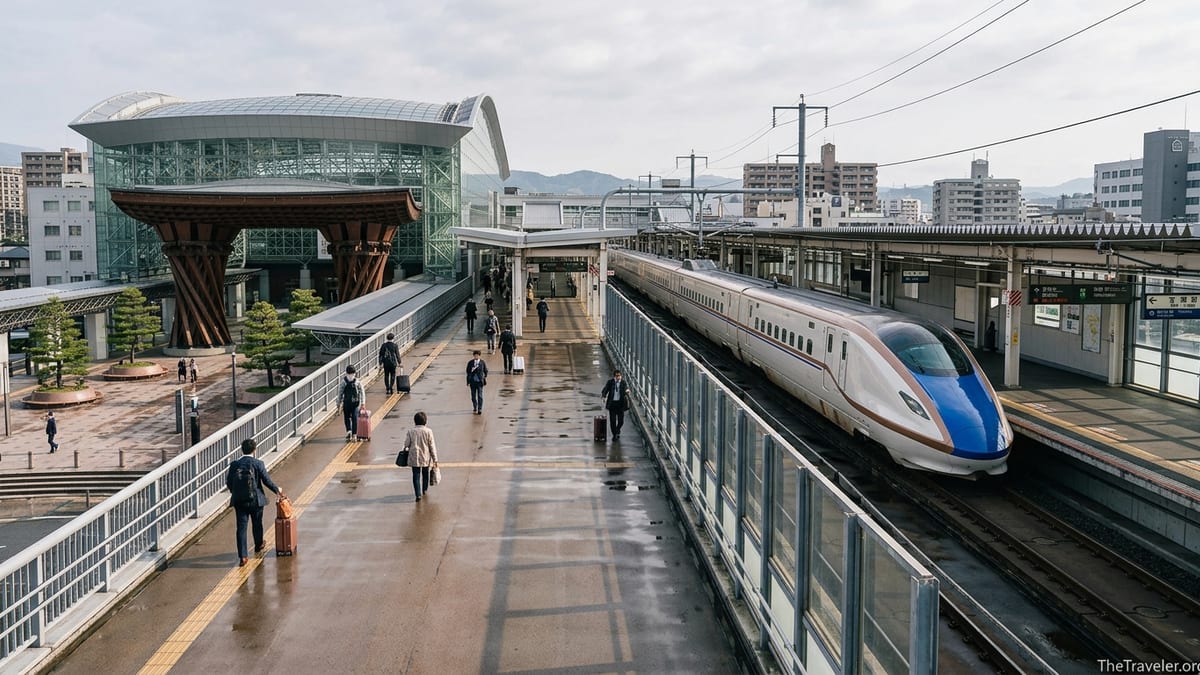
Understanding the Hokuriku Shinkansen after the 2024 extension
The Hokuriku Shinkansen now runs in a single sweep from Tokyo to Tsuruga, passing Omiya, Nagano, Joetsu Myoko, Toyama, Kanazawa, Komatsu, Fukui and several smaller stations. The extension from Kanazawa to Tsuruga opened on March 16, 2024, cutting journey times along the Sea of Japan coast and reshaping how travelers move between Hokuriku and the Kansai region. In practical terms, it means that places like Fukui and Tsuruga are now directly linked to Tokyo by Shinkansen instead of slower limited express trains.
From Tokyo Station, fastest services reach Nagano in about 80 to 90 minutes, Toyama in around 2 hours and Kanazawa in roughly 2 hours 40 minutes on the quickest runs. With the extension, Kanazawa to Tsuruga is now roughly 1 hour by Shinkansen, so a Tokyo to Tsuruga trip can be done in about 3 hours 30 minutes to 4 hours depending on the train and connections. Times vary by train category and time of day, but for most travelers the key reality is that the whole line is now a same day hop from Tokyo, even if you plan to continue into Kansai afterward.
One important change is the shift in how you reach Kyoto and Osaka. Before March 2024, the Thunderbird limited express ran directly between Osaka, Kyoto and Kanazawa, so you could board in Kyoto and step off in Kanazawa without changing trains. Since the extension opened, nearly all Thunderbird services now run only between the Kansai cities and Tsuruga. Travelers heading to Kanazawa, Toyama or Fukui now transfer at Tsuruga from Thunderbird to the Hokuriku Shinkansen, or in the reverse direction if coming from Tokyo.
For visitors this is not a downgrade. The transfer at Tsuruga is same station, clearly signed in English, and usually involves a short walk up or down one set of escalators. In return, you get more frequent high speed services along the newer Shinkansen tracks and a smoother ride than the old single seat Thunderbird journey. The key is to think of Tsuruga as a new hinge between Hokuriku and Kansai, rather than a complication.
Kagayaki, Hakutaka and Asama: which train should you choose
Three main services run on the Hokuriku Shinkansen: Kagayaki, Hakutaka and Asama. All use the same E7 or W7 series train sets, but their stopping patterns differ, which has a big impact on travel time and which stations you can use. Kagayaki is the fastest, Hakutaka is the usual workhorse for Hokuriku, and Asama covers the Tokyo to Nagano section.
Kagayaki runs mainly between Tokyo and Kanazawa or Tsuruga, with very limited stops. Most Kagayaki trains stop only at Omiya, Nagano and then select Hokuriku stations such as Toyama, Kanazawa and Tsuruga. Because of this, a morning Kagayaki from Tokyo can get you to Kanazawa in under 2 hours 40 minutes and Toyama in around 2 hours 10 minutes, making it ideal for travelers doing long hops with luggage. The important catch is that Kagayaki is fully reserved: there are no non reserved cars, so you must book a seat before boarding or you cannot board that service at all.
Hakutaka trains also run the full route, but stop at more intermediate stations. You will see Hakutaka calls at places like Karuizawa, Ueda, Iiyama, Joetsu Myoko, Itoigawa, Kurobe Unazukionsen, Shin Takaoka, Komatsu and Fukui, depending on the pattern. These trains are slightly slower than Kagayaki between Tokyo and Kanazawa or Tsuruga but give access to ski areas, onsen towns and smaller cities. Most cars on Hakutaka include non reserved seating, which makes it easier to ride on short hops such as Toyama to Kanazawa or Nagano to Iiyama without a prior reservation, especially outside holiday peaks.
Asama services operate between Tokyo and Nagano only. They serve all the main Nagano area stations including Karuizawa, Sakudaira, Ueda and Iiyama on some runs. For example, if you are staying in Karuizawa and want to visit Tokyo for the day, you will most likely take an Asama. Asama trains offer a mix of reserved and non reserved ordinary cars, plus Green Car and, on many services, GranClass seats, but they do not continue past Nagano into the Hokuriku coastal section.
Reserved versus non reserved seats and which trains skip smaller stations
On the Hokuriku Shinkansen, you choose between ordinary cars with non reserved or reserved seats, Green Car (first class) and, on many services, GranClass. The most important distinction for planning is whether your chosen train runs with non reserved cars at all. Kagayaki trains are entirely reserved seating, including ordinary cars, which means every passenger must have a specific seat reservation printed on their ticket or loaded onto an IC based e ticket. Hakutaka and Asama trains, by contrast, typically run with several non reserved cars at the front or rear.
In practical terms, a traveler doing Tokyo to Kanazawa on a busy spring weekend might deliberately pick a reserved seat on a Kagayaki to guarantee a place to sit, especially if carrying suitcases. Someone doing a short hop like Kanazawa to Fukui on a weekday morning might instead board a Hakutaka and sit in the non reserved section, tapping their IC card or using a paper ticket without specifying a seat. Non reserved tickets are usually a little cheaper than reserved seats, and they are more flexible if you want to leave earlier or later without changing the booking.
If you are hopping between smaller stations, you must check whether Kagayaki even stops there. Kagayaki skips many intermediate stations like Karuizawa, Ueda, Iiyama or Kurobe Unazukionsen, which are instead served by Hakutaka or Asama. For example, to reach the Snow Monkey Park area via Nagano, many travelers take a Hakutaka or Asama from Tokyo because these trains call at Nagano more frequently and at convenient times. Similarly, if you are heading to the Tateyama Kurobe Alpine Route via Toyama or Kurobe Unazukionsen, you will likely ride a Hakutaka that stops at your chosen gateway rather than a through Kagayaki that speeds past.
During major holidays like Golden Week, Obon or New Year, all ordinary cars, including non reserved sections, can be extremely crowded. On those dates it is wise to book reserved seats even for short segments such as Kanazawa to Toyama or Fukui to Tsuruga, both to avoid standing and to ensure you can board your preferred train. Reserved tickets on these sections usually add only a few hundred yen to the non reserved fare, and can be the difference between an easy transfer and a stressful one.
Classes of service, luggage and GranClass on the Hokuriku Shinkansen
The Hokuriku Shinkansen offers three main classes of accommodation. Ordinary class is the standard for most travelers, with 2 plus 3 seating, reclining seats, overhead racks and power outlets at all seats on the E7 and W7 trains. Green Car is the first class option, with 2 plus 2 seating, more legroom, quieter cars and generally a more relaxed atmosphere that business travelers and long distance tourists appreciate. At the top end is GranClass, a premium cabin at one end of the train with leather reclining seats, high partitions and a much more private feel.
GranClass on the Hokuriku Shinkansen between Tokyo and Hokuriku is available on many Kagayaki and Hakutaka services. These seats are significantly more expensive than Green Car, but in return you get a near business class airline style seat, a welcome amenity, and the calm of a small cabin of only a handful of passengers. On some services, full at seat attendant service with included food and drink is offered, while on others a “seat only” GranClass product is sold at a lower price with fewer extras. In practice, visitors most often choose GranClass for a special occasion trip, such as a honeymoon ride from Tokyo to Kanazawa, rather than for routine hops.
Luggage rules on the Hokuriku Shinkansen have tightened in recent years. For most travelers with medium suitcases and backpacks, the overhead racks and the spaces behind the last row of seats in each car are sufficient. Very large suitcases above a certain size now technically require an oversized luggage reservation, especially on some Shinkansen lines, and staff may ask you to store bulky items only in designated spaces. In day to day travel on the Hokuriku line, it is still common to see people place 60 to 70 liter suitcases behind the last row or in the overhead rack, but bringing huge international checked sized luggage can be awkward and is better avoided.
If you are doing a multi city trip such as Tokyo to Kanazawa, then on to Fukui and finally Kyoto, consider using luggage forwarding services for at least one long leg. For example, you might send your large suitcase from Tokyo directly to your Kanazawa hotel using a courier service, then travel with only a day pack on the Shinkansen. Once in Kanazawa, you could forward the same suitcase to your Kyoto hotel and travel light again on the Shinkansen and later Thunderbird. This reflects how many Japanese travelers use the network in practice and makes changing at Tsuruga much easier.
Buying tickets and using rail passes on the Hokuriku Shinkansen
There are two main ways to ride the Hokuriku Shinkansen: buying regular tickets or using a rail pass that covers the line. Regular tickets consist of two parts, even if printed as one slip: the basic fare between two cities and the limited express surcharge for using a Shinkansen. For example, a one way ordinary reserved ticket between Tokyo and Kanazawa on a Hakutaka in regular periods typically costs in the range of the mid 14,000 yen mark, while a similar journey from Tokyo to Tsuruga will cost a little more due to the greater distance. Non reserved fares on the same route are usually a few hundred yen cheaper.
Tickets can be purchased at Shinkansen ticket machines in English at major stations like Tokyo, Ueno, Omiya, Nagano, Toyama and Kanazawa, or over the counter at JR ticket offices. Many visitors now use online booking systems operated by JR East and JR West, which allow seat selection and payment in advance, then pickup from machines using a reservation number and credit card. With these systems you can, for instance, book a Kagayaki from Tokyo to Kanazawa and a Thunderbird from Tsuruga to Kyoto on the same day as two separate segments that line up neatly.
Several rail passes cover the Hokuriku Shinkansen, including the nationwide Japan Rail Pass, the JR East Nagano Niigata Area Pass and the JR Hokuriku Arch Pass. Holders of these passes can ride non reserved cars freely and book reserved seats without paying the surcharge, subject to the particular pass rules and seat reservation limits. In practice, if you hold a Japan Rail Pass and want to ride a fully reserved Kagayaki, you simply go to a ticket machine or office, show or scan your pass, and receive a separate reserved seat slip at no extra cost.
When planning, remember that the new Tsuruga section is operated jointly by JR East and JR West and some regional passes may have specific coverage limits. For example, a pass centered on Kansai and Hokuriku might cover Thunderbird between Osaka and Tsuruga and the Shinkansen between Tsuruga and Kanazawa or Fukui, but not all the way to Tokyo. Always confirm pass coverage before assuming that a particular segment, especially beyond Kanazawa, is included.
How the Tsuruga extension changed travel from Kyoto and Osaka
The opening of the Kanazawa to Tsuruga section in March 2024 quietly rewired the travel map between Hokuriku and Kansai. Previously, the classic route from Kyoto or Osaka to Kanazawa or Toyama was a direct Thunderbird limited express that hugged the shore of Lake Biwa and continued up the Sea of Japan coast to Kanazawa and sometimes beyond. Travel time from Kyoto to Kanazawa was about 2 hours 10 minutes on a single train. Those days of a one seat ride are mostly gone.
Today almost all Thunderbird services run between Osaka or Kyoto and Tsuruga only, more or less hourly in the daytime. At Tsuruga, the Hokuriku Shinkansen takes over for the journey north to Fukui, Kanazawa, Toyama and beyond. The total travel time from Kyoto to Kanazawa via Thunderbird plus Shinkansen is now closer to 2 hours in good connections, and between Kyoto and Toyama the extension has shaved around half an hour off the typical journey compared with the old combination of limited express and conventional lines. This matters in real trips: a morning Thunderbird from Kyoto can now have you in Kanazawa in time for an early lunch in the Omicho Market area, whereas in the past you might have arrived closer to midday.
The trade off is that you must change trains at Tsuruga. In practice this is straightforward. Thunderbird platforms are well signed and the Shinkansen concourse at Tsuruga is compact. Most connections allow around 10 to 20 minutes to walk up the escalators, pass through the transfer gate and find your new platform. For example, you might book Thunderbird 7 from Osaka to Tsuruga, arriving mid morning, then transfer to a Hakutaka bound for Kanazawa leaving 15 minutes later. On the return, the same pattern applies in reverse. It is wise to build in at least one train’s margin if you are catching a flight from Kansai Airport later that day, but for normal sightseeing days this single transfer is comfortable.
Another effect of the extension is the way travelers combine regions. It is now very natural to spend a few days in Kyoto, then ride Thunderbird to Tsuruga, Shinkansen to Fukui to see the dinosaur museum, and continue the same afternoon to Kanazawa. From there you might head to Toyama and use it as a base for the Tateyama Kurobe Alpine Route before finally riding the Shinkansen to Tokyo. The line has effectively turned Hokuriku into a bridge between Kansai and Kanto, rather than a side trip from only one end.
Choosing your best gateway: Tokyo, Nagano, Toyama, Kanazawa, Fukui and Tsuruga
Picking the right station as your base is as important as choosing the right train. Tokyo Station is the natural starting point for most international visitors and offers the greatest choice of Kagayaki, Hakutaka and Asama services. If your itinerary is heavy on Tokyo sightseeing with one side trip to Nagano or Kanazawa, it makes sense to start and end there. Many travelers staying around Tokyo Station, Ginza or Ueno simply walk or take one or two stops on the Yamanote Line to connect with their Shinkansen departure.
Nagano is the main gateway to the Japanese Alps and ski areas in winter, as well as Zenkoji Temple and excursions such as the Snow Monkey Park via local trains and buses. If your focus is on skiing in places like Hakuba or Nozawa Onsen, or on summer hiking in the highlands, consider riding directly from Tokyo to Nagano by Asama or Hakutaka and basing there for several nights. Travel times from Nagano to Toyama or Kanazawa are short, so you can also mix mountain days with overnight side trips to the coast.
Toyama works best as a spring and summer hub for the Tateyama Kurobe Alpine Route, Kurobe Gorge Railway and the wider Toyama Bay area. The Shinkansen station is integrated with local lines to Tateyama and Dentetsu Toyama, making early starts into the mountains easy. For example, travelers often ride a Hakutaka from Tokyo to Toyama in the afternoon, stay near the station, then catch the first local train to Tateyama the next morning to cross the Alpine Route and emerge in Nagano or Omachi in the evening.
Kanazawa is the cultural capital of Hokuriku and makes an excellent base for Kenrokuen Garden, the samurai and geisha districts and side trips to Noto Peninsula or Kaga Onsen. With the extension, Kanazawa now sits in the middle of a high speed corridor: about 2 hours 40 minutes from Tokyo on Kagayaki, roughly 70 to 80 minutes from Tsuruga on the Shinkansen, and a little over 2 hours from Kyoto with the Thunderbird transfer. Fukui is emerging as a secondary hub, particularly for those visiting the Fukui Prefectural Dinosaur Museum or the temples and cliffs along the nearby coast. Tsuruga itself is more of a junction than a tourist destination but can be a convenient overnight stop if late night connections from Kansai are tight.
Putting it together: sample journeys on the Hokuriku Shinkansen
Consider a one week route that many travelers now follow. You land in Tokyo and spend two nights in the city, then on day three take a mid morning Kagayaki to Kanazawa. After dropping bags at your hotel, you spend the afternoon in Kenrokuen and the Nagamachi samurai district. On day four you ride a short Hakutaka hop to Toyama, leave your suitcase in a coin locker or at the hotel, and head up to Tateyama for a one day tasting of the Alpine Route before returning to Toyama for the night.
On day five you board a Hakutaka or Kagayaki to Fukui, visit the dinosaur museum by bus or local train, and continue in the evening to Tsuruga. There you stay near the station, then on day six you catch a morning Thunderbird to Kyoto, reaching the city before lunchtime. After two or three days in Kyoto and Osaka, you either fly out of Kansai Airport or ride the Tokaido Shinkansen back to Tokyo. Throughout this journey, the Hokuriku Shinkansen is your backbone, with Thunderbird as a feeder line on the Kansai side.
Another pattern suits winter sports fans. You might take an Asama or Hakutaka from Tokyo to Nagano, transfer to a bus for Nozawa Onsen or Shiga Kogen and spend several days skiing. When the snow legs are tired, you ride back to Nagano, jump on a Hakutaka to Kanazawa for a dose of culture and seafood, then continue to Tsuruga and Kansai, or back to Tokyo. Because the trains are frequent, you can adjust timings around weather conditions, choosing a mid afternoon departure if morning slopes are too good to leave.
Shorter trips also benefit from the line. For example, if you are based in Kyoto and want a quick overnight in Kanazawa, you can leave Kyoto mid morning on a Thunderbird, change at Tsuruga to a Shinkansen, arrive in Kanazawa early afternoon, and return the next day along the same path. Even with the transfer, this is easy enough that many Kansai residents now treat Kanazawa as an accessible weekend destination.
FAQ
Q1. Do I have to reserve a seat on all Hokuriku Shinkansen trains?
On Kagayaki services you must have a reserved seat, as these trains carry no non reserved cars. Hakutaka and Asama trains usually offer both reserved and non reserved ordinary cars, so you can ride them without a reservation if you are willing to sit in the non reserved section and risk standing at busy times.
Q2. How do I transfer between the Hokuriku Shinkansen and Thunderbird at Tsuruga?
At Tsuruga you step off the Thunderbird on the conventional platforms, follow clear signs in English to the Shinkansen transfer gates, pass through ticket gates using your tickets or rail pass, and go up to the elevated Shinkansen platforms. The walk typically takes 5 to 10 minutes, and most timetables build in around 10 to 20 minutes for the connection.
Q3. Which station is best as a base for exploring the Japanese Alps?
Nagano is usually the best gateway for the Japanese Alps and major ski areas served by buses or local trains, such as Hakuba, Nozawa Onsen and Shiga Kogen. From Nagano you can also continue by Shinkansen to Toyama or Kanazawa for side trips to the coast.
Q4. Can I use the Japan Rail Pass on Kagayaki, Hakutaka and Asama?
Yes, the nationwide Japan Rail Pass covers ordinary cars on Kagayaki, Hakutaka and Asama. You still need to obtain a reserved seat ticket for Kagayaki and for reserved cars on Hakutaka and Asama, but you do not pay extra for the reservation itself when using a valid pass.
Q5. Is GranClass worth the extra cost on the Hokuriku Shinkansen?
GranClass offers a very comfortable, quiet cabin with large reclining seats and a more private feel, and on some services additional at seat service. It is significantly more expensive than Green Car or ordinary class, so many travelers choose it only for a special treat, such as a honeymoon ride between Tokyo and Kanazawa, rather than for every journey.
Q6. How early should I book Shinkansen seats during busy seasons?
During peak periods like Golden Week in late April and early May, the mid August Obon holidays and New Year, it is wise to book reserved seats as soon as your travel dates are fixed, often several weeks in advance. Outside these times, you can usually book a day or two ahead or even on the day of travel except for the busiest morning and evening departures.
Q7. What is the best station for visiting Kanazawa’s Kenrokuen Garden?
The main gateway for Kenrokuen Garden is Kanazawa Station itself. From the station you can reach the garden and nearby samurai and geisha districts by local bus or taxi in around 10 to 15 minutes, making Kanazawa an excellent base for one or two nights focused on culture and food.
Q8. Are there luggage size limits on the Hokuriku Shinkansen?
Very large suitcases can be difficult to store and may require use of designated luggage spaces or an oversized reservation, depending on current rules. Medium suitcases and backpacks usually fit in overhead racks or behind the last row of seats, but if you are carrying multiple large pieces it is more comfortable to use luggage forwarding services between hotels.
Q9. Does the Hokuriku Shinkansen operate early in the morning and late at night?
Yes, there are early morning departures from both Tokyo and Hokuriku cities and evening trains returning in both directions, though the very first and last trains may have fewer services. For most travelers, operating hours are generous enough to allow day trips, but if you have late night flights or early commitments, check exact times close to your travel dates.
Q10. Should I use Tokyo, Kyoto or Osaka as my main hub when including Hokuriku?
If you are flying into Tokyo and want to explore both the Alps and the Hokuriku coast, Tokyo makes a convenient starting hub with many train options. If your focus is Kansai sights like Kyoto and Osaka plus a short Hokuriku side trip, basing in Kyoto or Osaka and using Thunderbird plus the Hokuriku Shinkansen via Tsuruga can be more efficient.