


I wrote this cost report the way I wish more Okinawa articles did: by rebuilding an actual island-hopping trip line by line, instead of flattening everything into a single daily average. The Ryukyu Islands (Okinawa Prefecture) are not one destination with one price. Naha can feel like a good-value city break. Resort islands like Miyakojima can spike your lodging and car costs. And small remote islands can be surprisingly pricey because you pay “the island-hopping multiplier”: extra flights, extra ferries, repeated airport and port transfers, and multiple hotel check-ins that quietly add up.
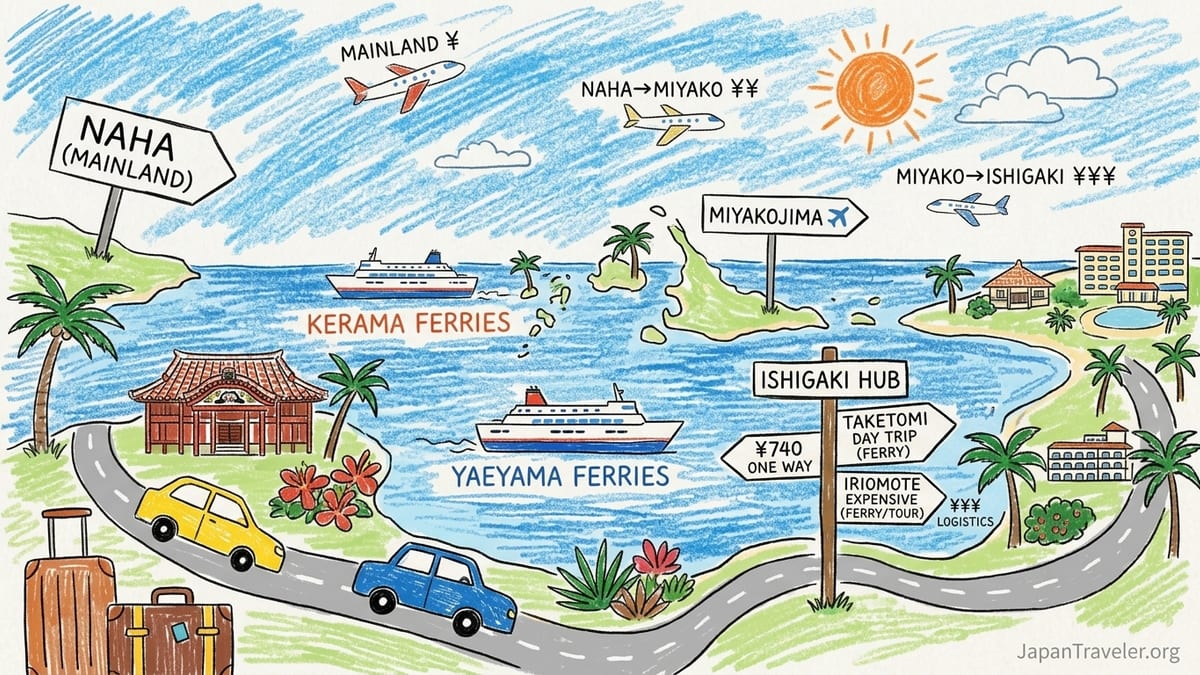
The Trip I’m Pricing Out (And Why This Route Costs More)
To keep this grounded, I’m reconstructing a very typical first-time Ryukyu “sampler” route I’ve done myself: fly in from mainland Japan to Naha (Okinawa Main Island), ferry out to the Kerama Islands (Zamami/Aka), then hop south by air to Miyakojima, then onward to Ishigaki (Yaeyama Islands) with a couple of ferry day trips (Taketomi and Iriomote). That mix hits the three big cost personalities of Okinawa travel: city base, small-island ferry life, and resort-style beach islands.
The reason this route matters is that the number and type of islands you choose is itself a cost driver. Some outer islands have flights via Naha, which can be fast but expensive, and sometimes forces you into multiple separate one-way tickets. Other islands require ferries from a hub port, which can be cheaper but adds transfer time, luggage hassle, and weather risk. When you island hop, you are not just paying for transportation. You are paying for logistics.
My sample travel period is shoulder season, not a holiday week, because that is when I’ve found flights and rooms are still available without peak surcharges. Wherever I cite a specific “firsthand” price below, I include the travel period and the island because costs differ dramatically between Naha, a resort island, and a small remote island even within the same prefecture.
One more thing: I’m using yen (JPY) throughout, since nearly everything on the islands is priced in yen and exchange rates change too quickly to be helpful long-term. If you want your personal total in dollars, convert at your card’s rate after the fact.
Flights: Mainland Japan To Naha, Then The Island-Hopping Multiplier
The biggest psychological shift when budgeting Okinawa is that flights stop being a “one-time” line item the moment you decide to hop. In my case, I effectively created three separate flight moments: mainland Japan to Naha, Naha to Miyakojima, then Miyakojima to Ishigaki (often routed via Naha depending on schedules and fare sales). Each additional island hop increases the number of tickets, baggage rules to track, and chances you’ll pay a fare premium for the one departure time that fits your ferry or hotel schedule.
For a concrete mainland-Japan example: Japan Airlines publishes real examples of domestic pricing that can be surprisingly high on certain routes and dates. For instance, JAL has shown a one-way “normal seat” fare example from Miyako (MMY) to Osaka Kansai (KIX) at 40,090 yen for a specific date (September 17, 2026). That is not what everyone pays, but it is a real-world reminder that Okinawa flights can behave like peak leisure routes, not cheap commuter hops.
My own strategy on this exact style of trip has been to treat inter-island flights as their own budget category, separate from the “mainland round trip.” Even when I catch sale fares, the island-hopping multiplier shows up in the form of multiple booking fees, multiple baggage checks, and often at least one segment that I buy at an inconvenient price because I need to be on a specific island by a specific afternoon.
If you are trying to keep costs down, the most impactful choice is to reduce the number of flight legs. Two islands can be cheaper than three even if the hotels are similar, simply because the extra flight leg often forces another airport transfer and another half-day of paid accommodation around flight times.
Ferries: Where Money Was Saved (And Where Timing Costs You)
Ferries are where island hopping can save money, especially around Okinawa Main Island’s nearby island groups. The Kerama Islands (Zamami and Aka) are a prime example because you can reach them from Tomari Port in Naha without flying. The catch is that ferry schedules dictate your day, and rough seas can disrupt plans, which sometimes forces a last-minute extra hotel night.
For the Keramas, fares are very real and very specific. Zamami Village fare tables for January 1, 2026 show adult passenger pricing for the Naha Tomari to Zamami or Aka routes and also show that bringing a car is dramatically more expensive, with the note that the car fare includes the driver’s ferry ticket. Even if you never bring a car, this document is useful because it confirms that ferry pricing is not static and has seen changes.
In practice, I save money by ferrying out for a short stay (one or two nights) rather than day-tripping. A day trip can be cheaper on paper, but on the Keramas the “good” fast-boat times often sell out, and if you pick the slower sailing you can lose so many hours that you end up paying for a taxi, a beach rental package, and a rushed lunch without actually getting a full beach day. The money-saving version of a Kerama visit is usually an overnight that avoids last ferry stress and lets you snorkel early and late.
Over in the Yaeyama Islands, ferries are less optional. Ishigaki is the hub, and the recognizable, real-world example is Taketomi Island: Ishigaki City’s own Yaeyama Islands guide lists a one-way fare of 740 yen and a travel time of about 10 to 15 minutes. That is exactly the sort of day trip that can reduce costs, because you can sleep in an Ishigaki hotel (where there is more competition and more inventory) while paying a relatively small add-on for a second island experience.
Rental Cars, Fuel, Parking, And The “Start Over” Problem On Each Island
Cars are the sneakiest island-hopping cost because every time you change islands, you often have to start over: a new rental contract, another mandatory insurance decision, another tank of fuel, and another set of parking rules. On Okinawa Main Island, a car can be good value if you are going north (for beaches and sights) because distances are real, buses take time, and parking outside central Naha is often manageable. On smaller islands, you might not need a car at all, but if you do, the daily cost can be higher simply because there are fewer rental agencies and fewer vehicles.
On this style of trip, I typically rent a car on Okinawa Main Island for a fixed block (for example, 3 days to cover the north, then return it before ferrying out). On Miyakojima, I rent again because the best beaches are spread out and taxis for multiple stops add up quickly. On Ishigaki, I weigh it: if I’m doing Iriomote as a day trip by ferry and tour, I can sometimes skip the car. If I’m road-tripping Ishigaki’s coast and viewpoints, the car becomes worth it again.
Parking fees are small line items that become meaningful because you pay them repeatedly: at beaches, at popular viewpoints, and sometimes at hotel lots that charge separately. The easiest way to understand the “start over” problem is to imagine paying a modest parking fee once on a city trip versus paying it five times across three islands because every day involves a new port, a new lot, and a new beach entrance.
Fuel is typically not the budget breaker by itself, but it becomes part of the multiplier. When you rent on multiple islands, you are almost guaranteed to buy fuel multiple times even if you only drive a little on each island, because you still have to return the tank at the required level. It’s the same phenomenon as buying several “small” transit tickets on different networks instead of using one weekly pass in a single city.
Accommodation: Naha Value, Resort Island Spikes, And The 2027 Accommodation Tax Note
Accommodation is where the Ryukyus can swing from “reasonable” to “how is this Japan?” very quickly. In my own spending, Naha tends to be the value anchor: there are more hotels, more competition, and more dining nearby so you don’t have to rely on resort restaurants. Remote islands and resort islands behave differently. Remote islands can be pricey because there are fewer rooms, and if you miss your ferry, you may have no backup. Resort islands like Miyakojima can be pricey because demand is strong and many travelers want the same beachfront experience on the same limited coastline.
The island-hopping multiplier hits lodging in a very specific way: repeated check-ins and check-outs. That sounds like a time problem, but it becomes a money problem because it pushes you into awkward one-night stays, luggage storage costs, and sometimes paying for a room that you only use for a half-night because of an early ferry or late arrival flight.
Future-facing cost note that matters for anyone planning beyond this year: Okinawa Prefecture’s accommodation tax begins February 1, 2027, applying to stays on or after that date (with an exception noted by the prefecture for a stay that crosses January 31 to February 1). Multiple hotels and municipal sources are already publishing notices for guests. The practical takeaway is simple: if you are writing or reading a cost article for trips in 2027 and beyond, you must add the accommodation tax line item using the then-current rules for the prefecture and the municipality where you sleep.
Because lodging tax rules can change and can differ by city, the safest approach is to treat it like an airport fee: budget for it, expect it to be collected separately in some cases, and confirm at the property if you are prepaying online. The bigger your island hop list, the more nights you will likely have in multiple municipalities, and the more times that tax could appear across your receipts.
Food And Convenience Spending: Where My Daily Receipts Actually Came From
Food spending in the Ryukyus is not just about restaurants. On island-hopping trips, my receipts are usually a mix of: quick breakfasts from convenience stores before an early ferry, a couple of “destination” meals (like Okinawan soba, fresh sashimi bowls, or island café lunches), and then at least one night where I eat at or near the hotel because I arrive tired after a transfer. Those transfer days are exactly when budgets slip, because you pay for convenience twice: once in transport, and again in food choices.
Naha is where I spend the least per meal because the density of options makes it easy to choose value. On smaller islands, there might be only a handful of dinner places, and if you did not book ahead, you may end up at the one place still serving food at 8 p.m. On resort-forward islands, the risk is different: you can easily spend more inside the resort ecosystem because leaving requires a car, a taxi, or a bus that doesn’t run late.
My most consistent “island-hopping” food cost driver is timing. A 7 a.m. departure day often means a convenience store breakfast and coffee plus a second snack after arrival. A late arrival often means buying a bento or eating at the nearest casual chain. None of those is expensive alone, but they repeat every time you switch islands.
If you want to reduce food costs without turning your trip into a deprivation challenge, the most realistic move is to plan around one “nice” meal per island and keep transfer days simple. I’ve found it’s better to spend on a memorable local dinner on Ishigaki or Miyakojima than to waste money on rushed, forgettable meals that happen only because you are stranded between a port and a check-in time.
Beaches, Snorkeling, Diving, And Paid Facilities (The Costs People Forget)
The beach itself is usually free. What costs money is everything you need to enjoy it comfortably: lockers, showers, rental gear, boat trips, and sometimes paid parking near the sand. On my receipts, the most common “surprise” line items are small facility fees and rentals I could have avoided if I had packed differently or timed my day better.
On the Kerama Islands, snorkeling is often the headline activity, and a big part of the experience can be done from shore depending on conditions and your comfort. But if you want a guided boat snorkel or a dive, you are paying for expertise, fuel, and limited capacity. Those tours can easily become one of the top two daily expenses on a small island day. The money-saving alternative I use most often is to choose one paid water activity per island, not per day. It keeps the trip feeling special without creating a runaway total.
On Miyakojima, the “facility spend” tends to show up at popular beaches where paid parking and rental counters are standardized. You can keep costs down by bringing your own mask and snorkel (and sanitizing properly), but you still may end up paying for a beach shower after a long saltwater day if you are heading straight to dinner.
In the Yaeyama Islands, day trips to Taketomi are a good example of spending control: you can pay a modest ferry fare and then choose a low-cost way to explore (walking, renting a bicycle) instead of stacking multiple paid tours in a single day. If you want the big-ticket nature day, Iriomote is where many travelers choose to spend, because it is not a place you “accidentally” visit. You go there on purpose, and that intentionality helps justify the cost.
Luggage Storage, Transfers, And Other Small Fees That Add Up
Island hopping creates a category I call “in-between costs.” They do not feel like travel highlights, but they show up on your card statement: coin lockers at airports or ports, short taxi rides because your hotel is not walkable, bus tickets you would never need if you stayed put, and the occasional baggage forwarding or storage day when check-out is hours before your ferry.
These costs multiply because you repeat the same problems on each island. In Naha, you might store luggage for a day trip to the Keramas. On Miyakojima, you might arrive before check-in and need a plan for bags. On Ishigaki, you might be juggling ferry day trips with a hotel that wants you out at 10 a.m. Even if each storage or transfer is modest, the repetition can become a real chunk of the overall trip.
A very practical, real-world example: if you are trying to connect from Naha Airport to Tomari Port for a Kerama ferry, the transfer itself can cost money and time, and if you miss the sailing you are not just delayed, you are buying extra meals and possibly an extra hotel night. This is why I treat port and airport transfer buffers as a budget line, not just a scheduling detail.
Where I save money is by building day trips out of one base whenever it makes sense. Ishigaki to Taketomi is a classic: you can get the “second island” feeling without paying for another hotel, another check-in, and another set of luggage logistics. Not every island can be done that way, but when it can, it is one of the cleanest savings moves available.
The Takeaway
A Ryukyu Islands trip can be a surprisingly controllable budget if you base yourself on one main hub (like Naha or Ishigaki) and add a small number of ferry-accessible day trips. Costs climb fast when you stack separate flight legs, multiple car rentals, and one-night hotel stays across different islands, because the trip starts paying for logistics instead of experiences.
If you only remember one planning principle, make it this: your island list is your budget. Choosing islands with direct access from your hub and grouping activities so you are not constantly transferring will usually save more money than skipping a museum ticket or downgrading one dinner.
Also, if you are traveling in 2027 or later, your lodging total is not complete until you account for Okinawa’s accommodation tax rules that begin February 1, 2027. That tax may be small per night, but island hopping tends to increase the number of check-ins, which increases the number of times you pay “per night” fees.
Finally, do not let anyone reduce this kind of trip to a single daily average. The truth of Okinawa budgeting is uneven by design: a ferry day is cheap until it forces a taxi and a locker, a resort beach day is expensive but memorable, and a flight hop might cost more than your entire day of food. Price your trip the way you’ll actually travel it, island by island.
FAQ
Q1. What is the single biggest cost driver when island hopping in Okinawa?
Adding extra flight legs and redoing logistics on each island (airport transfers, separate tickets, repeated check-ins) is usually the biggest driver.
Q2. Is it cheaper to base in Naha and do day trips, or to sleep on outer islands?
For nearby islands like the Keramas, a Naha base can be cheaper, but an overnight can be better value if day-trip ferry times are limited or sell out.
Q3. What is a real example of a low-cost island day trip from Ishigaki?
Taketomi is a classic example: Ishigaki City’s Yaeyama guide lists about 10 to 15 minutes travel time and a 740 yen one-way fare.
Q4. Do ferry prices in Okinawa change by season or year?
They can. For example, Zamami Village publishes fare tables and a January 1, 2026 revision document shows updated pricing, so it’s worth checking the latest tables before booking.
Q5. Why do rental car costs feel higher on an island-hopping itinerary?
Because you often rent multiple times on different islands, which means repeating base fees, insurance decisions, fuel top-offs, and sometimes paid parking rules.
Q6. What is a real-world reminder that Okinawa flights can be expensive?
JAL has shown a one-way “normal seat” example from Miyako (MMY) to Osaka Kansai (KIX) at 40,090 yen on September 17, 2026, illustrating that prices can spike.
Q7. Are beaches in Okinawa free?
The sand usually is, but paid facilities often include parking, showers, lockers, and rental gear. Those small charges are what add up across multiple islands.
Q8. When does Okinawa’s accommodation tax start?
Okinawa Prefecture’s accommodation tax applies to stays on or after February 1, 2027 (with a specific exception noted by the prefecture for a stay that crosses January 31 to February 1).
Q9. Why shouldn’t you budget this trip using one daily average?
Because costs spike unevenly on transfer days and activity days. A flight day can cost more than a full day of meals, while a ferry day trip can be relatively cheap.
Q10. What is the best way to save money without cutting experiences?
Reduce flight hops, use a hub-and-day-trip approach where possible (like Ishigaki plus Taketomi), and pick one paid “signature” activity per island instead of stacking tours daily.