


Riding the Shinkansen is often the highlight of a trip to Japan, but the ticket options, online systems and luggage rules can feel confusing the first time you book. The good news is that once you understand a few core concepts, reserving seats on popular routes such as Tokyo to Kyoto, Tokyo to Osaka or Kyoto/Osaka to Hiroshima becomes very straightforward, whether you book at the station or in advance with services like Smart EX.
Understanding Shinkansen tickets, routes and seat types
For most first time visitors, the key Shinkansen corridor is the Tokaido and Sanyo line, which runs from Tokyo through Shinagawa, Shin Yokohama, Nagoya, Kyoto and Shin Osaka, then onward to Hiroshima and Hakata in Fukuoka. Some trains continue as the Kyushu Shinkansen toward Kagoshima Chuo. This is the corridor covered by the Smart EX online reservation service operated by JR Central, JR West and JR Kyushu, and it includes the classic first timer journeys such as Tokyo to Kyoto, Tokyo to Osaka and Kyoto to Hiroshima.
When you buy a Shinkansen ticket, you are really buying two elements: the base fare for distance travelled and a Shinkansen express surcharge that depends on the train type and whether your seat is reserved. On a Tokyo to Kyoto Nozomi service this is usually combined into one ticket or one digital reservation, so you will not have to handle these parts separately, but it helps to know why prices change when you switch train type or seat class.
Cars on Shinkansen trains are divided into Ordinary Class and Green Car. Ordinary is similar to economy on a plane, with a 2 plus 3 seat layout in most cars. Green Car is the premium car with a 2 plus 2 layout, more legroom, wider seats and a quieter atmosphere. On the Tokaido and Sanyo Shinkansen, Green Cars are fully reserved; you cannot just board them with a non reserved ticket. All Nozomi trains and many Hikari and Sakura services have a mix of reserved and non reserved Ordinary cars, clearly marked on the platform signs and carriage side displays.
Reserved seats mean you have a specific car and seat number, such as Car 11 Seat 5A, printed on your ticket or shown in your Smart EX reservation. Non reserved seats are first come first served in the designated cars. On a busy Friday evening from Tokyo to Osaka, a reserved seat guarantees you a place to sit and room for luggage, while non reserved cars can be standing room only between Tokyo and Nagoya.
How Smart EX works and why it suits visitors
Smart EX is an official online reservation service for the Tokaido, Sanyo and Kyushu Shinkansen that allows registration with most overseas credit cards and lets you make seat reservations before you arrive in Japan. After you sign up on the English site or app, you can search trains between stations such as Tokyo and Kyoto, select specific departures like a 9:03 Nozomi, choose seats and pay in yen. For many routes Smart EX offers slightly discounted fares compared with buying a regular paper ticket at the station, especially if you book several days in advance.
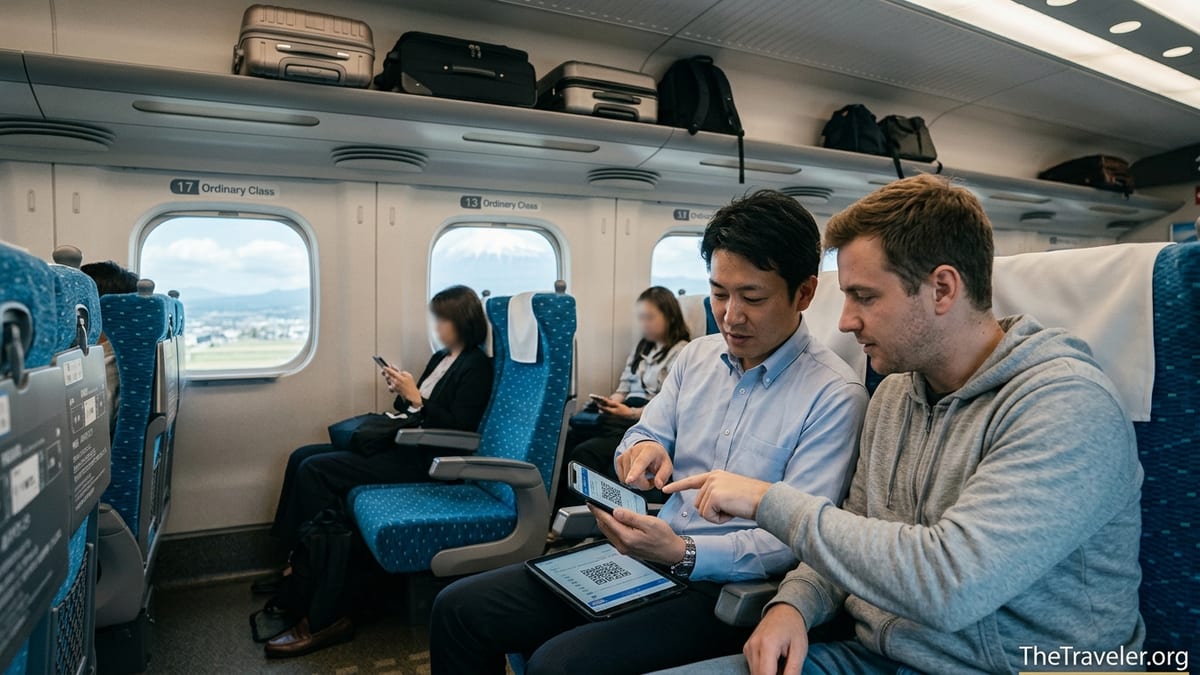
Smart EX gives you two ways to board. The first is to use a QR ticket: your reservation generates a QR code in the app or website. At the station, you hold this QR code to the Shinkansen gate reader, which prints a small paper slip showing your car and seat and opens the gate. If you are travelling to or from a regular JR station such as Shinjuku, you tap your IC card for the local segment and then scan the QR code for the Shinkansen segment at the transfer gate, following the diagrams shown on the gate displays.
The second method is to link your Smart EX reservation to a transport IC card such as Suica, PASMO or ICOCA. You register your IC card number inside Smart EX and assign it to each passenger. At the Shinkansen gate, you simply tap the IC card once; the system recognizes both your regular train fare and your Shinkansen reservation and opens the gate with no extra paper. Many frequent travelers prefer this because it avoids handling QR codes at crowded stations like Tokyo or Shin Osaka and makes transfers from metro or JR local lines smoother.
One practical example: if you are flying into Haneda, then using the monorail and JR Yamanote Line to Tokyo Station with Suica, and you have a Tokyo to Kyoto Shinkansen booked in Smart EX, you can arrive at Tokyo Station, follow signs to Shinkansen Transfer, tap the same IC card at the transfer gate and walk straight to your car. You will not need to visit a ticket machine or counter at all.
Booking at station ticket machines and JR staffed counters
Not everyone wants to sign up for an online service, and sometimes you need assistance in person. Every major Shinkansen station has bilingual ticket machines and staffed JR counters where you can buy tickets on the day or in advance. For Tokyo to Kyoto, you can buy a ticket up to one month before travel. You can also buy open dated base fare tickets and add Shinkansen seat reservations later if you are not sure about timings.
At larger stations such as Tokyo, Shinagawa, Kyoto and Shin Osaka, look for the green ticket machines marked in English for Shinkansen and JR Lines. The interface normally lets you switch to English on the opening screen. To book, you select your origin and destination (for example Tokyo to Shin Osaka), your date and time, train type preference (Nozomi, Hikari or Kodama on the Tokaido line) and whether you want reserved or non reserved seats, Ordinary or Green Car. After choosing a train, you can select aisle or window and sometimes a specific car number. The machine then prints paper tickets showing the boarding gate, car and seat.
If you prefer human help, head to the main JR ticket office usually signed as "Ticket Office" or "Midori no Madoguchi." Staff can check for transfers and seat availability in English, and this is the best way to make more complex bookings, such as multiple trips on one itinerary or a Kyoto to Hiroshima to Hakata sequence. For example, you could visit the counter in Tokyo Station and book three legs at once: Tokyo to Kyoto on a morning Nozomi, Kyoto to Hiroshima two days later on a Hikari and Hiroshima to Shin Osaka on a Sakura, ensuring all reserved seats and oversized baggage spaces are confirmed before you leave Tokyo.
One thing to watch at counters and machines is peak travel periods. During Golden Week in late April and early May, the Obon week in mid August and the New Year period spanning late December to early January, Nozomi and Hikari services on the Tokyo to Osaka corridor can sell out of reserved Ordinary seats several days ahead. In those periods, booking as soon as the one month window opens, either through Smart EX or at a JR counter, gives you the best chance to get your preferred departure and to sit together if you are in a group.
Reserved vs non reserved, Green Car and choosing the best seats
Most first time travelers are deciding between three main options: non reserved Ordinary, reserved Ordinary and reserved Green Car. Non reserved is the simplest; you buy a ticket marked non reserved and sit in any free seat in the designated cars, usually Cars 1 to 3 on Tokaido Shinkansen trains. This works well on quieter midday trains on weekdays, such as a 13:10 Tokyo to Kyoto Hikari outside school holidays, where you may find half empty cars and can choose any available window seat.
Reserved Ordinary seats cost a little more but guarantee you a specific seat. They are strongly recommended on busy routes such as evening Tokyo to Shin Osaka Nozomi trains, or for anyone carrying large luggage. Families and groups also benefit because you can reserve a block of adjacent seats. If you are using Smart EX, you will see a simple seat map when you choose your train; you can pick a pair of seats on the Mount Fuji side for a morning departure or select seats near the oversized luggage area in the last row of a car.
Green Car costs more again and offers a more spacious and quiet ride. Seats are wider, recline further and have more legroom, and there are fewer passengers per car. On a three hour Tokyo to Hiroshima trip, some travelers appreciate the extra comfort enough to justify the price difference, especially if they are carrying laptops or want to work. It is worth noting that Green Cars on the Tokaido and Sanyo Shinkansen are entirely reserved; there is no non reserved Green option, so you must hold a specific seat reservation to enter these cars.
Seat selection matters for both views and luggage. On the Tokyo to Nagoya section of the Tokaido Shinkansen, the Mount Fuji view is best from window seats on the right hand side of the train when travelling from Tokyo (these are usually seats labelled "E" in Ordinary and "D" in Green). On a clear morning, if you depart Tokyo between 8:00 and 10:00 and sit on that side, you have a good chance to see Mount Fuji shortly after passing Shin Yokohama and Odawara. If you prefer easier access to the aisle or plan to retrieve items from overhead racks often, choose aisle seats instead.
Using ticket gates, QR tickets and IC card linking in practice
Understanding how to pass through the gates makes travel day much less stressful. Shinkansen platforms are behind separate gates from regular JR lines. At a major station like Tokyo, you will first pass the regular JR gates, then walk inside the station to a clearly marked Shinkansen entrance. If you hold a paper Shinkansen ticket bought from a machine or counter, you insert it into the slot at the Shinkansen gate; it will pop out at the other side, and you keep it until you exit at your destination where the gate may retain it.
With Smart EX QR tickets, you hold your phone screen up to the QR reader at the Shinkansen gate. The screen does not need to be extremely bright, but avoid cracked or very dirty protectors. The gate prints a small slip with your car and seat number and opens. Keep that slip handy, as it acts as your physical reminder of the reservation, especially useful if your phone battery runs low on board. If you are transferring from a local JR or metro train, you will usually first exit through a special Shinkansen transfer gate that accepts a combination of your QR ticket and IC card or paper local ticket based on the diagrams posted beside the machines.
If you have linked your Smart EX reservation to an IC card, the process is even simpler. For example, if you have an Apple Wallet Suica linked to your Tokyo to Osaka Nozomi booking, you can arrive at Tokyo Station by Yamanote Line, walk to the Shinkansen transfer gate and tap only your phone. The system recognizes you have a valid Shinkansen reservation and lets you through, without issuing any extra paper. At Shin Osaka, you tap again to exit and then can transfer to the metro using the same IC card as usual.
In all cases, pay attention to the car number signs above the platform and on the ground. Tokyo to Kyoto Nozomi trains can be 16 cars long, and walking the length of the platform with suitcases is not fun. Your reservation or slip will show, for example, Car 11 Seat 10C. Look at the overhead displays for "11" and stand near the boarding line marked on the platform. Cars with oversized luggage space are typically at one end of the train; if you have reserved such a seat, the system will assign a specific car and last row seat for you.
Luggage rules, oversized reservations and smart packing
Since 2020, the Tokaido, Sanyo and Kyushu Shinkansen have special rules for large suitcases. Ordinary carry on sized bags with total dimensions (height plus width plus depth) of 160 centimeters or less can go in the overhead racks or at your feet. Many typical 65 to 75 liter suitcases fall under this threshold. Items larger than that, up to 250 centimeters in total dimensions, count as oversized baggage and require an advance reservation in special seats with an oversized baggage area, located at the back row of designated cars. You pay no extra fee for this, but you must reserve that seat type in advance.
When booking via Smart EX, if you indicate that you are bringing oversized luggage, the system will automatically offer seats with an oversized baggage area. For example, if you are booking a Tokyo to Hiroshima Nozomi with a 28 inch suitcase whose total dimensions exceed 160 centimeters, you can select "seat with oversized baggage area" and the system will assign you a last row seat with space directly behind the seat backs for your case. At the station, signs in English point to these cars, and staff may also check that passengers using the space have the correct seat reservations.
If you turn up at the Shinkansen platform with oversized luggage but no reservation, staff may allow you to board and use a free space if available, but they also have the right to charge a penalty and may ask you to move bags that block aisles or doors. During busy periods such as the start of Golden Week or the first weekend of August, overhead racks fill quickly even with regular sized bags, so oversized reservations are strongly recommended. An alternative is to use luggage delivery services from airports and hotels so that you travel the Shinkansen with only a small carry on size bag.
Another option is to split your packing. For example, on a Tokyo to Osaka round trip with side visits, you might send your large suitcase from Tokyo hotel to Kyoto hotel using a courier and travel with a small backpack. That keeps you comfortably within the standard luggage limits, avoids the need to find an oversized baggage seat and makes boarding and alighting at busy stations like Shin Osaka or Kyoto much less stressful. For everyday items like snacks, cameras and jackets, use a soft daypack that can easily fit under the seat or in small gaps in the racks.
Route specific tips: Tokyo–Kyoto, Tokyo–Osaka and Kyoto/Osaka–Hiroshima
Tokyo to Kyoto is one of the most popular Shinkansen trips for visitors. The fastest Nozomi services take around two hours and fifteen minutes. If you book a mid morning Nozomi, say around 9:00 or 10:00, you balance avoiding rush hour crowds with arriving in Kyoto in time for hotel check in. For views of Mount Fuji, select right side window seats from Tokyo, and aim for departures on clear days. Using Smart EX, you can search these specific departure times, pick seats E or D for the Fuji side and add oversized baggage seats if necessary.
Tokyo to Osaka is very similar, since most trains that go to Kyoto continue to Shin Osaka. The journey is roughly two and a half hours by Nozomi. Shin Osaka is the main bullet train hub, and many people then transfer to the Osaka Metro or JR Osaka Loop Line. If your hotel is near Umeda or Namba, consider whether it is easier to get off at Shin Osaka or continue by local JR or metro. With a linked IC card in Smart EX, your transfer is seamless; for example, you can ride the Shinkansen from Tokyo to Shin Osaka using your reserved seat, then use the same IC card to pass through to the Midosuji Line for Namba.
From Kyoto or Shin Osaka to Hiroshima, several direct Sakura services run on the Sanyo Shinkansen. These trains are slightly slower than Nozomi but generally more relaxed, with a mix of reserved and non reserved seats and a travel time of about ninety minutes from Shin Osaka to Hiroshima. On this leg, Green Car can be especially pleasant if you are planning to rest after busy days in Kansai. Booking a reserved seat also makes it easier to handle luggage, since you can choose a seat near the door or at the last row if you have a larger case and have secured an oversized baggage reservation.
One practical itinerary might look like this: Tokyo to Kyoto on a mid morning Nozomi reserved seat with Smart EX and IC card linking, two days later Kyoto to Hiroshima on an afternoon Hikari or Sakura booked at a Kyoto Station machine, then Hiroshima to Shin Osaka on a reserved Ordinary seat purchased as part of a combined Smart EX booking while still in Tokyo. This mix of online and in person booking lets you lock in the busiest and longest legs in advance while keeping some flexibility for shorter hops.
Peak travel seasons, timing and booking strategies
Japan has three main domestic peak travel seasons: Golden Week from late April through early May, the Obon holiday in mid August and the New Year period from late December into the first days of January. In addition, school holidays in late March and late July, as well as weekends during autumn foliage season in November, can also see very busy trains on the Tokyo to Kyoto and Tokyo to Osaka corridor. During these times, both reserved Ordinary and Green Car seats on popular Nozomi trains can sell out as soon as the one month booking window opens.
If you plan to travel Tokyo to Kyoto on, for example, April 28, it is wise to use Smart EX to book exactly one month earlier when sales begin for that date. When the window opens, you can select the specific train and car you want, including seats with oversized baggage areas if you are carrying large suitcases. For less busy days, booking a few days to a week in advance is usually enough, and outside of holidays you can often buy same day tickets at station machines for midday departures.
Travel time of day matters as well. Early morning trains leaving Tokyo between 6:00 and 8:00 are popular with business travelers but can still be less crowded in non reserved cars than evening services. Late morning and early afternoon trains, such as departures around 10:00 to 14:00, are generally comfortable for tourists, especially midweek. The heaviest crowds are often on Friday evenings heading out of Tokyo and Sunday evenings heading toward Tokyo, so aim for earlier in the day or book reserved seats if you must travel in those windows.
For visitors staying in Japan for several weeks and making many Shinkansen journeys, combining Smart EX with regional rail passes or advance purchase offers from JR companies can yield savings, but availability and terms change frequently. To keep things simple on a first trip focused on Tokyo, Kyoto, Osaka and Hiroshima, most travelers will find booking individual Shinkansen journeys through Smart EX and topping up an IC card for local travel both convenient and cost effective.
The Takeaway
Booking and riding the Shinkansen in Japan becomes much less intimidating once you understand the main pieces: the Tokaido and Sanyo corridor, the difference between reserved and non reserved seats, Ordinary and Green Car, and the recent luggage rules that affect large suitcases. Smart EX is a powerful tool because it allows you to reserve seats from outside Japan, choose specific seats such as Mount Fuji side windows, and board using either a QR ticket or a linked IC card with no need to queue at a ticket machine.
For the classic first time routes of Tokyo to Kyoto, Tokyo to Osaka and Kyoto or Osaka to Hiroshima, a simple strategy works well: use Smart EX to reserve mid morning or early afternoon trains with reserved Ordinary seats and, if needed, oversized baggage areas; link reservations to your IC card where possible; and travel with luggage that fits easily into the overhead racks. When you know how to handle the ticket gates, where to stand on the platform and which side to sit for the best views, the Shinkansen becomes not just a way to get from city to city but one of the most enjoyable parts of your journey through Japan.
FAQ
Q1. Can I use Smart EX to book Shinkansen tickets before I arrive in Japan?
Yes. Smart EX allows you to register with an overseas credit card, search trains such as Tokyo to Kyoto or Osaka, and reserve seats from outside Japan before your trip.
Q2. What is the difference between reserved and non reserved seats on the Shinkansen?
Reserved seats give you a specific car and seat number, guaranteeing a place to sit. Non reserved seats are first come first served in designated cars and may be standing room only at busy times.
Q3. Is Green Car worth the extra cost for routes like Tokyo to Kyoto?
Green Car offers wider seats, more legroom and a quieter atmosphere. For longer rides such as Tokyo to Hiroshima or for travelers who value comfort and space, many feel the upgrade is worthwhile.
Q4. How do I sit on the Mount Fuji side between Tokyo and Kyoto?
When traveling from Tokyo toward Kyoto or Osaka, choose window seats on the right hand side of the train, usually labelled seat E in Ordinary Class and seat D in Green Car, and aim for a clear morning departure.
Q5. What counts as oversized luggage on the Shinkansen?
On the Tokaido, Sanyo and Kyushu Shinkansen, luggage with total dimensions over 160 centimeters and up to 250 centimeters is treated as oversized and requires a reservation for a seat with an oversized baggage area.
Q6. How do I reserve a seat with an oversized baggage area?
When booking via Smart EX or at station machines and counters, indicate that you have oversized luggage. The system will assign you a last row seat in a car equipped with a dedicated baggage space behind the seats.
Q7. Can I just show my Smart EX QR code at the gate instead of printing tickets?
Yes. Holding your Smart EX QR code to the Shinkansen gate reader lets you enter without traditional paper tickets. The gate prints a small slip showing your car and seat for reference.
Q8. What are the busiest times on the Tokyo to Osaka Shinkansen route?
Friday evenings leaving Tokyo, Sunday evenings returning, and national holiday periods such as Golden Week, Obon and New Year are typically the most crowded, so reserved seats are strongly recommended.
Q9. Can I link multiple people’s tickets to IC cards in Smart EX?
Yes. You can register several IC cards in one Smart EX account and assign each Shinkansen ticket to a specific card, so every traveler in your group taps their own card at the gate.
Q10. Do I need to arrive very early at the station for my Shinkansen?
Arriving 20 to 30 minutes before departure is usually enough. This gives you time to find the correct Shinkansen gate, walk to your car on the platform and buy drinks or snacks before boarding.