


Dragging a 25-kilo suitcase through Tokyo Station at rush hour is nobody’s idea of a dream holiday. The good news is that Japan has turned luggage logistics into an art form. From takkyubin delivery that whisks bags from Tokyo to Kyoto while you relax in Hakone, to hotel-to-airport services, station lockers and thoughtful rules for large bags on the Shinkansen, it is entirely possible to travel the country almost hands free if you know how the system works.
What “Hands-Free Travel” Really Means in Japan
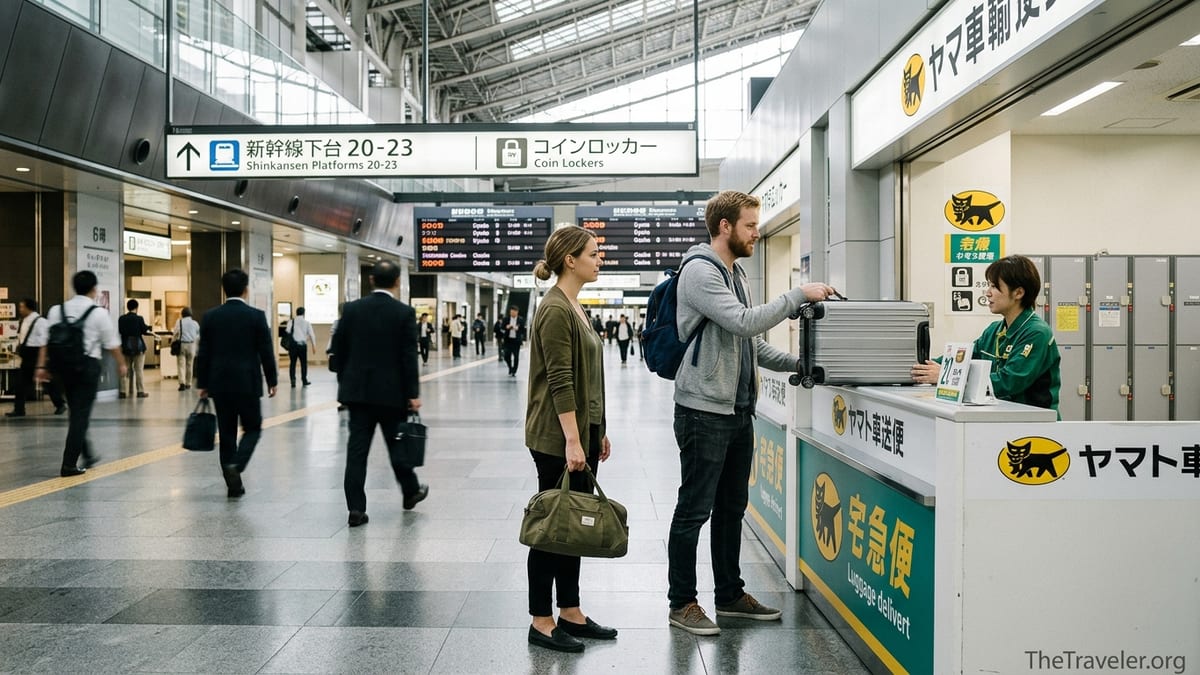
Japan National Tourism Organization actively promotes what it calls hands free travel, encouraging visitors to move around the country with only a small daypack while larger suitcases are delivered separately. In practical terms, this means checking your main luggage with a courier at your hotel, at airport counters or even at some major train stations, then hopping on a train with just a change of clothes and essentials.
JNTO’s guidance reflects a few realities on the ground. Stations like Tokyo, Shinjuku or Kyoto can involve multiple staircases, long underground passages and crowded platforms where rolling a giant suitcase is difficult and sometimes unsafe. Older ryokan in areas such as Hakone or Kanazawa may have narrow corridors and tatami rooms where big hard-shell cases feel out of place. By using luggage forwarding, lockers and smart packing, you make public transport more pleasant both for yourself and for the people around you.
Hands free travel is not just for long-distance routes. Travelers use it to send big bags ahead when doing day trips out of Osaka, to enjoy a final day of sightseeing in Tokyo before flying home from Haneda or Narita, or to keep ski gear out of the way when moving between resorts in Hokkaido and city hotels in Sapporo. Once you see how easy it is to send a suitcase from a hotel front desk, you may find yourself wondering why other countries have not adopted the same model.
Takkyubin Basics: How Luggage Forwarding Works
The backbone of luggage forwarding in Japan is takkyubin, a door-to-door parcel and baggage service offered by major companies such as Yamato Transport and Sagawa Express. Travelers most often encounter Yamato by its black cat logo on yellow signs at airport counters, hotel front desks and convenience stores. These services can move suitcases, golf bags, skis and boxes between hotels, private accommodations and airports within Japan.
Forwarding is usually an overnight or two-day service between cities. For example, sending a standard checked-size suitcase from a hotel in Shinjuku to a hotel in central Kyoto typically costs in the ballpark of 2,000 to 3,000 yen per bag, depending on size and distance, and will often arrive the next day if you send it by late morning. Some routes, such as airport to city-center hotel within the same metro area, may offer same-day delivery when you check in early, while longer distances like Hokkaido to Kyushu usually require at least two days.
Size and weight rules are generous by airline standards but not unlimited. A common maximum for standard luggage services is around 160 centimeters in combined length, width and height, with weight limited to roughly 25 to 30 kilograms per piece. Larger items such as ski bags or big cardboard boxes are usually accepted under higher size categories at a higher price. Travelers rarely run into problems if they are sending normal checked suitcases; issues typically arise only with oversize sports gear or very heavy boxes.
You do not need an account or Japanese phone to use takkyubin. Payment is usually in cash or card at the counter, and many hotels can add the fee to your room bill. Delivery labels are in Japanese, but most service counters and hotel staff provide bilingual forms or will fill them out for you if you show your hotel confirmations. As long as you know when you will check in and have your next hotel’s name and address, you can start traveling luggage free almost immediately.
Where to Drop Off Your Bags and Typical Delivery Timing
Most visitors encounter luggage forwarding first at their hotel. Mid-range and higher-end hotels in cities like Tokyo, Kyoto and Osaka almost always handle takkyubin at the front desk. You roll your suitcase to reception in the morning, say you want to send it to your next hotel, and the staff will bring out a label, confirm your destination and preferred delivery date, and call the courier for pickup. The courier usually comes once or twice a day, often late morning and mid-afternoon, but the precise time is up to the local depot, not the hotel.
Convenience stores are the second most useful option. Major chains such as 7-Eleven, FamilyMart and Lawson often have a small Yamato or Sagawa logo near the entrance or by the counter, indicating they accept takkyubin drop-offs. This is particularly helpful if you are staying in a small guesthouse or vacation rental without staff. In practice, travelers walk in with their suitcase, tell the cashier they want to send takkyubin, and are given a form and a place to attach the label to the handle. In busy neighborhoods in Tokyo or Osaka, late-morning cut-off times for next-day delivery to nearby regions are common, while evening drop-offs usually mean arrival a day later.
Airports are another key hub. At Narita, Haneda, Kansai and many regional airports, dedicated baggage delivery counters run by companies such as Yamato and JAL ABC accept bags for hotel delivery and for shipping home addresses within Japan. For example, a traveler arriving at Narita in the morning can hand over two large suitcases at an airport counter for same-day delivery to a central Tokyo hotel, then ride the train into the city with just a backpack. Similarly, someone departing from Kansai Airport can check their suitcase at their Osaka hotel in the morning using a hotel-to-airport service and pick it up at an airline-affiliated counter in the departure lobby that evening before check-in.
Across all these channels, timing is the main thing to keep in mind. Within the same region, airport-to-hotel or station-to-hotel can sometimes be same day if you drop off early enough, often by mid-morning. Longer distances such as Tokyo to Hiroshima or Sapporo to Kyoto are more reliably next-day or two-day deliveries. Public holiday periods, heavy snow in winter and remote islands can all add an extra day. As a rule of thumb, if your itinerary absolutely depends on having a bag at your next hotel by a specific time, add a one-day buffer so that any delay does not disrupt your plans.
Filling Out the Shipping Form and Working With Hotels
Luggage forwarding forms can look intimidating at first glance, but the essential information is straightforward: your name and contact details, the destination name and address, a contact number for the destination, the desired delivery date and the contents type (usually just “luggage”). At hotel front desks, staff typically fill in the Japanese address and hotel phone for you based on your next booking, while you verify your own name and mobile number and choose the delivery date.
When using a convenience store or a standalone courier office, it helps to have your next hotel’s name and address in Japanese. Many hotel websites list both English and Japanese versions of their address, and most booking confirmations include the Japanese address as well. If your confirmation is in English only, you can show it on your phone and staff will often look up the Japanese version or write it for you on the form. The contact number can usually be the hotel’s main phone line; you do not need a local SIM card for your own number as long as the destination can be reached if there is any issue.
One practical tip is to tell your next hotel ahead of time that you will be forwarding luggage. A short message such as “We will send one suitcase by takkyubin arriving on April 10 under the name Smith” is enough. Many hotels already expect this and have back-of-house storage space. Boutique ryokan and small guesthouses particularly appreciate the heads-up because they may store incoming bags in staff areas or spare rooms until you arrive. On check-in day, you usually find your suitcase already placed in your room or waiting near reception with a tag.
Payment and insurance are equally simple. Standard takkyubin fees are flat-rate based on size bands and distance, so you will be quoted a price per piece when you ship. Many services include basic coverage against loss or damage up to a certain value. If you are sending particularly valuable items, the safer option is to carry them with you in your daypack rather than placing them in forwarded luggage. In practice, lost or significantly delayed bags are rare, but it is still wise to keep passports, cash, electronics and essential medication on your person.
Planning Around One-Night Stops: Example Tokyo–Hakone–Kyoto
Forwarding is especially powerful on itineraries with one-night stays where hauling a full suitcase would be inconvenient. A common example is the classic route from Tokyo to Kyoto with a night in Hakone. Instead of wrestling large luggage onto the Hakone Tozan Railway and funicular, many travelers send their big suitcase directly from their Tokyo hotel to their Kyoto hotel and carry only an overnight bag to Hakone.
In practice, this might look like checking out of a Shinjuku hotel on Monday morning. At 8:30 a.m., you bring your main suitcase to the front desk and ask to send it to your Kyoto hotel, where you will check in on Tuesday. The staff fill in the takkyubin form and confirm that it will arrive in Kyoto on Tuesday afternoon. You pay the forwarding fee, remove anything you will need in Hakone like toiletries and a change of clothes, and then travel to Hakone with a small duffel or backpack. On Tuesday you ride the Shinkansen from Odawara to Kyoto with your overnight bag only, and when you reach your Kyoto hotel in the afternoon, your suitcase is already waiting.
The same approach works for other short detours: spending one night in Takayama between Tokyo and Kanazawa, two days in the Fuji Five Lakes area, or a side trip to Naoshima between Osaka and Hiroshima. The key is to think one or two nights ahead, check delivery time estimates, and send your main suitcase to the place where you will stay the longest. You can even chain forwarding: send a large bag from Tokyo to Hiroshima while you travel slowly through Nagoya and Osaka, then forward it again from Hiroshima to Fukuoka while you stop in Miyajima.
When planning, pay attention to your arrival day. Some smaller accommodations in rural areas may not accept courier deliveries on certain days or may have limited front desk hours. If you are arriving at a countryside ryokan on a day when they are short staffed, it is polite to confirm by email that they can receive forwarded bags the day before. If they prefer not to, you can instead send the suitcase to a large hotel near a major station you will pass through and pick it up there when you return to a big city.
What to Pack in Your Overnight or “Transit” Bag
Traveling hands free does not mean traveling empty handed. When your main suitcase is en route by takkyubin, you still need a small overnight bag or backpack with enough essentials for one or two nights. For many travelers this becomes a hybrid between a personal item and a compact weekender: something light enough to carry comfortably on local trains, but big enough for clothes and toiletries.
For an overnight in Hakone between Tokyo and Kyoto, for example, a practical packing list might include nightwear, a fresh shirt or top for the next day, underwear and socks, a light sweater depending on season, compact toiletries and basic cosmetics, phone and camera chargers, and any necessary medication. If you plan to visit hot spring baths, a small towel and a bag for wet items can be helpful, though many ryokan provide towels and yukata. Consider packing a thin foldable tote bag inside your daypack; if you buy souvenirs or extra snacks, the tote can absorb the overflow without turning your backpack into an unmanageable mess.
Documents and valuables should always stay with you rather than in forwarded luggage. Keep your passport, travel insurance details, wallets and cards, rail passes, and main electronics in your overnight bag. A compact power bank and a multi-port USB charger can be especially useful on days when you are changing trains frequently. For families, packing one shared overnight bag for everyone rather than individual small bags can simplify boarding and disembarking, since only one adult needs to manage it while the others handle tickets and children.
Weight is worth considering as well. While a 30-liter backpack stuffed with clothes and gadgets might be manageable at first, it can feel heavy after climbing multiple staircases at Kyoto Station or walking uphill to a ryokan in Hakone. Aim for a bag that you can easily lift one-handed and place on an overhead rack if needed. Many travelers find that once they experience the comfort of moving between cities with only this small bag, they start forwarding their main suitcase more often than originally planned.
Lockers vs Luggage Forwarding vs Shinkansen: Pros and Cons
Luggage forwarding is powerful, but it is not the only option. Station coin lockers are ubiquitous across Japan and are ideal for short-term storage when you do not need your suitcase at all for a day. Major hubs like Tokyo, Ueno, Osaka and Kyoto Stations have banks of small, medium and large lockers, often near ticket gates or in underground concourses. Prices vary by size and location, but large lockers that fit full-size suitcases are commonly in the low hundreds of yen per calendar day, with smaller ones cheaper. You pay at the machine using coins or IC cards, stash your bag, and retrieve it later that same day or the next.
Lockers work best when you are doing a day trip and returning to the same station. For example, if you are based in Kyoto but taking a day trip via Shinkansen to Hiroshima, you might lock your large suitcase at Kyoto Station in the morning, bring only a daypack to Hiroshima, then pick up the suitcase in Kyoto that evening. Where lockers are less suitable is on itineraries where you are sleeping in a different city that night, because you must come back to the station where you stored the bag to retrieve it. During peak seasons, large lockers near popular exits can also fill up early in the day, leaving only smaller sizes available.
Carrying luggage directly onto the Shinkansen is the third approach. On lines like the Tokaido Shinkansen between Tokyo and Shin-Osaka, there are clear rules about oversized baggage. Standard suitcases that are within roughly 160 centimeters total in three dimensions typically fit either in the overhead racks or in the space behind the last row of seats in each carriage. Bags larger than this threshold require a reservation for an oversized baggage seat, which is booked at the same time as your ticket. On many other Shinkansen routes, such as those operated by JR East in the Tohoku and Hokuriku regions, luggage racks and deck spaces are available without special reservation, though general size and weight limits still apply.
The strongest case for forwarding rather than carrying is comfort and flexibility. With no large suitcase to worry about, you can move freely through transfer stations, hop onto unreserved Shinkansen cars when convenient, and avoid the stress of lifting heavy bags onto racks. The main trade-off is that forwarding requires you to think at least one day ahead and accept that you will not have access to your suitcase for a period of time. Lockers are more spontaneous and perfect for a few hours or a single day, while carrying on the train costs nothing but can be tiring and awkward in crowds. Many visitors use a mix: forwarding between major bases, lockers for day trips, and direct carry for shorter hops where connections are simple.
Shinkansen Bag Rules and Practical Tips
To decide whether to forward or carry, it helps to understand current Shinkansen luggage rules. On the main Tokaido, Sanyo and Kyushu Shinkansen corridor linking Tokyo with Osaka, Hiroshima and Fukuoka, passengers bringing very large suitcases over a defined size threshold must reserve seats that include access to an oversized baggage area. Standard airline-style checked suitcases that fall under that threshold are usually fine without special booking and can go on overhead shelves or in open spaces near doors, but extremely large cases and bulky sports gear need reservations.
In practice, travelers with typical large suitcases face two questions: can they comfortably lift the bag into the overhead rack, and are they traveling at peak times when aisle and door spaces are crowded. If you are arriving in Japan after a long international flight with a heavy hard-shell case and transferring directly to a Shinkansen at Tokyo Station around evening rush hour, forwarding from the airport or spending a night in Tokyo and forwarding from the hotel the next morning can make that first long-distance ride much smoother. On the other hand, if you are traveling at off-peak times with lighter bags, carrying them onto the train is often manageable as long as you keep them out of aisles and doorways.
Families and groups should pay extra attention to luggage management on platforms. Shinkansen trains stop for only a few minutes, and it can be stressful to load multiple large suitcases while also shepherding children and finding seats. One strategy is for one adult to board first with tickets and secure seats while another adult passes luggage up from the platform. Another is to reserve seats in the last row of a car, where there is often free space behind the seats for large bags, then board early and place your suitcase there. If you find yourself on board with luggage that is clearly too big for the overhead racks and no reserved space, the polite approach is to ask the conductor where to place it rather than leaving it blocking doors.
Regional trains and limited express services that are not Shinkansen can have smaller luggage spaces and stricter crowding, especially during commuter hours. On routes like the Hakone Tozan Railway, Nankai line to Koyasan or local trains across suburban Tokyo, forwarding big suitcases ahead and carrying only a small bag makes a significant difference. Even if your luggage technically complies with size rules, the practical comfort of you and your fellow passengers may be better served by takkyubin on those legs.
The Takeaway
Japan’s luggage ecosystem is unusually well developed, but it still rewards a bit of advance planning. If you build forwarding into your itinerary, especially around one-night stays and complex transfers, you can experience the country with a level of comfort that surprises many first-time visitors. Think of your big suitcase as cargo that only needs to be where you are staying the longest; the rest of the time, a thoughtfully packed overnight bag is more than enough.
For many travelers, a balanced strategy works best. Use takkyubin to send heavy bags from Tokyo to Kyoto while you relax in Hakone or Fuji Five Lakes. Take advantage of station lockers for day trips that start and end in the same place. Carry luggage onto the Shinkansen when distances are short, schedules are simple and you can safely manage the weight. Keep JNTO’s hands free travel philosophy in mind and you will find that even navigating vast stations like Tokyo or Osaka can feel surprisingly light.
Above all, do not be shy about asking for help. Hotel staff are used to filling out forwarding forms, airport counters routinely explain delivery options in English, and station attendants can point you to locker areas or luggage spaces on trains. With their assistance and a bit of foresight, you can trade the image of sweating behind a suitcase for one of strolling through Japan’s stations and streets with just a small bag and a lot more energy.
FAQ
Q1. How far in advance should I send my suitcase by takkyubin between cities?
For most intercity routes such as Tokyo to Kyoto or Osaka, sending your bag one day before you need it is usually sufficient, especially if you drop it off by late morning, but building in a two-day buffer around holidays or long distances gives extra peace of mind.
Q2. Can I forward luggage directly from the airport to my first hotel and avoid carrying it on the train?
Yes, major airports like Narita, Haneda and Kansai have luggage delivery counters that can send bags directly to city hotels, often with same-day delivery if you arrive in the morning, so you can ride into town carrying only hand luggage.
Q3. Is there a risk that my forwarded suitcase will get lost or significantly delayed?
While no system is perfect, serious problems are rare, and most travelers report their bags arriving on the promised day; it is still wise to keep passports, money, electronics and medication with you rather than in forwarded luggage.
Q4. How much does it typically cost to send a suitcase within Japan?
Prices vary by company, size and distance, but a standard checked-size suitcase sent between major cities often costs in the approximate range of 2,000 to 3,000 yen per piece, with larger or heavier items costing more.
Q5. What happens if I arrive at my next hotel before my forwarded luggage?
If your bag is scheduled for later that day, most hotels will hold it at the front desk or send it up to your room when it arrives, so you can check in with your overnight bag first and access the suitcase later without waiting in the lobby.
Q6. Are station coin lockers a good alternative to forwarding large luggage?
Coin lockers are excellent for short-term storage when you will return to the same station that day, such as a day trip, but forwarding is more practical when you are sleeping in a different city and do not plan to come back to the station where you started.
Q7. Do I need a special seat reservation for large suitcases on all Shinkansen lines?
On some major Shinkansen routes, very large bags over a set size require a reserved seat with oversized baggage space, while standard large suitcases that fit overhead usually do not; on other lines, general luggage racks and deck spaces are available without special reservations.
Q8. Can I use takkyubin if I am staying in a small guesthouse or vacation rental without a staffed front desk?
Yes, you can often drop off bags at nearby convenience stores that handle courier services and send them to any address, but it is important to confirm with your accommodation that they can receive and store luggage before you arrive.
Q9. What should I always keep with me instead of in forwarded luggage?
You should keep passports, cash, bank cards, travel documents, electronics, chargers, essential medication and at least one change of clothes with you in your overnight bag rather than sending them inside your forwarded suitcase.
Q10. Is it possible to forward luggage multiple times during one trip, for example from Tokyo to Hiroshima and then to Fukuoka?
Yes, many travelers forward suitcases several times across a longer itinerary, sending them from one base city to the next while they travel in between with smaller bags, as long as each hotel or accommodation can receive the delivery.