


Ise Jingu is Japan’s most sacred Shinto site, and from Nagoya it is also one of the most practical full day trips you can make. Direct Kintetsu trains cover the distance in roughly 80 to 100 minutes, so with an early start you can comfortably visit both Geku and Naiku, stroll the atmospheric streets of Oharaimachi and Okage Yokocho, and still be back in Nagoya by evening. This guide walks through realistic timings, route choices, and add ons like Meoto Iwa and Toba so you can build a day that feels immersive rather than rushed.
Understanding Ise as a Day Trip from Nagoya
From central Nagoya, Ise sits close enough that a one day visit makes sense for many travelers. Direct Kintetsu Limited Express trains from Kintetsu Nagoya Station reach Iseshi or Ujiyamada in about 80 to 90 minutes, and some slower services take around 100 minutes. JR’s Rapid Mie from JR Nagoya Station typically needs about 90 minutes to reach Iseshi. In practice this means you can leave Nagoya between 7:00 and 8:00 in the morning and be walking toward Ise Jingu Geku by about 9:00 to 9:30.
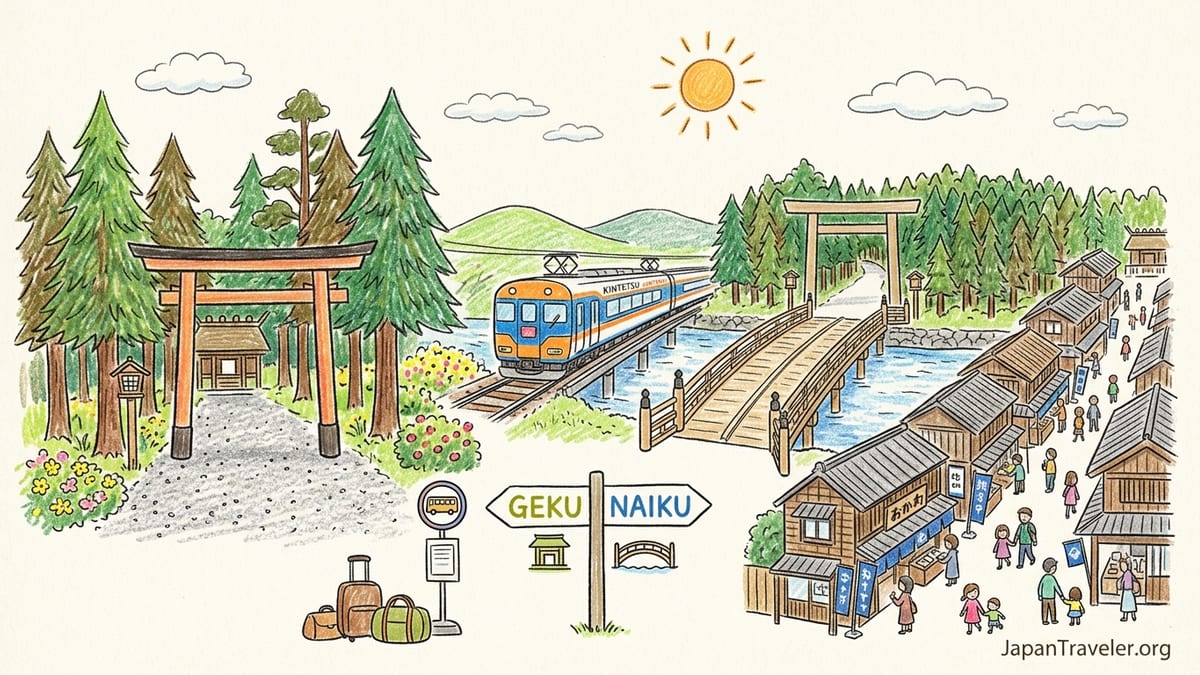
The core of a first time visit is Ise Jingu’s two main shrines. Geku, formally Toyouke Daijingu, lies closer to the train stations and is usually visited first. Naiku, or Kotaijingu, is the more famous Inner Shrine surrounded by deep forest and fronted by the traditional townscape of Oharaimachi and Okage Yokocho. A realistic day from Nagoya focuses on these two areas, using local buses between them, then adds side trips only if you have spare energy and do not mind a late return.
Most visitors find that a well planned day at Ise feels full but not exhausting. A common pattern is arriving around 9:30, visiting Geku until about 11:00, transferring by bus to Naiku, spending two to three hours around Naiku, Oharaimachi, and Okage Yokocho, then heading back toward the station in the mid to late afternoon. This leaves time for a relaxed dinner in Nagoya. Trying to add Toba’s attractions or multiple coastal stops is possible, but it changes the character of the day from contemplative to highly scheduled.
Because Ise Jingu is an active religious center rather than a museum, there are few fixed “must see” exhibits. The experience is about atmosphere, walking, and small details: the feel of gravel paths underfoot, the scent of cedar forest, the sound of the Isuzu River by Naiku. Building space into your day for unhurried walking is just as important as choosing the right train.
Kintetsu Limited Express vs JR Rapid Mie
Travelers starting in Nagoya essentially have two rail options to reach Ise: Kintetsu Limited Express or JR Rapid Mie. The Kintetsu Limited Express runs from Kintetsu Nagoya Station directly to Iseshi and Ujiyamada, usually in about 80 to 90 minutes. Seats are reserved and more comfortable, with typical one way fares around 2,800 yen including the limited express surcharge for standard class. You buy both the base ticket and the limited express ticket before boarding, either at a ticket machine with an English menu or at the Kintetsu ticket counter inside the station building.
JR’s Rapid Mie departs from JR Nagoya Station, which is convenient if you are staying near the Shinkansen side of Nagoya or using JR rail passes. The journey to Iseshi takes roughly 90 minutes without transfers. The Rapid Mie uses commuter style rolling stock with non reserved seating for most cars, so the level of comfort is closer to a rapid suburban train than an intercity express. For Japan Rail Pass holders, the main complication is that a short section of the line runs on Ise Railway tracks, which requires an additional local fare, often around 500 yen, paid out of pocket on top of the pass.
In terms of cost, JR Rapid Mie can be slightly cheaper if you already hold a JR pass or if you prioritize base fare alone. Kintetsu is usually more expensive by a modest amount but offers a more relaxed ride, guaranteed seat reservations, and convenient arrival close to Naiku and Geku bus connections. Travelers who value comfort and predictability, such as families with children or those visiting on weekends and holidays, often choose Kintetsu for the out and back journey, treating the train itself as part of the experience.
Practically speaking, your accommodation location in Nagoya often decides it. If you are staying near JR Nagoya Station or arriving that morning by Shinkansen, JR Rapid Mie avoids a cross station transfer. If you are already on the Meitetsu or Kintetsu side of the station area or you want reserved seats and simple ticketing, Kintetsu Limited Express is the smoother choice. In both cases, departures are generally at least hourly, so you can adjust your plan around crowds and your preferred start time.
Iseshi vs Ujiyamada: Choosing Your Arrival Station
Ise has two main rail gateways. Iseshi Station is shared by JR and Kintetsu and sits slightly closer to Geku. Ujiyamada Station is a Kintetsu only terminal with a grand retro facade and a compact bus plaza that serves as a key hub for buses to Naiku and Toba. For most day trippers focused on Ise Jingu, the difference between the two is small in terms of walking time, but it influences how you structure your visit.
If you arrive on JR Rapid Mie, you will disembark at Iseshi Station. From here, Geku’s torii gate is roughly a 10 to 15 minute walk along clear sidewalks with signage in English and Japanese. There are luggage lockers inside the station building and near the tourist information counter, which is useful if you are carrying a daypack or small suitcase. Many visitors walk straight to Geku, spend about an hour exploring the grounds, then return to the station bus stop to catch a bus across town to Naiku.
Travelers arriving by Kintetsu Limited Express can choose trains that stop at both Iseshi and Ujiyamada. Some people prefer to get off at Iseshi to visit Geku first, then move by bus. Others ride one more stop to Ujiyamada and start with Naiku. Ujiyamada’s bus plaza generally has slightly more frequent buses toward Naiku and Futami, and the station building itself, with its domed roof and stained glass, is worth a quick look. On busy weekends, Ujiyamada can sometimes feel more crowded because it concentrates Kintetsu passengers headed straight to Naiku.
A practical compromise is to arrive at Iseshi in the morning so you can walk to Geku and enjoy the quieter atmosphere, then later catch a bus from Naiku back to Ujiyamada in the afternoon for your return Kintetsu Limited Express. This creates a simple loop that minimizes backtracking. For example, you might book a 7:30 Kintetsu Limited Express from Nagoya to Iseshi, arrive around 9:00, and schedule your evening return from Ujiyamada around 17:00, giving you roughly seven hours on the ground in Ise.
Visiting Geku and Naiku Efficiently
Ise Jingu is spread between Geku and Naiku, and seeing both on a day trip is realistic if you keep your schedule focused. Geku tends to feel quieter and more contemplative. From Iseshi Station, you follow signs for about 10 to 15 minutes to the shrine entrance, pass under the torii, and walk through a forested approach. A relaxed visit, including the main hall, auxiliary shrines, and a pause by the small pond or sacred tree areas, typically takes 45 to 75 minutes depending on how much time you spend in silent observation.
After Geku, you move to Naiku, which lies several kilometers away. The most efficient method is the local bus. Buses connect Geku and Naiku in roughly 20 minutes, with stops near both shrine entrances. The ride is short but can be busy around midday and on weekends, so budget a little waiting time. If you started your Geku visit around 9:15 and leave the grounds at 10:30 or 11:00, you can usually arrive at Naiku before or just after lunch, which works well because the food options around Oharaimachi and Okage Yokocho are far better than near Geku.
Naiku itself can easily absorb two hours or more. From the bus stop closest to Jingu Kaikan or the main Naiku area, you cross Uji Bridge onto the shrine grounds and walk along a long gravel path shaded by tall cedars. Reaching the main sanctuary involves gentle slopes and steps. There are no interior photos allowed and the architecture is intentionally simple, so the experience is mostly about the journey through the forest and the quiet at the top. Many visitors stop at the riverside area near Uji Bridge to rinse hands or simply watch the water flow before or after their shrine visit.
If you aim to depart Naiku by mid afternoon, a reasonable schedule might look like this: arrive at Geku around 9:15, depart around 10:30, reach Naiku by bus at 11:00, allocate about 60 to 90 minutes for Naiku itself including walking, and then spend the early afternoon in Oharaimachi and Okage Yokocho for food and shopping. This structure leaves a margin for lines at bus stops, slow walking, and contemplative time at the shrines, instead of turning the visit into a race between attractions.
Oharaimachi and Okage Yokocho: How Long to Stay
Oharaimachi and Okage Yokocho adjoin the entrance to Naiku and are integral to the Ise experience. Oharaimachi is an 800 meter stone paved street of restored merchant houses and wooden facades, lined with specialty shops selling Ise udon, local sweets, and souvenirs. Okage Yokocho is a denser cluster of alleys and courtyards within that area, with small museums, tea houses, and more focused shopping. Together they are where you will likely eat lunch, sample desserts, and pick up gifts.
For many travelers, 90 minutes to two hours is a comfortable amount of time here. This allows for a sit down lunch, a slow walk along Oharaimachi, and a casual detour through the side alleys of Okage Yokocho. For instance, you might arrive back from Naiku proper around 12:30, choose a bowl of Ise udon at a popular shop, then stop at a famous sweets shop for akafuku rice cakes before browsing craft stores that specialize in local ceramics or sake. If you are the type to linger in shops, plan for the full two hours.
On particularly busy days such as Golden Week, weekends in autumn, or New Year periods, queues for well known eateries can easily add 20 to 30 minutes per stop. In that case, it is wise to either eat slightly early, around 11:00, or slightly late, after 13:30, and be flexible about your choice of restaurant. If you only have one day, it is rarely worth waiting an hour for a specific meal. Many less famous shops serve excellent Ise udon or seafood bowls with much shorter waits.
Because Oharaimachi and Okage Yokocho lie immediately outside Naiku’s entrance, you can move back and forth as needed. Some visitors prefer to have a snack or light lunch before entering Naiku, then return later for coffee or dessert. Others prioritize visiting the shrine first in case of sudden weather changes, then reward themselves with food afterward. Either pattern works, as long as you keep an eye on the time of your return train, especially if you have a reserved Kintetsu Limited Express in the early evening.
Local Buses and Getting Around Ise
Ise’s local buses are essential for making the most of a short visit. The route between Geku and Naiku takes around 20 minutes and runs throughout the day, connecting stops near Iseshi Station, Geku, and Naiku. There are also buses from Iseshi and Ujiyamada to Futami and onward toward Toba. Most tourists pay in cash using the fare box at the front of the bus, where you take a numbered ticket when boarding and match the number to a digital fare display to see what you owe when getting off.
For a day trip focused on the shrines, you will likely ride the Geku–Naiku bus at least once, possibly twice if you return the same way. A simple example: arrive at Iseshi, walk to Geku, then after your visit take the bus to Naiku. After finishing at Naiku and Oharaimachi, you can either ride the bus back to Geku or continue to Ujiyamada Station depending on your reserved return train. Buses from Naiku usually stop at Ujiyamada, which is convenient for Kintetsu passengers. Travel times and connections are typically posted at the bus stops in Japanese and English, and staff at the tourist information counters in Iseshi or Ujiyamada can help you confirm the next departure.
Because traffic around Naiku can be heavy during peak holidays and weekends, buses occasionally take a little longer than the timetable suggests. When planning your return to Nagoya, give yourself a buffer of at least 20 to 30 minutes between your expected arrival at the station and the departure of any reserved train. For example, if you have a 17:00 Kintetsu Limited Express from Ujiyamada, aim to leave Naiku on a bus no later than around 16:00 to 16:15. This buffer covers small delays, ticket purchases, and a quick stop to collect luggage from lockers if needed.
For those who prefer more independence, taxis are widely available at Naiku and near the stations, but the cost adds up quickly compared with the bus, especially for solo travelers. For two or three people sharing, a taxi between Naiku and Iseshi can be a reasonable backup option if a bus is overcrowded or you are cutting it close for a train. However, relying exclusively on taxis is rarely necessary for a straightforward day trip centered on Ise Jingu.
Adding Meoto Iwa or Toba: Is It Realistic in One Day
Meoto Iwa, the “Wedded Rocks” near Futami, is a popular add on to an Ise day trip. From Iseshi or Ujiyamada, local buses reach Futami in about 20 minutes. The stop near Futami Okitama Shrine is a short walk from the shoreline, where you can see the two rocks bound by shimenawa rope in the water. A simple visit including the bus ride, a short walk along the coast, and some time for photos usually takes about 90 minutes to two hours round trip from Ujiyamada or Iseshi, assuming smooth connections.
Toba, further along the coast, hosts attractions like Mikimoto Pearl Island and aquariums. Reaching Toba from Iseshi or Ujiyamada by train can take roughly 30 to 40 minutes each way, and each major attraction there can absorb one to two hours. That means adding Toba on top of both Geku and Naiku and time in Oharaimachi inevitably compresses your schedule. For example, a traveler who spends the morning at Geku and Naiku, a couple of hours in the shopping streets, then tries to ride a train to Toba for even one attraction will likely be returning to Nagoya quite late in the evening.
In practice, adding Meoto Iwa is realistic if you are comfortable with a somewhat full day and you keep your shrine visits efficient. A sample pattern might be: depart Nagoya around 7:30, arrive at Iseshi around 9:00, visit Geku until 10:15, bus to Naiku, tour Naiku until 12:00, eat a quick lunch and brief stroll in Oharaimachi until 13:15, then ride a bus or train to Futami and spend 60 to 90 minutes at Meoto Iwa before returning to Ujiyamada for a 17:00 or 18:00 train back to Nagoya. This schedule gives you only limited browsing time in Okage Yokocho, so it suits travelers who prioritize varied sights over shopping.
By contrast, combining both Meoto Iwa and Toba with a full visit to Geku and Naiku in a single day is possible only with a very early departure and a late return, and even then it can feel rushed. Small delays in buses or indecision over lunch can easily cascade into missed trains. Unless you are comfortable treating the day as a timed itinerary with minimal flexibility, it is wiser to choose either Meoto Iwa or Toba, not both, for a Nagoya based day trip.
When an Overnight Stay in Ise Shima Makes Sense
There are several clear cases where staying overnight in Ise or the wider Ise Shima region makes more sense than trying to compress everything into a day trip. The first is if you want to see Ise Jingu at its quietest early in the morning. Staying in Ise city allows you to reach Geku or Naiku around opening time, when the paths are still relatively empty and the light in the forest is soft. After a morning at the shrines, you still have almost a full day for Meoto Iwa, Toba, or even a cruise among the islands of Ago Bay.
The second case is if you are interested in a traditional ryokan or onsen experience along the coast. Towns like Toba and the shores of Ago Bay host seaside ryokan that serve elaborate kaiseki dinners featuring local seafood. In that scenario, you might visit Geku and Naiku on day one, transfer to a ryokan in Toba for dinner and hot springs, then visit Meoto Iwa or Mikimoto Pearl Island the next morning before returning to Nagoya or continuing on to another region. This creates a more varied trip that combines spiritual sites, food, and coastal scenery.
Overnighting is also sensible for travelers with children, older relatives, or anyone who prefers slower days with built in rest. Instead of stringing together multiple buses and trains in one day, you can spread the same activities across two lighter days. For example, day one could be Geku, Naiku, and plenty of time in Oharaimachi and Okage Yokocho, with early evening shopping at Iseshi or Ujiyamada before checking into a simple business hotel. Day two could be focused solely on Meoto Iwa and Toba, with unhurried time at the aquarium or on a bay cruise.
If your wider itinerary already includes several intense city days in Tokyo, Nagoya, or Osaka, treating Ise Shima as a one or two night “breather” can be particularly rewarding. Rather than darting in and out from Nagoya, you allow the slower rhythms of the area to reset your pace. Even a single night in Ise, waking up early enough to walk through the Naiku forest before tour buses arrive, can feel very different from a quick box ticking day trip.
The Takeaway
Planning an Ise day trip from Nagoya starts with choosing your rail route and setting realistic expectations. Kintetsu Limited Express offers a comfortable, reserved seat ride of about 80 to 90 minutes from Kintetsu Nagoya Station to Iseshi or Ujiyamada, while JR Rapid Mie from JR Nagoya Station typically takes around 90 minutes to Iseshi with simpler connections for JR rail pass users. From either station, Geku is easily reached on foot, and local buses tie together Geku, Naiku, and the stations in about 20 minutes.
Once on the ground, the most satisfying days focus on depth rather than distance. Visiting both Geku and Naiku, then spending at least 90 minutes to two hours in Oharaimachi and Okage Yokocho for food and atmosphere, already fills a full but comfortable day. Adding Meoto Iwa works if you accept a tighter schedule and limit browsing and cafe time. Toba and its attractions are better suited to an itinerary that includes at least one night in Ise Shima, allowing you to enjoy both the shrines and the sea without watching the clock.
By thinking through train choice, station arrival, bus use, and how long you want in each area, you can shape an Ise visit that matches your travel style. Whether you step off an early Kintetsu Limited Express and return to Nagoya after sunset, or linger for a coastal ryokan stay, Ise Jingu and its surrounding streets reward the time you give them with a distinctive blend of sacred atmosphere, traditional townscape, and small everyday details that stay with you long after the trip ends.
FAQ
Q1. Is an Ise day trip from Nagoya really enough time to see Ise Jingu?
An early start from Nagoya gives you enough time to visit both Geku and Naiku, plus a relaxed meal and short stroll in Oharaimachi and Okage Yokocho. It will feel like a full day, but if you avoid adding too many side trips, it is manageable without being exhausting.
Q2. Which is better from Nagoya, Kintetsu Limited Express or JR Rapid Mie?
Kintetsu Limited Express offers reserved seats and a slightly more comfortable ride in about 80 to 90 minutes, at a modestly higher cost. JR Rapid Mie is usually a bit cheaper and convenient for JR pass holders, with a travel time of around 90 minutes but mostly non reserved commuter style seating.
Q3. Should I arrive at Iseshi or Ujiyamada Station for Ise Jingu?
Iseshi is best if you want to walk to Geku first, since it is roughly 10 to 15 minutes away on foot. Ujiyamada is convenient if you plan to focus on Naiku and use buses, as many routes toward Naiku and Futami start or stop there. Many visitors arrive at Iseshi and depart from Ujiyamada to create a simple loop.
Q4. How much time should I plan for Oharaimachi and Okage Yokocho?
Most travelers find that 90 minutes to two hours works well, allowing for a sit down lunch, a slow walk along Oharaimachi’s main street, and some browsing in Okage Yokocho. On busy weekends or holidays, you may want a little longer to account for lines at popular restaurants.
Q5. Can I visit Meoto Iwa and still return to Nagoya the same day?
Yes, if you prioritize efficiency and do not mind a slightly packed schedule. Buses from Iseshi or Ujiyamada reach Futami in about 20 minutes, and a brief visit to Meoto Iwa can be done in 60 to 90 minutes once you arrive. You will have less leisure time at Oharaimachi, so decide which experiences matter most to you.
Q6. Is it realistic to add Toba to an Ise day trip from Nagoya?
Adding Toba on top of Geku, Naiku, and time in Oharaimachi makes for a very long and tightly scheduled day. Trains from Iseshi or Ujiyamada to Toba take roughly 30 to 40 minutes each way, and major attractions there need at least one to two hours. In most cases, Toba fits better into an overnight Ise Shima stay.
Q7. Do I need to reserve seats in advance on Kintetsu Limited Express?
Seat reservations are required on Kintetsu Limited Express, and you can usually book on the day at Kintetsu Nagoya Station. For busy periods such as weekends in autumn or national holidays, reserving a specific morning departure a day or two ahead is wise, especially if you are traveling as a group and want to sit together.
Q8. How much walking is involved in visiting Geku and Naiku?
Expect a fair amount of walking on gravel paths and some steps, particularly at Naiku. A typical visit can involve several kilometers of walking spread across the day, including the stroll between Iseshi Station and Geku, the shrine approaches, and time spent exploring Oharaimachi and Okage Yokocho. Comfortable shoes are important.
Q9. When does it make sense to stay overnight in Ise or Ise Shima?
An overnight stay makes sense if you want unhurried visits to Geku and Naiku, plus Meoto Iwa or Toba, or if you are interested in a seaside ryokan and onsen experience. It is also a good idea for families, older travelers, or anyone who prefers slower paced days instead of a packed one day itinerary.
Q10. What is a simple sample schedule for a Nagoya to Ise day trip?
A practical example is: depart Nagoya around 7:30 on a Kintetsu Limited Express, arrive at Iseshi around 9:00, walk to Geku and visit until about 10:30, bus to Naiku and explore the shrine until 12:00, then spend 12:00 to 14:00 in Oharaimachi and Okage Yokocho for lunch and shopping. Afterward, make your way by bus back to Ujiyamada or Iseshi for a 16:00 to 18:00 train returning to Nagoya, depending on how relaxed you want your afternoon to be.