

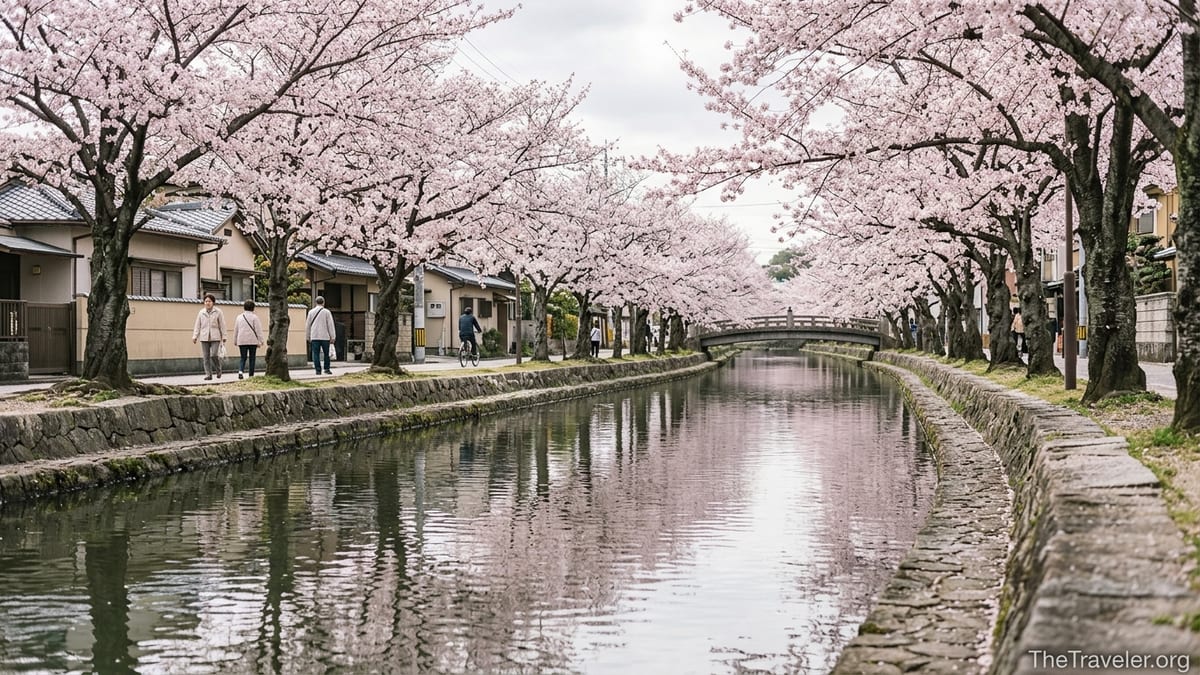
Planning a trip to Japan for cherry blossom season is both magical and maddening. Sakura do not simply “arrive in Japan” on one date. Instead, the bloom unfurls in a wave that starts in the subtropical south and marches slowly north over several weeks, with local weather nudging the schedule earlier or later each year. With 2027 trips already on sale and only rough early forecasts available, the key to a great hanami experience is understanding how the season really works and building a flexible itinerary around it.
How Sakura Season Actually Moves Through Japan
Cherry blossom season in Japan is best imagined as a moving front rather than a single nationwide event. In a typical year, the first Somei Yoshino blossoms appear in Okinawa in late January, reach major cities like Fukuoka and Hiroshima in late March, move through Tokyo and Kyoto around late March to early April, and finally arrive in northern Tohoku and Hokkaido from late April into early May. The full south to north progression can stretch over nearly four months, which is why travelers who understand the pattern have a far better chance of timing their trip well.
Average timing data compiled from the Japan Meteorological Agency and travel bureaus shows that Tokyo’s historical full bloom hovers around the very end of March or the first days of April, while Kyoto and Osaka usually follow within a couple of days. Further north, Sendai often peaks around early to mid April, and Sapporo in Hokkaido tends to hit full bloom in late April or the first week of May. These are 30‑year averages, not guarantees, but they provide a valuable backbone for planning when detailed 2027 forecasts are not yet available.
In practice, this means a traveler who can spend 10 to 14 days in Japan can “ride” the bloom by starting in a warmer region and finishing further north. For example, someone visiting from March 25 to April 8 might begin in Fukuoka and Hiroshima, move through Osaka and Kyoto, and end in Tokyo or even Sendai to stay close to peak conditions. Conversely, an early May trip can skip Tokyo if it has already gone green and instead target Hirosaki in Aomori Prefecture and Sapporo’s parks, where blossoms are often still in full swing during Japan’s Golden Week holidays.
It is also important to realize that within any one city, neighborhoods warm up at different rates. A south‑facing riverside path in Kyoto may reach full bloom several days earlier than a shaded temple garden in the hills. Local tourism offices and city websites often highlight this micro‑timing, and it can help you find late pockets of sakura even when the official “full bloom” date has passed.
First Bloom vs Full Bloom and How Long Peak Really Lasts
Official cherry blossom forecasts in Japan distinguish between two key moments: kaika, the first bloom, and mankai, the full bloom. First bloom is typically recorded when roughly five or six flowers open on a monitored sample tree in each city, often a venerable cherry in a central park or shrine. Full bloom is when about 80 percent of that tree’s flowers have opened. The gap between these stages is usually around a week, but it can shrink or stretch depending on temperature swings and wind.
For travelers, the practical question is how long “peak conditions” actually last. In many popular destinations, you can expect roughly one week of truly prime viewing around full bloom, give or take a few days. In Tokyo, for instance, Shinjuku Gyoen and Ueno Park often look spectacular for a solid five to seven days if the weather cooperates, while in northern regions like Tohoku and Hokkaido, cooler air can preserve blossoms slightly longer. Heavy rain and strong wind can abruptly end the show within 24 to 48 hours, so flexibility is essential.
Some parks offer more resilience than a single date might suggest. Spots such as Tokyo’s Ueno Park, Kyoto’s Maruyama Park, or Osaka Castle Park typically have a mix of early, mid‑season, and late‑blooming varieties. Even if the flagship Somei Yoshino trees are shedding petals, you may still find weeping cherries, mountain cherries, or double‑flowered varieties coming into their own nearby. Travelers who assume that sakura are either “on” or “off” in an entire city often miss these waves inside the larger wave.
Understanding the life cycle of the blossoms can also help you appreciate what you see. The few days of peak bloom with perfectly intact petals are undeniably photogenic, but the “hazakura” period, when green leaves emerge among drifting petals, has a subtle charm of its own. In Kyoto’s Philosopher’s Path or along the Meguro River in Tokyo, petal‑covered water and sidewalks can be just as memorable as the earlier, pristine view.
Planning by Region: From Okinawa to Hokkaido
Because the sakura front travels steadily north, building your trip around regions rather than fixed dates in one city is a smarter strategy. In Okinawa, cherry blossoms often begin in late January and peak through February, especially around Naha and in the hills of northern Okinawa Island. These are different species, such as kanhi‑zakura, with deeper pink petals that create a very different mood than the pale clouds of Tokyo’s Somei Yoshino, but they are an excellent option for travelers escaping a Northern Hemisphere winter.
On Japan’s main southern island of Kyushu, cities like Fukuoka, Kumamoto, and Kagoshima often see full bloom in the last week of March. Fukuoka’s Maizuru Park and Nishi Park, Kumamoto Castle’s grounds, and the riversides of Kumamoto and Kagoshima draw large local crowds but remain less internationally famous than Tokyo or Kyoto. For a traveler with a flexible schedule in late March, flying into Fukuoka instead of Tokyo can significantly increase the odds of hitting peak sakura somewhere during a two‑week trip.
Central Japan, including Kansai and the Chubu region, is the heartland of classic cherry blossom imagery. Kyoto’s Kamo River, Arashiyama district, and temple gardens usually peak in very late March or early April. Osaka Castle Park and Nara’s Mount Yoshino also follow this window, although Mount Yoshino stretches across different elevations, so lower slopes often bloom earlier than the upper reaches, creating a staggered display over roughly two weeks. Further north and inland, places like Takayama in Gifu Prefecture and Kanazawa on the Sea of Japan coast bloom a few days to a week later than Kyoto on average, making them excellent second stops after Kansai if your dates lean into early April.
In the Tohoku region, cities such as Sendai, Fukushima, and Aizu‑Wakamatsu often peak from early to mid April, while Hirosaki in Aomori Prefecture is known for its late April timing and dramatic castle moat filled with fallen petals. Hokkaido is the final act: Hakodate and Sapporo usually enjoy full bloom in late April or early May, with Sapporo’s Maruyama Park and the long cherry boulevard in Hakodate’s Goryokaku Fort providing expansive views. A traveler arriving in Japan around April 25 can skip Tokyo’s bare branches and instead split their time between Hirosaki and Sapporo, reaching both by shinkansen and limited express trains.
Dealing With Forecasts, Shifting Dates, and Booking Pressure
One of the biggest challenges for international visitors is that airline tickets and hotels for spring 2027 are already being sold, while reliable cherry blossom forecasts are not usually issued until late winter. Professional Japanese weather companies and the Japan Weather Association typically release their first detailed national forecasts around January, then refine them every one to two weeks through March as actual temperatures are measured. By contrast, many overseas blog posts and package tours tout specific March or April dates nearly a year in advance, which should be treated as rough guidelines, not promises.
Hotel and transport pressure is real, especially in Tokyo, Kyoto, and Osaka. Central business districts and popular hanami neighborhoods often see rates double or triple compared with low season. A mid‑range business hotel room in central Tokyo that might cost the equivalent of 120 US dollars in November can spike to 250 dollars or more during late March weekends, with non‑refundable bookings filling up six to nine months in advance. Shinkansen reserved seats between Tokyo and Kyoto also book out more quickly for late March and early April dates, particularly on Fridays and Saturdays.
To balance this pressure with the uncertainty of bloom timing, look for refundable or easily changeable hotel bookings. Many Japanese and international chains offer flexible rates that can be cancelled until a few days before arrival. Booking a slightly more expensive flexible room in Kyoto for March 28 to April 1, for example, allows you to shift your stay to Kanazawa or Hiroshima if updated forecasts in February or March show Kyoto’s peak moving earlier or later. Similarly, using rail passes that let you change shinkansen seat reservations at ticket counters without penalty gives you more freedom to chase better conditions a few days before travel.
Travelers should also pay attention to the spread between different forecast providers rather than to a single date. If one forecast suggests Tokyo’s full bloom around March 30 while another estimates April 2, treating that window as March 28 to April 4 will lead to more realistic expectations. When new forecasts show a consistent shift of several days earlier or later over repeated updates, that is a sign to adjust day‑by‑day plans, not to scrap the entire trip.
Alternatives and “Rescue” Destinations When Timing Misses
Even with the best planning, you may arrive to find Tokyo a few days past its finest or Kyoto still stubbornly in tight bud. The good news is that Japan offers a wealth of alternative sakura spots and different elevations that can rescue your itinerary. Because the bloom climbs not just northward but also upward into the hills, higher‑altitude areas near major cities often peak later than low‑lying urban parks.
Near Tokyo, for example, the mountainous town of Chichibu in Saitama Prefecture and the lakes around Mount Fuji usually bloom several days to a week after central Tokyo. If Ueno Park’s trees are already shedding petals, hopping on a limited express train toward Chichibu’s Hitsujiyama Park or taking a highway bus to Kawaguchiko can reveal fresher blossoms framed against hills or mountain views. Similarly, in the Kansai region, Kyoto’s city center may be finished while higher‑elevation spots like Ohara or Kurama still have trees at or near full bloom.
Northbound detours can also save a mistimed holiday. If late March in Kyoto looks too early, you might spend those days exploring castles and gardens in Hiroshima, Himeji, or Okayama, where bloom can be slightly ahead or behind depending on that year’s temperatures. For early April trips when Tokyo has peaked already, shifting focus to Nagano, Niigata, or the Tohoku cities of Sendai and Fukushima by shinkansen puts you back into the heart of the sakura front. In years when the season runs late, heading south from Tokyo to Shizuoka, Nagoya, or even Kyushu can deliver better blossom conditions.
And if you truly miss the main Somei Yoshino season, Japan still rewards the effort. Late‑blooming spots such as Takato Castle Park in Nagano, famous for its dense, pink Kohigan‑zakura that often flower after Tokyo is green, or Hokkaido’s coastal towns like Kushiro and Nemuro, where hardy varieties resist cold winds, can still offer satisfying hanami experiences well into May. Incorporating one of these insurance destinations into your route from the outset makes it much less likely that you will leave without seeing any blossoms at all.
Early and Late Bloomers: Extending Your Sakura Window
Another way to build resilience into your cherry blossom trip is to pay attention to different types of cherry trees and their natural calendars. In and around Tokyo and Kyoto, the standard reference is the pale Somei Yoshino variety, but many parks and temples plant early and late bloomers to stretch the season. For early color, look for kawazu‑zakura, which can start flowering as early as late February around the town of Kawazu on the Izu Peninsula and in Tokyo’s riverside districts, filling streets with deep pink blossoms weeks before the main season.
Within major cities, you will also find shidare‑zakura, or weeping cherries, which sometimes reach peak a little later than the surrounding trees. Kyoto’s Maruyama Park is particularly famous for its giant weeping cherry, which can still be beautiful when the city’s other trees are already dropping petals. Double‑flowered varieties like yae‑zakura often bloom in mid to late April, creating lush, pom‑pom‑like blossoms when the classic single‑petal trees have faded.
Beyond the strictly spring season, Japan has winter‑blooming cherries known as fuyuzakura. These appear sporadically from late autumn to early winter in places such as Obara in Aichi Prefecture, where pale blossoms overlap with red and gold maple leaves. While they are not a substitute for the full spring hanami atmosphere, they demonstrate how diverse Japan’s cherry trees are and provide a backup for travelers who cannot visit during March or April.
By deliberately including at least one early‑blooming and one late‑blooming destination in your itinerary, you widen your safety net. A traveler who spends a day at Kawazu’s riverside festival in early March, then visits Tokyo and Kyoto, and finally stops at Takato Castle in Nagano or Hirosaki in Aomori in mid April has built several chances to catch good blossoms somewhere, even if temperatures swing unexpectedly.
Practical Trip‑Planning Tips for 2027 and Beyond
When building a modern sakura itinerary, think in terms of ranges, hubs, and backups instead of single dates and single cities. Start by identifying a two to three week window when you can travel, then map that window against the historical bloom progression. For instance, if you are free from March 20 to April 5, it makes sense to anchor yourself in Kyushu or western Honshu in the first days, shift to Kansai and the Chubu region in the middle, and end in Tokyo or Tohoku toward the end. If your available dates are April 10 to April 25, you might prioritize Tokyo, Tohoku, and Hokkaido instead.
Next, choose two or three city hubs connected by shinkansen lines rather than trying to hop daily between distant locations. Popular combinations include Fukuoka–Hiroshima–Osaka, Osaka–Kyoto–Kanazawa, or Tokyo–Sendai–Aomori. Using a Japan Rail Pass or region‑specific passes, you can keep one or two nights unbooked or booked with flexible cancellation in each hub, then confirm them as updated forecasts come in. This approach is less stressful than committing to non‑refundable stays locked to very specific nights in Tokyo or Kyoto months in advance.
Be honest about crowds and costs. Major hanami weekends in Tokyo and Kyoto draw enormous local gatherings, with blue tarps covering lawns in Ueno Park and Yoyogi Park from morning to night. If you prefer quieter viewing, consider visiting big name spots on weekday mornings and reserving weekends for smaller regional parks or temple gardens. For example, you might admire Tokyo’s Chidorigafuchi moat at opening time on a Tuesday, then take a local train to smaller suburban parks like Koganei or Inokashira on Saturday when central areas are packed.
Finally, keep your expectations flexible. Think of cherry blossoms as the centerpiece of the trip but not the only reason for being there. Spring in Japan also brings seasonal food such as sakura‑themed wagashi sweets and limited‑time lattes in major café chains, traditional festivals, and comfortable walking weather in cities and countryside alike. Even if the blossoms are a few days off ideal, you will still be moving through a country that treats the season as a national celebration, from convenience store snacks to department store displays.
The Takeaway
Cherry blossom season in Japan is both predictable and unpredictable. The broad pattern is reliable: blossoms start in the south in late winter, sweep through major cities like Tokyo and Kyoto in late March and early April, and reach the north in late April and early May. Within that pattern, however, any given year can shift a week earlier or later, and local microclimates can create pockets of early or late flowers even inside a single city park.
The best strategy for travelers is to plan around the moving sakura front, not against it. Use long‑term historical averages to choose a likely window and region, then rely on professional forecasts released between January and March of your travel year to fine‑tune the details. Book flexible hotels in key hubs, include a mix of early and late‑blooming destinations, and keep a shortlist of “rescue” spots at different elevations and latitudes so you can pivot if needed.
With this mindset, you are no longer gambling everything on one weekend in Tokyo or one night in Kyoto. Instead, you are following the same northbound wave that locals track every year, giving yourself multiple chances to settle under the blossoms with a bento box or cup of green tea. The result is a trip that feels less like chasing a moving target and more like traveling in step with one of Japan’s most cherished seasonal rhythms.
FAQ
Q1. When will reliable cherry blossom forecasts for 2027 actually be available?
Most detailed nationwide forecasts are typically released by Japanese weather companies and agencies from late January through March of the travel year, with updates every one to two weeks. Anything you see much earlier than that is based mostly on historical averages and should be treated as an educated guess rather than a firm prediction.
Q2. How far in advance should I book flights and hotels for sakura season?
Flights and central hotels in Tokyo, Kyoto, and Osaka often sell out or become expensive 6 to 9 months ahead of late March and early April, so it is wise to reserve early. To manage uncertainty, prioritize refundable or changeable hotel rates in at least some of your stops so you can adjust dates or destinations when more accurate forecasts are published.
Q3. If I can only visit Japan once, which weeks give me the best overall chance of seeing blossoms?
If your schedule is flexible, the period from roughly the last week of March through the first week of April usually offers the best compromise for first‑time visitors. In many years, that window overlaps with peak or near‑peak blooms somewhere between Kyushu, Kansai, and Tokyo, and still allows you to adjust a few hours north or south by shinkansen based on the latest forecasts.
Q4. What should I do if Tokyo’s blossoms look like they will peak earlier than my trip?
If updated forecasts in late winter suggest Tokyo will peak well before your arrival, consider pivoting to slightly cooler or higher‑latitude areas for your main hanami days. Options include heading north to Sendai or Fukushima, exploring inland cities such as Nagano or Takayama, or planning extra time in Tohoku and Hokkaido if your trip is in mid to late April.
Q5. Can I still enjoy sakura if I arrive after the Somei Yoshino season has ended?
Yes. Look for late‑blooming varieties and cooler regions. Places like Takato Castle Park in Nagano, Hirosaki Castle in Aomori, and Sapporo’s parks in Hokkaido often bloom later than Tokyo and Kyoto. Double‑flowered cherries and weeping cherries in many cities also extend the season beyond the main variety’s peak.
Q6. Are there good cherry blossom experiences outside of Tokyo and Kyoto?
Absolutely. Fukuoka’s Maizuru Park, Hiroshima’s riverside promenades, Himeji Castle, Kanazawa’s Kenrokuen Garden, and Hirosaki Castle Park are just a few standout examples. These destinations can be less crowded with international visitors while still offering classic hanami scenes and easy access by train from major hubs.
Q7. How much does weather on the day affect the experience?
Weather plays a huge role. A sunny weekday morning with light wind can make even slightly past‑peak blossoms look magical, while heavy rain or strong gusts can strip petals quickly. When you arrive in a city with blossoms near their peak, it is wise to prioritize outdoor viewing early in your stay in case a storm system moves in later.
Q8. Do I need to reserve spots in parks for hanami picnics?
In most public parks you do not need formal reservations, but popular spots in big cities can fill up quickly, especially on weekends. Local groups often arrive early to spread ground sheets under the best trees. Visitors can usually find space at the edges or choose quieter parks, temple gardens, or riversides where crowds are lighter and regulations on eating and drinking may vary.
Q9. Is it worth visiting Japan in early spring if forecasts suggest I will miss peak bloom?
Yes. Even without perfect timing, early spring in Japan offers mild weather, seasonal food, and other flowers such as plum blossoms, magnolias, and camellias. You may also catch early or late cherry varieties in less famous locations, and you will benefit from slightly smaller crowds and better prices than the absolute peak sakura weekends.
Q10. Will this guide’s dates and advice change as 2027 approaches?
The overall south‑to‑north progression of the sakura front is stable from year to year, but specific timing for each city can shift. This guide should be read alongside the latest forecasts each winter, and trip details such as exact dates and suggested regions should be updated annually as new data and 2027‑specific predictions become available.