


Landing in Japan, many visitors quickly discover that everyone is tapping small plastic cards or phones at ticket gates instead of buying paper tickets. Those cards are Japan’s rechargeable IC cards, and in Tokyo the most famous names are Suica and PASMO. For a first-time visitor, they can seem confusing: are they different systems, which one should you get, and do you need a new card every time you change cities? This guide breaks down Suica, PASMO and ICOCA in clear, practical terms so you can choose the right card and start riding with a simple tap.
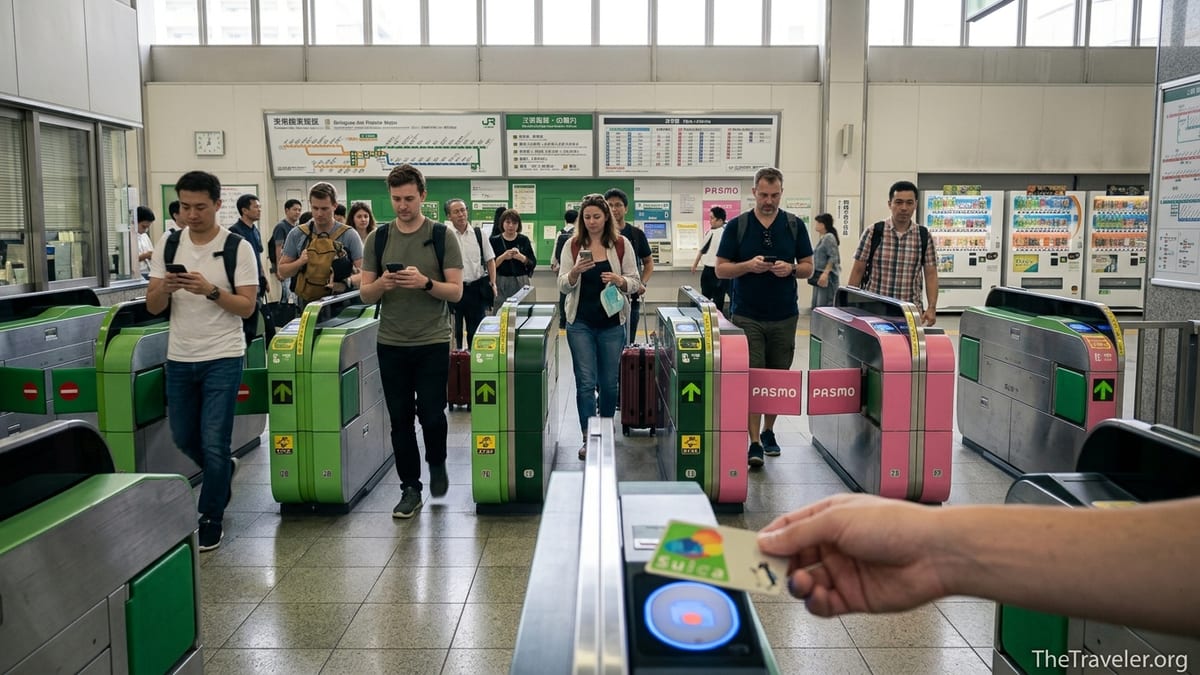
What Suica, PASMO and ICOCA Actually Do
Suica, PASMO and ICOCA are prepaid, tap-to-pay smart cards used mainly for local transport and small everyday purchases. You load money onto the card, then tap it on the ticket gate sensor when you enter and exit trains or buses; the correct fare is automatically deducted. The same stored balance can be used at many convenience stores, station kiosks, drink vending machines and some coin lockers that show the IC card logo.
In Tokyo, Suica is issued by JR East, the main JR railway company in eastern Japan, while PASMO is issued by a consortium of private railways, subway systems and bus operators around the capital. In the Kansai region, including Osaka and Kyoto, the equivalent IC brand is ICOCA, issued by JR West. Although the cards have different names, they use the same underlying technology and participate in a nationwide interoperability scheme, which means they are widely accepted across each other’s territories.
For a tourist, this means you can tap through JR East gates in Tokyo with PASMO, ride a Tokyo Metro subway with Suica, or use an ICOCA from Osaka to ride the JR Yamanote Line loop in Tokyo. The brand name on the card does not lock you to a single city. What all of these cards do share is the same basic role: they are tools for local and regional transport, and for quick, low-value purchases in everyday places like 7-Eleven, FamilyMart or station bento stands, rather than a replacement for all long-distance rail tickets.
Importantly, IC cards generally cannot be used as tickets for Shinkansen bullet trains or most limited express services. If you want to ride the Tokaido Shinkansen between Tokyo and Kyoto, for example, you still need a separate reserved-seat or non-reserved ticket, or a rail pass product. In practice, most visitors use an IC card for city transport and short hops around a region, and buy separate paper or digital tickets for longer intercity legs.
How Interchangeable Are Suica, PASMO and ICOCA?
Thanks to a system known as the Nationwide Mutual Usage Service, the major IC cards from different regions can be used almost interchangeably on most urban trains, subways and buses across Japan. In simple terms, if a ticket gate or payment terminal shows the generic IC logo rather than a single company logo only, a standard Suica, PASMO or ICOCA will generally work. This includes most transport in greater Tokyo, Nagoya, Osaka, Kyoto, Kobe, Fukuoka and many other cities.
For example, you could arrive at Haneda Airport, pick up a Welcome Suica, ride the Tokyo Monorail into the city, then later take that same card on the JR Chuo Line to Shinjuku, the Tokyo Metro Ginza Line to Asakusa, and a bus out to TeamLab Planets. A few days later, you might board a Shinkansen to Osaka, and once there, the same Welcome Suica will tap you through JR Osaka Loop Line gates, the Osaka Metro Midosuji subway, and many local buses. The same is true in reverse with an ICOCA you bought on arrival at Kansai International Airport and then brought to Tokyo later in your trip.
There are some limits and exceptions. Small rural lines, certain private bus operators and a handful of purely local systems may not accept out-of-area IC cards, or any IC card at all. Even within big cities, certain commuter passes or discount products are tied to a specific card brand and local residents. However, for a typical visitor itinerary focused on major cities and tourist routes, Suica, PASMO and ICOCA all function in almost the same way. The choice is mainly about where you land and which card is easiest to obtain, rather than long-term compatibility problems.
One point to remember: while the cards are mutually accepted, each one is still managed by its issuing company. Refund rules, deposit amounts and visitor-only card conditions differ. For example, a regular Suica or PASMO usually has a refundable deposit collected when you first purchase the card, while short-term tourist variants like Welcome Suica and certain tourist PASMO products often drop the deposit but also cannot be refunded in cash at the end of your trip.
Physical Cards vs Mobile Versions
Travelers today can choose between a physical plastic IC card and a digital version stored in a smartphone or smartwatch. On iPhone and Apple Watch, Suica, PASMO and ICOCA can be added directly to Apple Wallet as transit cards. In that case, you simply tap your phone or watch at the gate, and you can reload the balance from a registered payment card inside the app. Japan-issued Android phones also support mobile IC cards in local wallet apps, although foreign Android devices have much more limited compatibility.
Mobile versions bring concrete advantages. You cannot misplace them in a coat pocket, and if you lose your phone, the card can often be restored to a replacement device. You can reload from a credit card without standing in front of a ticket machine, which is particularly convenient when your balance runs low during rush hour in Shibuya Station or at Kyoto Station’s crowded ticket concourse. Balances and recent trip history are easy to check on screen. For many tech-comfortable travelers, a mobile Suica, PASMO or ICOCA is now the most convenient option.
There are also some practical limitations with mobile IC cards. For Apple Wallet, the device region normally must be set to Japan and you may need a compatible non-Visa card or a local payment method to add funds, depending on your bank. Some overseas credit cards are declined for top-ups, which forces travelers back to cash-based reloading at station machines even when using a phone. On Japanese Android, the local wallet systems are designed for phones sold in Japan, so a foreign-purchased Android model often cannot install the necessary apps at all. Before you commit to the mobile-only route, it is worth verifying that your device and cards will cooperate.
For many visitors, the simplest path is still a physical IC card purchased at the airport or first major station. Topping up with cash at a bilingual ticket machine is fast and reliable, the card works even when your phone battery is dead, and any deposit (on regular cards) can be partially refunded when you leave. If you are a frequent visitor to Japan and have a compatible device and payment method, however, switching to mobile Suica, PASMO or ICOCA can make day-to-day travel even smoother.
Visitor-Focused Cards: Welcome Suica, TOURIST PASMO and Others
To make things easier for short-term visitors, issuing companies offer tourist-only variants of their IC cards. One of the most popular is Welcome Suica, a red, deposit-free version of Suica aimed specifically at foreign travelers. It is typically sold at major JR East stations and airport gateways in the Tokyo region, such as Haneda Airport and Narita Airport. Welcome Suica works like a normal Suica for fares and small purchases but has a fixed validity period, often 28 days from first use, and it cannot be refunded for cash at the end of your trip, so you should try to spend the remaining balance before departure.
PASMO has offered similar visitor products. The earlier PASMO PASSPORT has now evolved into TOURIST PASMO, designed with foreign travelers in mind. It is normally sold at selected private railway and subway stations, especially around Tokyo’s airports and other major hubs. As with Welcome Suica, TOURIST PASMO provides the convenience of tap-in, tap-out travel and contactless payments without a separate deposit fee, in exchange for a limited validity and no cash refund at the end. These cards are ideal if your stay is shorter than a month and mostly focused on city travel.
In Kansai, past visitor-oriented products like KANSAI ONE PASS layered tourist discounts over ICOCA’s transport functionality. Sales of those specialist cards have been winding down, but a standard ICOCA still serves visitors perfectly well for everyday travel around Osaka, Kyoto, Nara and Kobe. You can pick one up at the JR ticket office in Kansai International Airport or at major JR stations like Osaka, Kyoto or Shin-Osaka, then use it just like Suica or PASMO for JR lines, metro lines and many buses throughout the region.
A key difference between these tourist-branded cards and standard local versions is what happens on your last day. With a regular Suica, PASMO or ICOCA, you can visit a staffed ticket office in the home region, return the card and receive the remaining balance minus a small handling fee, along with the original deposit if applicable. With Welcome Suica and similar tourist products, you are trading that refund option for simplicity and design. As a practical approach, try to run the card down in the final days by using it for snacks, drinks and small station purchases; anything left is the cost of convenience and a souvenir.
Where and How to Get an IC Card
Most travelers first get an IC card at the airport or at the first major station they pass through. In Tokyo, Haneda Airport’s train stations are particularly convenient: JR East’s ticket machines and counters sell Welcome Suica, while Keikyu and Tokyo Monorail areas, along with subway-connected stations like Shinagawa or Hamamatsucho, offer PASMO products. Narita Airport presents similar options at JR and private railway areas. Machines usually have an English button, and you can choose the initial load amount in increments such as 2000 or 3000 yen, which often include any deposit if you are buying a standard, non-tourist card.
In the Kansai area, Kansai International Airport’s JR and Nankai stations sell ICOCA cards at ticket machines and staffed counters. If you fly directly into Osaka, it often makes sense to purchase ICOCA there rather than worrying about Suica or PASMO. Later, when you travel to Tokyo or another region, that same ICOCA will continue to function at most IC-enabled gates without any need to swap cards. Similarly, travelers entering Japan via Chubu Centrair near Nagoya can buy TOICA or manaca, which also interoperate with Suica, PASMO and ICOCA across most of the country.
If you prefer a mobile card, you can “buy” one without visiting a counter at all. On an iPhone set to Japan region, you can open Wallet, tap to add a transit card, select Suica, PASMO or ICOCA, and then add a starting balance from a payment card. This is particularly useful if you arrive late at night, when station offices may be closed, but your phone still allows you to tap through gates. Just remember that not all international cards work for top-ups, and you may still need cash to reload at a machine once you are in Japan.
Wherever you purchase, consider the practicalities of your itinerary. If you are starting in Tokyo, a Welcome Suica or TOURIST PASMO from the airport is usually the easiest solution, especially for a stay under four weeks. If you are flying into Kansai International Airport and spending several days around Osaka, Kyoto and Nara before heading elsewhere, an ICOCA from the airport station is more straightforward and works almost everywhere you are likely to go.
Reloading, Using the Cards and Their Limits
Reloading a Suica, PASMO or ICOCA is simple. At most JR, private railway and subway stations, you will find IC card recharge machines that accept cash and sometimes bank cards. You insert or tap your card, choose a top-up amount such as 1000, 2000 or 5000 yen, feed in your bills or follow the on-screen payment instructions, and within a few seconds your card is ready with a higher balance. Many convenience stores and station kiosks can also reload physical IC cards at the register, particularly around major urban hubs.
In daily use, the cards shine in situations where single tickets would be cumbersome. If you are staying in Shinjuku and plan a day exploring Harajuku, Shibuya and Odaiba, an IC card lets you breeze through multiple transfer points without stopping at vending machines. In Osaka, a day going from Umeda to Osaka Castle, then out to Universal Studios Japan and back to Namba is just a series of taps. For shorter intercity hops like Kyoto to Osaka on a regular JR commuter train, an IC card is also more convenient than calculating a paper ticket fare each time.
At the same time, IC cards are not all-purpose train tickets. They are generally not valid for Shinkansen services, which require specific reserved or non-reserved tickets, and many limited express trains also need supplemental fees or reservations that are not handled automatically by a simple tap. For example, traveling from Tokyo to Kanazawa on the Hokuriku Shinkansen, or from Kyoto to Kinosaki Onsen on a limited express, will still involve visiting a ticket machine or counter, or using an online reservation service, in addition to using your IC card for local trains at either end.
For small purchases, IC cards function as e-money at many retailers. You can pay for a bottled drink at a vending machine in Tokyo Station, buy a snack at a NewDays kiosk, or settle your bill at a convenience store counter simply by tapping your card. This is particularly useful when you have a near-empty wallet of coins and want to use up the final few hundred yen before traveling home. However, IC card e-money is not universally accepted. Larger department stores, restaurants and hotels often prioritize credit cards and cash, so you should think of IC payments as a handy extra rather than a universal wallet replacement.
Using IC Cards Outside Tokyo and Across Regions
Many visitors worry that a card purchased in one region will stop working in another. In practice, the main brands used by tourists are usable across most of Japan’s major metropolitan areas. A Suica or PASMO acquired in Tokyo functions in ICOCA territory around Osaka and Kyoto, and likewise an ICOCA works in Tokyo’s Suica and PASMO networks. You will see the same IC logo on ticket gates in Sapporo, Sendai, Nagoya, Hiroshima, Fukuoka and elsewhere, signaling that the major interoperable cards are accepted.
For example, you could start your trip with a Welcome Suica at Narita Airport, spend a week in Tokyo, jump on a Shinkansen to Hiroshima, then tap that same card through JR Hiroshima Station gates and onto local streetcars or buses where IC is supported. Or you might buy an ICOCA at Kansai International Airport, use it around Osaka and Kyoto, then fly to Sapporo and continue tapping through Kitaca-area gates on JR Hokkaido lines. In each case, you do not need to juggle different local IC cards just because you crossed a regional boundary.
The main caveats appear in smaller cities and rural areas. Some regional bus companies and private railways have not joined the nationwide interoperability scheme or have introduced their own local IC systems that are separate from Suica, PASMO and ICOCA. In these places, you may revert to paying fares in cash or buying a paper ticket. When in doubt, check for the familiar IC logo at the gate or ask station staff. For a typical sightseeing route focused on Tokyo, Kansai and a few secondary cities, however, one IC card usually suffices from start to finish.
If you are planning a heavily rail-focused trip across multiple regions, it can be useful to combine a JR rail pass for your long-distance Shinkansen segments with a single IC card for everything else. For instance, a traveler using a Kansai–Hiroshima regional pass for medium and long-distance JR trains may still carry ICOCA for Osaka’s local subways and trams, while a visitor with a nationwide JR pass might rely on Suica or PASMO for city buses and non-JR lines not covered by the pass.
Suica vs PASMO vs ICOCA: Choosing Based on Your Itinerary
For most tourists, Suica, PASMO and ICOCA are functionally similar. The most practical way to choose is to start with where you land. If your flight arrives in Tokyo at Haneda or Narita, Welcome Suica and TOURIST PASMO are the most straightforward options because they are prominently sold right at the airport stations, work on nearly all trains and subways you are likely to ride, and do not require paying a separate deposit. You can load a few thousand yen at purchase and immediately ride into central Tokyo.
If you are flying into Osaka’s Kansai International Airport, it makes more sense to purchase ICOCA there. JR and Nankai stations at the airport sell ICOCA at machines and ticket offices, and that single card will carry you through JR lines, Osaka Metro, Kyoto city buses and many private railways around Kansai. When you later visit Tokyo or another region, the same ICOCA can still be used on most IC-equipped transport, so there is no need to chase a Suica or PASMO just because you changed cities.
Returning visitors or tech-focused travelers might prefer mobile versions, especially mobile Suica, because of its maturity and strong integration with Apple Wallet and local Android systems. In that case, you can effectively ignore the branding difference between Suica, PASMO and ICOCA and focus on whichever mobile card your device and payment method support most reliably. Just be sure to set everything up before you reach a crowded station at rush hour.
Ultimately, instead of worrying about fine distinctions, it is better to remember the overall role of these cards. Any one of Suica, PASMO or ICOCA will solve the same basic problem: letting you tap through local transport in Japanese cities without queuing for paper tickets and without exact change. Choose the card that is easiest to obtain at your point of arrival and fits your length of stay, then treat it as a flexible tool for local movement and small purchases while you use separate tickets or passes for intercity trains.
The Takeaway
Suica, PASMO and ICOCA all do essentially the same job for visitors: they are prepaid, tap-to-pay cards that make it easier to ride trains, subways and buses and to handle small everyday purchases. Thanks to nationwide interoperability, a card bought in Tokyo can be used in Osaka and many other cities, and an ICOCA purchased in Kansai will generally work in Tokyo’s Suica and PASMO areas. You do not need a suitcase full of different cards to move between regions.
The real decisions come down to where you arrive, how long you are staying and how comfortable you are with mobile payments. Welcome Suica and TOURIST PASMO are convenient short-term options for visitors landing in Tokyo, while a standard ICOCA is a natural choice for those starting in Kansai. Physical cards are robust and easy to reload with cash, while mobile versions suit repeat visitors and tech-savvy travelers who want to manage everything from their phones.
What IC cards cannot do is replace every other rail ticket. You will still need dedicated tickets or passes for Shinkansen and many limited express services, and you should not expect your IC card to be accepted at every shop and restaurant. Think of Suica, PASMO and ICOCA as your everyday city transport and snack-payment companions, not as unlimited travel passes.
With those expectations in mind, choosing an IC card becomes simple. Pick whichever card is easiest to get at your point of entry, load a comfortable balance, and start tapping. From your first airport train into the city to late-night subway rides back to your hotel, an IC card quietly removes friction from your trip and lets you focus on enjoying Japan rather than wrestling with ticket machines.
FAQ
Q1. Do I need a different IC card in every Japanese city I visit?
In most cases no. A single Suica, PASMO or ICOCA will work across major cities such as Tokyo, Osaka, Kyoto, Nagoya and many others where the shared IC logo appears at ticket gates.
Q2. Can I use Suica, PASMO or ICOCA on Shinkansen bullet trains?
Generally not. Shinkansen rides require separate reserved or non-reserved tickets or a rail pass. Use your IC card mainly for local trains, subways and buses at each end of your long-distance journey.
Q3. What is the difference between Welcome Suica and a regular Suica?
Welcome Suica is aimed at short-term visitors, usually has no deposit and a fixed validity period, and cannot be refunded in cash, while a regular Suica has a deposit and can often be refunded at a JR East ticket office.
Q4. Is PASMO better than Suica for tourists staying in Tokyo?
In daily use they are nearly identical. Both work on JR lines, subways and many buses in and around Tokyo. Most visitors simply choose whichever is easier to obtain at the airport or nearest station.
Q5. I am flying into Osaka. Should I still try to get a Suica?
If you land in Kansai, buying an ICOCA at Kansai International Airport or a major JR station is usually simpler. It will work around Osaka and Kyoto and also function in Tokyo later in your trip.
Q6. Can I add Suica, PASMO or ICOCA to my phone instead of using a plastic card?
Yes, many iPhones and Apple Watches support mobile transit cards, and some Japan-purchased Android phones do too. However, payment card compatibility varies, so some travelers still prefer a physical card for reliability.
Q7. How do I reload my IC card when the balance is low?
You can reload at station ticket machines that show the IC card logo, usually using cash and sometimes a bank card. Many convenience stores and kiosks can also top up physical cards at the register.
Q8. Can I get a refund of my remaining IC card balance when leaving Japan?
Standard Suica, PASMO and ICOCA usually allow refunds of remaining balance minus a handling fee, plus the card deposit, at staffed offices in their home regions. Visitor-only cards like Welcome Suica typically do not offer cash refunds.
Q9. Are IC cards accepted everywhere for shopping?
No. IC cards work for small purchases at many convenience stores, station shops and vending machines, but larger shops, restaurants and hotels often rely more on credit cards and cash.
Q10. What happens if I lose my IC card during the trip?
Unregistered physical cards are usually not replaceable and remaining balance is lost. Some mobile cards and registered accounts can be restored to a new device, so it is wise to treat your IC card like cash and keep it safe.