


Arriving in Japan has become smoother in recent years, but the rules can still feel confusing if you are planning a trip for the first time. In 2026, travelers are expected to navigate a mix of traditional passport checks, evolving visa rules and a digital pre-registration system called Visit Japan Web that generates QR codes used at kiosks in major airports. This guide walks you through what is legally required, what is optional but highly recommended, and how to prepare before you fly so that immigration, customs and tax free shopping go as smoothly as possible.
Japan entry basics: passports, visas and who needs what
Every traveler entering Japan must hold a valid passport and, where required, an appropriate visa. The Japanese government distinguishes between short term visitors, usually staying up to 90 days for tourism or business, and people coming to work, study or live long term. A visa is essentially an advance screening carried out by a Japanese embassy or consulate. It allows you to travel to a Japanese port of entry and ask immigration for permission to land, but it does not guarantee entry; final approval is always given by the immigration officer at the airport or seaport.
Many nationalities can visit Japan without applying for a visa in advance. According to the Ministry of Foreign Affairs of Japan, citizens of the United States, Canada, most European Union states, the United Kingdom, Australia, New Zealand, Singapore and several others are typically visa exempt for short stays, often up to 90 days, provided they are visiting for tourism or similar non remunerative purposes. The exact list and permitted length of stay vary by nationality and can change, so travelers should always confirm current rules directly with the Ministry of Foreign Affairs or their local Japanese embassy before booking non refundable flights or hotels.
Other nationalities, including many in Asia, Africa, the Middle East and parts of Latin America, may need to obtain a short term visa in advance, even for tourism. In some countries Japan now offers an online eVisa for tourists, which allows applicants to upload documents through a secure portal and receive an electronic visa instead of a sticker in their passport. Processing times and required documentation, such as bank statements, employer letters and flight itineraries, differ by country and by embassy. Because policies are frequently updated, it is important to treat any unofficial list you find on blogs or social media as a rough reference only and always verify requirements through official Japanese government channels.
Longer stays and activities such as paid work, university study, language school, internships with compensation or joining family already living in Japan almost always require a different category of visa and supporting documents, often including a Certificate of Eligibility issued by the Immigration Services Agency of Japan. These long term processes sit outside the scope of Visit Japan Web and should be started months before your target arrival date. Travelers who are unsure whether their situation counts as tourism, business or work should seek advice from a Japanese consulate rather than guessing at the category.
Understanding Visit Japan Web: what it does and what it does not
Visit Japan Web is an official online service that lets travelers complete immigration and customs registration in advance and store information needed for tax free shopping. It is provided by the Japanese government’s Digital Agency and is used by both foreign visitors and Japanese citizens returning home. Instead of filling out paper forms on the plane or in the arrivals hall, users can register their trip, answer immigration questions, declare what they are bringing into the country and prepare their tax free shopping profile online. The system then produces QR codes that can be scanned at airport kiosks or shown to officers.
It is important to understand that Visit Japan Web is not a visa application system and it does not change who needs a visa. If your nationality requires a visa to enter Japan, you must still apply through a Japanese embassy, consulate or an official eVisa platform if your country is eligible. Visit Japan Web assumes you already have legal permission to travel, whether that is through visa exemption or a granted visa. When you arrive in Japan, immigration officers will still examine your passport, check any visa or landing permission, and may ask questions about your stay.
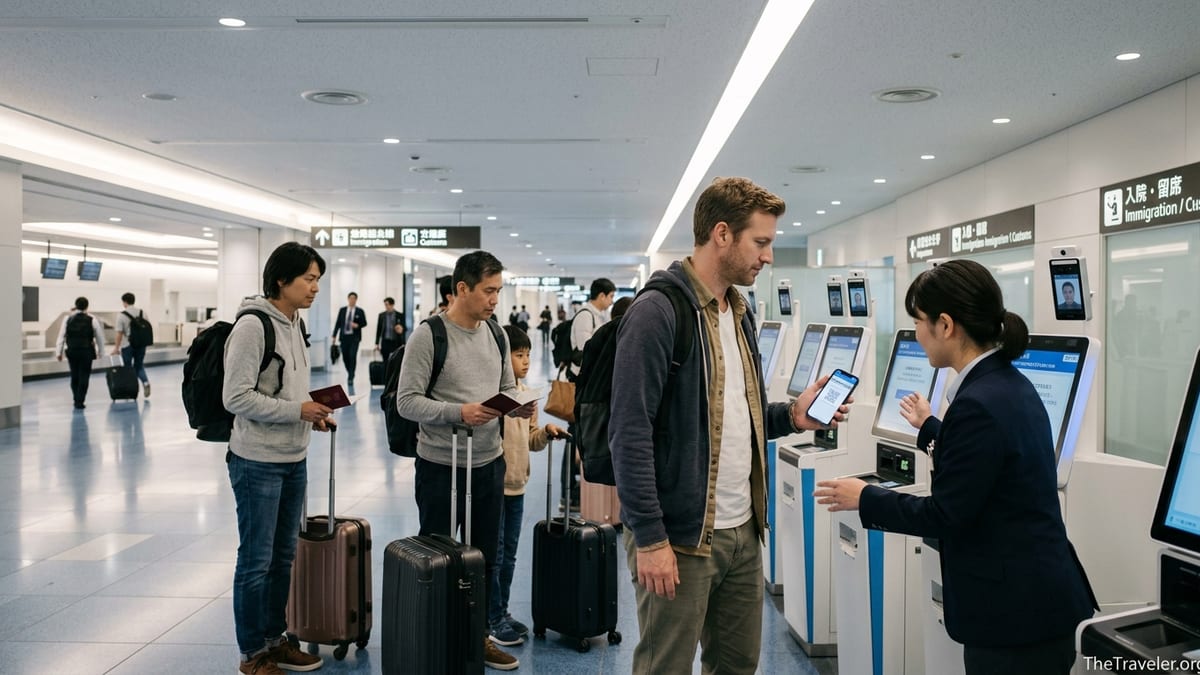
Using Visit Japan Web is technically optional for most travelers, but in practice it can save a significant amount of time. At major airports such as Narita, Haneda, Kansai and Chubu Centrair, there are now dedicated lines and integrated kiosks for people who arrive with Visit Japan Web QR codes prepared. These lines often move faster than the traditional counters used by travelers who are filling out paper “Disembarkation Card for Foreigner” forms and handwritten customs declarations. A common scenario involves a long haul passenger from Los Angeles or London who completes Visit Japan Web the week before departure, lands at Haneda, walks to the bank of blue and white kiosks, scans their QR code and passport, and is directed within minutes to a facial recognition immigration gate instead of a long manual line.
Because Visit Japan Web is web based rather than a downloaded app, you can log in from a smartphone, tablet or desktop browser. The interface is available in several languages including English and Japanese, and it supports adding multiple travelers in one account, which is especially helpful for families. However, every adult still receives an individual QR code and will go through biometric immigration checks separately. Parents can manage children’s data and QR codes from a single login, which simplifies things when traveling with school aged kids.
Information and documents to prepare before using Visit Japan Web
To use Visit Japan Web smoothly, it helps to assemble a few key details before you sit down to register. At minimum you will need your passport, your flight information and the address of your first accommodation in Japan. The passport must match what you will physically carry when you travel, including the same passport number and name spelling. For example, if you renewed your passport after booking your ticket, make sure you update your airline reservation and your Visit Japan Web entry to the new number so airport systems match.
Flight details are also important because the system asks for your port of arrival, airline and flight number. A traveler flying from San Francisco to Tokyo Narita on a specific carrier would need to enter that flight, while someone landing at Osaka Kansai from Bangkok will choose Kansai and their own airline and flight number. If you are continuing on to a domestic destination such as Sapporo or Fukuoka, Visit Japan Web is concerned only with your first entry point into Japan, where immigration and customs actually occur.
Accommodation information is another required element. You should have at least the name and full address of your first hotel, guesthouse or rental apartment. For instance, if you are staying at a business hotel in Shinjuku in Tokyo, you would enter the full street address and phone number as shown on your confirmation email. Travelers on multi city itineraries, such as a week in Tokyo followed by a few days in Kyoto and Hiroshima, can simply list the first hotel where they will sleep after arrival; you do not need to enter all subsequent stops into Visit Japan Web.
Beyond these basics, the system will ask questions that mirror those on paper immigration and customs forms. These include the purpose of your visit (tourism, business, visiting relatives), expected length of stay, and whether you are bringing in restricted or declarable items such as large amounts of cash, commercial goods or certain food products. Having a rough idea of how much cash you are carrying, the value of any high end electronics you plan to sell or give away, and whether you are transporting items like prescription medication in large quantities will make answering these questions straightforward.
Step by step: completing immigration and customs registration online
Once you have your documents and details at hand, you can register for a Visit Japan Web account using an email address and password. After confirming your email, you will log in and create a user profile by entering your full name, date of birth, nationality and passport information. If you are traveling with family members, you can add them as additional travelers under the same account. For example, a parent might add a partner and two children, each with their own passport data, so the group can be managed from one dashboard.
The next task is to create a new trip or itinerary. You enter your arrival airport, airline, flight number and scheduled date of arrival. You then input your intended length of stay and accommodation address. The system generates a “Japan Entry/Return Procedure” screen for that trip, where you will see sections for immigration, customs declaration and tax free shopping. To register immigration information, you select the appropriate button and answer questions similar to those on the disembarkation card, such as whether you have ever been deported, are carrying prohibited items or have certain criminal convictions. You also specify the purpose of travel as sightseeing, business meetings, visiting family, or another option provided in the menu.
After completing immigration questions, you return to the main trip screen and proceed to the customs declaration section. Here you indicate whether you are bringing into Japan items that exceed personal duty free allowances, such as large quantities of alcohol, tobacco or perfume, or commercial goods intended for sale. You also declare if you are carrying cash or traveler’s checks above a threshold that requires reporting, or bringing in food, plants or animal products that may be subject to quarantine rules. A common example is a traveler from Europe who is carrying a new laptop and camera for personal use plus a few boxed souvenirs; these fall under normal personal effects and generally do not need special declaration, whereas carrying a suitcase full of camera lenses for resale would.
Once both immigration and customs sections are marked complete, Visit Japan Web generates a unified QR code for the trip. Earlier versions produced separate QR codes for immigration and customs, but the system is moving toward a single 2D code that contains all necessary data. Each traveler must have their own code, so a family of four will have four separate codes even if they are on the same flight. The QR code can be displayed within the browser, saved as a screenshot to your phone’s photo gallery, or printed out. Many experienced travelers recommend taking screenshots or printing copies in case the airport’s Wi Fi is congested or your mobile data does not connect immediately after landing.
What to expect at Japanese airports: kiosks, QR codes and officer checks
On arrival at major international airports, signage in English and Japanese directs passengers using Visit Japan Web toward integrated kiosks. These units are designed to handle both immigration and customs registration in one flow. A typical experience at Tokyo Haneda or Narita goes like this: after getting off the aircraft and following “Arrivals” signs, you reach a hall with rows of kiosks displaying instructions. You approach a free kiosk, scan your Visit Japan Web QR code, then insert or tap your passport. The kiosk takes a live facial photo and, for most foreign nationals, captures fingerprints as part of biometric immigration procedures.
If all information matches and there are no flags, the system confirms your immigration data and links it with your passport record. You then follow signs to an automated immigration gate or a staffed counter, depending on your nationality and the airport’s current configuration. At automated gates, you scan your passport again, look at the camera, and wait for the gate to open. An immigration officer is typically stationed nearby to assist and to check additional documents if needed, such as a return ticket, reservation confirmations or evidence of sufficient funds. Your passport is stamped or, at some airports, a landing slip is printed and attached inside your passport indicating your status, such as “Temporary Visitor” and the permitted period of stay.
After immigration you collect your checked luggage and move toward customs. Travelers who used Visit Japan Web and integrated kiosks previously may be able to pass through electronic declaration gates. These gates re scan your face and passport, confirm your electronic customs declaration and open automatically if there are no issues. A customs officer may occasionally stop travelers for random inspection, but many pass through with a brief nod or greeting. Those who did not register online will instead fill out a paper customs form and queue at a staffed green or red channel desk.
Smaller international airports or regional terminals may not yet have the full suite of integrated kiosks or electronic gates, in which case Visit Japan Web is used primarily as a way to speed up immigration questioning and to avoid handwriting forms. Officers will scan your QR code at a desk, confirm your answers verbally, and may still require a paper customs form. Because procedures can differ slightly between airports and may change over time, it is wise to pay attention to the instructions given by airline staff as you approach landing and by airport signage once you disembark.
Customs rules, restricted items and practical examples
Regardless of whether you use Visit Japan Web, Japanese customs rules apply equally to all travelers. Some items are prohibited outright, while others are restricted or subject to duty and tax. Prohibited items generally include illegal drugs, certain weapons, counterfeit branded goods and materials that violate Japanese obscenity laws. Restricted items include some agricultural products, meat, plants and animals that may carry pests or diseases, which might need to go through quarantine inspection. Firearms and certain types of knives are also tightly controlled and usually cannot be brought in without specialized permits.
Duty free allowances for ordinary travelers are reasonably generous but not unlimited. For example, adults can usually bring in a limited quantity of alcohol, tobacco and perfume for personal use without paying extra tax. Exceeding those limits can result in assessment of customs duty and consumption tax, which you may be required to pay by card or cash at the airport. As a concrete example, a traveler arriving from Seoul with three bottles of whisky and several cartons of cigarettes purchased at duty free may find that part of their purchase exceeds the free allowance and must be declared, while a family of four carrying one bottle of sake and a few boxes of sweets for friends will almost never have to pay additional tax.
Electronics and personal belongings such as laptops, cameras, smartphones and clothing are usually treated as personal effects if they are clearly for your own use and not for resale. Bringing in one personal laptop, a phone and a DSLR camera is normal and does not require special paperwork. However, if customs officers see multiple identical items in original packaging, such as ten brand new smartphones or bundles of high end fashion accessories, they may treat them as commercial goods. In that case, you would be expected to declare them, pay any applicable duties and possibly provide documentation related to your business activities. Under declaring or hiding such items risks seizure and possible penalties.
Prescription medication is a particular area where travelers should plan ahead. Japan has strict rules on some ingredients, including certain stimulants and strong painkillers that are legal in other countries. Bringing a standard personal supply of routine medication in original packaging is typically permitted, but large quantities or certain drugs may require a special certificate in advance. Travelers who depend on prescription medications should contact their nearest Japanese embassy or consulate well before departure and, if advised, apply for the relevant medical import paperwork. Attempting to guess whether a specific drug is allowed can lead to serious problems at customs.
Tax free shopping and how Visit Japan Web fits in
Japan’s tax free shopping system allows short term foreign visitors to receive consumption tax exemptions on eligible purchases at registered stores. To use this system, you must show proof that you are a temporary visitor, typically via your passport and the landing permission or residence card showing a stay of less than six months. Many department stores in Tokyo, Osaka, Kyoto and other major cities have dedicated tax free counters where staff process the paperwork, verify your passport status and either deduct tax at the register or refund it at a central desk.
Visit Japan Web now supports tax free shopping procedures by allowing travelers to pre register the information needed by participating shops. In practice, this means that after you arrive and complete immigration, your tax free status can be verified electronically at stores that have compatible terminals. Instead of manually copying passport details into each store’s system, staff can scan a QR code or otherwise retrieve your tax free profile, speeding up the process. This is particularly helpful during peak shopping times in popular districts like Ginza or Shinsaibashi, where queues at tax free counters can grow long.
Not all shops participate in the electronic system, and many smaller stores still rely on traditional methods, such as stapling tax free forms into your passport and sealing bags of goods that must remain unopened until you leave Japan. As a real world example, a large electronics retailer in Akihabara might offer seamless digital tax free processing linked to Visit Japan Web, while a small kimono boutique in a Kyoto side street might require you to show your passport and sign paper forms. Both methods are legal; the difference is purely in convenience and processing time.
Travelers should also remember that tax free benefits apply only to eligible goods and that there are minimum spending thresholds per store on a single day. Consumable items such as snacks, cosmetics and alcohol are handled differently from general goods like clothing or electronics. The detailed rules are set by Japan’s National Tax Agency and can be updated, so anyone planning heavy shopping should review the latest guidance or ask staff at a major department store for clarification when they arrive.
What is legally required versus optional, and where to check your own rules
From a legal standpoint, the non negotiable requirements for entering Japan are a valid passport, a residence status or visa if your nationality and purpose of stay demand one, and truthful declarations to immigration and customs. Using Visit Japan Web is not in itself a legal obligation for tourists, and officers cannot deny entry solely because you chose to complete paper forms instead. However, airlines and airport staff increasingly encourage passengers to register online because it reduces congestion and speeds up processing for everyone.
What is mandatory is to provide accurate information, submit to biometric collection where required and follow the directions of immigration and customs officers. Lying about your purpose of travel, concealing prohibited items or refusing fingerprinting where it is legally required for foreign nationals can result in denial of entry or more serious consequences. Even if you have a valid visa, immigration remains empowered to refuse landing permission if they believe entry conditions are not met. This is one reason why officials and embassies strongly recommend that travelers carry documentation such as hotel confirmations, return tickets and evidence of funds, even if they are rarely asked to show them.
Because visa exemption lists, required documents and health related entry measures can change with little notice, travelers should treat official Japanese government sources as the final word on their own situation. The Ministry of Foreign Affairs of Japan publishes visa and visa exemption information and links to individual embassy and consulate websites, which provide country specific instructions. The Immigration Services Agency and Japan Customs publish details of airport procedures, integrated kiosks and customs rules, while the Digital Agency provides user manuals for Visit Japan Web. Before relying on any secondary guide, it is wise to cross check at least key points such as whether your nationality is currently visa exempt and how long you may stay.
A practical approach is to check the Ministry of Foreign Affairs visa pages and your local Japanese embassy’s site around the time you start planning your trip, then again one or two weeks before departure in case of updates. If there is any discrepancy between information you find in news articles, blogs or social media posts and what official pages state, defer to the official source. When in doubt about complex situations, such as dual nationality, previous overstays or bringing unusual items, contact a Japanese consulate in writing and keep their reply with your travel documents.
The Takeaway
Japan’s modern entry process blends traditional passport control with digital tools designed to make arrivals more efficient. For most short term visitors, the biggest decisions are whether they need a visa in advance, how to complete Visit Japan Web, and what they are allowed to bring through customs without difficulty. Taking the time to confirm your visa status with official Japanese government sources, assembling your flight and accommodation details, and registering through Visit Japan Web before you leave home can turn a potentially stressful hour in the arrivals hall into a relatively quick, almost routine experience.
Think of Visit Japan Web as a convenience layer on top of the legal requirements rather than a replacement for them. It does not grant the right to enter Japan and it does not override visa rules, but it does help you show immigration and customs that you have done your homework. With a valid passport, the correct visa or visa exempt status, honest declarations and a few QR codes saved to your phone, you will be well positioned to step off the plane, clear the formalities and start enjoying everything from Tokyo’s neon streets to quiet rural hot springs as soon as possible.
FAQ
Q1. Is Visit Japan Web mandatory for all travelers?
Visit Japan Web is not legally mandatory for most tourists, but many airports strongly encourage it because it speeds up immigration and customs. Travelers who do not use it must complete paper forms and may face longer lines.
Q2. Does Visit Japan Web replace a visa or change who needs one?
No. Visit Japan Web is separate from visa rules and does not grant entry rights. If your nationality requires a visa, you must still obtain one through official Japanese government channels.
Q3. When should I complete Visit Japan Web before my flight?
Most travelers complete Visit Japan Web between a few days and one week before departure, once flights and accommodation are confirmed. You can still update some details later if plans change, but completing it early reduces last minute stress.
Q4. Do children need their own Visit Japan Web QR codes?
Yes. Each traveler, including children, has an individual QR code. A parent or guardian can manage children’s profiles within their own account, but immigration and customs treat each child as a separate traveler.
Q5. What happens if my phone cannot connect to the internet on arrival?
It is wise to save screenshots or printouts of your QR codes before you fly. If you cannot access Visit Japan Web on arrival, airport staff can still process you using paper forms and manual checks.
Q6. I am visa exempt for 90 days. Can immigration still refuse me entry?
Yes. Visa exemption lets you travel to Japan without a visa, but immigration officers may refuse landing if they believe you do not meet entry conditions or if information you provide is incomplete or misleading.
Q7. Can I use Visit Japan Web if I hold a long term work or student visa?
Visit Japan Web is primarily designed for short term visitors and returning residents, but some long term visa holders also use it for customs. However, the exact procedures for work or study entrants can differ, so you should follow the guidance given by your sponsoring institution and immigration authorities.
Q8. What if I am carrying prescription medicine into Japan?
Small personal quantities of many medicines are allowed, but some ingredients are restricted. If you rely on prescription drugs, contact a Japanese embassy or consulate well before travel and ask if you need special approval to bring them.
Q9. Do all airports in Japan have integrated kiosks and electronic gates?
No. Major international hubs such as Narita, Haneda, Kansai and Chubu Centrair are more likely to have full kiosk systems. Smaller airports may use simpler setups where officers scan your QR code at desks or rely more on paper forms.
Q10. Where can I find the latest official information on visa and entry rules?
The most reliable sources are the Ministry of Foreign Affairs of Japan, the Immigration Services Agency, Japan Customs and your local Japanese embassy or consulate. Because rules can change, always check these official sites shortly before you travel.