


I used to think “the Japanese Alps without a car” sounded like a compromise. Then I actually did it: trains to gateway cities, buses timed like lifelines, ropeways and cable cars that behave like public transit, and a constant low-level anxiety about the final mile. In the Japanese Alps, that last mile is often a tunnel, a switchback road, or a bus terminal that closes early and reopens late. The good news is that many of the region’s headline mountain destinations were designed around public transport from the start. The bad news is that the system only feels effortless when you plan around the sparse mountain schedules, protect your connections, and accept that luggage is either a problem you solve in advance or a problem you carry uphill.
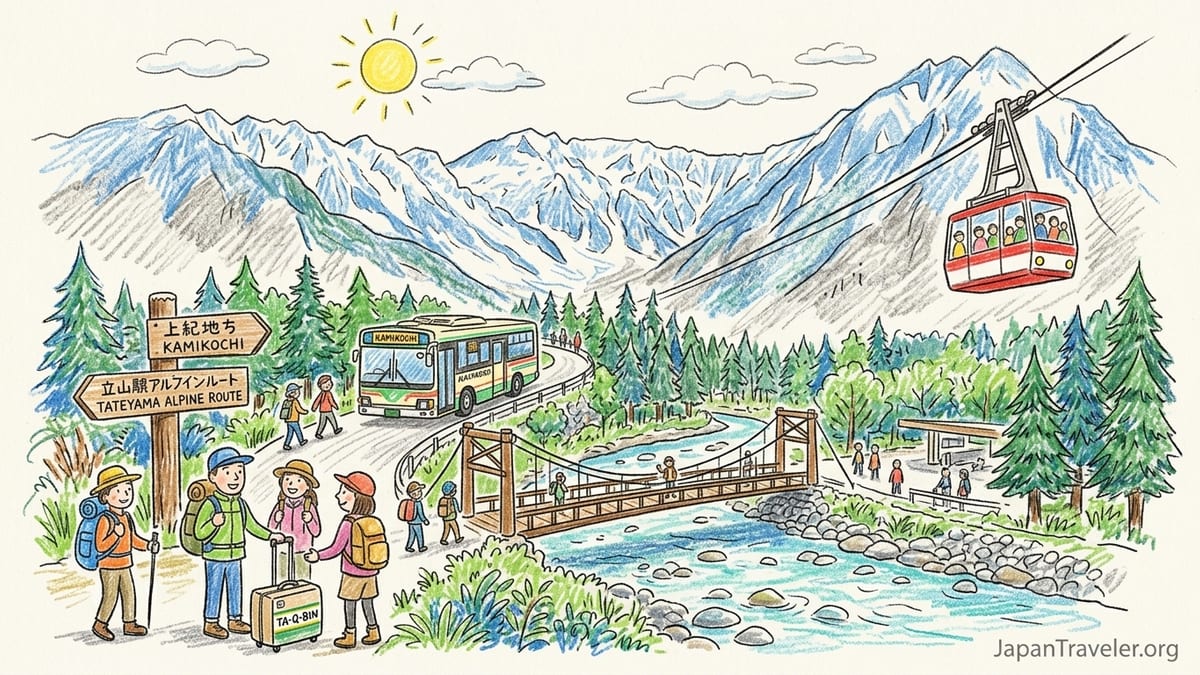
Why the Japanese Alps Are a Rare Place Where Car-Free Isn’t an Afterthought
In much of the world, public transport gets you near mountains, not into them. In the Japanese Alps, some of the most famous “deep mountain” sights actively depend on buses, ropeways, and cable cars. Kamikochi, inside Chubu Sangaku National Park, is the clearest example: private cars are prohibited from entering the valley, and everyone funnels in via shuttle bus or taxi from parking areas like Sawando (Nagano side) or Hirayu (Gifu side). The result is that arriving by bus does not feel second-best. It feels like the default.
The Tateyama Kurobe Alpine Route goes even further. It is not a single ride so much as a chain of mountain transport stitched across the range. The official Alpine Route information frames it as travel “with 6 vehicles” between Toyama-side Tateyama Station and Nagano-side Ogizawa Station, and the route experience is built around transfers. That matters for a car-free traveler because the route is essentially a public-transport itinerary by design, not a scenic road where a private vehicle wins.
But the car-free reality has a catch: the final-mile problem becomes the central problem. When the bus is every 30 minutes, missing it is annoying. When the bus is every 90 minutes, missing it is a schedule collapse. In the Alps, you can experience both in the same week: high-frequency rail in the lowlands, and thin bus timetables once you leave the valleys.
Kamikochi: The Car Ban That Makes Public Transport Feel “Native”
My most relaxing car-free day in the Japanese Alps started with a constraint: I could not drive into Kamikochi even if I wanted to. The official Kamikochi guidance is blunt about access: you can travel by public transportation, or you can drive only as far as Sawando or Hirayu and then switch to a bus or taxi. That forced-mode change eliminates the usual “should I rent a car?” debate, and it also reduces traffic chaos inside the park where most people come to walk beside the Azusa River, not hunt for parking.
From Matsumoto, the practical car-free approach is to treat Kamikochi like a two-step commute. You can ride the private Alpico Kamikochi Line from Matsumoto to Shin-Shimashima, then transfer to the bus for Kamikochi. Alpico’s own instructions are specific: buy the Kamikochi Line train ticket at the vending machines at Matsumoto Station, then connect onward. This detail matters because it is not a JR segment, and if you instinctively follow JR signage only, you can waste precious transfer time.
The part that changed most recently, and changed my planning style, is reservations. Alpico notes that from 2025, buses between Matsumoto and Kamikochi require reservations for both outbound and return trips, with tickets sold through third-party reservation platforms. That single rule turns “I’ll just show up” into “I need a timed slot,” which is fine when everything runs on time, and stressful when a prior train delay or a long coffee line threatens your departure.
The final-mile lesson in Kamikochi is not about the last mile inside the park, because walking is the point. It is about the last mile from the train platform to the correct bus queue, with the correct reservation, in the correct time window. Japanese punctuality helps, but it does not replace arriving early enough to read signs, find the right bay, and handle a platform change without sprinting.
The Tateyama Kurobe Alpine Route: A Transfer Chain Where One Missed Connection Rewrites Your Day
The Alpine Route is the ultimate car-free flex in the Japanese Alps: a continuous crossing that is public transport, sightseeing, and logistics puzzle all at once. On my crossing day, I treated transfers as the main event, not a nuisance between attractions. The official web ticket site describes the route as travel using “6 vehicles” between Tateyama Station and Ogizawa Station. In practice, that means you are constantly thinking ahead: where the next queue forms, how long the next ride is, and what time-of-day congestion does to your buffer.
Ticketing is where I felt the difference between “Japan is easy” and “Japan is easy if you prepare.” The Alpine Route operators strongly encourage advance web reservations, and the official site’s updates make it clear that web ticket availability can sell out for specific dates. I booked online when I could, and I watched for operational notes the way you’d watch weather. The same-day ticket guidance exists, but it is essentially permission to gamble: the ticket window can open early on certain days, and popular travel days can become a long morning of waiting.
Even if you do everything right, the schedule physics are unforgiving. The Alpine Route FAQ notes that the journey from Tateyama Station to Ogizawa “usually takes 6 to 8 hours,” including transfers and sightseeing time. That is the polite way of saying: this is an all-day commitment, and if you start late, you will have to rush, cut stops, or accept an overnight base on one side.
The practical consequence of missing a connection on the Alpine Route is not merely waiting for the next train. In mountain corridors, the “next” departure can be capacity-limited, and queues can become your hidden travel time. My best move was building transfer slack I did not think I needed: time to use restrooms, time to buy a snack before the next segment, and time for the line that looks short until you realize it is for a specific departure slot.
Shinhotaka Ropeway: The Easiest Big-Altitude Day Trip if You Respect Maintenance Days
For a pure “up-and-down” mountain day that still feels alpine, Shinhotaka Ropeway in Okuhida is one of the most public-transport-friendly options, because the ropeway upper station is effectively the destination. You arrive by bus, ride up, walk viewpoints, then ride back down. The ropeway is also unusually transparent about interruptions. The FY2026 operation schedule publicly lists suspension periods, and the official ropeway site regularly posts service news. I learned to check the ropeway’s own updates before locking in bus tickets because a shut ropeway does not just remove an activity, it breaks the logic of the day.
What made this a “last-mile” story for me was the bus stop. Shinhotaka Onsen is not a rail station. It is a bus terminal area where your day depends on how well your bus arrival aligns with ropeway operations and crowd levels. When weather is good, you are not the only person with this idea, and the bottleneck is not the gondola itself, it is the time you lose at the base station when everyone arrives in the same bus wave.
I also learned that ropeways have their own version of “peak commuting.” Shinhotaka has introduced services like priority boarding in certain periods, and even when you do not use such options, they are a signal that queues are common enough to need management. For car-free travelers, that matters because long lines can push your descent later, which can push your last bus later, which can push your dinner later, which can push your hotel check-in into a narrow window if you are staying somewhere rural.
This is where Japanese punctuality helps and does not help. If the ropeway runs as posted and your bus is on schedule, the day feels frictionless. If your ropeway time expands due to crowds, the bus does not wait for you. In the Alps, missing the last bus is not a small mistake, it is a rebooking event.
Last-Mile Reality: When Punctual Trains Save You and When Sparse Buses Corner You
In the Japanese Alps, the contrast between rail and bus schedules is the real mood swing. City-to-city travel on rail is the easy part: you can plan tight transfers with confidence because trains generally keep time. That “punctuality dividend” is what makes car-free travel viable across multiple bases like Matsumoto, Takayama, Toyama, and Nagano. You can arrive, walk to your hotel, and still make a late afternoon bus reservation because you trust the arrival clock.
Then you step into mountain bus territory and the whole rhythm changes. Alpico’s Kamikochi buses, for example, now require reservations for both directions, which makes timing feel airport-like: you are traveling on a slot, not just a route. That is fine until one upstream delay threatens to make you “miss your flight,” except here the consequence is not a different airline, it is sometimes waiting hours for the next available seat, or failing to find space at all during peak periods.
On the Nagano side of the Alpine Route, Ogizawa access illustrates another reality: some segments are operated by local mountain transport companies with their own seasonal schedules and fare tables that can change in spring. The bus timetables and fare information exist, but they live on separate operator pages, and you need to read them like you are stitching together a thru-hike. This is the part of the Alps where “Japan is easy” turns into “Japan is precise.”
The consequence of missing a connection is also different in the mountains. In a city, missing one train costs minutes. In the Alps, missing the wrong bus can cost your entire plan: a missed Kamikochi reservation can force you to abandon an overnight in Takayama, a missed Ogizawa access bus can push you into a late Alpine Route start, and a late Alpine Route start can erase your sightseeing time and still leave you paying full fares.
Luggage: The Hidden Weight That Decides Whether You Enjoy Transfers
I did not fully appreciate how much luggage determines the quality of a car-free Alps trip until I tried to do it “like normal travel,” rolling a suitcase through stations, onto buses, and into ropeway terminals. The problem is not only physical. It is cognitive: when you have luggage, every transfer becomes higher stakes because you move slower, you hesitate more, and you are less willing to explore station layouts. In the Alps, that hesitation is what makes you miss the connection.
The best luggage decision I made was using luggage forwarding on travel days that required multiple transfers. In Japan, takkyubin luggage delivery, best known through Yamato Transport’s TA-Q-BIN brand, is widely used for hotel-to-hotel shipping and is often arranged at hotel front desks. The practical rule I lived by was simple: if tomorrow includes a bus reservation or a transfer chain, ship the suitcase and carry a day bag with one night of essentials. The day feels lighter, and you stop treating every staircase as an enemy.
For same-day flexibility, station lockers were my backup tool, but they are not a magic wand. Lockers vary by operator and station, and prices and sizes vary. One major railway operator’s English coin locker guidance, updated in 2026, shows typical daily price ranges that scale by size, and it also notes the low-tech reality that some lockers still require coins. That detail matters when you arrive late and discover the coin changer is not where you expected. In practice, lockers worked best for me in big hubs, not small mountain stations where locker supply can be limited or nonexistent.
The third strategy, and the one that made my itinerary feel calm, was the overnight-base approach. Instead of changing hotels every night, I used gateway cities as bases and did mountain day trips: Matsumoto for Kamikochi access, Takayama for Okuhida and ropeway days, Toyama or Nagano for an Alpine Route crossing start. When you sleep in the same place two nights in a row, you eliminate the “carry everything today” problem and reduce the number of times a missed bus becomes a lodging crisis.
The Takeaway: Who Can Comfortably Go Car-Free, and Where a Car Still Wins
If you are comfortable with timed departures, you can absolutely travel the Japanese Alps without a car, and in some places you will arguably have a better trip without one. Kamikochi is the headline case because access is structured around buses and taxis from outside parking areas, and the valley experience is built for walkers, not drivers. Likewise, the Tateyama Kurobe Alpine Route is public transport by definition, and treating it as a transfer-based journey rather than a sightseeing add-on makes it feel coherent rather than chaotic.
The travelers who do best car-free are the ones who plan around the final mile. That means booking what needs booking, padding transfer time even when trains are punctual, and avoiding itineraries where a single missed bus erases an entire day. It also means having a luggage plan that matches your transfer density: forward the suitcase on multi-transfer days, rely on lockers only where you are sure they exist, and choose overnight bases that let you travel light on the mountain legs.
A car becomes genuinely useful when your goals live beyond the bus network: trailheads that are not served by seasonal routes, small onsen towns with one or two buses a day, photography schedules that require pre-dawn positioning, or shoulder-season travel when services thin out. In those cases, a car is not about comfort, it is about control. But for the marquee Alps experiences that already depend on public transport, the car-free version is not a workaround. It is the way the region is meant to be visited.
FAQ
Q1. Can I visit Kamikochi without renting a car?
Yes. Private cars are prohibited from entering Kamikochi, so visitors typically arrive by bus or taxi from access points such as Sawando or Hirayu, or via public transportation from gateway cities.
Q2. Do I need reservations for the Matsumoto to Kamikochi bus?
Yes in many cases. Alpico notes that from 2025, buses between Matsumoto and Kamikochi require reservations for both outbound and return trips, sold through third-party platforms.
Q3. How long should I budget for the Tateyama Kurobe Alpine Route crossing?
A full Tateyama Station to Ogizawa crossing commonly takes most of the day. The Alpine Route FAQ notes it usually takes about 6 to 8 hours including transfers and sightseeing time.
Q4. Is the Tateyama Kurobe Alpine Route something I can do last-minute?
Sometimes, but it is risky in peak seasons. The Alpine Route operators recommend advance web ticket reservations, and same-day tickets can involve early arrivals and uncertainty.
Q5. What transport types will I actually use on the Alpine Route?
You will use a chain of vehicles across the route, described by the official web ticket site as travel using six vehicles between Tateyama Station and Ogizawa Station, with multiple transfers.
Q6. Is Shinhotaka Ropeway feasible by public transport?
Yes, but plan around bus timing and ropeway operations. The ropeway publishes an FY2026 operation schedule including suspension periods, which can affect day-trip feasibility.
Q7. What is the “final-mile problem” in the Japanese Alps?
It is the gap between rail hubs and mountain destinations. Trains can be frequent and punctual, but mountain buses can be infrequent or reservation-based, so a missed connection can cause major delays.
Q8. Should I use luggage forwarding (takkyubin) in the Alps?
It can dramatically reduce stress on multi-transfer days. Takkyubin services such as Yamato Transport’s TA-Q-BIN are widely used for hotel-to-hotel luggage delivery in Japan.
Q9. Are station coin lockers reliable for storing suitcases?
They are useful in major stations, but availability and prices vary. Some stations require coins for lockers, and smaller mountain-area stations may have limited supply.
Q10. When does a rental car become worth it in the Japanese Alps?
A car is most useful for remote trailheads, low-frequency rural areas, pre-dawn plans, or shoulder-season travel when bus schedules thin out. For Kamikochi and the Alpine Route, public transport is often the better fit.