


Shizuoka’s side of Mount Fuji is finally getting the attention it deserves, and the Mt. Fuji‑Shizuoka Area Tourist Pass Mini is one of the main reasons. Priced at ¥6,500 for three consecutive days, this JR Central regional pass promises unlimited local travel around Shizuoka, Fujinomiya, and parts of the Fuji area, plus useful buses and even a Suruga Bay ferry. But on a real trip, does it actually save money compared with individual tickets, especially if you are coming from Nagoya or combining Shizuoka sightseeing with a Fuji visit? This guide breaks down what the pass covers, tests it against realistic itineraries, and explains who gets the best value.
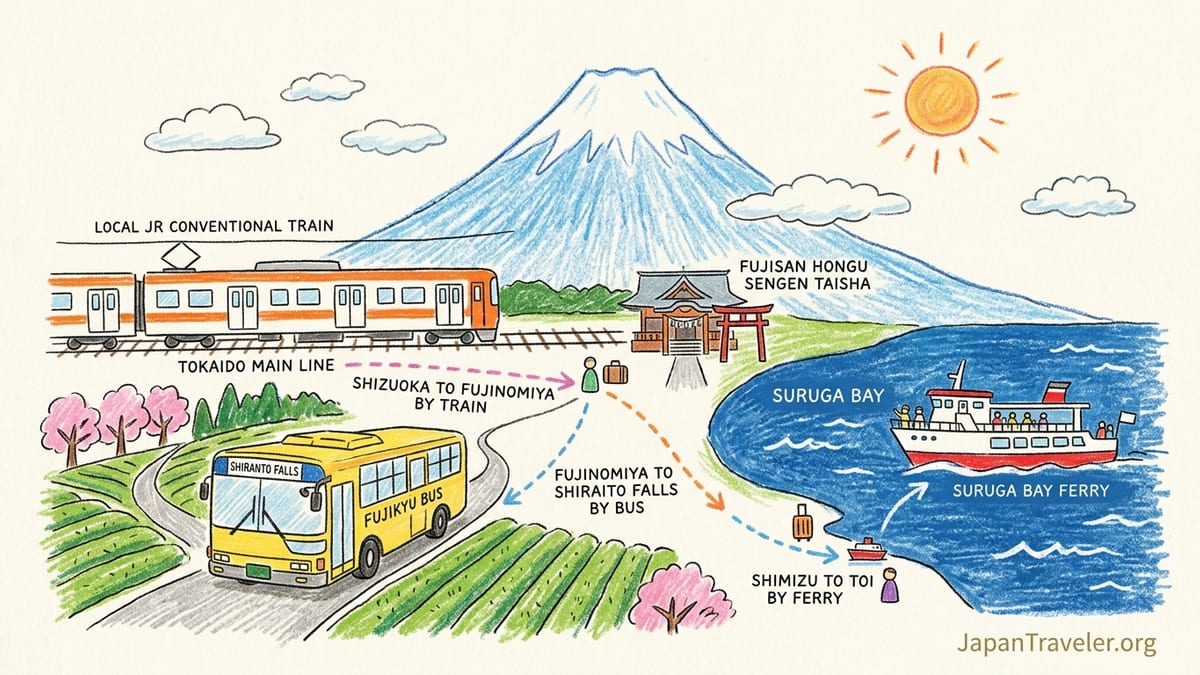
What the Mt. Fuji‑Shizuoka Area Tourist Pass Mini Actually Covers
The Mt. Fuji‑Shizuoka Area Tourist Pass Mini is a three day regional pass issued by JR Central for foreign visitors. As of mid‑2026, the official tourist pass site lists the price at ¥6,500 for adults for three consecutive calendar days. The pass focuses on local transport in Shizuoka Prefecture and the Shizuoka side of Mount Fuji rather than long distance shinkansen travel, so it complements rather than replaces a ticket or pass for getting into the region.
Within its validity area, the pass gives unlimited rides on JR conventional (non‑shinkansen) trains along the Tokaido Main Line between Atami and Toyohashi, plus the JR Minobu Line between Fuji and Nishi‑Minobu. It also covers the JR Gotemba Line section between Numazu and Gotemba. These lines connect key hubs such as Atami, Mishima, Numazu, Fuji, Fujinomiya, Shizuoka, Kakegawa, Hamamatsu, and Toyohashi, allowing you to shuttle up and down the prefecture without worrying about individual local fares.
Beyond JR trains, the pass includes several private rail and bus operators that are important for Mt. Fuji and coastal sightseeing. These typically include the Izuhakone Railway Sunzu Line between Mishima and Shuzenji, bus networks such as Fujikyu Shizuoka Bus and Shizutetsu Justline on specific routes around Shin‑Fuji, Fuji, Fujinomiya and Shizuoka, plus Tokai Bus around parts of the Izu Peninsula. One of the biggest perks is coverage of the Suruga Bay Ferry between Shimizu Port and Toi on the western Izu Peninsula, an otherwise relatively expensive crossing that also offers superb Fuji views on clear days.
What the pass does not include is just as important. The Mt. Fuji‑Shizuoka Area Tourist Pass Mini does not cover any Tokaido Shinkansen rides, even though the shinkansen runs right through Shizuoka prefecture. It also does not cover airport access from Tokyo or Nagoya, nor highway buses to Kawaguchiko or the Fuji Five Lakes. If you are picturing a single ticket that handles everything from Tokyo Station to the lakeside Lawson at Kawaguchiko, this is not it. Instead, think of the pass as a regional freedom ticket once you are already in the Shizuoka and Fuji area.
Key Routes and Transport Types You Can Use
Most travelers use the pass along a few core corridors. The first is the east‑west spine of the JR Tokaido Main Line between Atami and Toyohashi. Typical segments here include Atami to Shizuoka, Shizuoka to Hamamatsu, or Shizuoka to Fuji. A single local train ride from Shizuoka to Hamamatsu generally costs a little over ¥1,500 one way at regular fare levels, while a shorter hop like Shizuoka to Fuji is around the ¥1,000 mark. Two or three of these rides quickly add up, which is where the unlimited aspect of the pass starts to matter.
The second key corridor is the JR Minobu Line between Fuji and Fujinomiya. This is the main railway link to Fujinomiya, gateway to the historic Fujisan Hongu Sengen Taisha shrine and one of the main starting points for climbing Fuji on the Shizuoka side. A simple out‑and‑back trip from Fuji to Fujinomiya and back normally runs around a few hundred yen each way, which alone will not justify the pass, but when combined with other Tokaido Line segments and bus rides in the area, the economics start to improve.
On the bus side, the pass really shines for sightseeing days around Shin‑Fuji, Fuji, and Fujinomiya. For example, Fujikyu Shizuoka Bus routes between Shin‑Fuji Station or Fuji Station and Fujinomiya, and from Fujinomiya to attractions such as Shiraito Falls and Asagiri Plateau, are included. A single ride from Fujinomiya Station to Shiraito Falls costs roughly ¥1,000 round trip if purchased separately. Add in another bus up to Asagiri Plateau or Lake Tanuki, and you might easily spend ¥1,500 to ¥2,000 per day in bus fares alone.
The Suruga Bay Ferry is another high value inclusion for coastal itineraries. A one way adult ticket between Shimizu Port and Toi Port on the Izu Peninsula costs around ¥2,200 for adults when purchased separately, with a slightly discounted round trip available. Having this ferry included in an already affordable regional pass can tilt the math dramatically if you plan a day in Izu or use the ferry as a scenic way to connect Shizuoka City with onsen towns on the western Izu coast.
How the Pass Works in Practice: Example Itineraries
To understand whether the Mt. Fuji‑Shizuoka Area Tourist Pass Mini is worth it, it helps to plug it into realistic three day itineraries. Consider a traveler based in Shizuoka City for three nights, planning to see Fujinomiya and Mt. Fuji, then enjoy some coastal scenery. On day one they ride the Tokaido Main Line from Shizuoka to Fuji, change to the Minobu Line up to Fujinomiya, then take the bus to Shiraito Falls and back, and return to Shizuoka in the evening. On day two they take the train from Shizuoka to Shimizu, bus or local train to Shimizu Port, ride the Suruga Bay Ferry to Toi, spend time in an Izu onsen town, then ferry and train back. On day three they head east to Atami for hot springs and old town streets before returning to Shizuoka.
Purchased as individual tickets, this three day pattern quickly becomes expensive. A rough breakdown would be: Shizuoka to Fujinomiya and back via Fuji at around ¥2,000 to ¥2,500 total in JR fares, plus ¥1,000 to ¥1,500 for the Shiraito Falls bus rides. The Shizuoka to Shimizu and port access would be a few hundred yen, but the Suruga Bay Ferry round trip alone is over ¥4,000. A return ride from Shizuoka to Atami is again over ¥2,000. Add in a couple of shorter local hops within Shizuoka and Fujinomiya and you may be looking at ¥10,000 to ¥11,000 in local transport across three days, compared with the ¥6,500 pass cost.
A different but equally realistic use case is for travelers treating Shizuoka as a stop between Tokyo and Nagoya. For example, imagine arriving in Shizuoka from Tokyo using a separate shinkansen ticket, then activating the pass for three days of local exploration. Day one could be Shizuoka City sights and a sunset ride out toward Yaizu or Shimizu for coastal views of Fuji. Day two might focus on Fujinomiya, with trains to Fujinomiya and buses to Shiraito Falls and Asagiri Plateau. Day three could be an Izu Peninsula loop by train to Mishima, then Izuhakone Railway to Shuzenji, followed by Tokai Bus to coastal towns such as Toi, and the Suruga Bay Ferry back to Shimizu. The combined JR and private line fares for that pattern would again commonly exceed the pass price if purchased as individual tickets.
By contrast, if you planned a very light schedule such as one return day trip from Shizuoka to Fujinomiya and another from Shizuoka to Hamamatsu, then a short ride around Shizuoka City, your total might land closer to ¥6,000. In that case, the pass would only break even or save a token amount, and buying single tickets with an IC card could be simpler. The pass is therefore most valuable when you are prepared to structure three reasonably full days of train and bus travel within the valid area.
Value for Travelers Coming from Nagoya, Kyoto and Osaka
Because the Mt. Fuji‑Shizuoka Area Tourist Pass Mini does not include shinkansen rides, travelers starting in Nagoya, Kyoto, or Osaka need to see it as an add‑on rather than a replacement for Tokaido Shinkansen tickets. A typical pattern would involve buying a regular or discounted shinkansen ticket from Nagoya, Kyoto, or Shin‑Osaka to either Shizuoka, Hamamatsu, or another station in Shizuoka Prefecture, then activating the regional pass from the day you arrive.
For instance, a visitor could travel by Hikari or Kodama shinkansen from Nagoya to Shizuoka in about 1 hour, using a separate shinkansen ticket. Once in Shizuoka, they might schedule three days of local travel covered by the pass: one day east toward Fuji and Fujinomiya, one day focused on Shizuoka City and Shimizu with the ferry to Toi, and one day westward toward Hamamatsu, perhaps continuing by local JR trains to Toyohashi and back. Given how quickly point to point Tokaido Line fares add up between these cities, three days of active sightseeing frequently push total local transport beyond the ¥6,500 mark.
Travelers coming from Kyoto or Shin‑Osaka can do something similar. They might ride a morning shinkansen to Hamamatsu, activate the pass at Hamamatsu Station, then use it to explore Hamamatsu on arrival day before continuing along the Tokaido Line to Kakegawa or Shizuoka in the evening. On day two they could head to the Fuji and Fujinomiya area, and on day three ride as far east as Atami or as far west as Toyohashi all on the pass. If that same person instead bought separate JR tickets for each segment, three days of moving around could easily climb into the low five‑figure yen range.
The main caveat is that those purely transiting between Nagoya and Tokyo with minimal time in the region are unlikely to benefit. If you plan to step briefly off the shinkansen for a single half day look at Mt. Fuji from Shin‑Fuji Station, hop back on, and continue to Tokyo, the pass is almost certainly unnecessary. It is designed for travelers who treat Shizuoka as a multi‑day base rather than a one hour coffee stop between bigger cities.
Comparing the Pass to Other Fuji and Shizuoka Options
Many visitors default to the Yamanashi side around Kawaguchiko, often using passes such as the Fuji Hakone Pass, Fuji‑Hakone combo passes, or the Mt. Fuji Pass issued by Fujikyu. Those products typically bundle round trip access from Tokyo via the Chuo Line or Odakyu network with unlimited use of certain buses and ropeways around the Fuji Five Lakes and Hakone. They are excellent for a Fuji Five Lakes focused itinerary, but do little for travelers who want to linger around Shizuoka City, Shimizu, Hamamatsu, or the Izu Peninsula.
By contrast, the Mt. Fuji‑Shizuoka Area Tourist Pass Mini biases toward the Pacific coast side of Mount Fuji and Shizuoka Prefecture. It supports itineraries that combine iconic Fuji views with Shizuoka’s green tea terraces, coastal ports, and hot spring towns. For example, a traveler might spend one night in Fujinomiya, another in Shizuoka, and a third in an Izu onsen town, all using the same three day pass for their trains and buses. That is a very different style of trip from a Kawaguchiko‑only visit.
Compared with simply using an IC card and paying as you go, the advantages of the pass are predictability and the freedom to improvise. Once the pass is in hand, you can spontaneously decide to ride from Shizuoka to Atami for dinner, try a detour to Yaizu or Kakegawa, or hop on an extra bus to a viewpoint in Fujinomiya without re‑calculating each fare. However, if you intend to visit only one major attraction such as Shiraito Falls, or stay almost entirely within Shizuoka City, your total fares may not be high enough to justify a pass.
When compared with national rail products like the Japan Rail Pass, the Mt. Fuji‑Shizuoka Area Tourist Pass Mini fills a more niche, regional role. Since the nationwide pass saw a significant price increase in October 2023, many travelers now find that a mix of regional passes and individual tickets works out cheaper. For visitors focusing on central Japan and willing to slow down between Tokyo and Osaka, this Shizuoka‑focused pass and related products such as the Mt. Fuji‑Izu Area Tourist Pass PLUS can provide better value than an expensive nationwide rail pass, as long as you tailor your itinerary to take advantage of the included lines.
Who Benefits Most From the Mt. Fuji‑Shizuoka Area Tourist Pass Mini
The pass delivers the best value for travelers who plan to spend at least two full days, preferably three, actively using local trains and buses within Shizuoka Prefecture and the Fuji area. Ideal users are those basing themselves in Shizuoka City, Hamamatsu, or Fujinomiya and using the rail network to explore in several directions. If your typical day includes two or more substantial train legs plus one or two bus rides, it will be easy to cross the rough ¥2,200 per day threshold that makes the pass favourable.
Travelers approaching from Nagoya, Kyoto, or Osaka who want to break their journey with one to three nights in Shizuoka are another sweet spot. For example, a visitor coming from Kyoto might ride shinkansen to Shizuoka, then use the pass for a three day loop of Shizuoka City, Fujinomiya, and Izu before continuing to Tokyo. In that scenario, the pass acts as a flexible local add‑on sandwiched between two long distance shinkansen tickets.
The pass is also well suited to visitors who care about variety rather than ticking only the most famous Fuji viewpoints. They might combine Fujisan Hongu Sengen Taisha in Fujinomiya with tea plantations near Kakegawa, seaside views at Satta Pass near Shimizu, a Suruga Bay cruise, and Hamamatsu’s musical instrument museum, all within the same three days. For these travelers, the pass enables a richer, more spontaneous experience that would be cumbersome to manage with individual tickets alone.
On the other hand, the pass is not ideal for people whose only goal is to see Mount Fuji once on a day trip, or who are committed to the Kawaguchiko side and the Fuji Five Lakes. It is also a poor fit for ultra‑budget travelers who intend to move very slowly, perhaps staying five or six days in a single city and venturing out only once or twice. In those cases, regular IC card fares or a different regional product will likely be cheaper and simpler.
How to Decide: A Simple Cost Check for Your Itinerary
A straightforward way to decide whether the Mt. Fuji‑Shizuoka Area Tourist Pass Mini works for you is to sketch your likely three day pattern and estimate point to point fares. Start by listing your main bases and day trips. For example: Day one, Shizuoka to Fujinomiya to Shiraito Falls and back; day two, Shizuoka to Shimizu to Suruga Bay Ferry to Toi and back; day three, Shizuoka to Atami and back. Then check approximate one way fares for each train segment and known bus or ferry prices.
If your total over those three days clearly comes to more than around ¥8,000 in local transport, the pass at ¥6,500 is almost certainly worth it and gives you a buffer for unplanned side trips. If it lands between about ¥6,000 and ¥8,000, the decision becomes more about convenience and flexibility. If it falls below ¥6,000, especially if you have only one really active day sandwiched between two light days, individual tickets are likely more sensible.
Travelers approaching from Nagoya or Kyoto should run the numbers separately for their long distance shinkansen legs, since these are outside the pass. In many cases, using a discounted Kodama service or shinkansen ticket booked in advance, combined with the regional pass for three busy days in Shizuoka, will still undercut the cost of a nationwide rail pass. The key is to remember that the regional pass pays off only if you exploit its strengths: JR local lines along the coast, the Minobu Line into Fujinomiya, and included buses and ferry routes.
Finally, think about your travel style. If you are the sort of traveler who likes to linger in cafés, spend several hours in a single museum, or photograph one temple from every angle, you may not ride trains and buses often enough to justify a pass. If, instead, you enjoy covering multiple neighborhoods or towns in a single day and do not mind a few extra local train rides purely for the views of Fuji and the coast, you are exactly the person this pass was designed for.
The Takeaway
The Mt. Fuji‑Shizuoka Area Tourist Pass Mini is not a universal bargain, but for the right itinerary it offers excellent value and a liberating sense of freedom. Its strength lies in unlimited use of JR conventional lines between Atami and Toyohashi, the Minobu Line to Fujinomiya, key private rail lines, and practical bus routes around Fuji and Shizuoka, plus a high value inclusion in the Suruga Bay Ferry. At ¥6,500 for three consecutive days, it quickly pays for itself on itineraries that combine Shizuoka City, Fujinomiya and Mt. Fuji, and coastal or Izu Peninsula excursions.
Travelers approaching from Nagoya, Kyoto, or Osaka who are willing to add two or three nights in Shizuoka and explore widely by local train are among the biggest winners. So are visitors who want to experience Fuji in a less crowded way, blending shrine visits and waterfalls near Fujinomiya with quiet tea towns and seaside walks. By contrast, those who only plan a single Fuji day trip, or who are focused solely on Kawaguchiko and the Fuji Five Lakes from Tokyo, will be better served by other passes or simple point to point tickets.
Before you buy, take fifteen minutes to sketch your likely three day route and estimate individual fares. If your total crosses much above the ¥6,500 pass price and you like the idea of hopping on extra trains or buses whenever a new viewpoint or onsen town catches your eye, the Mt. Fuji‑Shizuoka Area Tourist Pass Mini is very likely worth it. For travelers keen to discover the Shizuoka side of Mount Fuji rather than following the crowd to Kawaguchiko, it can be one of the smartest tools in the planning kit.
FAQ
Q1. Does the Mt. Fuji‑Shizuoka Area Tourist Pass Mini include shinkansen rides?
The pass does not include any Tokaido Shinkansen services. It is valid on JR local and rapid trains on conventional lines within the designated area, plus certain private rail and bus routes, but you must buy separate shinkansen tickets to reach Shizuoka from Tokyo, Nagoya, Kyoto, or Osaka.
Q2. Can I use this pass to travel from Tokyo directly to Mount Fuji?
No, the pass does not cover travel from Tokyo or any airport into the region, nor does it include highway buses to Kawaguchiko or the Fuji Five Lakes. Most travelers buy a separate shinkansen or limited express ticket to a station inside Shizuoka Prefecture, such as Shizuoka, Shin‑Fuji, or Mishima, then activate the pass for regional travel from there.
Q3. Is the pass good for visiting Kawaguchiko and the Fuji Five Lakes?
The Mt. Fuji‑Shizuoka Area Tourist Pass Mini is designed for the Shizuoka side of Mount Fuji and does not cover most transport around Kawaguchiko or the Fuji Five Lakes. If your main goal is to stay around Kawaguchiko, consider passes issued by Fujikyu or Fuji‑Hakone style passes instead, and treat this Shizuoka pass as a separate product for a different trip.
Q4. How many days do I need in Shizuoka to make the pass worthwhile?
Because the pass is valid for three consecutive days, it generally offers the best value if you have at least two full days of active train and bus travel, ideally three. If you only plan one busy sightseeing day and two very light days, your total fares may not exceed the ¥6,500 pass price.
Q5. Does the pass cover buses to Shiraito Falls and other Fuji attractions?
Yes, selected Fujikyu Shizuoka Bus routes between Fuji or Fujinomiya and major attractions such as Shiraito Falls are covered. This can save around ¥1,000 or more per day compared with buying separate bus tickets, especially if you also ride other local buses during the same day.
Q6. Can I ride the Suruga Bay Ferry with this pass?
One of the highest value uses of the pass is that it covers the Suruga Bay Ferry between Shimizu Port and Toi. Since a one way ticket on this ferry typically costs over ¥2,000, including it as part of a three day pass can significantly improve the overall value.
Q7. Where can I buy the Mt. Fuji‑Shizuoka Area Tourist Pass Mini?
The pass is generally available to foreign visitors through official JR Central sales channels and partner travel agents, including major stations served by JR Central such as Tokyo, Shinagawa, Shin‑Yokohama, Nagoya, Kyoto, Shin‑Osaka, and key stations within Shizuoka Prefecture. Exact sales points can change, so it is wise to check current information shortly before your trip.
Q8. Is the pass worth it if I only want to see Mount Fuji once?
If your plan is simply a single day trip to see Mount Fuji, for example by visiting Fujinomiya and Shiraito Falls from Shizuoka, then returning to another city the next day with little additional local travel, the pass will often not save much money. In that case, buying individual train and bus tickets or using an IC card is usually more economical and simpler.
Q9. How does this pass compare with the Japan Rail Pass?
The Mt. Fuji‑Shizuoka Area Tourist Pass Mini is a focused regional product, while the Japan Rail Pass covers JR trains nationwide, including selected shinkansen. After recent price increases, the nationwide pass is only cost effective for very rail heavy itineraries. For travelers concentrating on central Japan and Shizuoka in particular, combining this regional pass with a few separate shinkansen tickets is often cheaper than buying a national pass.
Q10. Can I combine this pass with other regional passes?
Yes, some travelers combine the Mt. Fuji‑Shizuoka Area Tourist Pass Mini with other products, such as Fuji‑Hakone or Mt. Fuji passes on the Yamanashi side, but they generally cannot be used on the same trains or buses at the same time. The practical approach is to structure your trip into segments, using this pass for Shizuoka based days and a different pass or IC card system for days around Kawaguchiko or Hakone.