


The Kumano Kodo Iseji is one of Japan’s most atmospheric pilgrimage routes, threading from the sacred forests of Ise Jingu across the Mie coast toward the Kumano shrines. Quieter than the famous Nakahechi but rich in stone-paved passes, fishing villages and long Pacific beaches, it is an ideal choice for travelers who want a less crowded, more contemplative walk. This guide explains how the Iseji is structured, which sections work best as day hikes, how to link Ise Jingu with the Kumano region, and the practical details of accommodation, luggage and trains along the way.
Understanding the Character of the Kumano Kodo Iseji
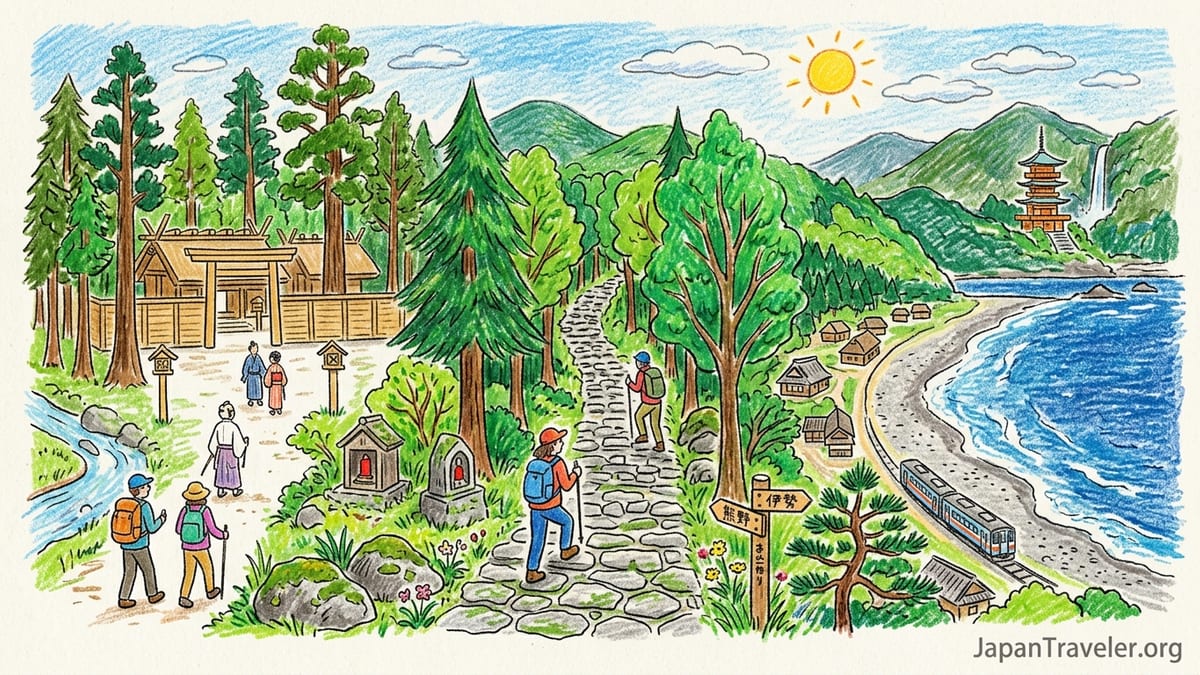
The Kumano Kodo is a network of ancient pilgrimage routes on Japan’s Kii Peninsula, a UNESCO World Heritage Site since 2004. The Iseji is the eastern approach, a roughly 170 kilometer trail that connects the Ise area in Mie Prefecture with the three grand Kumano shrines further south and west. Rather than staying in the deep interior mountains, the Iseji moves from rural river valleys to steep forested passes and then tracks the Pacific coastline, giving walkers a changing rhythm of inland and seaside landscapes.
Historically, pilgrims began at Ise Jingu, one of Japan’s most important Shinto shrines, then walked south toward Kumano Hongu Taisha, Kumano Hayatama Taisha and Kumano Nachi Taisha. Today, the Iseji route is waymarked and partially restored, but it remains far less developed than the Nakahechi. You are more likely to share the path with local hikers, retirees out for a day walk and the occasional serious pilgrim than with tour groups. For many travelers, this quieter atmosphere is the main attraction.
Geographically, the Iseji is often described in three broad parts: a northern section through rural “Oku-Ise” around the Miya-gawa River, a central section of classic stone-paved passes near towns like Kii-Nagashima and Owase, and a southern section along the Kumano coast near Mihama and Kumano City. Most walkers focus on the central and southern sections, where the route combines lush forest climbs with sea views, fishing villages and the long gravel beach of Shichiri-mihama.
You do not have to walk all 170 kilometers. Many visitors use the Iseji as an experiential add-on to a Mie or Kumano trip, choosing one or two representative passes as day hikes. Others plan a 4 to 7 day walk linking several key sections between towns with train stations and small inns. This flexibility, together with the steady presence of the JR Kisei Main Line along the coast, makes the Iseji easier to tailor to your time and energy than its remoteness might suggest.
Ise Jingu and the Northern Iseji: Starting Your Pilgrimage
Most journeys on the Iseji begin at Ise Jingu, whose two main complexes, Geku and Naiku, are set in dense cedar forest on the edge of the city of Ise. A realistic plan is to spend at least one full day visiting Ise Jingu, walking between Geku and Naiku, and exploring the traditional streets of Okage Yokocho and Oharai-machi near Naiku. From Nagoya, you can reach Ise by Kintetsu limited express in around 1 hour 40 minutes, or by JR rapid trains in roughly 2 hours with one connection via Taki or Kameyama.
North of the coast, the Iseji follows the Miya-gawa River through rural “Oku-Ise.” For most overseas visitors, this inland section is more a cultural curiosity than a must-hike. It passes through small farming towns and low hills, but many travelers prefer to use local trains and buses here, saving their walking days for the dramatic stone-paved passes further south. If you are short on time, it is perfectly acceptable to treat Ise Jingu and the central Iseji passes as two separate bases, linked by rail rather than by continuous footsteps.
If you do want to walk out of the Ise area, one typical approach is to base in Ise City for two nights, visiting the shrines on day one and then taking a short Iseji stage on day two. You might, for instance, ride a local train toward Tamaki or Taiki, walk a half-day section along farm lanes and low ridges, then return to Ise by train in the afternoon. This gives you a taste of leaving Ise as the old pilgrims did, without committing to every intervening stage.
Whatever your exact route, it is worth thinking of Ise Jingu not simply as a sightseeing stop but as a spiritual prologue. Even travelers with no religious background often find the atmosphere of towering cryptomeria trees, simple wooden shrine buildings and the flowing Isuzu-gawa river deeply calming. Beginning your Iseji experience here sets the tone for the quieter, less monumental but equally contemplative landscapes you will meet along the Mie coast.
Key Passes and Classic Sections Along the Mie Coast
The heart of the Iseji experience lies in its mountain passes, or “toge,” where sections of old stone paving wind through cedar and broadleaf forest. These passes are compact enough for day hikes, often starting and finishing at small coastal stations on the JR Kisei Main Line, which shadows the route down the peninsula. Among many options, a few stand out repeatedly in guidebooks, local government publications and recent trip reports.
One of the most recommended is Magose-toge, above the port town of Owase. This pass is famous for its long stretches of beautifully preserved cobblestones, cool forest and partial sea views as you approach or leave Owase. Many hikers take a local or rapid train to Owase Station in the morning, walk the 6 to 8 kilometer Magose-toge section at an unhurried pace in around 3 to 4 hours, then return to Owase for a late lunch of fresh seafood at a small local restaurant near the harbor before riding the train back to their base.
Another classic is Tsuzurato-toge near Kii-Nagashima. Historically a border between old provinces, this pass offers steep ascents and descents on stone-paved trails, with viewpoints back over the coast. Typical day walkers start at Kii-Nagashima Station, shuttle or walk to the trailhead, then cross the pass and descend to a different village or back toward the rail line, covering roughly 8 to 10 kilometers. The climb can be sweaty in summer, but in cooler months the combination of old paving and distant sea views makes it one of the most satisfying sections of the Iseji.
Further south, the route swings closer to the coast near Kumano City and Mihama. Here you encounter the Hadasu-no-michi, another evocative stone-paved path, and the famous Shichiri-mihama shoreline. Shichiri-mihama is a sweeping gravel beach, around 22 kilometers in length, that forms part of the Iseji’s “Hama-kaido” coastal route. Rather than walking its full length, many visitors choose a shorter segment, for example spending 2 to 3 hours following the beach and nearby shrine sites near Atashika, Udono or along the outskirts of Kumano City. Walking on the gravel can be tiring, so these shorter sections are a good way to appreciate the scale of the coastline without exhausting yourself.
How the Iseji Differs From the Nakahechi Route
Most English-language information on the Kumano Kodo focuses on the Nakahechi, the interior route from Tanabe to Kumano Hongu Taisha and on toward Nachi. The Iseji offers a different flavor. It still has steep climbs and descents, but overall it feels more coastal and more rural, with a mix of mountains, rivers and fishing towns rather than a continuous traverse of the deep interior. For some travelers, it feels closer to everyday Japanese life, with more encounters in tiny train stations, local supermarkets and harbors.
The Nakahechi has a well-developed support network: a dedicated booking site, a wider choice of minshuku and ryokan geared to foreign walkers, and clear infrastructure for luggage transfers and meals. The Iseji, in contrast, has fewer accommodations immediately on the trail, and many are traditional family-run inns with limited English and only a handful of rooms. This means more advance planning and occasionally more flexibility: you may need to adjust your ideal stage length to reach a town with lodging, or rely on short taxi transfers between your inn and the trailhead.
On the plus side, the Iseji’s relative obscurity means the paths are less crowded. In peak spring or autumn weeks, Nakahechi villages can be filled with walkers, and popular accommodations may book out months ahead. On the Iseji, recent hikers still report meeting only a few other parties on many passes, even in good weather. If your image of a pilgrimage involves long periods of solitude, the Iseji may fit better, provided you are comfortable with slightly more self-reliance and fewer English signs.
In terms of difficulty, the Iseji’s classic passes are comparable to moderate mountain day hikes: there are some steep, sometimes slippery segments, and stone steps that can be hard on the knees, but the distances are generally manageable if you are used to 10 to 15 kilometer walks. The coastal stretches and gravel beaches can be mentally demanding because the scenery changes slowly and the underfoot surface is uneven. Overall, most reasonably fit walkers who could handle the Nakahechi should be able to enjoy selected Iseji sections, particularly if they choose shoulder seasons and avoid the hottest summer weeks.
Planning Your Walk: Stages, Day Hikes and Sample Itineraries
A full traverse of the Iseji can take one to two weeks, but most international visitors opt for a more selective approach, combining highlights into a 3 to 7 day plan or choosing just one representative day hike as part of a broader Mie or Kansai trip. When planning, think first about your total available days, then decide whether you want to prioritize continuity or variety.
For a short taste of the Iseji, a practical two or three night plan could look like this: arrive in Ise and stay near Ise-shi or Ujiyamada Station, spend a day visiting Ise Jingu and nearby streets, then take an early train the next morning down the Kisei Main Line to Owase or Kii-Nagashima. Hike Magose-toge or Tsuzurato-toge as a day loop or traverse, have dinner and a soak at a local ryokan, then ride the train back to a larger hub such as Nagoya or Shingu the following day. This structure gives you both the shrine experience and a classic stone-paved pass with minimal logistics.
For a more focused walking trip of around 5 days, you might base yourself successively in two or three small towns along the coast. One sample pattern is Ise to Kii-Nagashima, then Owase, then Kumano City or Shingu. Between these bases, you can walk one key pass each day: Tsuzurato-toge from Kii-Nagashima, Magose-toge from Owase, then one or two shorter coastal and stone-paved sections near Hadasu and Shichiri-mihama. Distances on hiking days would typically range from 8 to 15 kilometers, which leaves time for transfers, meals and short breaks in shrines or small museums.
Serious walkers who want a more continuous pilgrimage can connect multiple passes on foot, but this requires careful study of local maps to balance the trail segments, paved road sections and accommodation. Some stages between rural villages may have limited or no lodging, so you will either need to accept longer days into the next town, or plan for short bus or taxi hops. As of 2026, Mie Prefecture and local tourism offices continue to publish English route maps and model itineraries, which are worth downloading before you finalize your daily plans.
Accommodation and Luggage Logistics Along the Iseji
Compared with the Nakahechi, where you can often string together minshuku every 10 to 15 kilometers, the Iseji requires more attention to where you will sleep. In the central and southern sections, most walkers base themselves in small coastal towns such as Kii-Nagashima, Owase, Mihama or Kumano City, using local transport to reach nearby trailheads. In these towns you will find a mix of business hotels near the station, small ryokan and minshuku, and in some places newer guesthouses aiming at hikers.
Prices vary, but a realistic range for a simple Japanese-style room with two meals is often in the vicinity of 9,000 to 15,000 yen per person per night, depending on season and the level of comfort. Business hotels near stations may offer bed-only rates from around 5,000 to 8,000 yen, with the trade-off that you will eat dinner at local izakaya or casual restaurants instead of at the inn. Many walkers mix these options: stay one night in a small ryokan with on-site dinner and breakfast, then a night in a basic hotel when they want to do laundry or have more flexibility in the evening.
Luggage transfers on the Iseji are not as standardized as on the Nakahechi, but they are possible with some planning. In practice, many travelers choose one of three strategies. The first is to travel light with a 30 to 40 liter backpack and carry everything on your hikes, relying on coin laundries in coastal towns every few days. The second is to use a nationwide luggage delivery service from a larger city such as Nagoya or Osaka to your first Iseji base, and then again from your final base to your next destination, hiking with a smaller daypack in between. The third is to arrange ad hoc transfers with specific inns or local taxi companies, especially if you are traveling as a couple or group and can share costs.
Whichever strategy you choose, it is important to communicate clearly with your accommodation, especially in smaller family-run inns where staff may not speak much English. Using simple printed notes in Japanese, or emailing in advance with a translation, can help avoid confusion about arrival times, meals and any taxi pickups from the station. In peak seasons such as late March to April and November, rooms in small towns can book out weeks or months in advance, so it is wise to reserve early rather than relying on last-minute availability.
Train Access and Getting Around the Mie Coast
One of the practical strengths of the Iseji is the presence of the JR Kisei Main Line, a railway that runs along the eastern and southern edge of the Kii Peninsula. This line links major hubs such as Nagoya and Osaka with smaller towns including Kii-Nagashima, Owase, Kumano-shi and Shingu. For walkers, it functions as both an access route from the big cities and a safety net during the hike: if the weather turns, or you are too tired to complete a planned section, you can often exit to a station and ride the train to your next base.
From Nagoya, limited express trains head toward Kii-Katsuura and Shingu, stopping at key Iseji access points along the Mie coast. Travel times vary, but Nagoya to Kii-Nagashima is commonly around 2 hours, and Nagoya to Owase approximately 2 hours 30 minutes, depending on the specific service and transfers. Slower local and rapid trains also run, which can be useful when you want more flexibility in start and end times for particular day hikes. From Osaka, travelers usually connect via the Hanwa Line and Kisei Main Line through Wakayama and Shingu if coming from the west.
On the ground, most hikers combine trains with very short bus or taxi hops between stations, trailheads and accommodation. For example, in Owase the Magose-toge trailhead is a short taxi ride or a walk of a few kilometers from the station, depending on your chosen route. In Kii-Nagashima, local buses may connect the station with villages closer to the base of Tsuzurato-toge. Taxi drivers in these towns are familiar with hikers asking for specific pass trailheads, but having the pass name written in Japanese characters on a piece of paper or phone screen is useful.
If you plan to ride the Kisei Main Line frequently across several days, investigate regional rail passes that sometimes include this corridor, or simply budget for point-to-point tickets. Many walkers find that, because their distances are relatively short and focused on a handful of towns, buying regular tickets at the machines or counters is straightforward. Just keep an eye on the timetable: services can be infrequent, especially in the middle of the day or late evening, so missing a train may mean an hour or more of extra waiting.
Combining Ise Jingu with a Kumano Pilgrimage
For many travelers, the highlight of the Kumano region is still the trio of grand shrines at Hongu, Shingu and Nachi. The Iseji offers a chance to approach these shrines in a more extended narrative arc, starting from Ise Jingu. In practice, however, relatively few overseas visitors walk every step between the two areas. Instead, they connect them creatively by rail and by foot, sampling both ends of the pilgrimage without needing two full weeks.
One common approach is to begin in Ise, spend a day at the shrines, then walk one or two Iseji passes as described earlier. Afterward, you travel onward by train to Shingu or Kii-Katsuura, using these towns as bases for day trips or short walks on the Nakahechi or local approach routes to the Kumano shrines. For example, you might take a bus from Shingu up to Kumano Hongu Taisha and the Oyunohara riverbank, walk a celebrated half-day section of the Nakahechi such as Hosshinmon-oji to Hongu, soak at a riverside onsen in Yunomine or Kawayu, then return to your base by bus.
Another appealing structure is to treat the Iseji as a “prequel” and the Nakahechi as a “main course.” You could spend 3 to 4 days walking selected Iseji sections between Kii-Nagashima, Owase and Kumano City, then transfer by train and bus to Tanabe or Hongu for a 2 to 4 day Nakahechi walk. This combination gives you both the quieter, coastal flavor of the Iseji and the more supported, shrine-focused Nakahechi experience. It also spreads your nights between fishing towns and mountain villages, showcasing different sides of the Kii Peninsula.
If you are especially short on time but drawn to the idea of a linked Ise and Kumano experience, it is still possible to craft a meaningful 3 or 4 day itinerary. For instance, you might spend one day and night in Ise, one day walking Magose-toge from a base in Owase, and one or two days based in Shingu visiting Kumano Hayatama Taisha and taking a half-day hike on nearby sections of the Kumano Kodo. Even briefly, the act of moving step by step between sacred sites, rather than only visiting them by bus or car, changes the texture of the trip.
The Takeaway
The Kumano Kodo Iseji offers a distinctive blend of sacred heritage, coastal scenery and everyday rural Japan. It is less polished and less internationally famous than the Nakahechi, but for many travelers this is precisely its charm. Steep stone-paved passes like Magose-toge and Tsuzurato-toge, the long curve of Shichiri-mihama beach, and quiet stations along the Kisei Main Line combine into a route that feels both historically significant and intimately human.
Whether you devote a week to multiple stages or simply carve out a single day to walk one representative pass, the key to enjoying the Iseji is thoughtful planning. Pay attention to accommodation options, train timetables and your own hiking comfort, and do not hesitate to knit together walking and rail travel rather than forcing a continuous line on the map. If you start at Ise Jingu and end your journey in the Kumano region, even partially by train, you will still be participating in a centuries-old pattern of pilgrimage across the Kii Peninsula.
FAQ
Q1. How many days do I need for the Kumano Kodo Iseji?
Most travelers allow 3 to 7 days to walk selected sections, or 10 to 14 days for a near-complete traverse. If you only want a taste, one full day for a classic pass like Magose-toge, plus a day at Ise Jingu, already gives a meaningful experience.
Q2. Which Iseji section is best for a first-time day hiker?
Magose-toge near Owase is often recommended because it combines well-preserved stone paving, forest, some views, and convenient access from Owase Station. Tsuzurato-toge near Kii-Nagashima is another excellent but slightly tougher option for those comfortable with steeper climbs.
Q3. How difficult is the Iseji compared with the Nakahechi route?
Overall difficulty is similar for the classic passes: expect steep ascents and descents of a few hundred meters, uneven stone steps and occasionally slippery sections. The Iseji feels more remote in places and has fewer services directly on the trail, so the challenge is as much logistical as physical.
Q4. Do I need to speak Japanese to hike the Iseji?
It is possible without Japanese, but you will need more patience and preparation than on the Nakahechi. Trail signage is improving but still partly in Japanese, and many small inns have limited English. Having key place names written in Japanese, using simple translation apps and booking accommodation well in advance make a big difference.
Q5. When is the best season to walk the Iseji?
Spring from late March to May and autumn from October to late November are generally the most comfortable, with mild temperatures and clearer views. Summer can be hot and humid with insects, while midwinter brings short daylight and occasional icy patches on higher passes, though the coastal climate is usually not extremely cold.
Q6. Can I walk the Iseji with only a small daypack?
Yes, if you base yourself in coastal towns and use trains, buses or taxis to reach trailheads. Many travelers send their large suitcase ahead with a luggage delivery service or leave it in a city like Nagoya or Osaka, then move along the Iseji with a 20 to 30 liter daypack carrying only daily essentials.
Q7. How do I access the Iseji from Tokyo or Osaka?
From Tokyo, many travelers take the shinkansen to Nagoya, then connect to Kintetsu or JR trains for Ise or to JR limited express services down the Kisei Main Line for coastal towns like Kii-Nagashima or Owase. From Osaka, you can reach Ise by Kintetsu limited express, or approach the Kumano side of the peninsula via Wakayama and Shingu.
Q8. Is camping allowed on the Kumano Kodo Iseji?
Wild camping on the trail is generally not recommended and may be restricted in some areas. The Iseji passes through private and community-managed forests and near small towns. Most hikers use official accommodation such as minshuku, ryokan and small hotels, which also help support local communities.
Q9. Can I combine the Iseji with a short Nakahechi walk?
Yes. A popular idea is to spend a few days walking Iseji passes around Kii-Nagashima and Owase, then travel by train and bus to Tanabe or Hongu and walk one or two Nakahechi stages, such as Takijiri to Takahara or Hosshinmon-oji to Hongu. This gives a richer picture of the Kumano Kodo without an excessively long trip.
Q10. Do I need a guide to hike the Iseji?
A guide is not essential for experienced hikers comfortable with route-finding and basic Japanese signage, but can be helpful if you prefer cultural context, worry about navigation or have limited time. Some local associations and specialist tour companies offer guided Iseji day hikes or multi-day itineraries, often including transport and accommodation arrangements.