


The JR Tohoku-South Hokkaido Rail Pass has quietly become one of the most useful regional passes for travelers who want to explore Japan’s north by train without paying full Shinkansen fares on every leg. Covering the whole Tohoku region plus key parts of southern Hokkaido, it offers six consecutive days of unlimited travel and can be excellent value if you plan a rail-focused itinerary between Sendai, Aomori and Hakodate, with the option to go further on to Sapporo and Otaru.
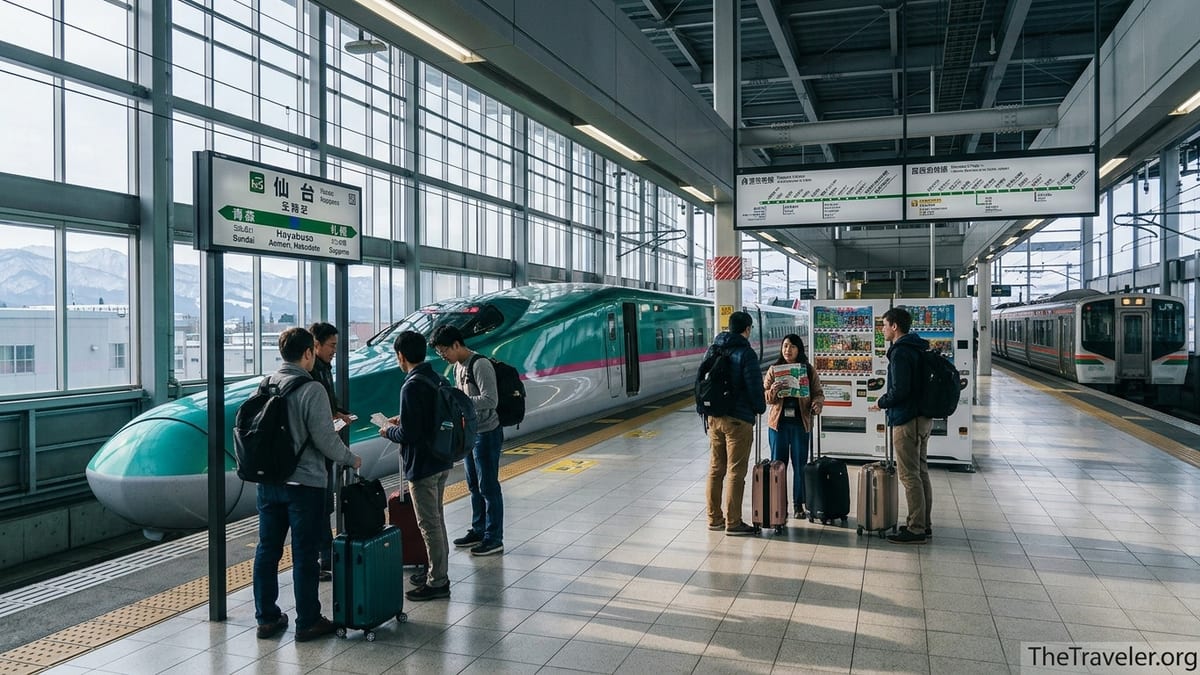
What the JR Tohoku-South Hokkaido Rail Pass Covers
The JR Tohoku-South Hokkaido Rail Pass is a joint product of JR East and JR Hokkaido. It is designed specifically for foreign passport holders and offers unlimited travel for six consecutive calendar days on most JR East and JR Hokkaido lines in the Tohoku region and southern Hokkaido. As of 2026, the adult price is 32,000 yen and the child price for ages 6 to 11 is 16,000 yen, with the same price whether you buy online or in Japan.
In practice, this pass lets you move freely between major Tohoku hubs such as Sendai, Morioka, Akita, Yamagata and Aomori, then across the undersea Seikan Tunnel to Hakodate in Hokkaido. From Hakodate you can continue on JR Hokkaido lines to Sapporo and Otaru, which makes the pass ideal for a northbound journey that starts in Sendai or Aomori and finishes in Sapporo, or the other way round. Many travelers use the pass for a loop such as Sendai to Aomori, then Aomori to Hakodate, on to Sapporo and Otaru, before returning to Hakodate or flying out of New Chitose Airport.
The coverage includes ordinary-class reserved and non-reserved seats on limited express, express, rapid and local trains within the designated area. This means you can pair fast Shinkansen rides for long intercity hops with slower local trains for side trips, such as taking the Shinkansen to Shin-Aomori and then a local or limited express train to Hirosaki for its castle park, or riding a limited express from Hakodate to Sapporo and then a local train on to Otaru’s canal district.
Although the pass is regional, its footprint is large enough that many itineraries that once required the JR East-South Hokkaido Rail Pass or even a nationwide JR Pass can now be covered more cheaply, provided you are comfortable starting or ending your trip outside Tokyo. For travelers focused on Tohoku and southern Hokkaido, it is often the best-value rail product currently available.
Validity, Seat Reservations and How the Six Days Work
The JR Tohoku-South Hokkaido Rail Pass is valid for six consecutive calendar days, not 144-hour blocks. If you start using the pass at 10:00 on a Monday, day one ends at 23:59 that same Monday and the pass expires at 23:59 on Saturday. Because of this, it usually pays to activate the pass on the morning of your first long-distance ride rather than for short hops or city transport the evening before.
Within the validity period, the pass allows unlimited rides in ordinary cars and includes the right to make seat reservations on eligible Shinkansen and limited express trains within the coverage area. You still need to obtain an actual reserved-seat ticket for each journey, either from a ticket machine, a staffed JR East or JR Hokkaido counter, or through the JR East reservation website if you purchased the pass online. The monetary cost of reservations is included in the pass, so you do not pay extra unless you upgrade to a Green Car or Gran Class, which is not normally allowed with this pass.
On the Shinkansen sections within the coverage area, many trains operate as all-reserved, particularly on busy routes such as the Hayabusa and Komachi services. In these cases, you must secure a seat reservation before boarding or you may be denied boarding altogether. On JR Hokkaido limited express trains between Hakodate and Sapporo, all ordinary seats are reserved, so you cannot simply sit anywhere with the pass; you need a seat ticket for the specific train departure, even though the reservation fee is covered.
Travelers who like flexibility can still benefit from the pass, but it is wise to reserve seats for long hops such as Shin-Aomori to Shin-Hakodate-Hokuto or Hakodate to Sapporo as soon as you finalize your day’s plan. For example, if you know you want the mid-morning Hayabusa from Shin-Aomori to Shin-Hakodate-Hokuto, you can stop at a Midori-no-madoguchi ticket office the day before and book a seat in a few minutes using your pass.
Included Shinkansen and Mainline Routes
The Tohoku-South Hokkaido Pass covers the Tohoku Shinkansen from stations in Tohoku such as Sendai, Morioka and Shin-Aomori northward to Shin-Aomori, then the Hokkaido Shinkansen from Shin-Aomori’s connecting station Shin-Aomori/Shin-Hakodate-Hokuto corridor to Shin-Hakodate-Hokuto. In practice, this means you can ride high-speed services like Hayabusa between Sendai, Morioka, Shin-Aomori and Shin-Hakodate-Hokuto as many times as you like during the six days, with ordinary reserved seats included.
Once in Hokkaido, the pass is valid on JR Hokkaido limited express trains such as the Hokuto service between Hakodate and Sapporo, as well as on local and rapid trains on JR Hokkaido lines within the designated southern Hokkaido area. This includes the rail line from Sapporo to Otaru, which is particularly scenic along the coast, and commuter-style rapid trains that serve New Chitose Airport from Sapporo if those lines fall inside the current official coverage area at the time of your trip. On the Tohoku side, the pass is valid on JR East conventional lines including local, rapid and limited express trains, plus the Aoimori Railway between Aomori and Hachinohe and the Iwate Galaxy Railway around Morioka, both of which operate former JR lines that now require special arrangements for pass coverage.
For example, a traveler could take a limited express or rapid train from Sendai to Ichinoseki, transfer to the Tohoku Shinkansen to Morioka, continue by Shinkansen to Shin-Aomori, then take a short local train to Aomori city, all within the pass area. The next day they might ride the Hokkaido Shinkansen to Shin-Hakodate-Hokuto, transfer to a limited express Hokuto to Sapporo, and finish on a local train to Otaru, with every leg covered by the pass as long as the entire route lies inside the current JR East and JR Hokkaido coverage map for this product.
Because the pass explicitly includes ordinary reserved seats on eligible Shinkansen and limited express services, it is well suited to long-distance travelers who want to minimize journey time. Unlike some cheaper local-only passes, you are not restricted to slow all-stations trains and can realistically plan long northbound routes such as Sendai to Sapporo in a single long day, using a combination of Shinkansen and limited express trains without paying any extra fares once the pass is activated.
Major Exclusions, Limitations and Practical Caveats
Despite its wide coverage, the JR Tohoku-South Hokkaido Rail Pass does not cover every train or service in the region. First, it is limited to JR East, JR Hokkaido and a small number of specified third-sector lines such as Aoimori Railway and the Iwate Galaxy Railway. Private railways, subways and most non-JR buses are excluded. That means city transport in Sapporo on the subway, trams in Hakodate and the Sendai subway are all separate expenses. If you plan a lot of in-city travel, you may still want to buy IC cards such as Suica or Kitaca for convenience.
The pass is also valid only in ordinary class. Green Car and Gran Class seats are not included, and you generally cannot upgrade by paying just the difference; in many cases you would need to pay full fares and limited express or Green surcharges separately. Night trains, if any operate during your visit, can come with special rules or be excluded. Some premium limited express services or sightseeing trains may require additional surcharges or may not be covered at all, depending on JR’s current conditions, so it is always wise to confirm at a ticket counter before boarding if you are in doubt.
Eligibility is another key limitation. The pass is available only to passengers holding a non-Japanese passport, usually with short-term visitor status. Japan residents on long-term visas and Japanese nationals are generally not eligible, although JR has occasionally relaxed rules for some products. When you exchange or collect the pass in Japan, staff will check your passport and status, so ensure you have it with you whenever you travel with the pass, as onboard staff can also ask to see it together with your ticket.
Finally, the pass has standard refund and change rules similar to other JR products. Once you have set the validity start date and the pass is active, you cannot extend or change the dates. Refunds, if allowed, are usually only possible before activation, minus a handling fee. If trains are delayed or canceled due to weather or other disruptions, you are not entitled to an automatic extension of the pass, and any extra accommodation or other transport costs are your responsibility. This makes it important to build some slack into your itinerary in winter, especially in snowy areas such as Aomori and Hokkaido.
Real-World Fare Comparisons and When the Pass Saves Money
At 32,000 yen for six days, the JR Tohoku-South Hokkaido Rail Pass is not a small purchase, so it is important to compare it with regular fares for the routes you actually plan to ride. Fares and surcharges change periodically, but the broad relationships tend to stay consistent. A simple starting point is to price out a few typical long-distance journeys and see how quickly they approach or exceed the cost of the pass.
Consider a northbound route starting in Sendai. A reserved-seat Shinkansen ticket from Sendai to Shin-Aomori on a Hayabusa service, bought as a regular one-way ticket, commonly runs in the ballpark of just over 12,000 yen in total when base fare and limited express surcharge are combined. From Shin-Aomori to Shin-Hakodate-Hokuto on the Hokkaido Shinkansen, another reserved-seat ticket typically costs around 9,000 to 10,000 yen. From Shin-Hakodate-Hokuto to Hakodate city, a short local or limited express segment adds roughly 400 to 1,000 yen depending on the exact service.
For that single Sendai to Aomori to Hakodate northbound flow over two days, you are already close to or above 22,000 to 23,000 yen in regular fares. If you then continue from Hakodate to Sapporo on a limited express Hokuto service, a reserved ordinary seat ticket often falls around 9,000 to 10,000 yen. That means a Sendai to Shin-Aomori, Shin-Aomori to Shin-Hakodate-Hokuto, and Hakodate to Sapporo combination can easily approach or exceed 30,000 yen at current prices if booked as separate long-distance tickets. Add a return trip from Sapporo back to Hakodate or extra side trips, and the total begins to surpass the 32,000 yen pass price.
As another example, imagine a six-day itinerary focused on exploring Tohoku and southern Hokkaido: Sendai to Morioka on the Shinkansen, Morioka to Shin-Aomori, a side trip to Hirosaki, Shin-Aomori to Shin-Hakodate-Hokuto, Hakodate to Sapporo and then Sapporo to Otaru and back. Buying each of these routes separately with reserved seats typically costs well over 40,000 yen in total, even before considering any additional local rides. In this scenario, using the rail pass saves a rough order of several thousand yen and adds the flexibility to make extra stops or change trains without financial penalty.
JR Tohoku-South Hokkaido Pass vs JR East-South Hokkaido and Other Passes
Many travelers planning a trip that includes both Tohoku and Hokkaido also look at the JR East-South Hokkaido Rail Pass or the JR East Pass products. The JR East-South Hokkaido Rail Pass typically costs more than the Tohoku-South Hokkaido Pass and adds coverage all the way down to Tokyo and the Kanto area, as well as Niigata and Nagano in some configurations. If your itinerary begins or ends in Tokyo and you plan to use the Shinkansen between Tokyo and Tohoku or Tokyo and Hakodate multiple times within six days, the East-South Hokkaido pass can still represent good value. For example, a single Tokyo to Shin-Hakodate-Hokuto Shinkansen trip with reserved seat can itself cost in the region of 28,000 to 30,000 yen one way, so a return already exceeds many regional pass prices.
However, if you intend to fly into Sendai, Aomori or Sapporo, or connect to the Tohoku region from Tokyo using a separate ticket or low-cost domestic flight, the JR Tohoku-South Hokkaido Rail Pass often works out cheaper and more targeted. For a traveler who spends almost all their time north of Sendai and Hakodate, paying extra for coverage in the Tokyo metropolitan area can be unnecessary. An example would be a visitor who flies from Tokyo to Aomori on a discount airline, then uses the Tohoku-South Hokkaido Pass to travel Aomori to Hakodate, Hakodate to Sapporo, and Sapporo to Otaru and back, before flying home from New Chitose Airport.
Compared with the JR East Pass products that focus mainly on Tohoku or the Nagano and Niigata regions, the Tohoku-South Hokkaido Pass has the crucial advantage of crossing into Hokkaido and including key sightseeing areas such as Hakodate and Sapporo. If your main goal is to stay in Tohoku and you have no plans to travel north of Aomori, a JR East Tohoku-focused pass may be better value, but the moment you add Hokkaido to your route, the joint JR East and JR Hokkaido product usually becomes the natural choice.
In short, the JR Tohoku-South Hokkaido Rail Pass is at its best when you plan an itinerary concentrated between Sendai and Sapporo, with multiple long-distance journeys over six days. If your trip is more spread out over two weeks with only one major rail leg, or if you mostly stay in Tokyo and only briefly visit Tohoku, then a different pass or individual tickets are more cost-effective.
Planning Sample Itineraries to Maximize Value
To get full value from the pass, it helps to cluster your long-distance rides within the six days and structure your trip so that city sightseeing days fall before or after the pass validity. For instance, if you are flying into Sapporo, you might spend your first two days exploring the city and nearby Otaru with regular tickets or an IC card, then start the pass on the morning you leave Sapporo for Hakodate. From there you could travel Hakodate to Shin-Hakodate-Hokuto, ride the Hokkaido Shinkansen to Shin-Aomori, stay in Aomori or Hirosaki, continue to Morioka, then finish in Sendai on day six, making several Shinkansen and limited express hops all under the pass.
Another pattern is to start in Sendai or Tokyo, travel north through Tohoku, then cross into Hokkaido and end in Sapporo. For example, you might take the Shinkansen from Sendai to Morioka on day one, with an afternoon side trip on local trains to Kakunodate. On day two, you ride to Shin-Aomori and overnight there or in Aomori city. Day three takes you through the Seikan Tunnel on the Hokkaido Shinkansen to Shin-Hakodate-Hokuto and on to Hakodate. Day four is spent using local trains around Hakodate and visiting nearby Onuma. Days five and six carry you on a limited express Hokuto to Sapporo and include a round-trip to Otaru before your pass expires.
When planning, remember that the pass counts calendar days rather than hours. It can be unwise to activate it late in the evening for a short ride from the airport when that same date could instead be used later in the week for a full day of Shinkansen and limited express travel. A common strategy is to pay cash or use an IC card for short airport or city transfers on arrival day, then activate the pass the next morning for your first long-distance rail leg.
Finally, think about seat availability at busy times. Golden Week, the Obon holidays and the New Year period see especially heavy demand on Shinkansen and limited express trains. If your six-day validity overlaps with any of these peaks, make reservations for the key northbound or southbound legs as far in advance as possible. The pass will cover the cost, but seats themselves can sell out on popular departures.
The Takeaway
The JR Tohoku-South Hokkaido Rail Pass offers a focused and flexible way to explore Japan’s northern regions by train, centered on Tohoku and southern Hokkaido. With six consecutive days of unlimited rides on eligible Shinkansen and conventional trains, it can unlock ambitious itineraries that would otherwise require spending tens of thousands of yen on individual tickets.
The pass is particularly good value for travelers who plan multiple long-distance hops between cities like Sendai, Morioka, Aomori, Hakodate and Sapporo within a compact time frame. It is less suitable if your trip includes only one major rail segment or is spread out over many days with little intercity travel. By understanding which lines and trains are included, where the boundaries and exclusions lie, and how its price compares to regular fares and other passes, you can decide whether this product matches your own plans.
Before you buy, sketch out your likely route with rough current fares for each leg and compare the total to the 32,000 yen pass price. If your planned journeys approach or exceed that figure and you value flexibility, the JR Tohoku-South Hokkaido Rail Pass is likely to be a smart investment in both savings and convenience for your time in northern Japan.
FAQ
Q1. Who is eligible to buy the JR Tohoku-South Hokkaido Rail Pass?
Foreign passport holders visiting Japan on a short-term stay are generally eligible. You will be asked to show your passport when purchasing, exchanging and sometimes when using the pass on trains.
Q2. How many days is the pass valid, and how are they counted?
The pass is valid for six consecutive calendar days. Validity runs from midnight to midnight, so the first day counts from 00:00 to 23:59, regardless of what time you first start riding.
Q3. Does the pass include all Shinkansen trains in the area?
It covers ordinary reserved and non-reserved seats on eligible Tohoku and Hokkaido Shinkansen services within the official coverage area. Some premium seats such as Green Car or Gran Class are not included.
Q4. Can I use the pass to travel between Tokyo and Tohoku?
The Tohoku-South Hokkaido Pass is focused on Tohoku and southern Hokkaido. For routes starting or ending in Tokyo, the JR East-South Hokkaido Rail Pass or other JR East passes are usually more appropriate.
Q5. Are seat reservations free with the pass?
Yes, ordinary-class seat reservations on covered Shinkansen and limited express trains are included. You still need to obtain a reserved-seat ticket from a machine, counter or online service.
Q6. Does the pass cover travel within Sapporo, Hakodate or Sendai city?
The pass is valid on JR trains within its area but does not cover subways, trams or most buses. In cities like Sapporo and Sendai, you will usually pay separately for non-JR transport.
Q7. Can I use the pass on the airport trains?
Whether airport access lines are covered depends on the operator. JR-operated segments within the pass area may be included, while non-JR airport services are not. Always confirm coverage at the time of purchase.
Q8. What happens if I lose the pass during my trip?
The pass cannot be reissued if lost or stolen. You would need to purchase regular tickets or another pass, so it is important to keep it and your passport in a safe place.
Q9. Is it possible to get a refund if my plans change?
Refunds are generally only available before you activate the pass and are subject to a handling fee. After the start date, refunds or extensions are normally not allowed, even if trains are delayed or canceled.
Q10. How far in advance should I buy or exchange the pass?
You can usually purchase the pass online before traveling or at major JR stations in Japan before your intended start date. Many travelers buy several days in advance, then choose the activation date when their long-distance rail segment begins.