

Northern Japan rewards travelers who are willing to leave the Shinkansen behind and follow narrow roads into cedar forests, snow corridors and fishing ports. In Tohoku and Hokkaido, a car is often the difference between skimming the surface and actually reaching onsen hamlets, secluded gorges and coastal towns that trains never touch. This guide focuses on when driving genuinely adds value, how to pair regional rentals with long-distance trains, and what you need to know about tolls, winter tires and mountain-road closures in Japan’s north.
Why Drive Northern Japan Instead of Staying on the Shinkansen
Between Tokyo, Sendai, Morioka and Shin-Aomori, the Tohoku Shinkansen is faster and more comfortable than any highway. The line covers the 679-kilometer backbone of the region at speeds of up to 320 km/h, while the parallel Tohoku Expressway charges substantial tolls for a drive that can take all day in traffic or snow. For long jumps between major cities, the train is usually the better choice both for time and cost, especially if you use a rail pass.
The experience changes completely once you leave those trunk routes. Places like Hachimantai Plateau, Oirase Gorge, Lake Towada and remote onsen clusters are poorly served by public transport, with sparse seasonal buses and long transfers. In these areas, a compact rental car lets you treat forest-lined roads and tiny villages as part of the trip rather than obstacles. JNTO has been actively promoting Tohoku as a northern Japan road-trip destination for exactly this reason: driving is often the only practical way to connect scenic spots in a single itinerary.
Think of the Shinkansen as your spine and the car as your arms and legs. Use the train to cover distance from Tokyo to a regional hub such as Sendai, Morioka or Aomori, then rent a car for two to five days of loops into the mountains or along the Sanriku Coast. This avoids paying both long-distance rail fares and high-speed expressway tolls in parallel and keeps you from being locked into one vehicle for the entire north.
In winter, the argument for judicious car use becomes stronger. Deep snow, icy surfaces and seasonal closures mean that you should be selective about where you drive. Having the flexibility to drop a car in Morioka and continue the next leg to Hakodate or Sapporo by Shinkansen allows you to dodge storms and avoid the most exposed passes, while still enjoying winter scenery on carefully chosen regional drives.
Classic Tohoku Driving Loops: Hachimantai, Towada & Oirase
The Towada-Hachimantai National Park area is one of the clearest examples of where a car adds enormous value. From Morioka, you can board a Tohoku Shinkansen in Tokyo in about two and a half hours, then pick up a rental car steps from Morioka Station. From there, it is a two-hour drive on a mix of expressway and mountain roads to Hachimantai’s volcanic plateau and onsen villages.
The Hachimantai Aspite Line is a 27-kilometer scenic road that traverses Mount Hachimantai between wetland viewpoints and hot spring towns. It closes each winter from roughly early November to mid-April because of heavy snow, then reopens as a so-called snow corridor with walls of snow lining the route in spring. This is a perfect example of a drive that is only possible by car; there is no rail line, and seasonal buses run infrequently and only in the warmer months. Having your own vehicle lets you stop at marshland viewpoints, walk short boardwalk trails and soak at mountain ryokan such as those around Matsukawa Onsen without watching the clock for the last bus.
Lake Towada and the Oirase Gorge are similarly car-friendly. You can reach the area by train to Hachinohe or Aomori, then rent a car and drive an hour or two inland. Many of the roads between Lake Towada and the Hakkoda Mountains close in winter from around late November to roughly April, but the route from Hachinohe via Oirase Stream remains open most of the year, albeit with snow and ice in midwinter. A car allows you to pull into each waterfall lay-by along Oirase, walk short riverside sections, then drive on, rather than being bound to the fixed stops of limited bus services and working within their short seasonal timetables.
In practice, a classic three to four day Tohoku loop might look like this: Shinkansen to Morioka, pick up a car, drive north through the Hachimantai area with an overnight in a hot spring ryokan, continue to Lake Towada for lakeside walks and a cruise in warmer seasons, follow Oirase Gorge down to Hachinohe, then return the car and board a train back south or onward to Aomori. Expressway use within this loop can be light, keeping tolls modest, while almost every scenic highlight is accessed by rural roads for which you genuinely need a vehicle.
Sanriku Coast and Mountain Onsen: Where Roads Beat Rails
The Sanriku Coast, stretching from around Ishinomaki and Matsushima Bay up past Miyako and Kuji toward Hachinohe, is one of Japan’s most intricate coastlines. A rail line covers some sections, and there are long-distance buses, but the route weaves in and out through many small fishing ports, coves and tsunami reconstruction areas that are hard to explore without a car. Driving lets you leave the main highway for detours to sea-cliff viewpoints, small ryokan on headlands and tiny seaside temples that see few foreign visitors.
For example, you could ride the Tohoku Shinkansen from Tokyo to Sendai, pick up a rental car and spend three to five days heading north via Matsushima Bay, Kesennuma and Ofunato to Miyako, then on to Hachinohe. Distances on paper can look short, but the coastal roads are twisty and time-consuming, so driving allows you to set your own pace and stay in lesser-known towns. In contrast, trying to stitch the trip together with coastal rail disruptions and infrequent buses can mean spending more time waiting on platforms than actually enjoying the scenery.
Inland, mountain onsen regions such as Nyuto Onsen in Akita or the Bandai and Azuma areas of Fukushima also strongly reward drivers. These hot spring clusters sit on high plateaus or in deep valleys that are technically reachable by bus from a JR station but with only a few departures per day, often timed poorly for overnight guests. A compact car lets you arrive before lunch, hop between several baths and stay until late checkout the next day. Scenic roads like the Bandai-Azuma Skyline and related routes in Fukushima close each winter from roughly mid-November to late April because of snow, but in the warmer months they offer volcanic panoramas that are effectively drive-only attractions.
Roads in the Sanriku and mountain onsen regions are generally well maintained, with clear signage and frequent service areas on major arteries. Yet the combination of indirect routes and thin public transit is precisely why vehicles matter. When planning, it is often wise to anchor each mini-road trip to a Shinkansen hub such as Sendai, Morioka or Fukushima, using the train to cover the initial jump from Tokyo and then looping into rural areas over two or three days before returning the car.
ETC Tolls, Expressways and One-Way Rental Fees in the North
Japan’s network of tolled expressways can be expensive if you attempt to drive the entire length of Tohoku and Hokkaido in a single rental. Running a car from the Tokyo area up the full Tohoku Expressway to Aomori involves close to 14,000 yen in tolls for a standard car, and that is for one direction only. Petrol will add a similar order of cost for such a distance. This is why many visitors save money by taking the high-speed train north and only driving local segments, rather than paying parallel toll and fuel costs on top of a long rental.
Most northern rental cars come with an ETC device that allows automatic payment of tolls. You insert a prepaid ETC card or link a card at the counter, then simply drive through ETC gates at expressway entrances and exits. For road trips based around rural Tohoku, your expressway segments are more likely to be short hops, such as Morioka to an interchange near Hachimantai or Aomori to Hachinohe before diving onto ordinary roads. In such cases, expect tolls to be a noticeable but manageable part of the budget rather than the main cost driver.
One-way rentals are common in northern Japan and can be very useful, but they carry surcharges that rise with distance. In Hokkaido, for instance, dropping a car in a different city within the same region such as Sapporo to Asahikawa typically incurs a modest extra fee, while returns across the island, such as Sapporo to Abashiri or Kushiro, are charged more. Tohoku has a similar pattern, with lower one-way fees for neighboring-prefecture returns and higher charges for long cross-region drops. Planning your loops so that you start and finish in the same area or along a logical corridor can keep these costs under control.
The broader point is that extended, linear drives from Tokyo through Tohoku and then across Hokkaido often end up being more expensive and stressful than a hybrid rail-and-car strategy. Each time you return to a Shinkansen hub to drop a car, you reset your toll and rental costs and gain the option to pivot, whether that means skipping a storm in Aomori or spending an extra night at a hot spring village instead of pushing on along an icy motorway.
Winter Tires, Snow Driving and Seasonal Road Closures
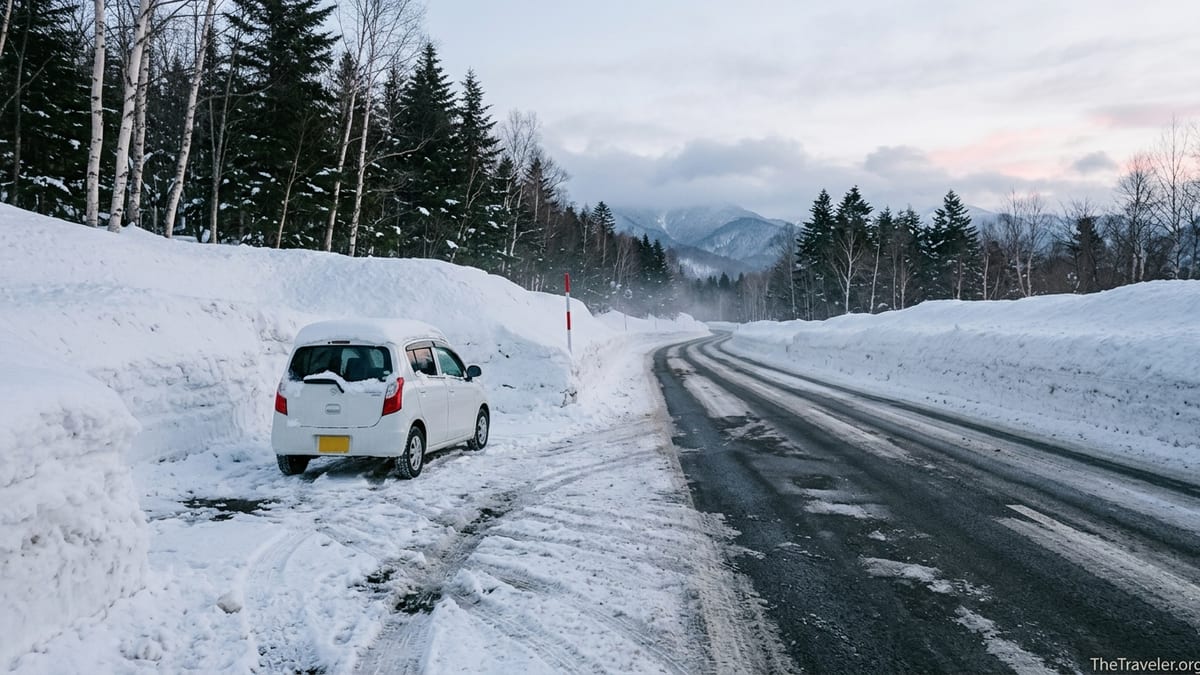
Snow is both the magic and the main hazard of northern Japan driving. From roughly December through March, heavy snow is common across much of Tohoku and Hokkaido, with some highlands seeing significant accumulation in November and even into April. Many scenic mountain roads, including the Hachimantai Aspite Line and similar routes, close completely for the core winter period. These closures typically run from early November through mid-April, with exact dates adjusted each year based on conditions.
In Hokkaido and snowier parts of Tohoku, rental companies routinely equip cars with studless winter tires at no additional cost during the cold season. Around Sapporo and New Chitose Airport, for example, fleets are automatically fitted with these tires in winter, because icy surfaces are a fact of life for months at a time. Snow tires greatly improve traction but do not eliminate the need for cautious driving. You should expect longer braking distances, smooth and gentle steering inputs and lower speed limits enforced through local practice even if not always signposted.
Real-world driving times stretch noticeably in winter. A summer drive between Asahikawa and the gorge area around Sounkyo in Hokkaido might take around an hour and a quarter, but in midwinter locals often allow about two hours for the same journey because of packed snow, occasional whiteouts and slower traffic. The same holds in Tohoku: what looks like a quick hop between Morioka and Hachimantai on a map can turn into a careful half-day drive when visibility drops and trucks crawl uphill in snow.
Before committing to winter driving, honestly assess your experience with snow and ice. Japanese authorities are efficient at clearing main roads, but side streets and mountain approaches can still be challenging. If you are not confident, consider focusing your driving on shoulder-season trips in October or late April when snow walls and autumn colors are visible but roads are mostly clear, or limit winter driving to lower-elevation routes and short distances between stations and onsen towns. In deep winter, you can always rely more on Shinkansen and limited express trains between cities, mixing in very short car rentals only where necessary.
When a Separate Hokkaido Rental Makes More Sense
A common first idea is to rent a car in Tokyo or Sendai, drive through Tohoku and then carry the same vehicle across to Hokkaido by ferry or via the Seikan rail tunnel area. In practice, this is rarely the most efficient choice. Ferries that accept cars between Honshu and Hokkaido are long, often overnight crossings with their own costs, and one-way rentals that start in Tohoku and finish in Hokkaido attract higher fees because they cross regional company boundaries.
Instead, many travelers find it more practical to treat Hokkaido as a separate driving chapter. You might, for example, take the Shinkansen from Tokyo to Shin-Hakodate-Hokuto and on to Sapporo by limited express train, then pick up a dedicated rental car around Sapporo Station or New Chitose Airport. From there, you could do a clockwise loop visiting Furano, Biei, Asahikawa, Sounkyo and back to Sapporo over five to seven days, using one-way rental options within Hokkaido if you prefer to end in a different city such as Asahikawa or Obihiro.
This separate-rental approach keeps your Tohoku car hire short and focused on local drives, while giving you a fresh contract for Hokkaido that is priced for travel within a single island. You avoid paying for days when the car would otherwise be sitting parked during long transfers, and you can select vehicle classes suited to local conditions, such as compact four-wheel-drive hatchbacks for winter in central Hokkaido and smaller economy cars for summer loops in Tohoku.
Separating the rentals also simplifies contingency planning. If a storm closes alpine roads in Hachimantai just as conditions clear in Hokkaido, you can shorten your Tohoku driving, drop the car, and still keep your Sapporo rental unchanged. Conversely, if a blizzard hits Hokkaido, you could cancel or reduce that car booking and rely on trains and city buses while still enjoying your earlier Tohoku road trip. This kind of flexibility is difficult if one long rental runs across the entire region and imposes penalties for changing the route.
Combining Trains and Short Regional Rentals: Sample Itineraries
The most rewarding northern Japan trips often use trains for speed and comfort, then rentals for detail work. A simple one-week example might begin with a Shinkansen ride from Tokyo to Sendai, followed by a two or three day car loop through Matsushima Bay and the southern Sanriku Coast, staying in small fishing towns and coastal onsen. You would then return the car in Sendai, ride the train to Morioka and start a second short rental aimed at Hachimantai and the Towada area.
Another itinerary could focus on the northernmost section of Honshu and then hop to Hokkaido. After taking a Shinkansen to Shin-Aomori, you might rent a car there to explore Aomori Bay, the Hakkoda Mountains in the warmer months, and Lake Towada via Oirase Gorge. After returning the car to Aomori or Hachinohe, you would travel onward by train to Hakodate or Sapporo, where a separate Hokkaido rental could cover destinations such as Niseko, Otaru or eastern Hokkaido’s national parks.
Travelers with two weeks might weave these elements together into a larger arc: several days based in Sendai with a car for coastal and inland onsen drives, a second chapter around Morioka and Hachimantai, and a final week in Hokkaido centered on Sapporo and Asahikawa. At each phase, the Shinkansen serves as the rapid connector between regions, while local cars open up the gaps that trains do not fill. This model is particularly useful in winter, when you can bob in and out of car use based on real-time weather and road information.
However you structure it, the guiding principle is to avoid driving long, repetitive highway segments just to cover distance. Expressways across northern Japan are safe and modern but monotonous, with views often limited by snow walls in winter. By letting trains handle the long hauls, you save your driving energy for the scenic passes, lake roads and coastal lanes where being behind the wheel genuinely improves the journey.
The Takeaway
Northern Japan is one of the country’s finest regions for thoughtful road trips, not because driving replaces the Shinkansen but because the two complement each other. Tohoku’s Hachimantai highlands, Lake Towada, Oirase Gorge, Sanriku Coast and remote onsen belts all reward the flexibility of a car, especially when combined with fast rail links between big cities. In Hokkaido, wide skies and open roads make a separate rental the natural choice for reaching national parks and snow country resorts.
The key is to distinguish between where a car enriches the experience and where it simply adds cost and fatigue. Use trains for the long backbone segments, then keep your rentals relatively short and region-focused, paying attention to seasonal closures, winter tire requirements and one-way fees. By doing so, you can turn the complex geography of northern Japan into a coherent journey of coastal villages, mountain baths and snowy vistas, rather than a series of disconnected tickets and timetables.
FAQ
Q1. Do I need a car for all of Tohoku, or just certain areas?
For long-distance travel between cities like Tokyo, Sendai and Morioka, the Shinkansen usually makes more sense. A car becomes valuable in specific rural pockets such as Hachimantai, Lake Towada and the Sanriku Coast where public transport is infrequent and attractions are spread out.
Q2. When are the main mountain roads in Tohoku closed by snow?
Most high-elevation scenic routes, including roads in the Hachimantai and Bandai-Azuma areas, typically close from around early or mid-November until roughly mid or late April. Exact dates vary each year, so it is essential to check current information before you travel.
Q3. Are winter tires included with rental cars in Tohoku and Hokkaido?
In Hokkaido and snow-prone parts of Tohoku, rental companies generally fit studless winter tires automatically during the cold season, often at no extra charge. In shoulder seasons or milder areas, you may need to request them when booking.
Q4. Is it safe for first-time snow drivers to rent a car in Hokkaido?
Conditions range from easy to challenging. While main roads are well cleared, black ice, snowdrifts and sudden whiteouts are possible. If you have no experience driving on snow or ice, it may be safer to limit driving to shorter, lower-elevation routes or visit in a non-winter month.
Q5. How expensive are expressway tolls compared with train tickets?
Long expressway runs, such as driving the full length of the Tohoku Expressway, can cost the equivalent of a significant rail ticket even before adding fuel. For shorter segments within a regional loop, tolls are more manageable and may be worthwhile for the time saved.
Q6. Are one-way rentals between Tohoku and Hokkaido a good idea?
They are possible but usually come with higher surcharges because they cross regional boundaries and involve long distances. In many cases, it works better to end your Tohoku rental near Aomori, travel by train to Hokkaido, and start a separate car hire there.
Q7. Can I rely entirely on public transport for Lake Towada and Oirase Gorge?
It is technically possible in certain seasons using buses from rail hubs like Aomori or Hachinohe, but services are limited and often seasonal. A car offers much greater flexibility, letting you stop at multiple trailheads, viewpoints and small accommodations along the gorge.
Q8. Do I need an ETC card, or can I pay tolls in cash?
You can still pay tolls in cash at manned booths, but using an ETC card with the in-car device is quicker and often more convenient, especially when entering and exiting expressways several times in a day.
Q9. How should I plan driving times in winter compared with summer?
As a rough guideline, allow significantly more time in winter, sometimes up to double for routes that cross snowy passes. Even flat sections can become slow when traffic moves cautiously on packed snow or visibility drops.
Q10. Is parking difficult or expensive in rural Tohoku and Hokkaido?
Outside major city centers, parking is usually straightforward and often free at sightseeing spots, roadside stations and many ryokan. In larger cities such as Sendai or Sapporo you should budget for paid parking, especially near stations and downtown areas.