


Riding the rails from Tokyo into the far north of Japan is no longer just a way to get from capital to Sapporo as fast as possible. With the Tohoku Shinkansen cutting through the mountains of Honshu and the Hokkaido Shinkansen plunging under the sea through the Seikan Tunnel, it is easy to treat the whole route as a single high speed sprint. Yet Japan National Tourism Organization and regional rail operators increasingly promote this corridor as a journey in its own right, where bullet trains link castle towns, seafood ports, onsen resorts and some of the country’s most atmospheric scenic railways. With some planning, you can turn an eight hour dash into a week of memorable stopovers.
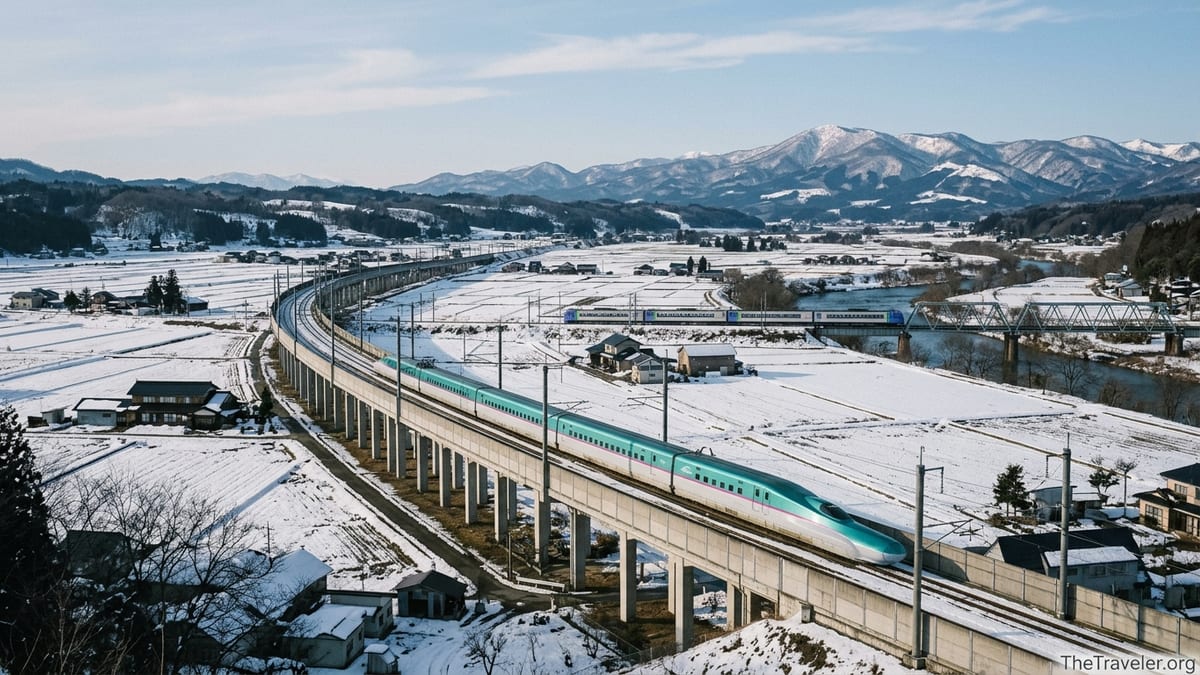
Understanding the Route: From Tokyo to Sapporo by Rail
The modern rail journey to northern Japan starts at Tokyo Station and ends in Sapporo, with a change of trains along the way. The Tohoku Shinkansen runs north from Tokyo through Fukushima, Sendai, Morioka and Shin-Aomori. From there, the Hokkaido Shinkansen continues through the Seikan Tunnel to Shin-Hakodate-Hokuto on Hokkaido. A limited express train then covers the final stretch across southern Hokkaido to Sapporo. Treated as one continuous trip with tight connections, the journey can be done in roughly eight hours, but that approach skips much of what makes the route special.
In practical terms, most travelers will use fast Hayabusa services on the Tohoku Shinkansen, which continue directly onto the Hokkaido Shinkansen tracks. You ride one bullet train from Tokyo as far as Shin-Hakodate-Hokuto, where you transfer to a Hokuto or similar limited express on the conventional Hakodate Main Line toward Sapporo. The same tracks also serve Hakodate city, so many visitors plan a night there before pressing deeper into Hokkaido.
The key to a rewarding trip is to break up this spine with one or more overnight stops in Tohoku and southern Hokkaido, and to branch off onto selected scenic and regional lines. That might mean leaving the Shinkansen at Sendai for Matsushima Bay, spending a night in Morioka and detouring on a local line into onsen country, or riding the Gono Line along the Sea of Japan coast after reaching Aomori. You do not need to do everything in one itinerary, but thinking of “Tokyo to Sapporo” as a flexible framework rather than a single ride opens up many more options.
Planning Your Tickets, Passes and Seat Reservations
For foreign visitors, rail passes remain one of the most convenient ways to explore northern Japan. Until early 2026, the JR East Pass (Tohoku area) was a common choice, but JR East has since redesigned its passes, introducing broader-area products that cover the full Tohoku region and link conveniently with the Hokkaido Shinkansen. Newer passes typically offer 5 or 10 consecutive days of unlimited travel on JR East lines, including the Tohoku Shinkansen, with adult prices in the range of several tens of thousands of yen. For travelers who are only doing a one way Tokyo to Sapporo trip with limited stops, buying individual tickets can sometimes be more economical, so it is worth comparing rough total fares against a pass.
If your plans include both Tohoku and multiple journeys in Hokkaido, it can make sense to combine an eastern Japan pass with a regional JR Hokkaido product. Limited express trains such as Hokuto between Shin-Hakodate-Hokuto and Sapporo require both a basic fare ticket and a limited express supplement, which are usually bundled when you buy a reserved seat ticket from ticket machines or JR counters. Pass holders still need to obtain reserved seat tickets for zero yen, using self-service machines or staffed offices, in order to secure a specific seat on bullet and limited express services.
Seat reservations are strongly recommended on the fast Hayabusa Shinkansen and the Hokuto limited express, especially in busy seasons such as early May, mid August and around New Year. Unlike some other Shinkansen lines, the Tohoku and Hokkaido Shinkansen do not have special “oversized luggage seats,” which means large suitcases are stored in overhead racks or at the ends of the cars. In practice, most carriages have a small space behind the last row of seats where a couple of larger cases can stand upright; arriving early for boarding gives you the best chance of using these spots without inconveniencing other travelers.
For a concrete example, imagine you plan to depart Tokyo in late October, spend three nights in Tohoku and then continue to Hokkaido. You might reserve a Hayabusa from Tokyo to Sendai several weeks in advance, another Shinkansen seat from Sendai to Shin-Aomori a few days later, and finally a Hokkaido Shinkansen sector from Shin-Aomori through the Seikan Tunnel to Shin-Hakodate-Hokuto, timed to meet a Hokuto limited express to Sapporo. With a compatible rail pass, each reservation can be issued from a machine in under a minute once you are in Japan.
Tokyo to Sendai: First Leg into Tohoku
The first significant stage, from Tokyo to Sendai, takes little more than an hour and a half on the fastest services, but even this short hop marks a clear shift in scenery. Leaving Tokyo Station, the Tohoku Shinkansen quickly accelerates through Saitama and Tochigi, then begins to slice through low mountains and farmland. Travelers heading north in the morning on clear winter days often see distant views of snow on the Oku-Nikko peaks and the Nasu range, while spring and summer bring patchworks of rice paddies.
Sendai, the largest city in Tohoku, makes an excellent first stopover. The area around the station is dense with business hotels, department stores and restaurants, which makes arrival straightforward even for first time visitors. Within a short ride of the station you can visit the tree-lined boulevards of central Sendai, the Zuihoden mausoleum of feudal lord Date Masamune, or the coastal town of Matsushima, long celebrated as one of Japan’s classic scenic views. A trip to Matsushima typically combines a short JR local train ride with a bay cruise past pine-covered islets, easily done in half a day.
Spending two nights in Sendai also gives you time to taste regional specialties such as gyutan grilled beef tongue, zunda sweet edamame paste desserts and fresh seafood from nearby Ishinomaki and Kesennuma. For rail travelers, this is also a chance to explore local lines that rarely appear on standard itineraries. One option is a short ride on the Senseki Line to Ishinomaki, pairing a visit to a coastal town with insight into Tohoku’s recovery efforts after the 2011 earthquake and tsunami. Another is using Sendai as a base for a side trip to the onsen town of Akiu, reached by bus but pairing well with a rail-based itinerary.
Sendai to Morioka and Shin-Aomori: Deeper into Northern Honshu
From Sendai northward, the Tohoku Shinkansen enters its most scenic stretches. Trains thread through the Ou and Kitakami mountain ranges, diving into tunnels and emerging above broad river valleys. Between Sendai and Morioka, a Hayabusa or combined Yamabiko service typically takes around 40 to 50 minutes, short enough to manage as a day trip but long enough to sense the changing landscape as the plains narrow and the mountains draw closer.
Morioka is a compact city that rewards an overnight stop, particularly for travelers interested in food and traditional crafts. The rivers that flow through town and the view of Mount Iwate on clear days give Morioka a quieter feel than Sendai, and many visitors time their stay to enjoy local noodle dishes such as wanko soba, reimen cold noodles or jajamen. The city also works well as a base for excursions to the mountain onsen of Hachimantai and the historical landscape of Hiraizumi, although those side trips require additional train and bus connections.
Continuing north toward Shin-Aomori, journey times stretch slightly and winter snow becomes increasingly likely. On crisp days in late autumn, travelers can glimpse brilliant foliage in the hills between Morioka and Hachinohe, while in mid winter the same valleys often appear as monochrome landscapes of bare trees and deep snow. Reaching Shin-Aomori gives you access not only to Aomori city, with its waterfront Nebuta Museum and hearty seafood markets, but also to a network of local and scenic lines that trace both the Sea of Japan coast and the Pacific side of northern Honshu.
Shin-Aomori itself is primarily a transfer station, connected by short local trains to Aomori Station closer to the bay, but it is an important decision point. Here you can either continue directly onto the Hokkaido Shinkansen, crossing into Hokkaido the same day, or pause to explore Aomori Prefecture. Many travelers choose to spend at least one night in Aomori city in order to sample local shellfish and apple-based sweets, then ride a scenic train the following day before looping back toward Shin-Aomori or Shin-Hakodate-Hokuto.
Crossing to Hokkaido: Through the Seikan Tunnel to Shin-Hakodate-Hokuto
From Shin-Aomori, Hayabusa Shinkansen services continue onto the Hokkaido Shinkansen tracks, passing through the Seikan Tunnel beneath the seabed of the Tsugaru Strait. The tunnel itself is a feat of engineering nearly 54 kilometers long, but from a passenger perspective the crossing is surprisingly understated. After leaving the Aomori side, the train runs through a series of long tunnels, and there is little to see beyond the windows besides brief glimpses of daylight on the approaches. What you do notice is a subtle shift when the train emerges on Hokkaido, with different station names and signage appearing as you approach Shin-Hakodate-Hokuto.
Shin-Hakodate-Hokuto is a modern interchange station rather than a destination in its own right. The Shinkansen platforms sit above ground level, while conventional platforms for Hakodate Main Line services are on the lower level. Most travelers immediately transfer to a limited express Hokuto for Hakodate town or onward to Sapporo, but you can also use local trains from here to explore smaller stations on the Hakodate Main Line. The station concourse has basic services including convenience stores, simple eateries and tourist information, but hotel choices are better in Hakodate city itself about 15 to 20 minutes away by limited express or local train.
Hakodate makes a natural overnight stop after the long run from Tohoku. The city combines a historic port atmosphere with attractions that are easy to reach using a simple tram network. A popular pattern is to arrive in the afternoon, stroll through the Motomachi district with its sloping streets and former consular buildings, then ride the ropeway up Mount Hakodate around dusk for views of the city’s famous nightscape. The following morning, an early visit to Hakodate Morning Market for grilled scallops, sea urchin bowls or crab before catching a late morning Hokuto to Sapporo can turn a simple transfer into a memorable break in the journey.
Travelers who do not wish to continue to Sapporo the same day they cross to Hokkaido may also choose to stay in Onuma, a lakeside area on the way between Shin-Hakodate-Hokuto and Hakodate. Some limited express trains stop at Onuma Koen Station, but even when they do not, local trains still make the trip easy. In clear weather, the view of Mount Komagatake rising above the lake’s islands is one of southern Hokkaido’s most photogenic scenes, especially in autumn when foliage colors are reflected in the water.
Shin-Hakodate-Hokuto to Sapporo: Limited Express Across Southern Hokkaido
The journey from Hakodate or Shin-Hakodate-Hokuto to Sapporo is covered by Hokuto and related limited express services operated by JR Hokkaido. These trains usually consist of diesel or hybrid multiple units optimized for curves and winter conditions, and the trip takes roughly three and a half to four hours depending on the stopping pattern. Reserved seats are recommended, particularly in peak seasons and on trains timed to meet arriving Shinkansen services, but unreserved cars are commonly available for travelers with flexible schedules.
As you leave the Hakodate area, the train winds around bays and through small fishing towns, then climbs through more mountainous terrain before reaching the industrial and port city of Muroran and continuing toward Sapporo. Between late December and March, much of this route can be snow covered, and passengers often remark on seeing snowplows and snow walls along the tracks. In summer, the same line passes green hills and glimpses of the Pacific, with longer daylight hours making it easier to enjoy the scenery from afternoon trains.
Some travelers choose to break the journey in places such as Toya, where a station on the line provides access by bus or taxi to Lake Toya’s onsen resorts, or in Noboribetsu, a major hot spring town a short bus ride inland from Noboribetsu Station. Stopping at one of these onsen areas for a night or two can transform a simple transfer into a mini hot spring retreat, with traditional ryokan stays, elaborate kaiseki dinners and outdoor baths in cooler mountain air. Afterward, a mid morning limited express continues the journey to Sapporo in time for an afternoon stroll through Odori Park and Susukino.
Upon arrival in Sapporo, many visitors base themselves near Sapporo Station, where modern hotels connect directly to the concourse or sit within a few minutes’ walk. This makes it easy to schedule early morning departures if you are later returning south by train, and it also places you close to food basements in major department stores, the Sapporo Beer Museum tram connections, and seasonal events such as the Sapporo Snow Festival in February. For travelers who have come all the way from Tokyo by rail, the first night in Sapporo often becomes a celebration of arrival, with miso ramen, jingisukan grilled lamb or Hokkaido dairy desserts on the menu.
Scenic and Regional Trains to Weave into Your Itinerary
Beyond the main Shinkansen spine, northern Japan offers a web of scenic and themed trains that JNTO and JR companies actively promote as experiences in themselves. One of the best known in Tohoku is the Resort Shirakami on the Gono Line, which runs along the Sea of Japan coast between Akita and Aomori Prefectures. This train features large windows, coastal views and occasional onboard events such as live shamisen performances on some departures. Many travelers board at Akita or Hirosaki and ride for one or two hours through stretches where sea cliffs and the Shirakami-Sanchi World Heritage beech forests create an ever changing backdrop.
Another noteworthy service is the Tohoku Emotion, a restaurant train operating along the Sanriku coast between Hachinohe and Kuji. On board, passengers enjoy multicourse meals in dining car style spaces while watching the Pacific scenery glide by, turning a regional rail line into an upscale excursion. Reservations are essential and fares reflect the dining component rather than just transport, so this train works best as a special splurge within a longer Tohoku stay rather than as a simple transfer.
In winter, stove trains on the Tsugaru Railway in Aomori Prefecture provide nostalgic journeys in carriages fitted with coal stoves, where passengers warm themselves and grill snacks while snow covered fields pass outside. Meanwhile, character themed services such as the POKÉMON with YOU train in the southern part of Tohoku appeal to families, with colorful interiors, play areas and photo spots. These trains typically require advance reservations and may operate mainly on weekends or specific seasons, so checking schedules and booking early is important if you want to include them.
Connecting these scenic lines often involves short hops on regular local or limited express trains. For example, a traveler might ride the Shinkansen from Tokyo to Akita, board a Resort Shirakami along the Gono Line for an afternoon coastal run, stay overnight in Aomori city, then continue via Shin-Aomori and the Hokkaido Shinkansen to Shin-Hakodate-Hokuto the next morning. With a flexible regional rail pass, you can piece together these experiences without worrying about individual ticket costs each time you change trains.
Seat Reservations, Luggage and Onboard Experience
On the Tohoku and Hokkaido Shinkansen, most travelers opt for ordinary class, which already offers generous legroom and reclining seats in a 2 plus 3 layout. Green Car and Gran Class options exist on some services, providing more spacious seating and extras such as at seat service, but they are not essential for comfort. All car types require a reserved seat on most Hayabusa trains, so you will either be holding a specific reservation or boarding in a non reserved section on slower services like Yamabiko if available on your chosen time slot.
When it comes to luggage, the key practical point is that there are no formal oversized luggage seat reservations on these northern bullet trains, unlike lines such as the Tokaido Shinkansen between Tokyo and Osaka. Instead, luggage management relies on shared spaces. Overhead racks comfortably fit carry on suitcases and small checked bags, while medium sized suitcases can be placed upright behind the last row of seats in each car or in small alcoves near doors. If you are traveling with very large or multiple suitcases, consider using a luggage forwarding service to send bags directly from a Tokyo hotel to accommodation in Sendai or Sapporo, allowing you to travel on the longer Shinkansen segments with just a daypack.
Limited express trains between Shin-Hakodate-Hokuto and Sapporo also offer reserved and non reserved seating, typically in ordinary class with some Green Car sections on selected services. Overhead racks on these trains are slightly smaller, but there are often open floor spaces at car ends that passengers share for larger bags. In winter, it is common to see skiers and snowboarders using these racks and ends of cars, especially on services passing through Niseko area connections, so booking trains outside of peak weekend hours can make luggage handling easier.
Onboard services vary by train type. Shinkansen still provide vending machines on some sets, but full trolley service has become less common, so stocking up at station convenience stores and ekiben bento stalls before boarding is wise. Major stations such as Tokyo, Sendai, Morioka, Shin-Aomori, Hakodate and Sapporo all have well developed ekiben cultures, with boxed meals featuring regionally themed dishes. Trying gyutan bento out of Sendai, sea urchin and crab boxes in Hakodate, or Hokkaido dairy rich desserts from Sapporo station kiosks turns each long ride into an opportunity to taste local flavors.
Choosing Stopover Cities That Work
Many travelers planning their first northern Japan rail trip find it helpful to think in terms of two or three key stopovers between Tokyo and Sapporo. A fairly classic pattern is to stay first in Sendai, then in Aomori or Hakodate, before finishing in Sapporo. This divides the distance into manageable segments of roughly one and a half to three hours each, leaving time on arrival days for local sightseeing rather than spending every day aboard trains from morning until evening.
Sendai works well as a first base because of its size, accessible day trips and straightforward connection from Tokyo. Aomori and neighboring Hirosaki provide a taste of northern Honshu, with opportunities to visit apple orchards, Nebuta themed museums and, in season, cherry blossoms at Hirosaki Castle. Hakodate brings you into Hokkaido with a compact tram served center, hillside churches and the busy morning market. Any of these cities can anchor one or two nights, linked by bullet trains that keep travel times predictable even in winter snow.
Travelers with more time often add smaller hubs as second tier stopovers. Morioka, with its relaxed riverside feel and views of Mount Iwate, is an appealing place to slow down for a day, particularly when combined with a half day side trip to Hiraizumi’s World Heritage temples by local or Shinkansen plus local train. On the Hokkaido side, making room for an onsen night at Noboribetsu or Lake Toya, or spending time in coastal towns along the Hakodate Main Line, helps balance big city stays in Sendai and Sapporo with quieter interludes.
Whatever pattern you choose, check your rail pass validity period and sketch a rough day by day outline before you start booking seats. For example, someone with seven nights might plan Tokyo to Sendai on day one, Sendai to Morioka on day three, Morioka to Aomori on day four, Aomori to Hakodate on day five and Hakodate to Sapporo on day six, finishing with a full free day in Sapporo before flying out. Structured this way, no single rail segment exceeds about three hours, and you always arrive with at least part of the day remaining to enjoy your chosen stopover city.
The Takeaway
Riding the rails from Tokyo into Tohoku and onward to Hokkaido is one of Japan’s most rewarding long distance journeys, but only if you resist the temptation to treat it as a single long transfer. The combination of Tohoku Shinkansen, Hokkaido Shinkansen and the Hokuto limited express makes it technically possible to leave Tokyo after breakfast and arrive in Sapporo by evening. Yet doing so would mean skimming past castles, coastal scenery, onsen resorts and regional food cultures that give northern Japan its particular character.
By planning a route that uses bullet trains for the main northbound push, then breaking the trip with thoughtful stopovers in cities such as Sendai, Morioka, Aomori, Hakodate and Sapporo, you turn a straightforward journey into a chain of experiences. Layering in scenic trains like Resort Shirakami on the Gono Line, restaurant trains such as Tohoku Emotion, or nostalgic local services on the Tsugaru Railway can add texture and variety that pure high speed travel lacks.
Successful itineraries in northern Japan also depend on some practical habits: choosing the right combination of rail passes and point to point tickets, reserving key Shinkansen and limited express seats in advance, and traveling light enough that luggage does not dominate your day. With those basics in place, the corridor from Tokyo to Sapporo becomes less of a line on a map and more of an open invitation to explore mountain valleys, coastal vistas and port towns at your own pace.
Whether you have four days or two weeks, the essential message is the same. Do not rush. Let the Tohoku and Hokkaido rails show you not just where you are going, but everything worth pausing for along the way.
FAQ
Q1. How long does it take to travel from Tokyo to Sapporo by train with stopovers?
With one or two overnight stops in places like Sendai and Hakodate, most travelers spread the journey over three to five days, with no single rail segment exceeding about three to four hours.
Q2. Do I need a Japan Rail Pass to ride the Tohoku and Hokkaido Shinkansen?
No, you can buy individual tickets, but a regional or national pass can be cost effective if you plan multiple long distance trips and scenic detours within Tohoku and Hokkaido.
Q3. Is seat reservation mandatory on the Tohoku Shinkansen?
Most fast Hayabusa services are fully reserved, so you must have a seat reservation. Slower services may have non reserved cars, but booking seats is still highly recommended.
Q4. How should I handle large luggage on these northern Shinkansen lines?
Use overhead racks for smaller bags and shared spaces at car ends for larger suitcases, or consider luggage forwarding so you can ride with only a daypack on longer segments.
Q5. What is a realistic first time itinerary from Tokyo to Sapporo by train?
A common pattern is Tokyo to Sendai, then Sendai to Aomori or Hakodate, and finally Hakodate to Sapporo, with one or two nights in each stopover city.
Q6. Are scenic trains like Resort Shirakami included in rail passes?
Most JR passes cover the basic fare for scenic trains such as Resort Shirakami, but you still need to reserve a specific seat, which may require a separate limited express or reserved seat ticket.
Q7. Can winter snow disrupt train travel in Tohoku and Hokkaido?
Heavy snow can cause delays, but Shinkansen and major limited express services are built to operate in winter conditions, so complete cancellations are relatively rare compared with road closures.
Q8. Is it better to fly or take the train between Tokyo and Sapporo?
Flying is usually faster point to point, but the train offers a continuous journey through Tohoku, easier city center to city center travel and the chance to add scenic stops along the way.
Q9. How far in advance should I reserve seats for busy periods?
During peak times such as Golden Week in early May, mid August holidays and New Year, reserving Shinkansen and popular scenic trains as soon as booking opens about one month before travel is advisable.
Q10. Are there language barriers when buying tickets or making reservations?
Major stations along the Tokyo to Sapporo route have English signage, multilingual ticket machines and staff used to assisting foreign travelers, so basic transactions are usually straightforward even without Japanese.