


The Kansai region around Osaka, Kyoto and Kobe has some of Japan’s most complex rail ticket options. JR passes, private-rail passes and smartcards all promise savings, but the best choice depends entirely on where you go and how intensively you travel. This guide cuts through the noise and shows, with concrete examples, which Kansai rail product actually makes sense for your itinerary in 2026.
How Kansai’s Rail System Is Organized
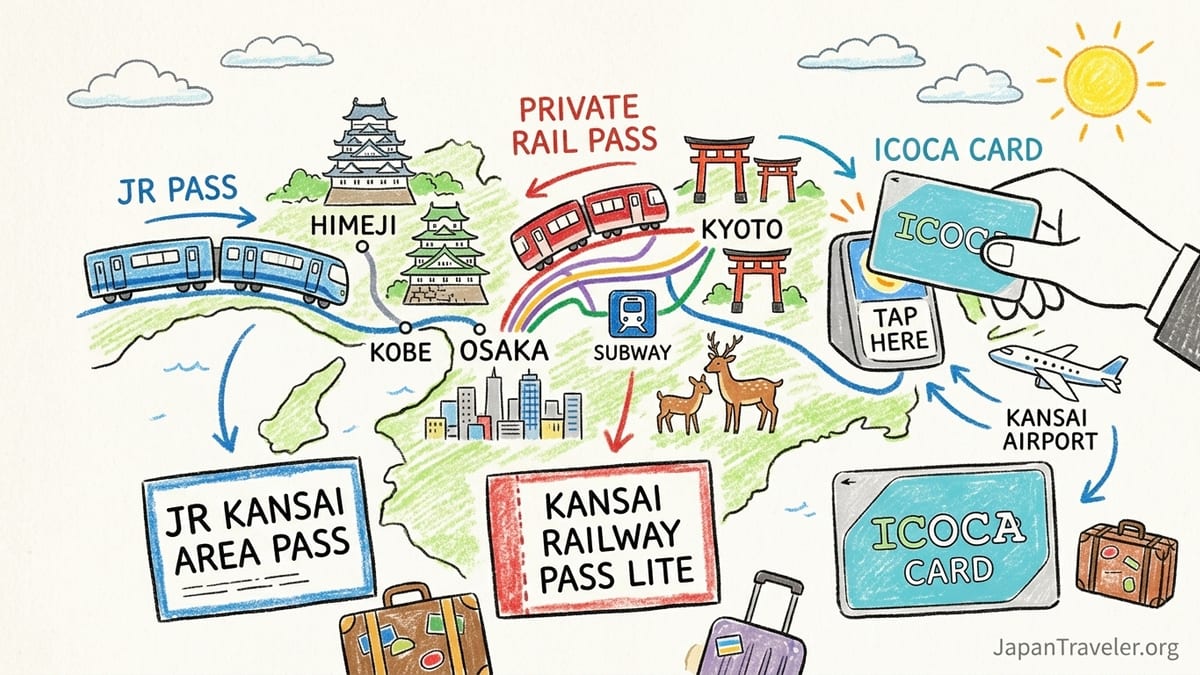
Before choosing a pass, it helps to understand who runs which trains. In Kansai, Japan Rail West (JR West) operates the JR lines that link Kansai Airport with Osaka, Kyoto, Nara, Himeji, Wakayama and beyond. These include the Kansai Airport Express Haruka, the JR Kyoto Line between Osaka and Kyoto, the Osaka Loop Line and the JR lines to Nara and Himeji. Most JR-focused passes, such as the JR Kansai Area Pass and JR Kansai Wide Area Pass, are valid only on these JR West services plus a few affiliated buses.
Alongside JR, a dense network of private railways and subways carries just as many travelers. Hankyu connects Osaka with Kyoto and Kobe, Hanshin links Osaka and Kobe, Keihan links Osaka and eastern Kyoto, Kintetsu reaches Nara and the south, Nankai runs trains from Kansai Airport and Osaka to Wakayama and Koyasan, and separate subway systems run in Osaka, Kyoto and Kobe. These operators are not covered by JR passes. Instead, they are bundled into private-rail products such as the Kansai Railway Pass Lite, as well as local day passes issued by cities and individual railway companies.
On top of this, stored-value IC cards like ICOCA overlay the entire picture. ICOCA works across almost all JR and private lines, plus buses, simply by tapping in and out and paying individual fares. It does not in itself give discounts, but its flexibility often beats a pass for light or scattered travel days. Understanding this three-way split between JR-only passes, multi-company private-rail passes and pay-as-you-go IC cards is the key to picking the right product.
The practical implication is simple. If your Kansai trip is built around long JR rides, such as airport transfers plus Himeji or Kinosaki Onsen, JR passes will usually be your friend. If you will be crisscrossing Osaka and Kyoto by subway and private rail, a private-rail pass or ICOCA can be better value. Many itineraries mix both styles, so a combination of a short JR pass window plus IC card for the rest of the stay often works best.
JR Kansai Area Pass: Best For Classic Kansai Sightseeing
As of 2026, the JR Kansai Area Pass is JR West’s core regional product for visitors doing the classic Kansai circuit of Osaka, Kyoto, Nara, Kobe, Himeji, Wakayama and Otsu. The pass is sold in versions from 1 to 4 consecutive days, with prices that have risen in recent years but still offer strong value if you ride intensively. A key feature is that it covers the Kansai Airport Express Haruka between Kansai International Airport and central Osaka or Kyoto within the validity area, which makes it attractive for arrival or departure days.
For a concrete example, imagine a traveler arriving at Kansai Airport, then going on to Kyoto, day-tripping to Nara and returning to Osaka before heading back to the airport. Bought as separate JR tickets at 2025–2026 fares, a Kansai Airport to Kyoto Haruka fare can easily approach the mid-2000 yen range one way in ordinary reserved class, Kyoto to Nara and back on JR adds several hundred yen each way, and Osaka back to Kansai Airport on Haruka or a rapid service adds roughly another 1,000 yen or more. Even with cautious, rounded figures, this easily climbs into the 4,000 to 5,000 yen range in just two days of activity.
When that level of movement is concentrated into 1 to 3 days, the JR Kansai Area Pass can save money compared with buying individual tickets. For example, pairing a Haruka airport transfer with a full day of JR travel between Kyoto, Fushimi-Inari, Nara and Osaka on a 2 or 3 day pass often covers or beats the pass price even after the recent increases. Travelers who stay mostly within one city or who rely on private rail, such as using Hankyu from Osaka to Kyoto’s Arashiyama area or Keihan along the Kamogawa, will see less benefit because those journeys are excluded.
The catch is timing and intensity. The pass runs on consecutive calendar days. If you arrive late at night and activate on arrival, you may waste a day. If you have a slow day of mostly walking and subways in the middle, that day still counts against the total. For that reason, many travelers find it best to cluster their long JR rides into a tight window and time the pass activation so that airport transfers and major day trips fall inside that period.
JR Kansai Wide Area Pass: When You Go Beyond Osaka and Kyoto
The JR Kansai Wide Area Pass is a 5 day product aimed at travelers who want to go beyond the core Kansai cities without buying a nationwide Japan Rail Pass. It includes everything in the regular Kansai Area Pass plus a much larger area reaching Kinosaki Onsen on the Sea of Japan coast, Amanohashidate on the Tango Peninsula, Shirahama on the Kii Peninsula and as far as Okayama to the west. Crucially, it includes limited express services such as Kuroshio to Shirahama and Kounotori or Hamakaze toward Kinosaki Onsen, which are expensive if bought as individual tickets.
Consider a typical hot-springs focused itinerary. You spend three nights in Osaka, with one long day trip to Himeji, another overnight or long day at Kinosaki Onsen and a side trip toward Amanohashidate or Okayama. Based on current fare tables, a return trip between Osaka and Kinosaki Onsen on JR limited express services alone can easily run well into five figures in yen, as can a limited express trip between Osaka and Shirahama. When you add Osaka to Himeji and a couple of local JR hops around Kyoto or Kobe, you are quickly exceeding the cost of a 5 day Kansai Wide Area Pass.
Where the Kansai Wide Pass does not shine is for visitors who never leave the Osaka, Kyoto, Nara and Kobe core. A family spending five days split between Osaka and Kyoto with no long side trips will rarely spend enough on JR alone to justify the pass price. In that case, a shorter Kansai Area Pass timed around airport transfers or a simple ICOCA card will usually be cheaper. The Wide Pass also does not cover private railways such as the Kitakinki Tango Railway near Amanohashidate that are not part of JR West, so some remote last segments may still require separate tickets.
If your Kansai stay includes even one big JR excursion, such as Osaka to Kinosaki Onsen or Osaka to Shirahama and back, the Kansai Wide Area Pass often pays off with that trip alone when you compare individual limited express fares and surcharges. Add Himeji or Okayama on another day and the value becomes even more compelling. The key is to make sure you can use at least three or four of the five days for substantial JR travel rather than letting the pass sit idle.
Private-Rail Products: Kansai Railway Pass Lite and Local Passes
While JR passes are excellent for longer hops, many Kansai visitors spend most of their time on non-JR trains and subways. In 2026, the product long known as the Kansai Thru Pass has been rebranded as the Kansai Railway Pass Lite. It is a multi-day pass for foreign visitors that covers an extensive network of private railways and metros across Kansai, including Osaka Metro, Kyoto Subway, Kobe City Subway and lines belonging to Hankyu, Hanshin, Keihan, Kintetsu, Nankai and several smaller operators. JR lines and the Haruka are not included, which makes it complementary rather than competing with JR products.
Take a traveler based in central Kyoto who plans to explore the region mostly by private rail. One day could be Kyoto to Osaka via Hankyu, with plenty of back-and-forth subway hopping in Osaka. Another day might be Kyoto to Nara by Kintetsu and local subways. A third might involve zigzagging through Kobe and back to Osaka on Hankyu or Hanshin. Paying as you go with ICOCA, all those metro and private-rail flights of fancy quickly add up to several thousand yen over three days. The Kansai Railway Pass Lite, priced for 2 or 3 days of unlimited travel within a defined validity window, is designed precisely for this style of itinerary and can easily save money if you ride frequently.
At the same time, it is easy to over-buy. If your days are slow, focused on a single neighborhood or mostly walking, you may not get enough rides to justify a flat-rate pass. For instance, a day spent in central Kyoto visiting temples on foot with just a couple of subway rides might cost barely more than 500 to 700 yen in actual fares, which would fall well below the cost per day of a regional private-rail pass. That is why travelers whose Kansai plans are limited to one or two modest day trips, such as Osaka to Nara on Kintetsu plus a few subway rides, often do better with ICOCA and individual tickets.
Beyond the Kansai Railway Pass Lite, many operators issue their own city or corridor passes. Osaka has one day and multi-day metro and bus passes; Kyoto offers subway plus bus combination products; and some railways, such as Hankyu and Keihan, sell inexpensive day passes for their own networks that are ideal for focused excursions like Osaka to Arashiyama and back. When you do the math, these targeted passes can outperform the big regional products for highly specific plans such as a single day of temple-hopping in Kyoto or a focused Kobe food crawl that rarely touches JR lines.
ICOCA and Pay-As-You-Go Tickets: When A Pass Is Not Worth It
ICOCA is JR West’s contactless stored-value card and the de facto standard for tap-in travel around Kansai. In 2026, a typical adult ICOCA card costs around 2,000 yen at purchase, which usually consists of a refundable 500 yen deposit plus about 1,500 yen of preload. You then add value in cash or at ticket machines as needed and tap through JR, private rail and subway gates, with the correct fare deducted automatically each time. The card can also be used in many convenience stores and vending machines throughout the region.
ICOCA shines for flexibility. If you only plan a handful of rides on a given day, such as taking the Osaka Metro from Namba to Umeda and back plus one JR hop to Kobe, your total spend might be under 1,000 yen. Using a day pass priced around 1,000 yen or more would not save money unless you took additional rides. Likewise, for a family arriving at Kansai Airport in the evening and simply riding into Osaka on a private Nankai train, then staying mostly in one neighborhood the next day, loading ICOCA and paying by trip is often cheaper than activating a JR-wide pass immediately.
There are a few nuances to keep in mind. ICOCA itself does not provide discounts on regular adult fares; you pay the normal fare that would appear on a paper ticket. Some private-rail promotional tickets, such as Nankai’s airport deals or Hankyu or Keihan tourist passes, can undercut ICOCA fares for specific routes on specific days. The deposit can usually be refunded minus a small handling fee if you return the card to a JR West service counter before leaving Japan, which makes ICOCA attractive even for short stays, especially when you value the time saved at ticket machines.
ICOCA plus individual limited express or shinkansen tickets can also be the right choice on days when you take just one big JR ride. For a Kyoto to Hiroshima side trip sandwiched between mostly local Kansai sightseeing days, it may make sense to buy a separate long-distance JR ticket while relying on ICOCA for the Osaka and Kyoto subways on either end. The central question is always whether the sum of your point to point fares on a given set of days will exceed the price of a flat-rate pass. If not, stick with ICOCA and targeted discounted tickets.
Sample Itineraries: When Each Product Wins or Loses
To make this concrete, consider four realistic itineraries. First, a short classic circuit: three nights in Kyoto, two in Osaka, with arrival and departure at Kansai Airport, plus day trips to Nara and Himeji. If you buy JR tickets separately, Haruka from the airport to Kyoto and back, Kyoto to Nara round trip and Osaka to Himeji round trip can easily approach or exceed 10,000 yen per person at 2025–2026 prices, depending on seat choices. A 3 or 4 day JR Kansai Area Pass timed to cover both airport transfers, the Nara excursion and the Himeji day trip often comes out cheaper. You would then use ICOCA for any Osaka or Kyoto subway rides outside those days.
Second, imagine a Kansai plus hot-springs plan: two nights in Osaka, two in Kinosaki Onsen and one in Kyoto, all within six days. The big cost items here are the limited express trains between Osaka and Kinosaki Onsen and the JR legs around Osaka, Kyoto and possibly Himeji. Buying those intercity tickets individually can reach into the low tens of thousands of yen. In this case, a 5 day JR Kansai Wide Area Pass is designed to cover the entire loop, including the long limited express segments, and usually beats the sum of point to point fares. You might then rely on ICOCA or private-rail day passes for the one off extra day outside the pass’s five day window.
Third, consider an urban-focused trip: six nights split evenly between Osaka and Kyoto, no airport trains because you fly into and out of Tokyo, and only one regional side trip to Nara by Kintetsu plus one to Kobe mostly on Hankyu or Hanshin. Here most of your riding will be on subways and private rail, hopping between districts like Umeda, Namba, Shinsaibashi, Gion and Arashiyama. In this case, a JR Kansai pass of any kind is wasted. A 2 or 3 day Kansai Railway Pass Lite or a series of local metro and private-rail day passes, supplemented by ICOCA pay-as-you-go on light days, will almost certainly be cheaper.
Finally, imagine a light-touch Kansai stopover within a longer Japan trip. You spend two nights in Osaka with one evening trip to Dotonbori, a half-day in Nara and then depart for Tokyo on the shinkansen. You arrive from another region by shinkansen as well. The long-distance tickets are already decided separately. Your Kansai-area riding might add up to only four or five moderate fares. Even after you factor in a JR ride from Osaka to Nara and back, the cost probably stays far below the price of any multi-day pass. In this scenario, the simplest and cheapest solution is almost always ICOCA plus individual JR and private-rail tickets.
How To Decide: A Step by Step Approach
The simplest way to decide what to buy is to write down your Kansai days on paper and estimate what you will realistically ride on each one. Start by listing only the bigger point to point journeys: airport transfers, trips to Nara, Kobe, Himeji, Kinosaki Onsen, Shirahama, Amanohashidate or Okayama. Check whether those rides are on JR lines or on private railways like Kintetsu, Hankyu or Nankai. Multiply a rough one way fare by two for round trips and sum them for each cluster of consecutive days.
Next, compare those totals with the current prices of the passes. If a cluster of two or three days of mostly JR rides adds up to more than the cost of a 2 or 3 day JR Kansai Area Pass, the pass likely makes sense. If five days of heavy JR hopping including at least one expensive limited express trip adds up to more than the Kansai Wide Area Pass price, that pass becomes attractive. Conversely, if most of your planned rides are short subways and private-rail hops within Osaka and Kyoto, check the cost per day of the Kansai Railway Pass Lite or local metro passes and compare it to what a handful of individual fares would cost.
Once you have identified the heaviest rail days, think about timing. Align the validity of JR passes so that long JR rides and airport transfers sit neatly inside the pass window. Many travelers activate a JR Kansai Area Pass on the day they leave Kansai, using it for Osaka or Kyoto to Kansai Airport plus a last round of sightseeing on JR lines. Others activate on arrival to cover the inbound Haruka plus the first big day trip. There is no universal rule; the goal is simply to avoid paying for pass days on which you ride very little.
If after doing this rough calculation no pass clearly wins, that is your signal that ICOCA plus a few targeted discounted tickets is the right answer. An IC card is never a big mistake; at worst you will have paid essentially the standard fare with the convenience of tap and go gates. Passes, by contrast, only deliver savings if you push them hard. Thinking in terms of “Will I ride enough to beat the price of this pass by at least a comfortable margin?” is the mindset that keeps you from over-buying.
The Takeaway
When stripped of marketing language, Kansai’s transport puzzle has a clear logic. JR West passes reward longer and faster travel along JR corridors, private-rail products reward heavy use of non-JR trains and subways, and ICOCA simply provides convenient access to everything when your daily riding is light or mixed. No single ticket suits every itinerary, and most trips benefit from combining at least two of these options over the course of a stay.
For a classic Kansai loop anchored on Osaka, Kyoto, Nara and Himeji, the JR Kansai Area Pass, used on your heaviest JR days and wrapped with ICOCA on the others, remains one of the most effective ways to keep rail costs under control. If you push farther afield to Kinosaki Onsen, Amanohashidate, Shirahama or Okayama, the Kansai Wide Area Pass can cover a huge amount of value in five days. Travelers whose plans revolve around city neighborhoods, food districts and temple walks with only modest regional hops can safely skip JR passes entirely and look instead to the Kansai Railway Pass Lite, local day tickets and straightforward pay-as-you-go IC travel.
The most important step happens before you buy anything: sketch your real itinerary, price the big sections with a fare calculator or official site and only then match a pass to your pattern of movement. If a pass obviously saves money on paper, it almost always does in practice. If it does not, the flexibility of ICOCA and individual tickets is usually the smarter play.
FAQ
Q1. Is the JR Kansai Area Pass worth it if I only visit Osaka, Kyoto and Nara?
The pass can be worth it if you combine airport transfers on Haruka with at least one or two JR day trips such as Kyoto to Nara and Osaka to Himeji within a short window of 2 to 4 consecutive days. If you only ride JR lightly and rely mostly on subways and private rail, ICOCA and local passes are usually cheaper.
Q2. When should I choose the Kansai Wide Area Pass instead of the regular Kansai pass?
Choose the Kansai Wide Area Pass if you plan at least one or two long JR limited express trips beyond the core cities, such as Osaka to Kinosaki Onsen, Shirahama, Amanohashidate or Okayama. The high cost of these intercity rides is where the 5 day Wide Pass typically recoups its price.
Q3. Does the JR Kansai Area Pass cover subways in Osaka or Kyoto?
No. The JR Kansai Area Pass only covers JR West trains and certain JR buses within its validity map plus the Kansai Airport Express Haruka. It does not cover Osaka Metro, Kyoto Subway or other private rail and metro operators, so you will still need ICOCA or separate tickets for those rides.
Q4. What is the difference between the Kansai Railway Pass Lite and JR passes?
The Kansai Railway Pass Lite is a private-rail product that covers metro and private railways such as Hankyu, Hanshin, Keihan, Kintetsu, Nankai and city subways. JR passes like the Kansai Area or Kansai Wide passes cover only JR West lines. They are complementary: the former is ideal for urban and private-rail heavy travel while the latter suits longer JR-focused journeys.
Q5. Should I still get an ICOCA card if I buy a rail pass?
Yes, in most cases ICOCA is still useful. Even with a JR or private-rail pass, you will likely have gaps where the pass does not apply, such as short subway segments or days outside the pass validity. Having ICOCA lets you tap through gates without stopping at ticket machines for every out-of-coverage ride.
Q6. Can I use JR Kansai passes on the shinkansen?
The standard JR Kansai Area Pass does not include shinkansen services. The Kansai Wide Area Pass allows limited use of certain shinkansen sections within its map, but it is mainly designed around conventional limited express and rapid services. For full long-distance shinkansen flexibility, national or larger area passes are required.
Q7. How do I know if a specific train is covered by my pass?
The safest method is to compare the train’s operator and route with the official coverage map of your pass. If the service is run by JR West on a line clearly shown within the pass area, a JR pass will cover it. If the train is operated by Hankyu, Keihan, Kintetsu, Nankai or another private company, then only private-rail passes or ICOCA will apply.
Q8. Is it possible to combine a JR pass and a private-rail pass during the same trip?
Yes, and many travelers do so. For example, you might use a 3 day JR Kansai Area Pass to cover airport trains and regional JR day trips, then activate a 2 day Kansai Railway Pass Lite for intensive subway and private-rail sightseeing inside Osaka and Kyoto. The key is to avoid overlapping validity on days when one pass would be enough.
Q9. Are one day city passes better than regional passes for short stays?
For concentrated city days where you ride metro or trams frequently, such as a full day on Osaka Metro or Kyoto’s buses and subways, city specific one day passes can be more economical than broad regional products. They are especially good when your sightseeing is confined to a single city and you do not need the wider coverage of a Kansai wide pass.
Q10. What should I do if my calculations show only a small saving from a pass?
If the projected saving is small, for example a few hundred yen over several days, it is often safer to skip the pass and use ICOCA plus individual tickets. Passes are most worthwhile when they clearly beat the total of point to point fares by a comfortable margin, giving you room for minor plan changes without losing value.