


The 5-day Takayama-Hokuriku Area Tourist Pass has long been a favorite for travelers linking Nagoya, the Japan Alps, Shirakawa-go and the Hokuriku coast before finishing in Kyoto or Osaka. But with prices and train patterns changing in recent years, it is no longer a simple “buy it and you will save” decision. For some itineraries the pass can still deliver excellent value and hassle-free travel. For others, separate tickets or a different pass now make more sense. This guide looks at the current 19,800 yen pass in detail, focusing on real routes, realistic costs and how visitors in 2026 can decide whether it is worth it.
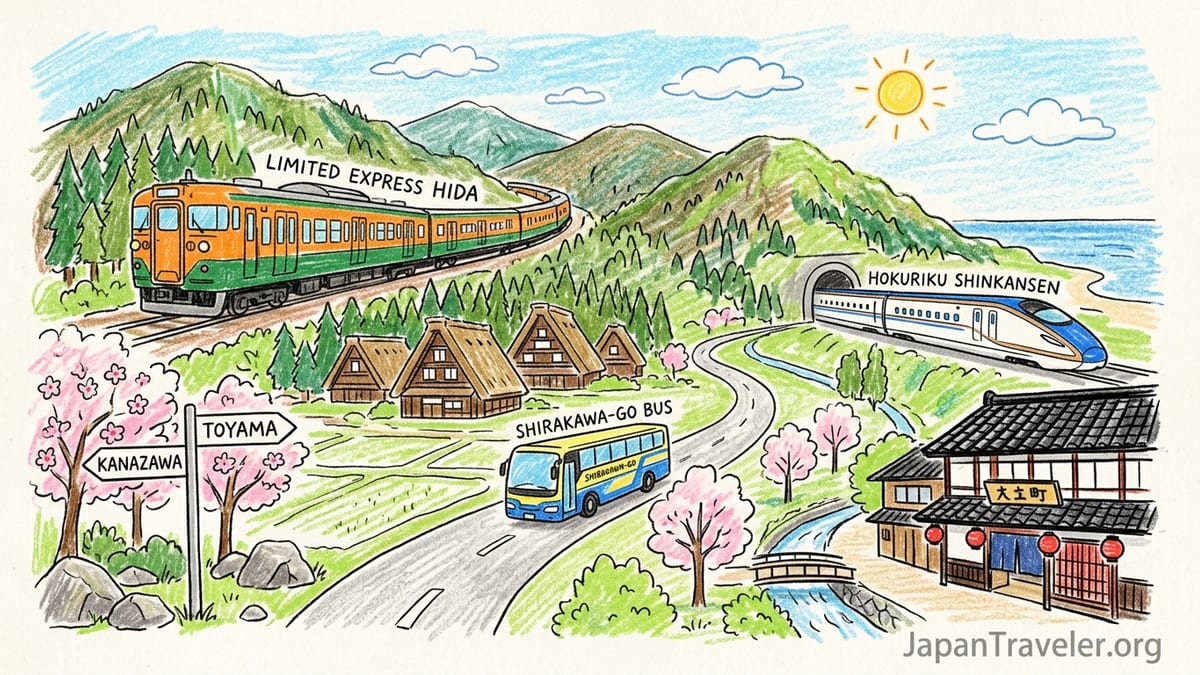
What the Takayama-Hokuriku Area Tourist Pass Covers in 2026
The Takayama-Hokuriku Area Tourist Pass is a 5-consecutive-day pass jointly offered by JR Central and JR West. It gives unlimited rides on JR local and rapid trains, JR limited express trains and sections of the Hokuriku Shinkansen within a defined area roughly bounded by Nagoya, Takayama, Toyama, Kanazawa, Fukui, Kyoto and Osaka. It also includes specific highway bus routes to Shirakawa-go, which is a rare advantage among JR regional passes.
At the time of writing, the regular adult price is 19,800 yen when purchased in Japan, with a small discount when bought overseas through partner agencies. Children aged 6 to 11 pay roughly half. The pass is only available to foreign visitors on a Temporary Visitor status of stay, and must be activated for five consecutive calendar days. You cannot pause the validity or spread the days out.
The core rail routes covered include the Tokaido Main Line between Nagoya and Maibara, the Takayama Main Line between Gifu and Toyama, the Hokuriku Main Line and Hokuriku Shinkansen between Tsuruga and Kanazawa/Toyama, and the urban JR network around Kyoto and Osaka including Kansai Airport. In practice, this means you can travel, for example, Nagoya to Takayama on the Limited Express Hida, then Takayama to Toyama on the same service, continue by Hokuriku Shinkansen between Toyama and Kanazawa, and then ride Limited Express Thunderbird between Tsuruga and Osaka without paying additional base fares.
On the bus side, the pass covers most joint Nohi Bus, Hokutetsu Bus and Toyama Chiho Railway highway bus services connecting Takayama, Shirakawa-go, Kanazawa and Toyama. The precise list can change, but as of 2026, the headline inclusion that matters to most travelers is that Takayama to Shirakawa-go to Kanazawa or Toyama can be done with no extra bus fare as long as you ride the designated services and secure the necessary seat reservations in advance.
Key Routes Between Nagoya, Takayama, Shirakawa-go, Hokuriku, Kyoto and Osaka
The classic use case for this pass is a one-way journey that begins in Nagoya or Kansai and loops through the mountains and Hokuriku coast. A very typical modern itinerary goes: Nagoya → Takayama → Shirakawa-go → Kanazawa → Fukui → Kyoto or Osaka. The pass is designed around those flows, so it covers nearly every leg of this route on JR lines or partner buses.
From Nagoya, travelers usually board the Limited Express Hida toward Takayama. A reserved seat on this train between Nagoya and Takayama typically costs around 7,000 yen one way, including base fare and limited express surcharge. Continuing from Takayama to Toyama on the same Limited Express Hida adds roughly another 4,000 yen. With the pass, both sectors are fully covered and you can reserve seats without paying extra, subject to the pass’s quota of free reservations.
From Toyama or Kanazawa, you can continue along the Hokuriku corridor. The Hokuriku Shinkansen between Toyama and Kanazawa or Kanazawa and Tsuruga is included, though you are restricted to the all-stop or semi-fast services that fall under JR West’s regional pass rules. From Tsuruga, Limited Express Thunderbird services run down the shore of Lake Biwa toward Kyoto and Osaka. A typical Kanazawa to Osaka route, for example, combines Hokuriku Shinkansen Kanazawa to Tsuruga and Thunderbird Tsuruga to Osaka, and normally costs in the region of 9,000 to 11,000 yen for a reserved seat. With the pass you can ride this combination multiple times during the validity.
The bus links to Shirakawa-go are where the pass really stands out. The Takayama to Shirakawa-go highway bus, and onward buses between Shirakawa-go and Kanazawa or Toyama, are high-demand services that usually cost about 2,800 to 3,000 yen one way for adults. A day-trip loop Takayama → Shirakawa-go → Takayama often runs to around 5,600 yen per person in bus fares alone. When these legs are covered by your rail pass, the savings quickly become significant if you are including Shirakawa-go as a central feature of your itinerary.
Reservation Requirements and Major Exclusions
Although the Takayama-Hokuriku Area Tourist Pass allows unlimited rides in its area, there are important rules about seat reservations and some notable exclusions that can catch travelers by surprise. Understanding these details is essential before deciding if the pass is right for you in 2026.
For JR trains, the pass includes free reserved seats on designated limited express services such as the Hida and Thunderbird, and on eligible Hokuriku Shinkansen services between Kanazawa or Toyama and Tsuruga. There is a cap on the number of free seat reservations per pass, which in recent years has usually been six reserved train rides. Beyond that, you may either ride in unreserved cars where available or pay the limited express surcharge for additional reservations. Seat reservations can be made at major JR Central and JR West ticket offices and reservation machines in the pass area, including Nagoya, Takayama, Toyama, Kanazawa, Fukui, Kyoto and Osaka stations.
On the bus side, reservation rules are stricter. Routes between Kanazawa and Shirakawa-go and between Toyama and Shirakawa-go almost always require advance reservations, while some Takayama to Shirakawa-go services have a mix of reserved and non-reserved buses dispatched based on demand. In busy seasons such as autumn foliage and winter illuminations, popular departures can book out days or even weeks in advance. In practice, many pass holders call Nohi Bus or Hokutetsu Bus reservation centers or reserve in person at the Takayama Nohi Bus Center or Kanazawa station as soon as they arrive in Japan.
Equally important are the exclusions. The pass does not cover the Tokaido Shinkansen between Nagoya, Kyoto and Shin-Osaka, so you cannot ride Nozomi, Hikari or Kodama bullet trains on that line using this pass. If you wish to go directly from Nagoya to Kyoto or Osaka by Shinkansen, you must buy separate tickets. The pass also excludes private railway lines such as the Meitetsu network around Nagoya, the Toyama Chiho Railway outside the specified bus segments, and non-designated highway bus routes. Local city buses and subways in Nagoya, Takayama, Kanazawa, Kyoto and Osaka are also not included.
Real-World Cost Comparisons: When the Pass Saves Money
To judge value, it helps to compare the 19,800 yen pass price with actual fares for concrete itineraries. Consider a classic one-way route over five days: Day 1 Nagoya → Takayama, Day 2 Takayama → Shirakawa-go → Kanazawa, Day 3 Kanazawa → Fukui (day trip to Eiheiji), Day 4 Fukui → Kyoto, Day 5 Kyoto → Kansai Airport. If you bought standard tickets, Nagoya → Takayama by Limited Express Hida is about 7,000 yen. Takayama → Shirakawa-go bus is roughly 2,800 yen, Shirakawa-go → Kanazawa another 2,800–3,000 yen. Kanazawa → Fukui by limited express or rapid costs around 3,000 yen return. Fukui → Kyoto via Tsuruga is in the ballpark of 6,000 yen for a reserved seat, and Kyoto → Kansai Airport by Haruka or Kansai Airport Rapid is around 3,000 yen. Added up, this itinerary can easily exceed 24,000–26,000 yen in transport costs.
On the same route with a Takayama-Hokuriku Area Tourist Pass, all these legs are covered, including the highway buses to and from Shirakawa-go and the airport access train. Even if we use conservative fare estimates, the pass would save somewhere between 4,000 and 6,000 yen per person, while also giving the flexibility to make detours, such as adding a half-day trip from Kanazawa to the traditional town of Nanao or from Kyoto to Lake Biwa within the same five days.
Another strong-value scenario is traveling from Osaka into the Hokuriku and Hida regions and out via Nagoya. For instance, imagine Day 1 Osaka → Kanazawa, Day 2 Kanazawa → Shirakawa-go → Takayama, Day 3 Takayama → Nagoya, with two additional days for local JR trips around Kyoto and Osaka. Without the pass, Osaka → Kanazawa via Thunderbird and Hokuriku Shinkansen typically costs close to 10,000 yen. Kanazawa → Shirakawa-go → Takayama by highway buses would likely run to roughly 5,500–6,000 yen. Takayama → Nagoya by Limited Express Hida is again about 7,000 yen. Even before counting small JR hops in Kansai, you are already near or above the 19,800 yen cost of the pass.
These examples show that the pass tends to be a good deal when three conditions are met. First, you are making a substantial one-way journey that includes both the mountains and the Hokuriku coast, rather than simply shuttling between two cities. Second, you plan to visit Shirakawa-go using the expensive highway buses that the pass covers. Third, you can align most of that travel within five consecutive days so that the pass is heavily used every day rather than sitting idle.
When Separate Tickets or Other Passes Work Better
The Takayama-Hokuriku Area Tourist Pass is not a universal money saver. For some itineraries, especially slower-paced ones or those centered on just one region, separate tickets or a different regional pass give better value. Looking at realistic scenarios helps clarify this.
Suppose you fly into Nagoya, spend two nights in the city, then take a round-trip Nagoya → Takayama for two nights and return to Nagoya, with no visit to Shirakawa-go or Hokuriku. In this case, your main rail cost is two Limited Express Hida rides, each about 7,000 yen, for a total near 14,000 yen. Local JR rides within Nagoya are inexpensive and often under 250 yen per trip, and many city sights rely on subways that are not covered by the pass anyway. Paying 19,800 yen for the pass would likely mean overspending by 5,000 yen or more.
Another common pattern is a Kansai-focused trip with only a quick foray into Hokuriku. For example, if you spend four days around Kyoto and Osaka, then do a simple round trip Kyoto → Kanazawa for one night and back, the total rail cost might be around 13,000–16,000 yen depending on train choice. If you are not visiting Shirakawa-go and you are not using Takayama or Toyama at all, the Takayama-Hokuriku pass’s bus coverage and Takayama Main Line benefits go unused. In that case, a JR West product like the Kansai-Hokuriku Area Pass or simple individual tickets may be more appropriate.
Slow travelers who want to linger longer in Takayama or Kanazawa may also struggle to fit their desired route into five consecutive days. A traveler who wants three full nights in Takayama, a long stay in Kanazawa and easy side trips from Kyoto or Osaka over a week and a half may find that two different passes or well-planned advance-purchase limited express tickets are cheaper than trying to compress everything into a single 5-day pass window. Likewise, if your route is essentially one-directional on the Tokaido Shinkansen, such as Nagoya → Kyoto → Osaka without Takayama or Hokuriku, the Takayama-Hokuriku pass is the wrong tool, because it does not cover that bullet train corridor at all.
Sample Itineraries Starting in Nagoya
To make the decision more concrete, consider two detailed examples starting in Nagoya. The first is a fairly aggressive mountain-and-coast route designed to maximize the pass. Day 1: Nagoya → Takayama by Limited Express Hida. Day 2: Morning Takayama → Shirakawa-go, afternoon Shirakawa-go → Kanazawa by covered highway buses. Day 3: Kanazawa → Toyama by Hokuriku Shinkansen, half-day in Toyama, then evening Toyama → Fukui. Day 4: Fukui → Kyoto, with a side trip to Lake Biwa on local JR lines. Day 5: Kyoto → Kansai Airport via the Haruka or Kansai Airport Rapid. On published fares, this stack of limited express segments, Shinkansen rides and buses will comfortably exceed 25,000 yen per adult, making the 19,800 yen pass a strong value play.
A second Nagoya-based scenario is more modest. Day 1: Nagoya → Takayama, Day 2: Day trip Takayama → Shirakawa-go → Takayama, Day 3: Takayama → Nagoya, Day 4: Nagoya → Kyoto by Tokaido Shinkansen, Day 5: Local sightseeing in Kyoto with a short JR hop to Nara. Here, only the legs between Nagoya, Takayama and Shirakawa-go are in the Takayama-Hokuriku area, and the critical Nagoya → Kyoto bullet train is not covered. If you buy the pass, you would still have to pay separately for the Shinkansen, while the JR coverage on Day 5 is minor. In this case, adding up the fares usually yields roughly 7,000 yen each way Nagoya ↔ Takayama plus about 5,600 yen for the Shirakawa-go day trip, totaling around 19,600 yen, which is almost exactly the price of the pass. Once you factor in that the pass does not help with the Shinkansen, separate tickets may be simpler and at least as economical.
These examples highlight a key planning principle. If your Nagoya itinerary pushes forward in one direction toward Hokuriku and Kansai, the pass tends to shine. If you are doing a loop that returns to Nagoya before moving elsewhere on the Tokaido Shinkansen, your savings evaporate. Before purchasing, sketch out each long-distance leg you intend to ride during a five-day window and compare the combined ticket cost to 19,800 yen, remembering that short local rides rarely shift the balance.
Practical Tips for Getting the Most from the Pass
If you decide that the Takayama-Hokuriku Area Tourist Pass fits your route and budget, a few practical strategies can help you extract maximum value and avoid headaches. First, plan your five consecutive days around the most expensive segments: the Limited Express Hida or Thunderbird, the Hokuriku Shinkansen, and the highway buses to Shirakawa-go. For instance, if you arrive in Nagoya late at night, there is little point activating the pass that day; instead, start it on the morning you leave by Limited Express Hida for Takayama.
Second, make your key seat reservations as early as you reasonably can once in Japan. Popular trains such as morning Hida departures out of Nagoya, evening Thunderbird services into Osaka, and mid-morning buses to Shirakawa-go in peak seasons can fill quickly. Use JR ticket offices or machines in major stations, and visit the Nohi or Hokutetsu bus counters in Takayama or Kanazawa when you first arrive in those cities. Even with the pass, you still need a physical reservation ticket or a noted booking in the bus system to guarantee a seat.
Third, remember that the pass is not a city transport card. Within Nagoya, Kyoto and Osaka, much of your movement will be on subways, trams and municipal buses. Budget separately for local transport or consider city passes or IC cards such as Suica or Icoca. Treat the Takayama-Hokuriku pass as a long-distance and intercity backbone ticket, not as a solution for every single ride you will take.
Finally, be flexible enough to adapt to operational changes. Landslides, heavy snow and maintenance work occasionally disrupt parts of the Takayama Main Line or Hokuriku corridor. In such cases, JR and the bus companies sometimes provide alternate buses or route options that remain covered by the pass. Checking information boards at stations and asking staff if a disruption affects your planned segment can help you avoid surprises and make informed rerouting choices.
The Takeaway
In 2026, the Takayama-Hokuriku Area Tourist Pass remains a powerful tool for travelers who want to connect Nagoya, the Hida mountains, Shirakawa-go and the Hokuriku coast with Kansai over five busy days. The current 19,800 yen price can still represent excellent value when you include at least one or two Limited Express Hida rides, a Shirakawa-go bus sector, and a longer hop along the Hokuriku corridor toward Kyoto or Osaka.
However, rising fares and more complex travel patterns mean that the pass is no longer a simple automatic recommendation. For slower itineraries concentrated in just one city pair, or for routes that rely heavily on the Tokaido Shinkansen between Nagoya, Kyoto and Osaka, separate tickets or alternative regional passes may be more appropriate. The key is to map out your actual long-distance legs within a five-day window and compare their combined cost with the pass price.
If your plan involves starting in Nagoya, heading into the mountains around Takayama, stepping back in time at Shirakawa-go, tracing the Sea of Japan coast through Kanazawa and Fukui and finishing among the temples of Kyoto or the neon of Osaka, the Takayama-Hokuriku Area Tourist Pass still earns its place in your wallet. If your route is simpler, your travel slower or your interest in Shirakawa-go limited, buying only what you ride may be the smarter choice.
FAQ
Q1. Does the Takayama-Hokuriku Area Tourist Pass cover the Limited Express Hida between Nagoya and Takayama?
The pass covers the Limited Express Hida on the Takayama Main Line within its area, including the popular Nagoya to Takayama and Takayama to Toyama sectors, with free reserved seats up to the pass’s reservation limit.
Q2. Are buses to Shirakawa-go fully included, or do I still need to pay extra?
Designated Nohi, Hokutetsu and Toyama Chiho Railway highway bus routes between Takayama, Shirakawa-go, Kanazawa and Toyama are included, so you do not pay separate bus fares, but you must still secure seat reservations on routes that require them.
Q3. Can I use the pass on the Tokaido Shinkansen between Nagoya, Kyoto and Shin-Osaka?
No. The pass does not cover any Tokaido Shinkansen services, including Nozomi, Hikari and Kodama. Trips on that bullet train corridor require separate tickets.
Q4. How many seat reservations can I make with the pass?
The pass allows a limited number of free seat reservations on eligible limited express and Hokuriku Shinkansen services, typically around six rides per pass, after which you must either ride in unreserved cars where available or pay limited express charges for further reservations.
Q5. Do I need advance reservations for all buses between Takayama, Shirakawa-go and Kanazawa?
Routes between Kanazawa and Shirakawa-go and between Toyama and Shirakawa-go usually require advance reservations, while between Takayama and Shirakawa-go some services are non-reserved. In practice, it is safest to reserve seats ahead, especially in peak seasons.
Q6. Is the pass worth it if I am only visiting Nagoya and Takayama without Shirakawa-go?
Often no. A simple round trip Nagoya to Takayama on Limited Express Hida is usually cheaper than the 19,800 yen pass, so separate tickets are typically better value if you are not using the Hokuriku or Shirakawa-go components.
Q7. Can I use the pass for local transport in cities like Kyoto, Kanazawa and Osaka?
The pass covers JR local and rapid trains within its area, such as the JR loop lines in Osaka and JR lines around Kyoto and Kanazawa, but it does not cover subways, private railways, trams or city buses, which require separate payment.
Q8. Where can I activate and reserve seats with the Takayama-Hokuriku pass?
You can exchange vouchers and activate the pass at major JR Central and JR West stations in the area, such as Nagoya, Takayama, Toyama, Kanazawa, Fukui, Kyoto, Osaka and Kansai Airport, and you can make seat reservations at ticket counters or reservation machines in these stations.
Q9. Is the pass suitable for a round trip Kyoto to Kanazawa without visiting Takayama?
If your only long-distance travel is a simple round trip between Kyoto and Kanazawa, separate tickets or a different JR West regional pass usually provide better value than the Takayama-Hokuriku pass, which is optimized for itineraries that also include Takayama and Shirakawa-go.
Q10. Can I break the five days of validity and use the pass on non-consecutive days?
No. Once activated, the pass is valid for five consecutive calendar days and cannot be paused or split. To maximize value, align your most expensive travel days within that continuous period.